



Find the best tutors and institutes for Class 12 Tuition
Q7.1:
Write IUPAC names of the following compounds:
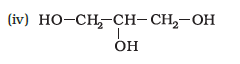
Write IUPAC names of the following compounds:
Solution :
1. Analysis of Molecular Structure (i)
Structure: $CH_3-CH_2-CH(CH_3)-CH(OH)-CH_2-CH_3$
- Longest Carbon Chain Identification: The longest chain containing the hydroxyl ($-OH$) group consists of 6 carbon atoms [Rule: Longest Chain Rule].
- Numbering: Numbering starts from the right to give the $-OH$ group the lowest possible locant. Thus, the $-OH$ is at $C-3$ and the methyl group ($-CH_3$) is at $C-4$ [Rule: Lowest Locant Rule].
- IUPAC Name: 4-methylhexan-3-ol.
2. Analysis of Molecular Structure (ii)
Structure: $CH_3-CH(CH_3)-CH(OH)-CH_3$
- Longest Carbon Chain Identification: The longest continuous carbon chain containing the $-OH$ functional group consists of 4 carbon atoms.
- Numbering: Numbering from right to left assigns the $-OH$ group to $C-2$ and the methyl substituent to $C-3$ [Rule: IUPAC Naming Priority].
- IUPAC Name: 3-methylbutan-2-ol.
3. Analysis of Molecular Structure (iii)
Structure: $CH_3-CH_2-CH_2-CH(OH)-CH_2-CH_2-CH_3$
- Longest Carbon Chain Identification: The chain consists of 7 carbon atoms (Heptane derivative).
- Numbering: The hydroxyl group is centrally located at $C-4$ regardless of direction [Rule: Symmetry].
- IUPAC Name: Heptan-4-ol.
4. Summary of IUPAC Nomenclature
| Structure Formula | IUPAC Name |
|---|---|
| $CH_3-CH_2-CH(CH_3)-CH(OH)-CH_2-CH_3$ | 4-Methylhexan-3-ol |
| $CH_3-CH(CH_3)-CH(OH)-CH_3$ | 3-Methylbutan-2-ol |
| $CH_3-CH_2-CH_2-CH(OH)-CH_2-CH_2-CH_3$ | Heptan-4-ol |
Geometric Representation (Example: 3-Methylbutan-2-ol)
Final Solution: The IUPAC names are 4-methylhexan-3-ol, 3-methylbutan-2-ol, and heptan-4-ol respectively.
More Questions from Class 12 Chemistry Alcohols Exercises
- Q7.1: Write IUPAC names of the following compounds:
- Q7.1: Write IUPAC names of the following compounds:
- Q7.1: Write IUPAC names of the following compounds:
- Q7.1: Write IUPAC names of the following compounds:
- Q7.1: Write IUPAC names of the following compounds:
- Q7.1: Write IUPAC names of the following compounds:
- Q7.1: Write IUPAC names of the following compounds:
- Q7.1: Write IUPAC names of the following compounds:
- Q7.1: Write IUPAC names of the following compounds:
- Q7.1 (x): Write IUPAC names of the following compounds: \(C_{6}H_{5}–O–C_{2}H_{5}\)
- Q7.1 (xi): Write IUPAC names of the following compounds: \(C_{6}H_{5}–O–C_{7}H_{15}(n–)\)
- Q7.1(i): Write IUPAC names of the following compounds:
- Q7.1(ii): Write IUPAC names of the following compounds:
- Q7.1(iii): Write IUPAC names of the following compounds:
- Q7.1(iv): Write IUPAC names of the following compounds:
- Q7.1(ix): Write IUPAC names of the following compounds:
- Q7.1(v): Write IUPAC names of the following compounds:
- Q7.1(vi): Write IUPAC names of the following compounds:
- Q7.1(vii): Write IUPAC names of the following compounds:
- Q7.1(viii): Write IUPAC names of the following compounds:
- Q7.1(x): Write IUPAC names of the following compounds:
- Q7.1(xi): Write IUPAC names of the following compounds:
- Q7.1(xii): Write IUPAC names of the following compounds:
- Q7.10: Write chemical reaction for the preparation of phenol from chlorobenzene.
- Q7.10: Write chemical reaction for the preparation of phenol from chlorobenzene.
- Q7.11: Write the mechanism of hydration of ethene to yield ethanol.
- Q7.11: Write the mechanism of hydration of ethene to yield ethanol.
- Q7.12: You are given benzene, conc. \(H_{2}SO_{4}\) and \(NaOH\). Write the equations for the preparation of phenol using these reagents.
- Q7.12: You are given benzene, conc. ((H_{2}SO_{4})) and NaOH. Write the equations for the preparation of phenol using these reagents.
- Q7.13 (i): Show how will you synthesise: 1-phenylethanol from a suitable alkene.
- Q7.13 (ii): Show how will you synthesise: cyclohexylmethanol using an alkyl halide by an \(S_{N}2\) reaction.
- Q7.13 (iii): Show how will you synthesise: pentan-1-ol using a suitable alkyl halide?
- Q7.13(i): Show how will you synthesise: 1-phenylethanol from a suitable alkene.
- Q7.13(ii): Show how will you synthesise: cyclohexylmethanol using an alkyl halide by an ((S_{N}2)) reaction.
- Q7.13(iii): Show how will you synthesise: pentan-1-ol using a suitable alkyl halide?
- Q7.14: Give two reactions that show the acidic nature of phenol. Compare acidity of phenol with that of ethanol.
- Q7.14: Give two reactions that show the acidic nature of phenol. Compare acidity of phenol with that of ethanol.
- Q7.15: Explain why is ortho nitrophenol more acidic than ortho methoxyphenol ?
- Q7.15: Explain why is ortho nitrophenol more acidic than ortho methoxyphenol ?
- Q7.16: Explain how does the \(–OH\) group attached to a carbon of benzene ring activate it towards electrophilic substitution?
- Q7.16: Explain how does the –OH group attached to a carbon of benzene ring activate it towards electrophilic substitution?
- Q7.17 (i): Give equations of the following reactions: Oxidation of propan-1-ol with alkaline \(KMnO_{4}\) solution.
- Q7.17 (ii): Give equations of the following reactions: Bromine in \(CS_{2}\) with phenol.
- Q7.17 (iii): Give equations of the following reactions: Dilute \(HNO_{3}\) with phenol.
- Q7.17 (iv): Give equations of the following reactions: Treating phenol wih chloroform in presence of aqueous \(NaOH\).
- Q7.17(i): Give equations of the following reactions: Oxidation of propan-1-ol with alkaline ((KMnO_{4})) solution.
- Q7.17(ii): Give equations of the following reactions: Bromine in ((CS_{2})) with phenol.
- Q7.17(iii): Give equations of the following reactions: Dilute ((HNO_{3})) with phenol.
- Q7.17(iv): Give equations of the following reactions: Treating phenol wih chloroform in presence of aqueous NaOH.
- Q7.18 (i): Explain the following with an example. Kolbe’s reaction.
- Q7.18 (ii): Explain the following with an example. Reimer-Tiemann reaction.
- Q7.18 (iii): Explain the following with an example. Williamson ether synthesis.
- Q7.18 (iv): Explain the following with an example. Unsymmetrical ether.
- Q7.18(i): Explain the following with an example. Kolbe’s reaction.
- Q7.18(ii): Explain the following with an example. Reimer-Tiemann reaction.
- Q7.18(iii): Explain the following with an example. Williamson ether synthesis.
- Q7.18(iv): Explain the following with an example. Unsymmetrical ether.
- Q7.19: Write the mechanism of acid dehydration of ethanol to yield ethene.
- Q7.19: Write the mechanism of acid dehydration of ethanol to yield ethene.
- Q7.2 (i): Write structures of the compounds whose IUPAC names are as follows: 2-Methylbutan-2-ol
- Q7.2 (ii): Write structures of the compounds whose IUPAC names are as follows: 1-Phenylpropan-2-ol
- Q7.2 (iii): Write structures of the compounds whose IUPAC names are as follows: 3,5-Dimethylhexane –1, 3, 5-triol
- Q7.2 (iv): Write structures of the compounds whose IUPAC names are as follows: 2,3 – Diethylphenol
- Q7.2 (ix): Write structures of the compounds whose IUPAC names are as follows: Cyclopent-3-en-1-ol
- Q7.2 (v): Write structures of the compounds whose IUPAC names are as follows: 1 – Ethoxypropane
- Q7.2 (vi): Write structures of the compounds whose IUPAC names are as follows: 2-Ethoxy-3-methylpentane
- Q7.2 (vii): Write structures of the compounds whose IUPAC names are as follows: Cyclohexylmethanol
- Q7.2 (viii): Write structures of the compounds whose IUPAC names are as follows: 3-Cyclohexylpentan-3-ol
- Q7.2 (x): Write structures of the compounds whose IUPAC names are as follows: 4-Chloro-3-ethylbutan-1-ol.
- Q7.2(i): Write structures of the compounds whose IUPAC names are as follows: 2-Methylbutan-2-ol
- Q7.2(ii): Write structures of the compounds whose IUPAC names are as follows: 1-Phenylpropan-2-ol
- Q7.2(iii): Write structures of the compounds whose IUPAC names are as follows: 3,5-Dimethylhexane –1, 3, 5-triol
- Q7.2(iv): Write structures of the compounds whose IUPAC names are as follows: 2,3 – Diethylphenol
- Q7.2(ix): Write structures of the compounds whose IUPAC names are as follows: Cyclopent-3-en-1-ol
- Q7.2(v): Write structures of the compounds whose IUPAC names are as follows: 1 – Ethoxypropane
- Q7.2(vi): Write structures of the compounds whose IUPAC names are as follows: 2-Ethoxy-3-methylpentane
- Q7.2(vii): Write structures of the compounds whose IUPAC names are as follows: Cyclohexylmethanol
- Q7.2(viii): Write structures of the compounds whose IUPAC names are as follows: 3-Cyclohexylpentan-3-ol
- Q7.2(x): Write structures of the compounds whose IUPAC names are as follows: 4-Chloro-3-ethylbutan-1-ol.
- Q7.20 (i): How are the following conversions carried out? Propene \(\rightarrow\) Propan-2-ol.
- Q7.20 (ii): How are the following conversions carried out? Benzyl chloride \(\rightarrow\) Benzyl alcohol.
- Q7.20 (iii): How are the following conversions carried out? Ethyl magnesium chloride \(\rightarrow\) Propan-1-ol.
- Q7.20 (iv): How are the following conversions carried out? Methyl magnesium bromide \(\rightarrow\) 2-Methylpropan-2-ol.
- Q7.20(i): How are the following conversions carried out? Propene ((\rightarrow)) Propan-2-ol.
- Q7.20(ii): How are the following conversions carried out? Benzyl chloride ((\rightarrow)) Benzyl alcohol.
- Q7.20(iii): How are the following conversions carried out? Ethyl magnesium chloride ((\rightarrow)) Propan-1-ol.
- Q7.20(iv): How are the following conversions carried out? Methyl magnesium bromide ((\rightarrow)) 2-Methylpropan-2-ol.
- Q7.21 (i): Name the reagents used in the following reactions: Oxidation of a primary alcohol to carboxylic acid.
- Q7.21 (ii): Name the reagents used in the following reactions: Oxidation of a primary alcohol to aldehyde.
- Q7.21 (iii): Name the reagents used in the following reactions: Bromination of phenol to 2,4,6-tribromophenol.
- Q7.21 (iv): Name the reagents used in the following reactions: Benzyl alcohol to benzoic acid.
- Q7.21 (v): Name the reagents used in the following reactions: Dehydration of propan-2-ol to propene.
- Q7.21 (vi): Name the reagents used in the following reactions: Butan-2-one to butan-2-ol.
- Q7.21(i): Name the reagents used in the following reactions: Oxidation of a primary alcohol to carboxylic acid.
- Q7.21(ii): Name the reagents used in the following reactions: Oxidation of a primary alcohol to aldehyde.
- Q7.21(iii): Name the reagents used in the following reactions: Bromination of phenol to 2,4,6-tribromophenol.
- Q7.21(iv): Name the reagents used in the following reactions: Benzyl alcohol to benzoic acid.
- Q7.21(v): Name the reagents used in the following reactions: Dehydration of propan-2-ol to propene.
- Q7.21(vi): Name the reagents used in the following reactions: Butan-2-one to butan-2-ol.
- Q7.22: Give reason for the higher boiling point of ethanol in comparison to methoxymethane.
- Q7.22: Give reason for the higher boiling point of ethanol in comparison to methoxymethane.
- Q7.23: Give IUPAC names of the following ethers:
- Q7.23: Give IUPAC names of the following ethers:
- Q7.23: Give IUPAC names of the following ethers:
- Q7.23: Give IUPAC names of the following ethers:
- Q7.23: Give IUPAC names of the following ethers:
- Q7.23(i): Give IUPAC names of the following ethers:
- Q7.23(ii): Give IUPAC names of the following ethers:
- Q7.23(iii): Give IUPAC names of the following ethers:
- Q7.23(iv): Give IUPAC names of the following ethers:
- Q7.23(v): Give IUPAC names of the following ethers:
- Q7.23(vi): Give IUPAC names of the following ethers:
- Q7.24 (i): Write the names of reagents and equations for the preparation of the following ethers by Williamson’s synthesis: 1-Propoxypropane
- Q7.24 (ii): Write the names of reagents and equations for the preparation of the following ethers by Williamson’s synthesis: Ethoxybenzene
- Q7.24 (iii): Write the names of reagents and equations for the preparation of the following ethers by Williamson’s synthesis: 2-Methoxy-2-methylpropane
- Q7.24 (iv): Write the names of reagents and equations for the preparation of the following ethers by Williamson’s synthesis: 1-Methoxyethane
- Q7.24(i): Write the names of reagents and equations for the preparation of the following ethers by Williamson’s synthesis: 1-Propoxypropane
- Q7.24(ii): Write the names of reagents and equations for the preparation of the following ethers by Williamson’s synthesis: Ethoxybenzene
- Q7.24(iii): Write the names of reagents and equations for the preparation of the following ethers by Williamson’s synthesis: 2-Methoxy-2-methylpropane
- Q7.24(iv): Write the names of reagents and equations for the preparation of the following ethers by Williamson’s synthesis: 1-Methoxyethane
- Q7.25: Illustrate with examples the limitations of Williamson synthesis for the preparation of certain types of ethers.
- Q7.25: Illustrate with examples the limitations of Williamson synthesis for the preparation of certain types of ethers.
- Q7.26: How is 1-propoxypropane synthesised from propan-1-ol? Write mechanism of this reaction.
- Q7.26: How is 1-propoxypropane synthesised from propan-1-ol? Write mechanism of this reaction.
- Q7.27: Preparation of ethers by acid dehydration of secondary or tertiary alcohols is not a suitable method. Give reason.
- Q7.27: Preparation of ethers by acid dehydration of secondary or tertiary alcohols is not a suitable method. Give reason.
- Q7.28 (i): Write the equation of the reaction of hydrogen iodide with: 1-propoxypropane
- Q7.28 (ii): Write the equation of the reaction of hydrogen iodide with: methoxybenzene
- Q7.28 (iii): Write the equation of the reaction of hydrogen iodide with: benzyl ethyl ether.
- Q7.28(i): Write the equation of the reaction of hydrogen iodide with: 1-propoxypropane
- Q7.28(ii): Write the equation of the reaction of hydrogen iodide with: methoxybenzene
- Q7.28(iii): Write the equation of the reaction of hydrogen iodide with: benzyl ethyl ether.
- Q7.29: Explain the fact that in aryl alkyl ethers (i) the alkoxy group activates the benzene ring towards electrophilic substitution and (ii) it directs the incoming substituents to ortho and para positions in benzene ring.
- Q7.29: Explain the fact that in aryl alkyl ethers (i) the alkoxy group activates the benzene ring towards electrophilic substitution and (ii) it directs the incoming substituents to ortho and para positions in benzene ring.
- Q7.3 (i): Draw the structures of all isomeric alcohols of molecular formula \(C_{5}H_{12}O\) and give their IUPAC names.
- Q7.3 (ii): Classify the isomers of alcohols as primary, secondary and tertiary alcohols.
- Q7.3(i): Draw the structures of all isomeric alcohols of molecular formula ((C_{5}H_{12}O)) and give their IUPAC names.
- Q7.3(ii): Classify the isomers of alcohols as primary, secondary and tertiary alcohols.
- Q7.30: Write the mechanism of the reaction of \(HI\) with methoxymethane.
- Q7.30: Write the mechanism of the reaction of HI with methoxymethane.
- Q7.31 (i): Write equations of the following reactions: Friedel-Crafts reaction – alkylation of anisole.
- Q7.31 (ii): Write equations of the following reactions: Nitration of anisole.
- Q7.31 (iii): Write equations of the following reactions: Bromination of anisole in ethanoic acid medium.
- Q7.31 (iv): Write equations of the following reactions: Friedel-Craft’s acetylation of anisole.
- Q7.31(i): Write equations of the following reactions: Friedel-Crafts reaction – alkylation of anisole.
- Q7.31(ii): Write equations of the following reactions: Nitration of anisole.
- Q7.31(iii): Write equations of the following reactions: Bromination of anisole in ethanoic acid medium.
- Q7.31(iv): Write equations of the following reactions: Friedel-Craft’s acetylation of anisole.
- Q7.32: Show how would you synthesise the following alcohols from appropriate alkenes?
- Q7.32: Show how would you synthesise the following alcohols from appropriate alkenes?
- Q7.32: Show how would you synthesise the following alcohols from appropriate alkenes?
- Q7.32: Show how would you synthesise the following alcohols from appropriate alkenes?
- Q7.32(i): Show how would you synthesise the following alcohols from appropriate alkenes?
- Q7.32(ii): Show how would you synthesise the following alcohols from appropriate alkenes?
- Q7.32(iii): Show how would you synthesise the following alcohols from appropriate alkenes?
- Q7.32(iv): Show how would you synthesise the following alcohols from appropriate alkenes?
- Q7.33: When 3-methylbutan-2-ol is treated with HBr, the following reaction takes place: Give a mechanism for this reaction. (Hint : The secondary carbocation formed in step II rearranges to a more stable tertiary carbocation by a hydride ion shift from 3rd carbon atom.
- Q7.33: When 3-methylbutan-2-ol is treated with HBr, the following reaction takes place: Give a mechanism for this reaction. (Hint : The secondary carbocation formed in step II rearranges to a more stable tertiary carbocation by a hydride ion shift from ((3^{rd})) carbon atom.)
- Q7.4: Explain why propanol has higher boiling point than that of the hydrocarbon, butane?
- Q7.4: Explain why propanol has higher boiling point than that of the hydrocarbon, butane?
- Q7.5: Alcohols are comparatively more soluble in water than hydrocarbons of comparable molecular masses. Explain this fact.
- Q7.5: Alcohols are comparatively more soluble in water than hydrocarbons of comparable molecular masses. Explain this fact.
- Q7.6: What is meant by hydroboration-oxidation reaction? Illustrate it with an example.
- Q7.6: What is meant by hydroboration-oxidation reaction? Illustrate it with an example.
- Q7.7: Give the structures and IUPAC names of monohydric phenols of molecular formula, \(C_{7}H_{8}O\).
- Q7.7: Give the structures and IUPAC names of monohydric phenols of molecular formula, ((C_{7}H_{8}O)).
- Q7.8: While separating a mixture of ortho and para nitrophenols by steam distillation, name the isomer which will be steam volatile. Give reason.
- Q7.8: While separating a mixture of ortho and para nitrophenols by steam distillation, name the isomer which will be steam volatile. Give reason.
- Q7.9: Give the equations of reactions for the preparation of phenol from cumene.
- Q7.9: Give the equations of reactions for the preparation of phenol from cumene.
CBSE Solutions for Class 12 Chemistry Alcohols
Chapters in CBSE - Class 12 Chemistry
Top Tutors who teach Alcohols
 Top Tutor
 Chopasni Housing Board, Jodhpur
 3 yrs of
Exp
 Student's Home
 Tutor's home
i have taught to various students and commerce is my main stream. i am persuing CA course and i am interested in accounting, economics and business studies subjects. i am interested in teaching to school and college students.


 Top Tutor
Ottapalam, Ottapalam
8 yrs of
Exp
 2 students
 17 hrs of classes completed
 600
per hour
 Online Classes
I have 8 years of teaching experience in NEET and JEE Classes are taken with extra care



 Top Tutor
Ambala, Ambala
10 yrs of
Exp
4 students
273 hrs of classes completed
185
per hour
Online Classes
I am a History and law graduate, specializing in coaching students appearing for their board exams. From clearing concepts to teaching how to efficiently write answers, I do it all. For Class 12, I focus on: * Clear understanding of concepts, thinkers & case studies * Answer writing practice as per board requirements * Important questions, PYQs & expected topics * Smart revision techniques to improve scores My classes are one-on-one and tailored to your pace so that you feel confident before exams.
I had a great experience with Kanika Ma’am. She taught me political science for my boards. She is a very knowledgeable and kind teacher. Must recommend.

 Top Tutor
Choolissery, Thrissur
20 yrs of
Exp
1 student
446 hrs of classes completed
600
per hour
Online Classes
I'm Sini Jayaraj, and I'm excited to hear about your interest in Class 12 tuition. With over 20 years of experience teaching subjects like Mathematics, Physics, Chemistry, and Science, Teaching is my passion.... Enjoyed well in highschool and higher secondary level.. l'm confident I can help you excel, especially given your immediate start timeline.My background includes a B.Sc., B.Ed., and M.Sc., allowing me to provide a comprehensive understanding of the subjects. I have taught for 214 hours.I focus on making complex topics easy to grasp, perfectly aligning with your goal of simplifying the learning process.Would you be interested in booking a free demo class with me to discuss your specific needs and how I can support you? Or feel free to connect with me to discuss further.Warm regards,Sini Jayaraj secondary levels
 Top Tutor
Sector 13, Dwarka, Delhi
10 yrs of
Exp
1 student
165 hrs of classes completed
500
per hour
Online Classes
Tutor's home
I am an entrepreneur, giving online classes for past couple of years. I am certified in advanced Excel and completed my MBA in 2012. I always think of learning is the best done by observing, listening and practicing what was learnt.



