



Find the best tutors and institutes for Class 12 Tuition
Q7.1:
Write IUPAC names of the following compounds:
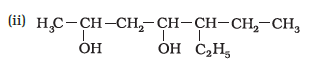
Write IUPAC names of the following compounds:
Solution :
Step 1: Structural Analysis of the Compound
The given chemical structure represents an acyclic aliphatic alcohol. To assign an IUPAC name, we must identify the longest continuous carbon chain containing the hydroxyl ($-OH$) functional group.
The structure provided corresponds to: $CH_3-CH(CH_3)-CH_2-CH_2-OH$
Step 2: Identifying the Parent Alkane and Functional Group
- Parent Chain Length: The longest chain containing the $-OH$ group consists of 4 carbon atoms. The prefix for a 4-carbon alkane is "butane" [Per IUPAC nomenclature rules for alkanes].
- Functional Group: The hydroxyl group ($-OH$) is present, assigning the suffix "-ol" to the parent name [Per IUPAC priority rules where alcohol > alkyl groups].
- Numbering Strategy: The chain must be numbered starting from the end closer to the hydroxyl group to assign it the lowest possible locant.
Step 3: Determining Locants and Substituents
| Component | Identification |
|---|---|
| Principal Chain | Butane (4 Carbons) |
| Principal Group | -ol at position 1 |
| Substituent | Methyl group at position 3 |
By numbering the chain from the right (where $C_1$ is attached to the $-OH$ group), the methyl group is located at carbon atom 3.
Step 4: Assembling the IUPAC Name
The naming convention follows the format: [Locant]-[Substituent] + [Parent Alkane Name] + [Locant of Functional Group] + [Suffix].
Calculation: $3\text{-methyl} + \text{butan} + 1\text{-ol}$
Final Solution: 3-Methylbutan-1-ol
More Questions from Class 12 Chemistry Alcohols Exercises
- Q7.1: Write IUPAC names of the following compounds:
- Q7.1: Write IUPAC names of the following compounds:
- Q7.1: Write IUPAC names of the following compounds:
- Q7.1: Write IUPAC names of the following compounds:
- Q7.1: Write IUPAC names of the following compounds:
- Q7.1: Write IUPAC names of the following compounds:
- Q7.1: Write IUPAC names of the following compounds:
- Q7.1: Write IUPAC names of the following compounds:
- Q7.1: Write IUPAC names of the following compounds:
- Q7.1 (x): Write IUPAC names of the following compounds: \(C_{6}H_{5}–O–C_{2}H_{5}\)
- Q7.1 (xi): Write IUPAC names of the following compounds: \(C_{6}H_{5}–O–C_{7}H_{15}(n–)\)
- Q7.1(i): Write IUPAC names of the following compounds:
- Q7.1(ii): Write IUPAC names of the following compounds:
- Q7.1(iii): Write IUPAC names of the following compounds:
- Q7.1(iv): Write IUPAC names of the following compounds:
- Q7.1(ix): Write IUPAC names of the following compounds:
- Q7.1(v): Write IUPAC names of the following compounds:
- Q7.1(vi): Write IUPAC names of the following compounds:
- Q7.1(vii): Write IUPAC names of the following compounds:
- Q7.1(viii): Write IUPAC names of the following compounds:
- Q7.1(x): Write IUPAC names of the following compounds:
- Q7.1(xi): Write IUPAC names of the following compounds:
- Q7.1(xii): Write IUPAC names of the following compounds:
- Q7.10: Write chemical reaction for the preparation of phenol from chlorobenzene.
- Q7.10: Write chemical reaction for the preparation of phenol from chlorobenzene.
- Q7.11: Write the mechanism of hydration of ethene to yield ethanol.
- Q7.11: Write the mechanism of hydration of ethene to yield ethanol.
- Q7.12: You are given benzene, conc. \(H_{2}SO_{4}\) and \(NaOH\). Write the equations for the preparation of phenol using these reagents.
- Q7.12: You are given benzene, conc. ((H_{2}SO_{4})) and NaOH. Write the equations for the preparation of phenol using these reagents.
- Q7.13 (i): Show how will you synthesise: 1-phenylethanol from a suitable alkene.
- Q7.13 (ii): Show how will you synthesise: cyclohexylmethanol using an alkyl halide by an \(S_{N}2\) reaction.
- Q7.13 (iii): Show how will you synthesise: pentan-1-ol using a suitable alkyl halide?
- Q7.13(i): Show how will you synthesise: 1-phenylethanol from a suitable alkene.
- Q7.13(ii): Show how will you synthesise: cyclohexylmethanol using an alkyl halide by an ((S_{N}2)) reaction.
- Q7.13(iii): Show how will you synthesise: pentan-1-ol using a suitable alkyl halide?
- Q7.14: Give two reactions that show the acidic nature of phenol. Compare acidity of phenol with that of ethanol.
- Q7.14: Give two reactions that show the acidic nature of phenol. Compare acidity of phenol with that of ethanol.
- Q7.15: Explain why is ortho nitrophenol more acidic than ortho methoxyphenol ?
- Q7.15: Explain why is ortho nitrophenol more acidic than ortho methoxyphenol ?
- Q7.16: Explain how does the \(–OH\) group attached to a carbon of benzene ring activate it towards electrophilic substitution?
- Q7.16: Explain how does the –OH group attached to a carbon of benzene ring activate it towards electrophilic substitution?
- Q7.17 (i): Give equations of the following reactions: Oxidation of propan-1-ol with alkaline \(KMnO_{4}\) solution.
- Q7.17 (ii): Give equations of the following reactions: Bromine in \(CS_{2}\) with phenol.
- Q7.17 (iii): Give equations of the following reactions: Dilute \(HNO_{3}\) with phenol.
- Q7.17 (iv): Give equations of the following reactions: Treating phenol wih chloroform in presence of aqueous \(NaOH\).
- Q7.17(i): Give equations of the following reactions: Oxidation of propan-1-ol with alkaline ((KMnO_{4})) solution.
- Q7.17(ii): Give equations of the following reactions: Bromine in ((CS_{2})) with phenol.
- Q7.17(iii): Give equations of the following reactions: Dilute ((HNO_{3})) with phenol.
- Q7.17(iv): Give equations of the following reactions: Treating phenol wih chloroform in presence of aqueous NaOH.
- Q7.18 (i): Explain the following with an example. Kolbe’s reaction.
- Q7.18 (ii): Explain the following with an example. Reimer-Tiemann reaction.
- Q7.18 (iii): Explain the following with an example. Williamson ether synthesis.
- Q7.18 (iv): Explain the following with an example. Unsymmetrical ether.
- Q7.18(i): Explain the following with an example. Kolbe’s reaction.
- Q7.18(ii): Explain the following with an example. Reimer-Tiemann reaction.
- Q7.18(iii): Explain the following with an example. Williamson ether synthesis.
- Q7.18(iv): Explain the following with an example. Unsymmetrical ether.
- Q7.19: Write the mechanism of acid dehydration of ethanol to yield ethene.
- Q7.19: Write the mechanism of acid dehydration of ethanol to yield ethene.
- Q7.2 (i): Write structures of the compounds whose IUPAC names are as follows: 2-Methylbutan-2-ol
- Q7.2 (ii): Write structures of the compounds whose IUPAC names are as follows: 1-Phenylpropan-2-ol
- Q7.2 (iii): Write structures of the compounds whose IUPAC names are as follows: 3,5-Dimethylhexane –1, 3, 5-triol
- Q7.2 (iv): Write structures of the compounds whose IUPAC names are as follows: 2,3 – Diethylphenol
- Q7.2 (ix): Write structures of the compounds whose IUPAC names are as follows: Cyclopent-3-en-1-ol
- Q7.2 (v): Write structures of the compounds whose IUPAC names are as follows: 1 – Ethoxypropane
- Q7.2 (vi): Write structures of the compounds whose IUPAC names are as follows: 2-Ethoxy-3-methylpentane
- Q7.2 (vii): Write structures of the compounds whose IUPAC names are as follows: Cyclohexylmethanol
- Q7.2 (viii): Write structures of the compounds whose IUPAC names are as follows: 3-Cyclohexylpentan-3-ol
- Q7.2 (x): Write structures of the compounds whose IUPAC names are as follows: 4-Chloro-3-ethylbutan-1-ol.
- Q7.2(i): Write structures of the compounds whose IUPAC names are as follows: 2-Methylbutan-2-ol
- Q7.2(ii): Write structures of the compounds whose IUPAC names are as follows: 1-Phenylpropan-2-ol
- Q7.2(iii): Write structures of the compounds whose IUPAC names are as follows: 3,5-Dimethylhexane –1, 3, 5-triol
- Q7.2(iv): Write structures of the compounds whose IUPAC names are as follows: 2,3 – Diethylphenol
- Q7.2(ix): Write structures of the compounds whose IUPAC names are as follows: Cyclopent-3-en-1-ol
- Q7.2(v): Write structures of the compounds whose IUPAC names are as follows: 1 – Ethoxypropane
- Q7.2(vi): Write structures of the compounds whose IUPAC names are as follows: 2-Ethoxy-3-methylpentane
- Q7.2(vii): Write structures of the compounds whose IUPAC names are as follows: Cyclohexylmethanol
- Q7.2(viii): Write structures of the compounds whose IUPAC names are as follows: 3-Cyclohexylpentan-3-ol
- Q7.2(x): Write structures of the compounds whose IUPAC names are as follows: 4-Chloro-3-ethylbutan-1-ol.
- Q7.20 (i): How are the following conversions carried out? Propene \(\rightarrow\) Propan-2-ol.
- Q7.20 (ii): How are the following conversions carried out? Benzyl chloride \(\rightarrow\) Benzyl alcohol.
- Q7.20 (iii): How are the following conversions carried out? Ethyl magnesium chloride \(\rightarrow\) Propan-1-ol.
- Q7.20 (iv): How are the following conversions carried out? Methyl magnesium bromide \(\rightarrow\) 2-Methylpropan-2-ol.
- Q7.20(i): How are the following conversions carried out? Propene ((\rightarrow)) Propan-2-ol.
- Q7.20(ii): How are the following conversions carried out? Benzyl chloride ((\rightarrow)) Benzyl alcohol.
- Q7.20(iii): How are the following conversions carried out? Ethyl magnesium chloride ((\rightarrow)) Propan-1-ol.
- Q7.20(iv): How are the following conversions carried out? Methyl magnesium bromide ((\rightarrow)) 2-Methylpropan-2-ol.
- Q7.21 (i): Name the reagents used in the following reactions: Oxidation of a primary alcohol to carboxylic acid.
- Q7.21 (ii): Name the reagents used in the following reactions: Oxidation of a primary alcohol to aldehyde.
- Q7.21 (iii): Name the reagents used in the following reactions: Bromination of phenol to 2,4,6-tribromophenol.
- Q7.21 (iv): Name the reagents used in the following reactions: Benzyl alcohol to benzoic acid.
- Q7.21 (v): Name the reagents used in the following reactions: Dehydration of propan-2-ol to propene.
- Q7.21 (vi): Name the reagents used in the following reactions: Butan-2-one to butan-2-ol.
- Q7.21(i): Name the reagents used in the following reactions: Oxidation of a primary alcohol to carboxylic acid.
- Q7.21(ii): Name the reagents used in the following reactions: Oxidation of a primary alcohol to aldehyde.
- Q7.21(iii): Name the reagents used in the following reactions: Bromination of phenol to 2,4,6-tribromophenol.
- Q7.21(iv): Name the reagents used in the following reactions: Benzyl alcohol to benzoic acid.
- Q7.21(v): Name the reagents used in the following reactions: Dehydration of propan-2-ol to propene.
- Q7.21(vi): Name the reagents used in the following reactions: Butan-2-one to butan-2-ol.
- Q7.22: Give reason for the higher boiling point of ethanol in comparison to methoxymethane.
- Q7.22: Give reason for the higher boiling point of ethanol in comparison to methoxymethane.
- Q7.23: Give IUPAC names of the following ethers:
- Q7.23: Give IUPAC names of the following ethers:
- Q7.23: Give IUPAC names of the following ethers:
- Q7.23: Give IUPAC names of the following ethers:
- Q7.23: Give IUPAC names of the following ethers:
- Q7.23(i): Give IUPAC names of the following ethers:
- Q7.23(ii): Give IUPAC names of the following ethers:
- Q7.23(iii): Give IUPAC names of the following ethers:
- Q7.23(iv): Give IUPAC names of the following ethers:
- Q7.23(v): Give IUPAC names of the following ethers:
- Q7.23(vi): Give IUPAC names of the following ethers:
- Q7.24 (i): Write the names of reagents and equations for the preparation of the following ethers by Williamson’s synthesis: 1-Propoxypropane
- Q7.24 (ii): Write the names of reagents and equations for the preparation of the following ethers by Williamson’s synthesis: Ethoxybenzene
- Q7.24 (iii): Write the names of reagents and equations for the preparation of the following ethers by Williamson’s synthesis: 2-Methoxy-2-methylpropane
- Q7.24 (iv): Write the names of reagents and equations for the preparation of the following ethers by Williamson’s synthesis: 1-Methoxyethane
- Q7.24(i): Write the names of reagents and equations for the preparation of the following ethers by Williamson’s synthesis: 1-Propoxypropane
- Q7.24(ii): Write the names of reagents and equations for the preparation of the following ethers by Williamson’s synthesis: Ethoxybenzene
- Q7.24(iii): Write the names of reagents and equations for the preparation of the following ethers by Williamson’s synthesis: 2-Methoxy-2-methylpropane
- Q7.24(iv): Write the names of reagents and equations for the preparation of the following ethers by Williamson’s synthesis: 1-Methoxyethane
- Q7.25: Illustrate with examples the limitations of Williamson synthesis for the preparation of certain types of ethers.
- Q7.25: Illustrate with examples the limitations of Williamson synthesis for the preparation of certain types of ethers.
- Q7.26: How is 1-propoxypropane synthesised from propan-1-ol? Write mechanism of this reaction.
- Q7.26: How is 1-propoxypropane synthesised from propan-1-ol? Write mechanism of this reaction.
- Q7.27: Preparation of ethers by acid dehydration of secondary or tertiary alcohols is not a suitable method. Give reason.
- Q7.27: Preparation of ethers by acid dehydration of secondary or tertiary alcohols is not a suitable method. Give reason.
- Q7.28 (i): Write the equation of the reaction of hydrogen iodide with: 1-propoxypropane
- Q7.28 (ii): Write the equation of the reaction of hydrogen iodide with: methoxybenzene
- Q7.28 (iii): Write the equation of the reaction of hydrogen iodide with: benzyl ethyl ether.
- Q7.28(i): Write the equation of the reaction of hydrogen iodide with: 1-propoxypropane
- Q7.28(ii): Write the equation of the reaction of hydrogen iodide with: methoxybenzene
- Q7.28(iii): Write the equation of the reaction of hydrogen iodide with: benzyl ethyl ether.
- Q7.29: Explain the fact that in aryl alkyl ethers (i) the alkoxy group activates the benzene ring towards electrophilic substitution and (ii) it directs the incoming substituents to ortho and para positions in benzene ring.
- Q7.29: Explain the fact that in aryl alkyl ethers (i) the alkoxy group activates the benzene ring towards electrophilic substitution and (ii) it directs the incoming substituents to ortho and para positions in benzene ring.
- Q7.3 (i): Draw the structures of all isomeric alcohols of molecular formula \(C_{5}H_{12}O\) and give their IUPAC names.
- Q7.3 (ii): Classify the isomers of alcohols as primary, secondary and tertiary alcohols.
- Q7.3(i): Draw the structures of all isomeric alcohols of molecular formula ((C_{5}H_{12}O)) and give their IUPAC names.
- Q7.3(ii): Classify the isomers of alcohols as primary, secondary and tertiary alcohols.
- Q7.30: Write the mechanism of the reaction of \(HI\) with methoxymethane.
- Q7.30: Write the mechanism of the reaction of HI with methoxymethane.
- Q7.31 (i): Write equations of the following reactions: Friedel-Crafts reaction – alkylation of anisole.
- Q7.31 (ii): Write equations of the following reactions: Nitration of anisole.
- Q7.31 (iii): Write equations of the following reactions: Bromination of anisole in ethanoic acid medium.
- Q7.31 (iv): Write equations of the following reactions: Friedel-Craft’s acetylation of anisole.
- Q7.31(i): Write equations of the following reactions: Friedel-Crafts reaction – alkylation of anisole.
- Q7.31(ii): Write equations of the following reactions: Nitration of anisole.
- Q7.31(iii): Write equations of the following reactions: Bromination of anisole in ethanoic acid medium.
- Q7.31(iv): Write equations of the following reactions: Friedel-Craft’s acetylation of anisole.
- Q7.32: Show how would you synthesise the following alcohols from appropriate alkenes?
- Q7.32: Show how would you synthesise the following alcohols from appropriate alkenes?
- Q7.32: Show how would you synthesise the following alcohols from appropriate alkenes?
- Q7.32: Show how would you synthesise the following alcohols from appropriate alkenes?
- Q7.32(i): Show how would you synthesise the following alcohols from appropriate alkenes?
- Q7.32(ii): Show how would you synthesise the following alcohols from appropriate alkenes?
- Q7.32(iii): Show how would you synthesise the following alcohols from appropriate alkenes?
- Q7.32(iv): Show how would you synthesise the following alcohols from appropriate alkenes?
- Q7.33: When 3-methylbutan-2-ol is treated with HBr, the following reaction takes place: Give a mechanism for this reaction. (Hint : The secondary carbocation formed in step II rearranges to a more stable tertiary carbocation by a hydride ion shift from 3rd carbon atom.
- Q7.33: When 3-methylbutan-2-ol is treated with HBr, the following reaction takes place: Give a mechanism for this reaction. (Hint : The secondary carbocation formed in step II rearranges to a more stable tertiary carbocation by a hydride ion shift from ((3^{rd})) carbon atom.)
- Q7.4: Explain why propanol has higher boiling point than that of the hydrocarbon, butane?
- Q7.4: Explain why propanol has higher boiling point than that of the hydrocarbon, butane?
- Q7.5: Alcohols are comparatively more soluble in water than hydrocarbons of comparable molecular masses. Explain this fact.
- Q7.5: Alcohols are comparatively more soluble in water than hydrocarbons of comparable molecular masses. Explain this fact.
- Q7.6: What is meant by hydroboration-oxidation reaction? Illustrate it with an example.
- Q7.6: What is meant by hydroboration-oxidation reaction? Illustrate it with an example.
- Q7.7: Give the structures and IUPAC names of monohydric phenols of molecular formula, \(C_{7}H_{8}O\).
- Q7.7: Give the structures and IUPAC names of monohydric phenols of molecular formula, ((C_{7}H_{8}O)).
- Q7.8: While separating a mixture of ortho and para nitrophenols by steam distillation, name the isomer which will be steam volatile. Give reason.
- Q7.8: While separating a mixture of ortho and para nitrophenols by steam distillation, name the isomer which will be steam volatile. Give reason.
- Q7.9: Give the equations of reactions for the preparation of phenol from cumene.
- Q7.9: Give the equations of reactions for the preparation of phenol from cumene.
CBSE Solutions for Class 12 Chemistry Alcohols
Chapters in CBSE - Class 12 Chemistry
Top Tutors who teach Alcohols

 Top Tutor
 Bejai, Mangalore
 15 yrs of
Exp
 8 students
 203 hrs of classes completed
 800
per hour
 Online Classes
I am Dr. Shivaprasad Shetty, a Chemistry educator with over 17 years of teaching experience, specializing in Class 12 Chemistry. Teaching has been a long-standing commitment for me, and I focus on helping students develop strong conceptual understanding, analytical thinking, and confidence in the subject. My approach is centered on making Chemistry clear, structured, and easy to apply in examinations. I hold a Doctor of Philosophy (Ph.D.) in Chemistry, which has provided me with advanced academic knowledge and research-based understanding of the subject. My academic training enables me to explain complex chemical concepts with clarity, precision, and depth, ensuring that students build a strong foundation in the subject. Over the years, I have worked as a Chemistry teacher at the college level and have accumulated more than 15 years of teaching experience. During this time, I have consistently delivered strong academic results and received positive feedback from students. I take pride in guiding learners toward better understanding and improved performance in their examinations. My teaching experience has allowed me to work with students of varying academic abilities, helping them overcome challenges in Chemistry and develop confidence in problem-solving. I focus on simplifying difficult topics and ensuring that students grasp the core concepts before moving on to advanced applications. My teaching methodology is based on structured lesson planning with clear objectives for each session. I ensure that every topic is taught in a systematic manner, beginning with fundamentals and gradually progressing to higher-level understanding. I strongly believe that clarity in basics is essential for mastering Chemistry. My classes are interactive and concept-oriented, encouraging students to actively participate and engage with the subject. I also incorporate practical-based explanations and real-life applications wherever possible, which helps students connect theoretical concepts with practical understanding and improves retention. I conduct online classes and use PowerPoint presentations along with whiteboard teaching to make lessons more effective and visually clear. My goal is to create a focused and supportive learning environment where students can strengthen their understanding of Chemistry and achieve academic success with confidence.
Excellent teaching with good clarity . It is interesting and interactive. Easy to understand and classes are having good content with good teaching methodology


 Top Tutor
Gulshan Bellina Rd Greater Noida, Noida
10 yrs of
Exp
18 students
255 hrs of classes completed
500
per hour
 Student's Home
My name is have a B.Com degree from graduation and an M.Com degree for master's . Apart from this, I have cleared the CA Inter course . I have been teaching accountancy subjects for the last 10 years to Class 11 & Class 12 students. There are so many students who took classes from me and have scored well in their exams . The only reason for this is that the students' concepts are cleared very well.
"Mujhe apne Accountancy teacher se kaafi kuch seekhne ko mila. Unka teaching style bahut hi engaging aur clear hai, jo har complex topic ko bhi simple bana deta hai. Har lesson practical examples ke saath hota hai, jo humare liye easily samajhna possible banata hai. Unke dedication aur passion ki wajah se hum Accountancy ko na sirf samajh paate hain, balki enjoy bhi karte hain. Best teacher ever!" ☺🙏🏻

 Super Tutor
Virugambakkam, Chennai
2 yrs of
Exp
12 students
461 hrs of classes completed
1000
per hour
Online Classes
My students get acquainted with me easily... I will be both friendly and strict ( according to the need)... Students love to learn physics with me. Their learning process will be in easy and efficient. They will Excel in concepts and problem solving
 Super Tutor
Sector 75, Faridabad
9 yrs of
Exp
31 students
361 hrs of classes completed
1500
per hour
Online Classes
Student's Home
I step into the world of education driven by a deep-seated passion for teaching, bringing a wealth of experience in the realms of Accounts, Economics, and Business Studies for Class 11th and 12th. My journey as an educator commenced in 2016, and it has been a fulfilling odyssey ever since. In my pursuit of imparting knowledge, I have chosen both online and offline avenues. Whether through the virtual realm or in the comfort of students' homes, my commitment to fostering a comprehensive understanding of Accounts, Economics, and Business Studies remains unwavering. As a seasoned professional in the teaching landscape, I specialize in the intricate subjects that form the backbone of commerce education. My approach is rooted in the belief that education should not only be informative but also transformative. I strive to make complex concepts accessible, enabling students to navigate the challenges of Class 11th and 12th with confidence. I hold a firm belief that teaching is not just a profession; it's a calling. It's about instilling a love for learning, nurturing critical thinking, and preparing students for the dynamic world of commerce. Through a blend of online and offline methodologies, I aim to create an engaging and effective learning experience for every student under my guidance. Join me on this educational journey, where the pursuit of knowledge is not just a task but a shared adventure. Together, let's unravel the intricacies of Accounts, Economics, and Business Studies. Looking forward to our learning voyage!
The classes are extremely helpful in understanding the concepts and forming full understanding of the subject. The notes given provide an easy review for the exam and the revision classes allow complete recall for the exams.
 Top Tutor
HMT Estate 2nd Stage, Bangalore
20 yrs of
Exp
37 students
2764 hrs of classes completed
600
per hour
Online Classes
I am a teacher. Teaching chemistry for the past 20+ years. I also have some experience in research in applied chemistry. I have a masters degree in chemistry and a bachelors degree in education. In addition to teaching I have experience in school administration and content development. My key skills are to train the students for various competitive exams like JEE, NEET, BITSAT, CET.



