



Find the best tutors and institutes for Class 12 Tuition
Q7.23:
Give IUPAC names of the following ethers:
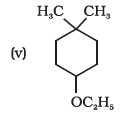
Give IUPAC names of the following ethers:
Solution :
Analytical Framework for IUPAC Nomenclature of Ethers
According to IUPAC recommendations, ethers are named as alkoxyalkanes. The chain containing the higher number of carbon atoms is considered the parent alkane, while the group with the smaller number of carbon atoms is treated as an alkoxy substituent. [Ref: IUPAC Blue Book, P-61.2.1]
Step 1: Identifying Structures and Parent Chains
| Structure | Longest Carbon Chain | Alkoxy Substituent |
|---|---|---|
| (i) $CH_3OC_2H_5$ | Ethane ($C_2H_6$) | Methoxy ($CH_3O-$) |
| (ii) $CH_3OC_6H_5$ | Benzene ($C_6H_6$) | Methoxy ($CH_3O-$) |
| (iii) $C_6H_5OCH_2CH_2CH_3$ | Propane ($C_3H_8$) | Phenoxy ($C_6H_5O-$) |
| (iv) $CH_3O(CH_2)_4CH_3$ | Pentane ($C_5H_{12}$) | Methoxy ($CH_3O-$) |
Step 2: Systematic IUPAC Assignment
(i) $CH_3OC_2H_5$
- Parent chain: Ethane.
- Substituent: Methoxy group ($CH_3O-$) attached to the ethane chain.
- IUPAC Name: Methoxyethane
(ii) $CH_3OC_6H_5$
- Parent chain: Benzene.
- Substituent: Methoxy group ($CH_3O-$).
- IUPAC Name: Methoxybenzene (Anisole)
(iii) $C_6H_5OCH_2CH_2CH_3$
- Parent chain: Propane (3 carbons).
- Substituent: Phenoxy group ($C_6H_5O-$) at position 1.
- IUPAC Name: 1-Phenoxypropane
(iv) $CH_3O(CH_2)_4CH_3$
- Parent chain: Pentane (5 carbons).
- Substituent: Methoxy group ($CH_3O-$) at position 1.
- IUPAC Name: 1-Methoxypentane
Visual Representation of Structure (iv)
Final Solution: (i) Methoxyethane, (ii) Methoxybenzene, (iii) 1-Phenoxypropane, (iv) 1-Methoxypentane.
More Questions from Class 12 Chemistry Alcohols Exercises
- Q7.1: Write IUPAC names of the following compounds:
- Q7.1: Write IUPAC names of the following compounds:
- Q7.1: Write IUPAC names of the following compounds:
- Q7.1: Write IUPAC names of the following compounds:
- Q7.1: Write IUPAC names of the following compounds:
- Q7.1: Write IUPAC names of the following compounds:
- Q7.1: Write IUPAC names of the following compounds:
- Q7.1: Write IUPAC names of the following compounds:
- Q7.1: Write IUPAC names of the following compounds:
- Q7.1: Write IUPAC names of the following compounds:
- Q7.1 (x): Write IUPAC names of the following compounds: \(C_{6}H_{5}–O–C_{2}H_{5}\)
- Q7.1 (xi): Write IUPAC names of the following compounds: \(C_{6}H_{5}–O–C_{7}H_{15}(n–)\)
- Q7.1(i): Write IUPAC names of the following compounds:
- Q7.1(ii): Write IUPAC names of the following compounds:
- Q7.1(iii): Write IUPAC names of the following compounds:
- Q7.1(iv): Write IUPAC names of the following compounds:
- Q7.1(ix): Write IUPAC names of the following compounds:
- Q7.1(v): Write IUPAC names of the following compounds:
- Q7.1(vi): Write IUPAC names of the following compounds:
- Q7.1(vii): Write IUPAC names of the following compounds:
- Q7.1(viii): Write IUPAC names of the following compounds:
- Q7.1(x): Write IUPAC names of the following compounds:
- Q7.1(xi): Write IUPAC names of the following compounds:
- Q7.1(xii): Write IUPAC names of the following compounds:
- Q7.10: Write chemical reaction for the preparation of phenol from chlorobenzene.
- Q7.10: Write chemical reaction for the preparation of phenol from chlorobenzene.
- Q7.11: Write the mechanism of hydration of ethene to yield ethanol.
- Q7.11: Write the mechanism of hydration of ethene to yield ethanol.
- Q7.12: You are given benzene, conc. \(H_{2}SO_{4}\) and \(NaOH\). Write the equations for the preparation of phenol using these reagents.
- Q7.12: You are given benzene, conc. ((H_{2}SO_{4})) and NaOH. Write the equations for the preparation of phenol using these reagents.
- Q7.13 (i): Show how will you synthesise: 1-phenylethanol from a suitable alkene.
- Q7.13 (ii): Show how will you synthesise: cyclohexylmethanol using an alkyl halide by an \(S_{N}2\) reaction.
- Q7.13 (iii): Show how will you synthesise: pentan-1-ol using a suitable alkyl halide?
- Q7.13(i): Show how will you synthesise: 1-phenylethanol from a suitable alkene.
- Q7.13(ii): Show how will you synthesise: cyclohexylmethanol using an alkyl halide by an ((S_{N}2)) reaction.
- Q7.13(iii): Show how will you synthesise: pentan-1-ol using a suitable alkyl halide?
- Q7.14: Give two reactions that show the acidic nature of phenol. Compare acidity of phenol with that of ethanol.
- Q7.14: Give two reactions that show the acidic nature of phenol. Compare acidity of phenol with that of ethanol.
- Q7.15: Explain why is ortho nitrophenol more acidic than ortho methoxyphenol ?
- Q7.15: Explain why is ortho nitrophenol more acidic than ortho methoxyphenol ?
- Q7.16: Explain how does the \(–OH\) group attached to a carbon of benzene ring activate it towards electrophilic substitution?
- Q7.16: Explain how does the –OH group attached to a carbon of benzene ring activate it towards electrophilic substitution?
- Q7.17 (i): Give equations of the following reactions: Oxidation of propan-1-ol with alkaline \(KMnO_{4}\) solution.
- Q7.17 (ii): Give equations of the following reactions: Bromine in \(CS_{2}\) with phenol.
- Q7.17 (iii): Give equations of the following reactions: Dilute \(HNO_{3}\) with phenol.
- Q7.17 (iv): Give equations of the following reactions: Treating phenol wih chloroform in presence of aqueous \(NaOH\).
- Q7.17(i): Give equations of the following reactions: Oxidation of propan-1-ol with alkaline ((KMnO_{4})) solution.
- Q7.17(ii): Give equations of the following reactions: Bromine in ((CS_{2})) with phenol.
- Q7.17(iii): Give equations of the following reactions: Dilute ((HNO_{3})) with phenol.
- Q7.17(iv): Give equations of the following reactions: Treating phenol wih chloroform in presence of aqueous NaOH.
- Q7.18 (i): Explain the following with an example. Kolbe’s reaction.
- Q7.18 (ii): Explain the following with an example. Reimer-Tiemann reaction.
- Q7.18 (iii): Explain the following with an example. Williamson ether synthesis.
- Q7.18 (iv): Explain the following with an example. Unsymmetrical ether.
- Q7.18(i): Explain the following with an example. Kolbe’s reaction.
- Q7.18(ii): Explain the following with an example. Reimer-Tiemann reaction.
- Q7.18(iii): Explain the following with an example. Williamson ether synthesis.
- Q7.18(iv): Explain the following with an example. Unsymmetrical ether.
- Q7.19: Write the mechanism of acid dehydration of ethanol to yield ethene.
- Q7.19: Write the mechanism of acid dehydration of ethanol to yield ethene.
- Q7.2 (i): Write structures of the compounds whose IUPAC names are as follows: 2-Methylbutan-2-ol
- Q7.2 (ii): Write structures of the compounds whose IUPAC names are as follows: 1-Phenylpropan-2-ol
- Q7.2 (iii): Write structures of the compounds whose IUPAC names are as follows: 3,5-Dimethylhexane –1, 3, 5-triol
- Q7.2 (iv): Write structures of the compounds whose IUPAC names are as follows: 2,3 – Diethylphenol
- Q7.2 (ix): Write structures of the compounds whose IUPAC names are as follows: Cyclopent-3-en-1-ol
- Q7.2 (v): Write structures of the compounds whose IUPAC names are as follows: 1 – Ethoxypropane
- Q7.2 (vi): Write structures of the compounds whose IUPAC names are as follows: 2-Ethoxy-3-methylpentane
- Q7.2 (vii): Write structures of the compounds whose IUPAC names are as follows: Cyclohexylmethanol
- Q7.2 (viii): Write structures of the compounds whose IUPAC names are as follows: 3-Cyclohexylpentan-3-ol
- Q7.2 (x): Write structures of the compounds whose IUPAC names are as follows: 4-Chloro-3-ethylbutan-1-ol.
- Q7.2(i): Write structures of the compounds whose IUPAC names are as follows: 2-Methylbutan-2-ol
- Q7.2(ii): Write structures of the compounds whose IUPAC names are as follows: 1-Phenylpropan-2-ol
- Q7.2(iii): Write structures of the compounds whose IUPAC names are as follows: 3,5-Dimethylhexane –1, 3, 5-triol
- Q7.2(iv): Write structures of the compounds whose IUPAC names are as follows: 2,3 – Diethylphenol
- Q7.2(ix): Write structures of the compounds whose IUPAC names are as follows: Cyclopent-3-en-1-ol
- Q7.2(v): Write structures of the compounds whose IUPAC names are as follows: 1 – Ethoxypropane
- Q7.2(vi): Write structures of the compounds whose IUPAC names are as follows: 2-Ethoxy-3-methylpentane
- Q7.2(vii): Write structures of the compounds whose IUPAC names are as follows: Cyclohexylmethanol
- Q7.2(viii): Write structures of the compounds whose IUPAC names are as follows: 3-Cyclohexylpentan-3-ol
- Q7.2(x): Write structures of the compounds whose IUPAC names are as follows: 4-Chloro-3-ethylbutan-1-ol.
- Q7.20 (i): How are the following conversions carried out? Propene \(\rightarrow\) Propan-2-ol.
- Q7.20 (ii): How are the following conversions carried out? Benzyl chloride \(\rightarrow\) Benzyl alcohol.
- Q7.20 (iii): How are the following conversions carried out? Ethyl magnesium chloride \(\rightarrow\) Propan-1-ol.
- Q7.20 (iv): How are the following conversions carried out? Methyl magnesium bromide \(\rightarrow\) 2-Methylpropan-2-ol.
- Q7.20(i): How are the following conversions carried out? Propene ((\rightarrow)) Propan-2-ol.
- Q7.20(ii): How are the following conversions carried out? Benzyl chloride ((\rightarrow)) Benzyl alcohol.
- Q7.20(iii): How are the following conversions carried out? Ethyl magnesium chloride ((\rightarrow)) Propan-1-ol.
- Q7.20(iv): How are the following conversions carried out? Methyl magnesium bromide ((\rightarrow)) 2-Methylpropan-2-ol.
- Q7.21 (i): Name the reagents used in the following reactions: Oxidation of a primary alcohol to carboxylic acid.
- Q7.21 (ii): Name the reagents used in the following reactions: Oxidation of a primary alcohol to aldehyde.
- Q7.21 (iii): Name the reagents used in the following reactions: Bromination of phenol to 2,4,6-tribromophenol.
- Q7.21 (iv): Name the reagents used in the following reactions: Benzyl alcohol to benzoic acid.
- Q7.21 (v): Name the reagents used in the following reactions: Dehydration of propan-2-ol to propene.
- Q7.21 (vi): Name the reagents used in the following reactions: Butan-2-one to butan-2-ol.
- Q7.21(i): Name the reagents used in the following reactions: Oxidation of a primary alcohol to carboxylic acid.
- Q7.21(ii): Name the reagents used in the following reactions: Oxidation of a primary alcohol to aldehyde.
- Q7.21(iii): Name the reagents used in the following reactions: Bromination of phenol to 2,4,6-tribromophenol.
- Q7.21(iv): Name the reagents used in the following reactions: Benzyl alcohol to benzoic acid.
- Q7.21(v): Name the reagents used in the following reactions: Dehydration of propan-2-ol to propene.
- Q7.21(vi): Name the reagents used in the following reactions: Butan-2-one to butan-2-ol.
- Q7.22: Give reason for the higher boiling point of ethanol in comparison to methoxymethane.
- Q7.22: Give reason for the higher boiling point of ethanol in comparison to methoxymethane.
- Q7.23: Give IUPAC names of the following ethers:
- Q7.23: Give IUPAC names of the following ethers:
- Q7.23: Give IUPAC names of the following ethers:
- Q7.23: Give IUPAC names of the following ethers:
- Q7.23(i): Give IUPAC names of the following ethers:
- Q7.23(ii): Give IUPAC names of the following ethers:
- Q7.23(iii): Give IUPAC names of the following ethers:
- Q7.23(iv): Give IUPAC names of the following ethers:
- Q7.23(v): Give IUPAC names of the following ethers:
- Q7.23(vi): Give IUPAC names of the following ethers:
- Q7.24 (i): Write the names of reagents and equations for the preparation of the following ethers by Williamson’s synthesis: 1-Propoxypropane
- Q7.24 (ii): Write the names of reagents and equations for the preparation of the following ethers by Williamson’s synthesis: Ethoxybenzene
- Q7.24 (iii): Write the names of reagents and equations for the preparation of the following ethers by Williamson’s synthesis: 2-Methoxy-2-methylpropane
- Q7.24 (iv): Write the names of reagents and equations for the preparation of the following ethers by Williamson’s synthesis: 1-Methoxyethane
- Q7.24(i): Write the names of reagents and equations for the preparation of the following ethers by Williamson’s synthesis: 1-Propoxypropane
- Q7.24(ii): Write the names of reagents and equations for the preparation of the following ethers by Williamson’s synthesis: Ethoxybenzene
- Q7.24(iii): Write the names of reagents and equations for the preparation of the following ethers by Williamson’s synthesis: 2-Methoxy-2-methylpropane
- Q7.24(iv): Write the names of reagents and equations for the preparation of the following ethers by Williamson’s synthesis: 1-Methoxyethane
- Q7.25: Illustrate with examples the limitations of Williamson synthesis for the preparation of certain types of ethers.
- Q7.25: Illustrate with examples the limitations of Williamson synthesis for the preparation of certain types of ethers.
- Q7.26: How is 1-propoxypropane synthesised from propan-1-ol? Write mechanism of this reaction.
- Q7.26: How is 1-propoxypropane synthesised from propan-1-ol? Write mechanism of this reaction.
- Q7.27: Preparation of ethers by acid dehydration of secondary or tertiary alcohols is not a suitable method. Give reason.
- Q7.27: Preparation of ethers by acid dehydration of secondary or tertiary alcohols is not a suitable method. Give reason.
- Q7.28 (i): Write the equation of the reaction of hydrogen iodide with: 1-propoxypropane
- Q7.28 (ii): Write the equation of the reaction of hydrogen iodide with: methoxybenzene
- Q7.28 (iii): Write the equation of the reaction of hydrogen iodide with: benzyl ethyl ether.
- Q7.28(i): Write the equation of the reaction of hydrogen iodide with: 1-propoxypropane
- Q7.28(ii): Write the equation of the reaction of hydrogen iodide with: methoxybenzene
- Q7.28(iii): Write the equation of the reaction of hydrogen iodide with: benzyl ethyl ether.
- Q7.29: Explain the fact that in aryl alkyl ethers (i) the alkoxy group activates the benzene ring towards electrophilic substitution and (ii) it directs the incoming substituents to ortho and para positions in benzene ring.
- Q7.29: Explain the fact that in aryl alkyl ethers (i) the alkoxy group activates the benzene ring towards electrophilic substitution and (ii) it directs the incoming substituents to ortho and para positions in benzene ring.
- Q7.3 (i): Draw the structures of all isomeric alcohols of molecular formula \(C_{5}H_{12}O\) and give their IUPAC names.
- Q7.3 (ii): Classify the isomers of alcohols as primary, secondary and tertiary alcohols.
- Q7.3(i): Draw the structures of all isomeric alcohols of molecular formula ((C_{5}H_{12}O)) and give their IUPAC names.
- Q7.3(ii): Classify the isomers of alcohols as primary, secondary and tertiary alcohols.
- Q7.30: Write the mechanism of the reaction of \(HI\) with methoxymethane.
- Q7.30: Write the mechanism of the reaction of HI with methoxymethane.
- Q7.31 (i): Write equations of the following reactions: Friedel-Crafts reaction – alkylation of anisole.
- Q7.31 (ii): Write equations of the following reactions: Nitration of anisole.
- Q7.31 (iii): Write equations of the following reactions: Bromination of anisole in ethanoic acid medium.
- Q7.31 (iv): Write equations of the following reactions: Friedel-Craft’s acetylation of anisole.
- Q7.31(i): Write equations of the following reactions: Friedel-Crafts reaction – alkylation of anisole.
- Q7.31(ii): Write equations of the following reactions: Nitration of anisole.
- Q7.31(iii): Write equations of the following reactions: Bromination of anisole in ethanoic acid medium.
- Q7.31(iv): Write equations of the following reactions: Friedel-Craft’s acetylation of anisole.
- Q7.32: Show how would you synthesise the following alcohols from appropriate alkenes?
- Q7.32: Show how would you synthesise the following alcohols from appropriate alkenes?
- Q7.32: Show how would you synthesise the following alcohols from appropriate alkenes?
- Q7.32: Show how would you synthesise the following alcohols from appropriate alkenes?
- Q7.32(i): Show how would you synthesise the following alcohols from appropriate alkenes?
- Q7.32(ii): Show how would you synthesise the following alcohols from appropriate alkenes?
- Q7.32(iii): Show how would you synthesise the following alcohols from appropriate alkenes?
- Q7.32(iv): Show how would you synthesise the following alcohols from appropriate alkenes?
- Q7.33: When 3-methylbutan-2-ol is treated with HBr, the following reaction takes place: Give a mechanism for this reaction. (Hint : The secondary carbocation formed in step II rearranges to a more stable tertiary carbocation by a hydride ion shift from 3rd carbon atom.
- Q7.33: When 3-methylbutan-2-ol is treated with HBr, the following reaction takes place: Give a mechanism for this reaction. (Hint : The secondary carbocation formed in step II rearranges to a more stable tertiary carbocation by a hydride ion shift from ((3^{rd})) carbon atom.)
- Q7.4: Explain why propanol has higher boiling point than that of the hydrocarbon, butane?
- Q7.4: Explain why propanol has higher boiling point than that of the hydrocarbon, butane?
- Q7.5: Alcohols are comparatively more soluble in water than hydrocarbons of comparable molecular masses. Explain this fact.
- Q7.5: Alcohols are comparatively more soluble in water than hydrocarbons of comparable molecular masses. Explain this fact.
- Q7.6: What is meant by hydroboration-oxidation reaction? Illustrate it with an example.
- Q7.6: What is meant by hydroboration-oxidation reaction? Illustrate it with an example.
- Q7.7: Give the structures and IUPAC names of monohydric phenols of molecular formula, \(C_{7}H_{8}O\).
- Q7.7: Give the structures and IUPAC names of monohydric phenols of molecular formula, ((C_{7}H_{8}O)).
- Q7.8: While separating a mixture of ortho and para nitrophenols by steam distillation, name the isomer which will be steam volatile. Give reason.
- Q7.8: While separating a mixture of ortho and para nitrophenols by steam distillation, name the isomer which will be steam volatile. Give reason.
- Q7.9: Give the equations of reactions for the preparation of phenol from cumene.
- Q7.9: Give the equations of reactions for the preparation of phenol from cumene.
CBSE Solutions for Class 12 Chemistry Alcohols
Chapters in CBSE - Class 12 Chemistry
Top Tutors who teach Alcohols

 Top Tutor
 Vimanapura Krishna Nagar, Bangalore
 7 yrs of
Exp
 6 students
 717 hrs of classes completed
 700
per hour
 Online Classes
 Student's Home
In this competitive world education is the most important tool rather I say that it is sword by which one can win the competition.so I am in this field from last four years and teaching is my passion and even strength.My students are very happy with me in college as well as in tutions. Their results show it all. Students are always been encouraged to do studies one should not force them for the same.
 Top Tutor
Begur Road, Bangalore
5 yrs of
Exp
4 hrs of classes completed
350
per hour
Online Classes
 Tutor's home
I have been teaching since last more than 5 years. My way of teaching style is so simple so that it make students very easier to understand. I am taking classes of Math and Hindi subject.

 Top Tutor
Medchal, Hyderabad
14 yrs of
Exp
27 students
1976 hrs of classes completed
Online Classes
Teaching experience to students always feel challenging to me. Because every student has its own intellect power n grasping capability too. So understand them n teaching as per their ability is quite interesting. I love to teach those students who always try to grow themselves.
Really enjoying my Computer Science classes! The concepts are explained clearly, and even tricky topics feel easy to understand. The teaching is patient and interactive, and I feel more confident with every session. Highly recommended!
 Top Tutor
Andheri West, Mumbai
10 yrs of
Exp
8 students
106 hrs of classes completed
1000
per hour
Online Classes
Student's Home
I have over 10 years of teaching experience in reputed schools and colleges, where I have taught students across different academic levels with a strong focus on conceptual clarity and practical understanding. Throughout my career, I have handled diverse classrooms, adapting my teaching methods to suit students’ learning styles and academic needs. In school education, I have taught core subjects aligned with the curriculum, ensuring students build a strong foundation and perform confidently in examinations. I have extensive experience in lesson planning, syllabus completion, exam preparation, conducting assessments, and providing individual attention to students who need additional support.
Experience teacher, the best teacher with the best teaching.


 Super Tutor
Newada, Varanasi
17 yrs of
Exp
13 students
512 hrs of classes completed
1200
per hour
Online Classes
Tutor's home
Making chemistry simple & logical. 17+ years of experience teaching class 11, 12, jee & neet chemistry. B.Tech. (iit bhu), m.Tech. (iit delhi), ph.D. (iit bhu). Editor for the 13th edition of elementary problems in organic chemistry by m.S. Chouhan sir. Mentored students into top iits and aiims (bombay, kanpur, roorkee & more!). Top 10% global rank in the international teachers olympiad (2022 & 2023). Structured online classes with comprehensive notes & doubt-clearing. Let's master chemistry together!



