



Find the best tutors and institutes for Class 12 Tuition
Q7.1:
Write IUPAC names of the following compounds:
Write IUPAC names of the following compounds:
Solution :
Compound Analysis and IUPAC Nomenclature
The provided image depicts the following chemical structures for which IUPAC nomenclature must be derived based on the I.U.P.A.C. (International Union of Pure and Applied Chemistry) guidelines.
| Structure | Step-by-Step Derivation | IUPAC Name |
|---|---|---|
| (i) $CH_3-CH_2-CH(CH_3)-CH(OH)-CH_2-CH_3$ |
|
4-methylhexan-3-ol |
| (ii) $CH_3-CH(OH)-CH_2-CH(CH_3)-CH_3$ |
|
4-methylpentan-2-ol |
| (iii) $CH_3-CH(OH)-CH_2-CH_2-CH_3$ |
|
Pentan-2-ol |
| (iv) $(CH_3)_2C=CH-CH_2-CH_2-OH$ |
|
4,4-dimethylpent-3-en-1-ol |
Visual Representation of Structure (iv)
Logical Justifications
The nomenclature follows the [IUPAC Rule P-14.4], which mandates that the principal functional group ($-OH$) receives the lowest possible locant. Where unsaturation exists, the chain is named as an alkenol, ensuring the alkene and the hydroxyl group are contained in the parent chain [Per Section P-44.4.1].
Final Solution: The IUPAC names are: (i) 4-methylhexan-3-ol, (ii) 4-methylpentan-2-ol, (iii) Pentan-2-ol, (iv) 4,4-dimethylpent-3-en-1-ol.
More Questions from Class 12 Chemistry Alcohols Exercises
- Q7.1: Write IUPAC names of the following compounds:
- Q7.1: Write IUPAC names of the following compounds:
- Q7.1: Write IUPAC names of the following compounds:
- Q7.1: Write IUPAC names of the following compounds:
- Q7.1: Write IUPAC names of the following compounds:
- Q7.1: Write IUPAC names of the following compounds:
- Q7.1: Write IUPAC names of the following compounds:
- Q7.1: Write IUPAC names of the following compounds:
- Q7.1: Write IUPAC names of the following compounds:
- Q7.1 (x): Write IUPAC names of the following compounds: \(C_{6}H_{5}–O–C_{2}H_{5}\)
- Q7.1 (xi): Write IUPAC names of the following compounds: \(C_{6}H_{5}–O–C_{7}H_{15}(n–)\)
- Q7.1(i): Write IUPAC names of the following compounds:
- Q7.1(ii): Write IUPAC names of the following compounds:
- Q7.1(iii): Write IUPAC names of the following compounds:
- Q7.1(iv): Write IUPAC names of the following compounds:
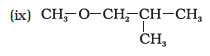
- Q7.1(ix): Write IUPAC names of the following compounds:
- Q7.1(v): Write IUPAC names of the following compounds:
- Q7.1(vi): Write IUPAC names of the following compounds:
- Q7.1(vii): Write IUPAC names of the following compounds:
- Q7.1(viii): Write IUPAC names of the following compounds:
- Q7.1(x): Write IUPAC names of the following compounds:
- Q7.1(xi): Write IUPAC names of the following compounds:
- Q7.1(xii): Write IUPAC names of the following compounds:
- Q7.10: Write chemical reaction for the preparation of phenol from chlorobenzene.
- Q7.10: Write chemical reaction for the preparation of phenol from chlorobenzene.
- Q7.11: Write the mechanism of hydration of ethene to yield ethanol.
- Q7.11: Write the mechanism of hydration of ethene to yield ethanol.
- Q7.12: You are given benzene, conc. \(H_{2}SO_{4}\) and \(NaOH\). Write the equations for the preparation of phenol using these reagents.
- Q7.12: You are given benzene, conc. ((H_{2}SO_{4})) and NaOH. Write the equations for the preparation of phenol using these reagents.
- Q7.13 (i): Show how will you synthesise: 1-phenylethanol from a suitable alkene.
- Q7.13 (ii): Show how will you synthesise: cyclohexylmethanol using an alkyl halide by an \(S_{N}2\) reaction.
- Q7.13 (iii): Show how will you synthesise: pentan-1-ol using a suitable alkyl halide?
- Q7.13(i): Show how will you synthesise: 1-phenylethanol from a suitable alkene.
- Q7.13(ii): Show how will you synthesise: cyclohexylmethanol using an alkyl halide by an ((S_{N}2)) reaction.
- Q7.13(iii): Show how will you synthesise: pentan-1-ol using a suitable alkyl halide?
- Q7.14: Give two reactions that show the acidic nature of phenol. Compare acidity of phenol with that of ethanol.
- Q7.14: Give two reactions that show the acidic nature of phenol. Compare acidity of phenol with that of ethanol.
- Q7.15: Explain why is ortho nitrophenol more acidic than ortho methoxyphenol ?
- Q7.15: Explain why is ortho nitrophenol more acidic than ortho methoxyphenol ?
- Q7.16: Explain how does the \(–OH\) group attached to a carbon of benzene ring activate it towards electrophilic substitution?
- Q7.16: Explain how does the –OH group attached to a carbon of benzene ring activate it towards electrophilic substitution?
- Q7.17 (i): Give equations of the following reactions: Oxidation of propan-1-ol with alkaline \(KMnO_{4}\) solution.
- Q7.17 (ii): Give equations of the following reactions: Bromine in \(CS_{2}\) with phenol.
- Q7.17 (iii): Give equations of the following reactions: Dilute \(HNO_{3}\) with phenol.
- Q7.17 (iv): Give equations of the following reactions: Treating phenol wih chloroform in presence of aqueous \(NaOH\).
- Q7.17(i): Give equations of the following reactions: Oxidation of propan-1-ol with alkaline ((KMnO_{4})) solution.
- Q7.17(ii): Give equations of the following reactions: Bromine in ((CS_{2})) with phenol.
- Q7.17(iii): Give equations of the following reactions: Dilute ((HNO_{3})) with phenol.
- Q7.17(iv): Give equations of the following reactions: Treating phenol wih chloroform in presence of aqueous NaOH.
- Q7.18 (i): Explain the following with an example. Kolbe’s reaction.
- Q7.18 (ii): Explain the following with an example. Reimer-Tiemann reaction.
- Q7.18 (iii): Explain the following with an example. Williamson ether synthesis.
- Q7.18 (iv): Explain the following with an example. Unsymmetrical ether.
- Q7.18(i): Explain the following with an example. Kolbe’s reaction.
- Q7.18(ii): Explain the following with an example. Reimer-Tiemann reaction.
- Q7.18(iii): Explain the following with an example. Williamson ether synthesis.
- Q7.18(iv): Explain the following with an example. Unsymmetrical ether.
- Q7.19: Write the mechanism of acid dehydration of ethanol to yield ethene.
- Q7.19: Write the mechanism of acid dehydration of ethanol to yield ethene.
- Q7.2 (i): Write structures of the compounds whose IUPAC names are as follows: 2-Methylbutan-2-ol
- Q7.2 (ii): Write structures of the compounds whose IUPAC names are as follows: 1-Phenylpropan-2-ol
- Q7.2 (iii): Write structures of the compounds whose IUPAC names are as follows: 3,5-Dimethylhexane –1, 3, 5-triol
- Q7.2 (iv): Write structures of the compounds whose IUPAC names are as follows: 2,3 – Diethylphenol
- Q7.2 (ix): Write structures of the compounds whose IUPAC names are as follows: Cyclopent-3-en-1-ol
- Q7.2 (v): Write structures of the compounds whose IUPAC names are as follows: 1 – Ethoxypropane
- Q7.2 (vi): Write structures of the compounds whose IUPAC names are as follows: 2-Ethoxy-3-methylpentane
- Q7.2 (vii): Write structures of the compounds whose IUPAC names are as follows: Cyclohexylmethanol
- Q7.2 (viii): Write structures of the compounds whose IUPAC names are as follows: 3-Cyclohexylpentan-3-ol
- Q7.2 (x): Write structures of the compounds whose IUPAC names are as follows: 4-Chloro-3-ethylbutan-1-ol.
- Q7.2(i): Write structures of the compounds whose IUPAC names are as follows: 2-Methylbutan-2-ol
- Q7.2(ii): Write structures of the compounds whose IUPAC names are as follows: 1-Phenylpropan-2-ol
- Q7.2(iii): Write structures of the compounds whose IUPAC names are as follows: 3,5-Dimethylhexane –1, 3, 5-triol
- Q7.2(iv): Write structures of the compounds whose IUPAC names are as follows: 2,3 – Diethylphenol
- Q7.2(ix): Write structures of the compounds whose IUPAC names are as follows: Cyclopent-3-en-1-ol
- Q7.2(v): Write structures of the compounds whose IUPAC names are as follows: 1 – Ethoxypropane
- Q7.2(vi): Write structures of the compounds whose IUPAC names are as follows: 2-Ethoxy-3-methylpentane
- Q7.2(vii): Write structures of the compounds whose IUPAC names are as follows: Cyclohexylmethanol
- Q7.2(viii): Write structures of the compounds whose IUPAC names are as follows: 3-Cyclohexylpentan-3-ol
- Q7.2(x): Write structures of the compounds whose IUPAC names are as follows: 4-Chloro-3-ethylbutan-1-ol.
- Q7.20 (i): How are the following conversions carried out? Propene \(\rightarrow\) Propan-2-ol.
- Q7.20 (ii): How are the following conversions carried out? Benzyl chloride \(\rightarrow\) Benzyl alcohol.
- Q7.20 (iii): How are the following conversions carried out? Ethyl magnesium chloride \(\rightarrow\) Propan-1-ol.
- Q7.20 (iv): How are the following conversions carried out? Methyl magnesium bromide \(\rightarrow\) 2-Methylpropan-2-ol.
- Q7.20(i): How are the following conversions carried out? Propene ((\rightarrow)) Propan-2-ol.
- Q7.20(ii): How are the following conversions carried out? Benzyl chloride ((\rightarrow)) Benzyl alcohol.
- Q7.20(iii): How are the following conversions carried out? Ethyl magnesium chloride ((\rightarrow)) Propan-1-ol.
- Q7.20(iv): How are the following conversions carried out? Methyl magnesium bromide ((\rightarrow)) 2-Methylpropan-2-ol.
- Q7.21 (i): Name the reagents used in the following reactions: Oxidation of a primary alcohol to carboxylic acid.
- Q7.21 (ii): Name the reagents used in the following reactions: Oxidation of a primary alcohol to aldehyde.
- Q7.21 (iii): Name the reagents used in the following reactions: Bromination of phenol to 2,4,6-tribromophenol.
- Q7.21 (iv): Name the reagents used in the following reactions: Benzyl alcohol to benzoic acid.
- Q7.21 (v): Name the reagents used in the following reactions: Dehydration of propan-2-ol to propene.
- Q7.21 (vi): Name the reagents used in the following reactions: Butan-2-one to butan-2-ol.
- Q7.21(i): Name the reagents used in the following reactions: Oxidation of a primary alcohol to carboxylic acid.
- Q7.21(ii): Name the reagents used in the following reactions: Oxidation of a primary alcohol to aldehyde.
- Q7.21(iii): Name the reagents used in the following reactions: Bromination of phenol to 2,4,6-tribromophenol.
- Q7.21(iv): Name the reagents used in the following reactions: Benzyl alcohol to benzoic acid.
- Q7.21(v): Name the reagents used in the following reactions: Dehydration of propan-2-ol to propene.
- Q7.21(vi): Name the reagents used in the following reactions: Butan-2-one to butan-2-ol.
- Q7.22: Give reason for the higher boiling point of ethanol in comparison to methoxymethane.
- Q7.22: Give reason for the higher boiling point of ethanol in comparison to methoxymethane.
- Q7.23: Give IUPAC names of the following ethers:
- Q7.23: Give IUPAC names of the following ethers:
- Q7.23: Give IUPAC names of the following ethers:
- Q7.23: Give IUPAC names of the following ethers:
- Q7.23: Give IUPAC names of the following ethers:
- Q7.23(i): Give IUPAC names of the following ethers:
- Q7.23(ii): Give IUPAC names of the following ethers:
- Q7.23(iii): Give IUPAC names of the following ethers:
- Q7.23(iv): Give IUPAC names of the following ethers:
- Q7.23(v): Give IUPAC names of the following ethers:
- Q7.23(vi): Give IUPAC names of the following ethers:
- Q7.24 (i): Write the names of reagents and equations for the preparation of the following ethers by Williamson’s synthesis: 1-Propoxypropane
- Q7.24 (ii): Write the names of reagents and equations for the preparation of the following ethers by Williamson’s synthesis: Ethoxybenzene
- Q7.24 (iii): Write the names of reagents and equations for the preparation of the following ethers by Williamson’s synthesis: 2-Methoxy-2-methylpropane
- Q7.24 (iv): Write the names of reagents and equations for the preparation of the following ethers by Williamson’s synthesis: 1-Methoxyethane
- Q7.24(i): Write the names of reagents and equations for the preparation of the following ethers by Williamson’s synthesis: 1-Propoxypropane
- Q7.24(ii): Write the names of reagents and equations for the preparation of the following ethers by Williamson’s synthesis: Ethoxybenzene
- Q7.24(iii): Write the names of reagents and equations for the preparation of the following ethers by Williamson’s synthesis: 2-Methoxy-2-methylpropane
- Q7.24(iv): Write the names of reagents and equations for the preparation of the following ethers by Williamson’s synthesis: 1-Methoxyethane
- Q7.25: Illustrate with examples the limitations of Williamson synthesis for the preparation of certain types of ethers.
- Q7.25: Illustrate with examples the limitations of Williamson synthesis for the preparation of certain types of ethers.
- Q7.26: How is 1-propoxypropane synthesised from propan-1-ol? Write mechanism of this reaction.
- Q7.26: How is 1-propoxypropane synthesised from propan-1-ol? Write mechanism of this reaction.
- Q7.27: Preparation of ethers by acid dehydration of secondary or tertiary alcohols is not a suitable method. Give reason.
- Q7.27: Preparation of ethers by acid dehydration of secondary or tertiary alcohols is not a suitable method. Give reason.
- Q7.28 (i): Write the equation of the reaction of hydrogen iodide with: 1-propoxypropane
- Q7.28 (ii): Write the equation of the reaction of hydrogen iodide with: methoxybenzene
- Q7.28 (iii): Write the equation of the reaction of hydrogen iodide with: benzyl ethyl ether.
- Q7.28(i): Write the equation of the reaction of hydrogen iodide with: 1-propoxypropane
- Q7.28(ii): Write the equation of the reaction of hydrogen iodide with: methoxybenzene
- Q7.28(iii): Write the equation of the reaction of hydrogen iodide with: benzyl ethyl ether.
- Q7.29: Explain the fact that in aryl alkyl ethers (i) the alkoxy group activates the benzene ring towards electrophilic substitution and (ii) it directs the incoming substituents to ortho and para positions in benzene ring.
- Q7.29: Explain the fact that in aryl alkyl ethers (i) the alkoxy group activates the benzene ring towards electrophilic substitution and (ii) it directs the incoming substituents to ortho and para positions in benzene ring.
- Q7.3 (i): Draw the structures of all isomeric alcohols of molecular formula \(C_{5}H_{12}O\) and give their IUPAC names.
- Q7.3 (ii): Classify the isomers of alcohols as primary, secondary and tertiary alcohols.
- Q7.3(i): Draw the structures of all isomeric alcohols of molecular formula ((C_{5}H_{12}O)) and give their IUPAC names.
- Q7.3(ii): Classify the isomers of alcohols as primary, secondary and tertiary alcohols.
- Q7.30: Write the mechanism of the reaction of \(HI\) with methoxymethane.
- Q7.30: Write the mechanism of the reaction of HI with methoxymethane.
- Q7.31 (i): Write equations of the following reactions: Friedel-Crafts reaction – alkylation of anisole.
- Q7.31 (ii): Write equations of the following reactions: Nitration of anisole.
- Q7.31 (iii): Write equations of the following reactions: Bromination of anisole in ethanoic acid medium.
- Q7.31 (iv): Write equations of the following reactions: Friedel-Craft’s acetylation of anisole.
- Q7.31(i): Write equations of the following reactions: Friedel-Crafts reaction – alkylation of anisole.
- Q7.31(ii): Write equations of the following reactions: Nitration of anisole.
- Q7.31(iii): Write equations of the following reactions: Bromination of anisole in ethanoic acid medium.
- Q7.31(iv): Write equations of the following reactions: Friedel-Craft’s acetylation of anisole.
- Q7.32: Show how would you synthesise the following alcohols from appropriate alkenes?
- Q7.32: Show how would you synthesise the following alcohols from appropriate alkenes?
- Q7.32: Show how would you synthesise the following alcohols from appropriate alkenes?
- Q7.32: Show how would you synthesise the following alcohols from appropriate alkenes?
- Q7.32(i): Show how would you synthesise the following alcohols from appropriate alkenes?
- Q7.32(ii): Show how would you synthesise the following alcohols from appropriate alkenes?
- Q7.32(iii): Show how would you synthesise the following alcohols from appropriate alkenes?
- Q7.32(iv): Show how would you synthesise the following alcohols from appropriate alkenes?
- Q7.33: When 3-methylbutan-2-ol is treated with HBr, the following reaction takes place: Give a mechanism for this reaction. (Hint : The secondary carbocation formed in step II rearranges to a more stable tertiary carbocation by a hydride ion shift from 3rd carbon atom.
- Q7.33: When 3-methylbutan-2-ol is treated with HBr, the following reaction takes place: Give a mechanism for this reaction. (Hint : The secondary carbocation formed in step II rearranges to a more stable tertiary carbocation by a hydride ion shift from ((3^{rd})) carbon atom.)
- Q7.4: Explain why propanol has higher boiling point than that of the hydrocarbon, butane?
- Q7.4: Explain why propanol has higher boiling point than that of the hydrocarbon, butane?
- Q7.5: Alcohols are comparatively more soluble in water than hydrocarbons of comparable molecular masses. Explain this fact.
- Q7.5: Alcohols are comparatively more soluble in water than hydrocarbons of comparable molecular masses. Explain this fact.
- Q7.6: What is meant by hydroboration-oxidation reaction? Illustrate it with an example.
- Q7.6: What is meant by hydroboration-oxidation reaction? Illustrate it with an example.
- Q7.7: Give the structures and IUPAC names of monohydric phenols of molecular formula, \(C_{7}H_{8}O\).
- Q7.7: Give the structures and IUPAC names of monohydric phenols of molecular formula, ((C_{7}H_{8}O)).
- Q7.8: While separating a mixture of ortho and para nitrophenols by steam distillation, name the isomer which will be steam volatile. Give reason.
- Q7.8: While separating a mixture of ortho and para nitrophenols by steam distillation, name the isomer which will be steam volatile. Give reason.
- Q7.9: Give the equations of reactions for the preparation of phenol from cumene.
- Q7.9: Give the equations of reactions for the preparation of phenol from cumene.
CBSE Solutions for Class 12 Chemistry Alcohols
Chapters in CBSE - Class 12 Chemistry
Top Tutors who teach Alcohols

 Top Tutor
 Govindpuram D-Block, Ghaziabad
 1 yrs of
Exp
 Online Classes
I am an experienced, enthusiastic and well focused Teacher and I am giving home tuition since 2018. I am certified in B1. I also have a degree in B1. My key skills are Hardworking, Determined and Passionate. My accomplishments are Topper in A1 level, Class topper of Class 12 th and 1 st rank in College. I like to read novels in my free time and I want to promote education and well-being of children at all times. Always engaged in continuous learning in order to broaden my Knowledge and Experience.


 Top Tutor
Mubaraknagar, Nizamabad
10 yrs of
Exp
 4 students
 91 hrs of classes completed
 650
per hour
Online Classes
 Student's Home
 Tutor's home
Hello, I'm HARISH, I've 10+ years of experience in teaching chemistry for Mains & ADV, NEET & state board exam levels.
Sir is presently teaching at Sri Chaitanya CBSE Curriculum School, Nizamabad. I like Sir's teaching skills. He explains very clearly.


 Top Tutor
Chandralok, Lucknow
20 yrs of
Exp
48 students
2308 hrs of classes completed
400
per hour
Online Classes
Tutor's home
It was fabulous. Class 12 kids are very honest in stating if they understood or not and that helps a lot to teach them.
 Top Tutor
Patel Nagar, Gurgaon
7 yrs of
Exp
550
per hour
Online Classes
Student's Home
Tutor's home
 Top Tutor
Narasapur, Gadag
10 yrs of
Exp
2 students
54 hrs of classes completed
400
per hour
Online Classes
I specialize in breaking down complex mathematical derivations, interpreting complex velocity-time or field graphs, and explaining the physical significance behind equations.Step-by-step algorithmic breakdown of complex integrals, visualizing 3D space geometries, and teaching the underlying logic of proofs.I break down intimidating, high-weightage topics into digestible sub-concepts. For example, before diving into complex Electromagnetic Induction problems, I ensure the student thoroughly grips Lenz's Law and magnetic flux concepts.
Do not underestimate him for being a small tutor; he is amazing! He is the most patient, steady, and supportive physics tutor you will ever find. He is literally the best, never once hesitating to explain something again and again. He is perfect and will do everything for you to have the best experience in class, and he is the best for conceptual clarity. No matter how many doubts you ask, he will never run out of explanations.



