



Find the best tutors and institutes for Class 10 Tuition
Q12(ii):
A game of chance consists of spinning an arrow which comes to rest pointing at one of the numbers 1, 2, 3, 4, 5, 6, 7, 8 (see Fig. 14.5 ), and these are equally likely outcomes. What is the probability that it will point at (ii) an odd number?
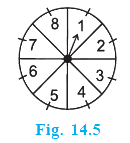
A game of chance consists of spinning an arrow which comes to rest pointing at one of the numbers 1, 2, 3, 4, 5, 6, 7, 8 (see Fig. 14.5 ), and these are equally likely outcomes. What is the probability that it will point at (ii) an odd number?
Solution :
Given: A game of chance involves a spinner with numbers $1, 2, 3, 4, 5, 6, 7, 8$. The outcomes are equally likely.
To Find: The probability that the arrow points at an odd number.
Step 1: Define the Sample Space
The sample space $S$ consists of all possible outcomes of the spinner.
$S = \{1, 2, 3, 4, 5, 6, 7, 8\}$
The total number of possible outcomes, denoted by $n(S)$, is $8$.
Step 2: Identify the Favorable Outcomes
Let $E$ be the event of getting an odd number.
An odd number is an integer that is not divisible by $2$.
From the set $S$, the odd numbers are $\{1, 3, 5, 7\}$.
The number of favorable outcomes, denoted by $n(E)$, is $4$.
Step 3: Apply the Probability Formula
The probability of an event $P(E)$ is defined as the ratio of the number of favorable outcomes to the total number of possible outcomes.
Formula: $P(E) = \frac{n(E)}{n(S)}$
[Since all outcomes are equally likely]
Step 4: Calculation
Substitute the values into the formula:
$P(E) = \frac{4}{8}$
Simplify the fraction by dividing both the numerator and the denominator by their greatest common divisor, which is $4$:
$P(E) = \frac{4 \div 4}{8 \div 4} = \frac{1}{2}$
Final Answer: The probability that the arrow will point at an odd number is $\frac{1}{2}$ or $0.5$.
More Questions from Class 10 Mathematics Probability EXERCISE 14.1
- Q1(i): Complete the following statements: (i) Probability of an event $E$ + Probability of the event ‘not $E$’ = .
- Q1(ii): Complete the following statements: (ii) The probability of an event that cannot happen is . Such an event is called .
- Q1(iii): Complete the following statements: (iii) The probability of an event that is certain to happen is . Such an event is called .
- Q1(iv): Complete the following statements: (iv) The sum of the probabilities of all the elementary events of an experiment is .
- Q1(v): Complete the following statements: (v) The probability of an event is greater than or equal to and less than or equal to .
- Q2(i): Which of the following experiments have equally likely outcomes? Explain. (i) A driver attempts to start a car. The car starts or does not start.
- Q2(ii): Which of the following experiments have equally likely outcomes? Explain. (ii) A player attempts to shoot a basketball. She/he shoots or misses the shot.
- Q2(iii): Which of the following experiments have equally likely outcomes? Explain. (iii) A trial is made to answer a true-false question. The answer is right or wrong.
- Q2(iv): Which of the following experiments have equally likely outcomes? Explain. (iv) A baby is born. It is a boy or a girl.
- Q3: Why is tossing a coin considered to be a fair way of deciding which team should get the ball at the beginning of a football game?
- Q4: Which of the following cannot be the probability of an event?
- Q5: If $P(E) = 0.05$, what is the probability of ‘not $E$’?
- Q6(i): A bag contains lemon flavoured candies only. Malini takes out one candy without looking into the bag. What is the probability that she takes out (i) an orange flavoured candy?
- Q6(ii): A bag contains lemon flavoured candies only. Malini takes out one candy without looking into the bag. What is the probability that she takes out (ii) a lemon flavoured candy?
- Q7: It is given that in a group of 3 students, the probability of 2 students not having the same birthday is 0.992. What is the probability that the 2 students have the same birthday?
- Q8(i): A bag contains 3 red balls and 5 black balls. A ball is drawn at random from the bag. What is the probability that the ball drawn is (i) red ?
- Q8(ii): A bag contains 3 red balls and 5 black balls. A ball is drawn at random from the bag. What is the probability that the ball drawn is (ii) not red?
- Q9(i): A box contains 5 red marbles, 8 white marbles and 4 green marbles. One marble is taken out of the box at random. What is the probability that the marble taken out will be (i) red ?
- Q9(ii): A box contains 5 red marbles, 8 white marbles and 4 green marbles. One marble is taken out of the box at random. What is the probability that the marble taken out will be (ii) white ?
- Q9(iii): A box contains 5 red marbles, 8 white marbles and 4 green marbles. One marble is taken out of the box at random. What is the probability that the marble taken out will be (iii) not green?
- Q10(i): A piggy bank contains hundred 50p coins, fifty ` 1 coins, twenty ` 2 coins and ten ` 5 coins. If it is equally likely that one of the coins will fall out when the bank is turned upside down, what is the probability that the coin (i) will be a 50 p coin ?
- Q10(ii): A piggy bank contains hundred 50p coins, fifty ` 1 coins, twenty ` 2 coins and ten ` 5 coins. If it is equally likely that one of the coins will fall out when the bank is turned upside down, what is the probability that the coin (ii) will not be a ` 5 coin?
- Q11: Gopi buys a fish from a shop for his aquarium. The shopkeeper takes out one fish at random from a tank containing 5 male fish and 8 female fish (see Fig. 14.4). What is the probability that the fish taken out is a male fish?
- Q12(i): A game of chance consists of spinning an arrow which comes to rest pointing at one of the numbers 1, 2, 3, 4, 5, 6, 7, 8 (see Fig. 14.5 ), and these are equally likely outcomes. What is the probability that it will point at (i) 8 ?
- Q12(iii): A game of chance consists of spinning an arrow which comes to rest pointing at one of the numbers 1, 2, 3, 4, 5, 6, 7, 8 (see Fig. 14.5 ), and these are equally likely outcomes. What is the probability that it will point at (iii) a number greater than 2?
- Q12(iv): A game of chance consists of spinning an arrow which comes to rest pointing at one of the numbers 1, 2, 3, 4, 5, 6, 7, 8 (see Fig. 14.5 ), and these are equally likely outcomes. What is the probability that it will point at (iv) a number less than 9?
- Q13(i): A die is thrown once. Find the probability of getting (i) a prime number;
- Q13(ii): A die is thrown once. Find the probability of getting (ii) a number lying between 2 and 6;
- Q13(iii): A die is thrown once. Find the probability of getting (iii) an odd number.
- Q14(i): One card is drawn from a well-shuffled deck of 52 cards. Find the probability of getting (i) a king of red colour
- Q14(ii): One card is drawn from a well-shuffled deck of 52 cards. Find the probability of getting (ii) a face card
- Q14(iii): One card is drawn from a well-shuffled deck of 52 cards. Find the probability of getting (iii) a red face card
- Q14(iv): One card is drawn from a well-shuffled deck of 52 cards. Find the probability of getting (iv) the jack of hearts
- Q14(v): One card is drawn from a well-shuffled deck of 52 cards. Find the probability of getting (v) a spade
- Q14(vi): One card is drawn from a well-shuffled deck of 52 cards. Find the probability of getting (vi) the queen of diamonds
- Q15(i): Five cards—the ten, jack, queen, king and ace of diamonds, are well-shuffled with their face downwards. One card is then picked up at random. (i) What is the probability that the card is the queen?
- Q15(ii)(a): Five cards—the ten, jack, queen, king and ace of diamonds, are well-shuffled with their face downwards. One card is then picked up at random. (ii) If the queen is drawn and put aside, what is the probability that the second card picked up is (a) an ace?
- Q15(ii)(b): Five cards—the ten, jack, queen, king and ace of diamonds, are well-shuffled with their face downwards. One card is then picked up at random. (ii) If the queen is drawn and put aside, what is the probability that the second card picked up is (b) a queen?
- Q16: 12 defective pens are accidentally mixed with 132 good ones. It is not possible to just look at a pen and tell whether or not it is defective. One pen is taken out at random from this lot. Determine the probability that the pen taken out is a good one.
- Q17(i): (i) A lot of 20 bulbs contain 4 defective ones. One bulb is drawn at random from the lot. What is the probability that this bulb is defective?
- Q17(ii): (ii) Suppose the bulb drawn in (i) is not defective and is not replaced. Now one bulb is drawn at random from the rest. What is the probability that this bulb is not defective ?
- Q18(i): A box contains 90 discs which are numbered from 1 to 90. If one disc is drawn at random from the box, find the probability that it bears (i) a two-digit number
- Q18(ii): A box contains 90 discs which are numbered from 1 to 90. If one disc is drawn at random from the box, find the probability that it bears (ii) a perfect square number
- Q18(iii): A box contains 90 discs which are numbered from 1 to 90. If one disc is drawn at random from the box, find the probability that it bears (iii) a number divisible by 5.
- Q19(i): A child has a die whose six faces show the letters as given below: The die is thrown once. What is the probability of getting (i) A?
- Q19(ii): A child has a die whose six faces show the letters as given below: The die is thrown once. What is the probability of getting (ii) D?
- Q20: Suppose you drop a die at random on the rectangular region shown in Fig. 14.6. What is the probability that it will land inside the circle with diameter $1$m?
- Q21(i): A lot consists of 144 ball pens of which 20 are defective and the others are good. Nuri will buy a pen if it is good, but will not buy if it is defective. The shopkeeper draws one pen at random and gives it to her. What is the probability that (i) She will buy it ?
- Q21(ii): A lot consists of 144 ball pens of which 20 are defective and the others are good. Nuri will buy a pen if it is good, but will not buy if it is defective. The shopkeeper draws one pen at random and gives it to her. What is the probability that (ii) She will not buy it ?
- Q22(i): Refer to Example 13. (i) Complete the following table:
- Q22(ii): Refer to Example 13. (ii) A student argues that ‘there are 11 possible outcomes 2, 3, 4, 5, 6, 7, 8, 9, 10, 11 and 12. Therefore, each of them has a probability $\frac{1}{11}$. Do you agree with this argument? Justify your answer.
- Q23: A game consists of tossing a one rupee coin 3 times and noting its outcome each time. Hanif wins if all the tosses give the same result i.e., three heads or three tails, and loses otherwise. Calculate the probability that Hanif will lose the game.
- Q24(i): A die is thrown twice. What is the probability that (i) 5 will not come up either time? [Hint : Throwing a die twice and throwing two dice simultaneously are treated as the same experiment]
- Q24(ii): A die is thrown twice. What is the probability that (ii) 5 will come up at least once? [Hint : Throwing a die twice and throwing two dice simultaneously are treated as the same experiment]
- Q25(i): Which of the following arguments are correct and which are not correct? Give reasons for your answer. (i) If two coins are tossed simultaneously there are three possible outcomes—two heads, two tails or one of each. Therefore, for each of these outcomes, the probability is $\frac{1}{3}$.
- Q25(ii): Which of the following arguments are correct and which are not correct? Give reasons for your answer. (ii) If a die is thrown, there are two possible outcomes—an odd number or an even number. Therefore, the probability of getting an odd number is $\frac{1}{2}$.
CBSE Solutions for Class 10 Mathematics Probability
Chapters in CBSE - Class 10 Mathematics
Top Tutors who teach Probability

 Top Tutor
 Sector 150, Noida
 5 yrs of
Exp
5 yrs of
Exp
 800
per hour
800
per hour
 Student's Home
 Tutor's home
Having 2 years experience in teaching class 6th to 10th across different boards.
 Top Tutor
Ashok Nagar D' Souza Layout, Bangalore
6 yrs of
Exp
Top Tutor
Ashok Nagar D' Souza Layout, Bangalore
6 yrs of
Exp
 13 students
 818 hrs of classes completed
400
per hour
818 hrs of classes completed
400
per hour
 Online Classes
I am a teacher , a statistician and a data analyst. I am willing to give online tution to uh in subject maths and statistics. I am a first ranker in my university in MSc (Statistics) and a gold medalist. I am certified in O level. I have cleared written exam for the post statistical officer in 2022 conducted by UPSC. Also cleared exam of MES but could not make in the interview. My key skills are teaching, solving queries, understanding students, visualising and analysing data. I have 6 years experience in teaching and i was a junior consultant having 4 years of experience in Ministry of labour and employment,Shimla . Currently i am working as a Monitoring Assistant in Department of Fisheries, Ministry of Fisheries,Animal Husbandry and Dairying, New Delhi. I know languages like R, python etc.

 Top Tutor
Chinsurah R S, Hooghly
15 yrs of
Exp
7 students
987 hrs of classes completed
350
per hour
Online Classes
Tutor's home
Top Tutor
Chinsurah R S, Hooghly
15 yrs of
Exp
7 students
987 hrs of classes completed
350
per hour
Online Classes
Tutor's home
I've taught at least 150 students of this Class till date ....online/offline together.
Very good teacher and friendly also. I have already join this sir's class. Very helpful teacher definitely. Thank you so much for your support. Highly recommended to all. Has good grip in the concept.
 Top Tutor
Mahipalpur, Delhi
14 yrs of
Exp
Student's Home
Top Tutor
Mahipalpur, Delhi
14 yrs of
Exp
Student's Home
As an experienced teacher for nine years, I have been teaching to make students interested in the subjects of Maths. My attitude is to help children improve in studies in the best possible way.
He is an excellent tutor who is very knowledgeable and conveys her knowledge of complex material in a manner easily understandable.

 Top Tutor
Bavdhan Vidnyan Nagar, Pune
5 yrs of
Exp
1 student
54 hrs of classes completed
250
per hour
Online Classes
Tutor's home
Top Tutor
Bavdhan Vidnyan Nagar, Pune
5 yrs of
Exp
1 student
54 hrs of classes completed
250
per hour
Online Classes
Tutor's home
I have taught in an institution to state ,ICSE , CBSE kids. Extra-ordinary Results. Ample of Study Material will be provided. We can have a demo class . You would enjoy the interactive and interesting sessions.
My experience with Parag sir was great, It is because of him that I got really good grades in my 10th and 12th standard.
Find more Tutor for Probability in your City
- Bangalore Mathematics Tutors
- Delhi Mathematics Tutors
- Chennai Mathematics Tutors
- Gurgaon Mathematics Tutors
- Noida Mathematics Tutors
- Hyderabad Mathematics Tutors
- Mumbai Mathematics Tutors
- Ghaziabad Mathematics Tutors
- Chandigarh Mathematics Tutors
- Pune Mathematics Tutors
- Jaipur Mathematics Tutors
- Surat Mathematics Tutors



