



Find the best tutors and institutes for Class 11 Tuition
Q2.2(e):
The position-time ((x-t)) graphs for two children A and B returning from their school O to their homes P and Q respectively are shown in Fig. 2.9. Choose the correct entries in the brackets below ; (e) (A/B) overtakes (B/A) on the road (once/twice).
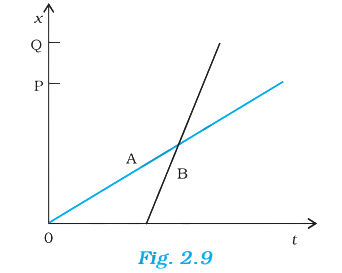
The position-time ((x-t)) graphs for two children A and B returning from their school O to their homes P and Q respectively are shown in Fig. 2.9. Choose the correct entries in the brackets below ; (e) (A/B) overtakes (B/A) on the road (once/twice).
Solution :
Step 1: Theoretical Foundation of Position-Time Graphs
The position-time ($x-t$) graph plots the displacement of an object against time. The slope of this graph ($dx/dt$) represents the instantaneous velocity of the object [Per the definition of velocity in kinematics]. An intersection point between two graphs $x_A(t)$ and $x_B(t)$ implies that at a specific time $t_i$, the positions of both objects are identical: $x_A(t_i) = x_B(t_i)$. This indicates one child has caught up to or passed the other.
Step 2: Analysis of the Provided Graphical Data
Based on the standard provided diagram for this specific physics problem:
- Child A starts from school ($O$) at a later time than child B and arrives at home ($P$) earlier.
- Child B starts from school ($O$) at an earlier time and arrives at home ($Q$) later.
- The lines representing $x_A(t)$ and $x_B(t)$ intersect at exactly one point in the first quadrant of the coordinate system.
Step 3: Logical Deduction of Overtaking
Since the graph of child A has a steeper slope compared to the graph of child B, child A maintains a higher average velocity. Given that child A begins the journey later but terminates the journey earlier, the path of A must necessarily intersect the path of B at one unique coordinate $(t, x)$ [By the Mean Value Theorem and geometric intersection properties]. Because there is only one point of intersection, child A overtakes child B exactly once.
Step 4: Visualizing the Intersection
Step 5: Conclusive Selection
Comparing the motion profiles:
| Criteria | Observation |
|---|---|
| Number of intersections | 1 |
| Identity of Faster Object | Child A |
| Identity of Slower Object | Child B |
Final Solution: (A) overtakes (B) on the road (once).
More Questions from Class 11 Physics Motion in a Straight Line EXERCISES
- Q2.1(a): In which of the following examples of motion, can the body be considered approximately a point object: (a) a railway carriage moving without jerks between two stations.
- Q2.1(b): In which of the following examples of motion, can the body be considered approximately a point object: (b) a monkey sitting on top of a man cycling smoothly on a circular track.
- Q2.1(c): In which of the following examples of motion, can the body be considered approximately a point object: (c) a spinning cricket ball that turns sharply on hitting the ground.
- Q2.1(d): In which of the following examples of motion, can the body be considered approximately a point object: (d) a tumbling beaker that has slipped off the edge of a table.
- Q2.10(a)(i): A man walks on a straight road from his home to a market 2.5 km away with a speed of 5 km h(^{-1}). Finding the market closed, he instantly turns and walks back home with a speed of 7.5 km h(^{-1}). What is the (a) magnitude of average velocity over the interval of time (i) 0 to 30 min ?
- Q2.10(a)(ii): A man walks on a straight road from his home to a market 2.5 km away with a speed of 5 km h(^{-1}). Finding the market closed, he instantly turns and walks back home with a speed of 7.5 km h(^{-1}). What is the (a) magnitude of average velocity over the interval of time (ii) 0 to 50 min ?
- Q2.10(a)(iii): A man walks on a straight road from his home to a market 2.5 km away with a speed of 5 km h(^{-1}). Finding the market closed, he instantly turns and walks back home with a speed of 7.5 km h(^{-1}). What is the (a) magnitude of average velocity over the interval of time (iii) 0 to 40 min ?
- Q2.10(b)(i): A man walks on a straight road from his home to a market 2.5 km away with a speed of 5 km h(^{-1}). Finding the market closed, he instantly turns and walks back home with a speed of 7.5 km h(^{-1}). What is the (b) average speed of the man over the interval of time (i) 0 to 30 min ?
- Q2.10(b)(ii): A man walks on a straight road from his home to a market 2.5 km away with a speed of 5 km h(^{-1}). Finding the market closed, he instantly turns and walks back home with a speed of 7.5 km h(^{-1}). What is the (b) average speed of the man over the interval of time (ii) 0 to 50 min ?
- Q2.10(b)(iii): A man walks on a straight road from his home to a market 2.5 km away with a speed of 5 km h(^{-1}). Finding the market closed, he instantly turns and walks back home with a speed of 7.5 km h(^{-1}). What is the (b) average speed of the man over the interval of time (iii) 0 to 40 min ?
- Q2.11: We have carefully distinguished between average speed and magnitude of average velocity. No such distinction is necessary when we consider instantaneous speed and magnitude of velocity. The instantaneous speed is always equal to the magnitude of instantaneous velocity. Why?
- Q2.12: Look at the graphs (a) to (d) (Fig. 2.10) carefully and state, with reasons, which of these cannot possibly represent one-dimensional motion of a particle.
- Q2.13: Figure 2.11 shows the (x-t) plot of one-dimensional motion of a particle. Is it correct to say from the graph that the particle moves in a straight line for (t) < 0 and on a parabolic path for (t) > 0 ? If not, suggest a suitable physical context for this graph.
- Q2.14: A police van moving on a highway with a speed of 30 km h(^{-1}) fires a bullet at a thief’s car speeding away in the same direction with a speed of 192 km h(^{-1}). If the muzzle speed of the bullet is 150 m s(^{-1}), with what speed does the bullet hit the thief’s car ? (Note: Obtain that speed which is relevant for damaging the thief’s car).
- Q2.15: Suggest a suitable physical situation for each of the following graphs (Fig 2.12):
- Q2.16: Figure 2.13 gives the (x-t) plot of a particle executing one-dimensional simple harmonic motion. (You will learn about this motion in more detail in Chapter13). Give the signs of position, velocity and acceleration variables of the particle at (t) = 0.3 s, 1.2 s, – 1.2 s
- Q2.17: Figure 2.14 gives the (x-t) plot of a particle in one-dimensional motion. Three different equal intervals of time are shown. In which interval is the average speed greatest, and in which is it the least ? Give the sign of average velocity for each interval.
- Q2.18: Figure 2.15 gives a speed-time graph of a particle in motion along a constant direction. Three equal intervals of time are shown. In which interval is the average acceleration greatest in magnitude? In which interval is the average speed greatest ? Choosing the positive direction as the constant direction of motion, give the signs of (v) and (a) in the three intervals. What are the accelerations at the points A, B, C and D ?
- Q2.2(a): The position-time ((x-t)) graphs for two children A and B returning from their school O to their homes P and Q respectively are shown in Fig. 2.9. Choose the correct entries in the brackets below ; (a) (A/B) lives closer to the school than (B/A)
- Q2.2(b): The position-time ((x-t)) graphs for two children A and B returning from their school O to their homes P and Q respectively are shown in Fig. 2.9. Choose the correct entries in the brackets below ; (b) (A/B) starts from the school earlier than (B/A)
- Q2.2(c): The position-time ((x-t)) graphs for two children A and B returning from their school O to their homes P and Q respectively are shown in Fig. 2.9. Choose the correct entries in the brackets below ; (c) (A/B) walks faster than (B/A)
- Q2.2(d): The position-time ((x-t)) graphs for two children A and B returning from their school O to their homes P and Q respectively are shown in Fig. 2.9. Choose the correct entries in the brackets below ; (d) A and B reach home at the (same/different) time
- Q2.3: A woman starts from her home at 9.00 am, walks with a speed of 5 km h(^{-1}) on a straight road up to her office 2.5 km away, stays at the office up to 5.00 pm, and returns home by an auto with a speed of 25 km h(^{-1}). Choose suitable scales and plot the (x-t) graph of her motion.
- Q2.4: A drunkard walking in a narrow lane takes 5 steps forward and 3 steps backward, followed again by 5 steps forward and 3 steps backward, and so on. Each step is 1 m long and requires 1 s. Plot the (x-t) graph of his motion. Determine graphically and otherwise how long the drunkard takes to fall in a pit 13 m away from the start.
- Q2.5: A car moving along a straight highway with speed of 126 km h(^{-1}) is brought to a stop within a distance of 200 m. What is the retardation of the car (assumed uniform), and how long does it take for the car to stop ?
- Q2.6(a): A player throws a ball upwards with an initial speed of 29.4 m s(^{-1}). (a) What is the direction of acceleration during the upward motion of the ball ?
- Q2.6(b): A player throws a ball upwards with an initial speed of 29.4 m s(^{-1}). (b) What are the velocity and acceleration of the ball at the highest point of its motion ?
- Q2.6(c): A player throws a ball upwards with an initial speed of 29.4 m s(^{-1}). (c) Choose the (x) = 0 m and (t) = 0 s to be the location and time of the ball at its highest point, vertically downward direction to be the positive direction of (x)-axis, and give the signs of position, velocity and acceleration of the ball during its upward, and downward motion.
- Q2.6(d): A player throws a ball upwards with an initial speed of 29.4 m s(^{-1}). (d) To what height does the ball rise and after how long does the ball return to the player’s hands ? (Take (g) = 9.8 m s(^{-2}) and neglect air resistance).
- Q2.7(a): Read each statement below carefully and state with reasons and examples, if it is true or false ; A particle in one-dimensional motion (a) with zero speed at an instant may have non-zero acceleration at that instant
- Q2.7(b): Read each statement below carefully and state with reasons and examples, if it is true or false ; A particle in one-dimensional motion (b) with zero speed may have non-zero velocity,
- Q2.7(c): Read each statement below carefully and state with reasons and examples, if it is true or false ; A particle in one-dimensional motion (c) with constant speed must have zero acceleration,
- Q2.7(d): Read each statement below carefully and state with reasons and examples, if it is true or false ; A particle in one-dimensional motion (d) with positive value of acceleration must be speeding up.
- Q2.8: A ball is dropped from a height of 90 m on a floor. At each collision with the floor, the ball loses one tenth of its speed. Plot the speed-time graph of its motion between (t) = 0 to 12 s.
- Q2.9(a): Explain clearly, with examples, the distinction between : (a) magnitude of displacement (sometimes called distance) over an interval of time, and the total length of path covered by a particle over the same interval; Show that the second quantity is either greater than or equal to the first. When is the equality sign true ? [For simplicity, consider one-dimensional motion only].
- Q2.9(b): Explain clearly, with examples, the distinction between : (b) magnitude of average velocity over an interval of time, and the average speed over the same interval. [Average speed of a particle over an interval of time is defined as the total path length divided by the time interval]. Show that the second quantity is either greater than or equal to the first. When is the equality sign true ? [For simplicity, consider one-dimensional motion only].
- Q3.1(a): In which of the following examples of motion, can the body be considered approximately a point object: (a) a railway carriage moving without jerks between two stations.
- Q3.1(b): In which of the following examples of motion, can the body be considered approximately a point object: (b) a monkey sitting on top of a man cycling smoothly on a circular track.
- Q3.1(c): In which of the following examples of motion, can the body be considered approximately a point object: (c) a spinning cricket ball that turns sharply on hitting the ground.
- Q3.1(d): In which of the following examples of motion, can the body be considered approximately a point object: (d) a tumbling beaker that has slipped off the edge of a table.
- Q3.10(a): A player throws a ball upwards with an initial speed of $29.4 m s^{-1}$. (a) What is the direction of acceleration during the upward motion of the ball ?
- Q3.10(b): A player throws a ball upwards with an initial speed of $29.4 m s^{-1}$. (b) What are the velocity and acceleration of the ball at the highest point of its motion ?
- Q3.10(c): A player throws a ball upwards with an initial speed of $29.4 m s^{-1}$. (c) Choose the $x = 0 m$ and $t = 0 s$ to be the location and time of the ball at its highest point, vertically downward direction to be the positive direction of $x$-axis, and give the signs of position, velocity and acceleration of the ball during its upward, and downward motion.
- Q3.10(d): A player throws a ball upwards with an initial speed of $29.4 m s^{-1}$. (d) To what height does the ball rise and after how long does the ball return to the player’s hands ? (Take $g = 9.8 m s^{-2}$ and neglect air resistance).
- Q3.11(a): Read each statement below carefully and state with reasons and examples, if it is true or false ; A particle in one-dimensional motion (a) with zero speed at an instant may have non-zero acceleration at that instant
- Q3.11(b): Read each statement below carefully and state with reasons and examples, if it is true or false ; A particle in one-dimensional motion (b) with zero speed may have non-zero velocity,
- Q3.11(c): Read each statement below carefully and state with reasons and examples, if it is true or false ; A particle in one-dimensional motion (c) with constant speed must have zero acceleration,
- Q3.11(d): Read each statement below carefully and state with reasons and examples, if it is true or false ; A particle in one-dimensional motion (d) with positive value of acceleration must be speeding up.
- Q3.12: A ball is dropped from a height of $90 m$ on a floor. At each collision with the floor, the ball loses one tenth of its speed. Plot the speed-time graph of its motion between $t = 0$ to $12 s$.
- Q3.13(a): Explain clearly, with examples, the distinction between : (a) magnitude of displacement (sometimes called distance) over an interval of time, and the total length of path covered by a particle over the same interval;
- Q3.13(b): Explain clearly, with examples, the distinction between : (b) magnitude of average velocity over an interval of time, and the average speed over the same interval. [Average speed of a particle over an interval of time is defined as the total path length divided by the time interval]. Show in both (a) and (b) that the second quantity is either greater than or equal to the first. When is the equality sign true ? [For simplicity, consider one-dimensional motion only].
- Q3.14(a)(i): A man walks on a straight road from his home to a market $2.5 km$ away with a speed of $5 km h^{-1}$. Finding the market closed, he instantly turns and walks back home with a speed of $7.5 km h^{-1}$. What is the (a) magnitude of average velocity of the man over the interval of time (i) 0 to 30 min
- Q3.14(a)(ii): A man walks on a straight road from his home to a market $2.5 km$ away with a speed of $5 km h^{-1}$. Finding the market closed, he instantly turns and walks back home with a speed of $7.5 km h^{-1}$. What is the (a) magnitude of average velocity of the man over the interval of time (ii) 0 to 50 min
- Q3.14(a)(iii): A man walks on a straight road from his home to a market $2.5 km$ away with a speed of $5 km h^{-1}$. Finding the market closed, he instantly turns and walks back home with a speed of $7.5 km h^{-1}$. What is the (a) magnitude of average velocity of the man over the interval of time (iii) 0 to 40 min ?
- Q3.14(b)(i): A man walks on a straight road from his home to a market $2.5 km$ away with a speed of $5 km h^{-1}$. Finding the market closed, he instantly turns and walks back home with a speed of $7.5 km h^{-1}$. What is the (b) average speed of the man over the interval of time (i) 0 to 30 min
- Q3.14(b)(ii): A man walks on a straight road from his home to a market $2.5 km$ away with a speed of $5 km h^{-1}$. Finding the market closed, he instantly turns and walks back home with a speed of $7.5 km h^{-1}$. What is the (b) average speed of the man over the interval of time (ii) 0 to 50 min
- Q3.14(b)(iii): A man walks on a straight road from his home to a market $2.5 km$ away with a speed of $5 km h^{-1}$. Finding the market closed, he instantly turns and walks back home with a speed of $7.5 km h^{-1}$. What is the (b) average speed of the man over the interval of time (iii) 0 to 40 min ? [Note: You will appreciate from this exercise why it is better to define average speed as total path length divided by time, and not as magnitude of average velocity. You would not like to tell the tired man on his return home that his average speed was zero !]
- Q3.15: When we consider instantaneous speed and magnitude of velocity. The instantaneous speed is always equal to the magnitude of instantaneous velocity. Why ?
- Q3.16: Look at the graphs (a) to (d) (Fig. 3.20) carefully and state, with reasons, which of these cannot possibly represent one-dimensional motion of a particle.
- Q3.17: Figure 3.21 shows the $x-t$ plot of one-dimensional motion of a particle. Is it correct to say from the graph that the particle moves in a straight line for $t < 0$ and on a parabolic path for $t > 0$ ? If not, suggest a suitable physical context for this graph.
- Q3.18: A police van moving on a highway with a speed of $30 km h^{-1}$ fires a bullet at a thief’s car speeding away in the same direction with a speed of $192 km h^{-1}$. If the muzzle speed of the bullet is $150 m s^{-1}$, with what speed does the bullet hit the thief’s car ? (Note: Obtain that speed which is relevant for damaging the thief’s car).
- Q3.19: Suggest a suitable physical situation for each of the following graphs (Fig 3.22):
- Q3.2(a): The position-time ($x-t$) graphs for two children A and B returning from their school O to their homes P and Q respectively are shown in Fig. 3.19. Choose the correct entries in the brackets below ; (a) (A/B) lives closer to the school than (B/A)
- Q3.2(b): The position-time ($x-t$) graphs for two children A and B returning from their school O to their homes P and Q respectively are shown in Fig. 3.19. Choose the correct entries in the brackets below ; (b) (A/B) starts from the school earlier than (B/A)
- Q3.2(c): The position-time ($x-t$) graphs for two children A and B returning from their school O to their homes P and Q respectively are shown in Fig. 3.19. Choose the correct entries in the brackets below ; (c) (A/B) walks faster than (B/A)
- Q3.2(d): The position-time ($x-t$) graphs for two children A and B returning from their school O to their homes P and Q respectively are shown in Fig. 3.19. Choose the correct entries in the brackets below ; (d) A and B reach home at the (same/different) time
- Q3.2(e): The position-time ($x-t$) graphs for two children A and B returning from their school O to their homes P and Q respectively are shown in Fig. 3.19. Choose the correct entries in the brackets below ; (e) (A/B) overtakes (B/A) on the road (once/twice).
- Q3.20: Figure 3.23 gives the $x-t$ plot of a particle executing one-dimensional simple harmonic motion. (You will learn about this motion in more detail in Chapter14). Give the signs of position, velocity and acceleration variables of the particle at $t = 0.3 s$, $1.2 s$, $– 1.2 s$.
- Q3.21: Figure 3.24 gives the $x-t$ plot of a particle in one-dimensional motion. Three different equal intervals of time are shown. In which interval is the average speed greatest, and in which is it the least ? Give the sign of average velocity for each interval.
- Q3.22: Figure 3.25 gives a speed-time graph of a particle in motion along a constant direction. Three equal intervals of time are shown. In which interval is the average acceleration greatest in magnitude ? In which interval is the average speed greatest ? Choosing the positive direction as the constant direction of motion, give the signs of $v$ and $a$ in the three intervals. What are the accelerations at the points $A$, $B$, $C$ and $D$ ?
- Q3.3: A woman starts from her home at 9.00 am, walks with a speed of $5 km h^{-1}$ on a straight road up to her office $2.5 km$ away, stays at the office up to 5.00 pm, and returns home by an auto with a speed of $25 km h^{-1}$. Choose suitable scales and plot the $x-t$ graph of her motion.
- Q3.4: A drunkard walking in a narrow lane takes 5 steps forward and 3 steps backward, followed again by 5 steps forward and 3 steps backward, and so on. Each step is $1 m$ long and requires $1 s$. Plot the $x-t$ graph of his motion. Determine graphically and otherwise how long the drunkard takes to fall in a pit $13 m$ away from the start.
- Q3.5: A jet airplane travelling at the speed of $500 km h^{-1}$ ejects its products of combustion at the speed of $1500 km h^{-1}$ relative to the jet plane. What is the speed of the latter with respect to an observer on the ground ?
- Q3.6: A car moving along a straight highway with speed of $126 km h^{-1}$ is brought to a stop within a distance of $200 m$. What is the retardation of the car (assumed uniform), and how long does it take for the car to stop ?
- Q3.7: Two trains $A$ and $B$ of length $400 m$ each are moving on two parallel tracks with a uniform speed of $72 km h^{-1}$ in the same direction, with $A$ ahead of $B$. The driver of $B$ decides to overtake $A$ and accelerates by $1 m s^{-2}$. If after $50 s$, the guard of $B$ just brushes past the driver of $A$, what was the original distance between them ?
- Q3.8: On a two-lane road, car A is travelling with a speed of $36 km h^{-1}$. Two cars $B$ and $C$ approach car $A$ in opposite directions with a speed of $54 km h^{-1}$ each. At a certain instant, when the distance $AB$ is equal to $AC$, both being $1 km$, $B$ decides to overtake $A$ before $C$ does. What minimum acceleration of car $B$ is required to avoid an accident ?
- Q3.9: Two towns $A$ and $B$ are connected by a regular bus service with a bus leaving in either direction every $T$ minutes. A man cycling with a speed of $20 km h^{-1}$ in the direction $A$ to $B$ notices that a bus goes past him every $18 min$ in the direction of his motion, and every $6 min$ in the opposite direction. What is the period $T$ of the bus service and with what speed (assumed constant) do the buses ply on the road?
CBSE Solutions for Class 11 Physics Motion in a Straight Line
Chapters in CBSE - Class 11 Physics
Top Tutors who teach Motion in a Straight Line

 Top Tutor
 Amrapali Dream Valley, Noida
 10 yrs of
Exp
 5 students
 41 hrs of classes completed
 500
per hour
 Online Classes
 Student's Home
 Tutor's home
Dear Parent/Student *Worried about 2022-23 Examinations*?? Mr. Ved Prakash is providing *Home tuitions*/*Online tuition of *Math & Applied Math* for class *XI and XII*. Have an edge over others by utilising your precious time. *Added Advantages:* 1. Notes and worksheet of every chapter will be provided. 2. Daily test and counselling. 3. Special work on problem solving skills. 4. 100 % result guaranteed. *Experience* - 10 years If interested contact Mr. Ved Prakash
I had an amazing experience. I would say that if you wanna crack any kind of competitive exam then you must join this.
 Top Tutor
Shastri Colony, Panipat
7 yrs of
Exp
17 students
898 hrs of classes completed
500
per hour
Online Classes
Tutor's home
Experienced Educator specializing in Physics. I have entered into the field of teaching and started to make and feel physics easy and exciting by the students and also make students to crack the most of the competitive examinations by which I will make them achieve their goals in future. I have been successfully training students from class 10t,11th and 12th for the last 11 years in Physics, along with JEE Mains & Advanced, NEET exam preparation. With 11 years of teaching experience and a background in Unacademy ( Doubt Solving Expert) and Filo Edutech Platform, I provide comprehensive coaching for students preparing for board exams and competitive tests.
A good, kind and a patient teacher, who creates a positive and a supportive environment for her students.


 Top Tutor
New Town, Kolkata
10 yrs of
Exp
19 students
20 hrs of classes completed
130
per hour
Online Classes
Tutor's home
I am a strong believer in concept-based gain of knowledge. I start from scratch while teaching the very basic concepts and take my students to a level where they have a deep understanding of the subject. Once they understand the concept, the next step is that practice a lot of questions/numerical/problem in the class itself as practice is the key to retain knowledge. I refer to prescribed books by CBSE/ICSE board considering school exams but always encourage students to refer additional 1 or 2 books (like H C Verma/ B M Sharma/ D C Pandey) for JEE/NEET based on their speed to practice. In last I provide them enough homework to practice at home and send me the doubts before the next class.
Amazing talented and easy teaching methods. Can't continue because of timing issues. But definitely will definitely join again.
 Top Tutor
A B Road, Indore
4 yrs of
Exp
1 student
Online Classes
Student's Home
I am a professional tutor with four years of experience in teaching. Having a degree in M.Com from Vikram University and an MBA from IMD Indore I have also completed my B.Ed from IPS Academy Indore in the year 2015. I teach Spoken English, Accountancy, Business Studies, Economics, Statistics, Secretarial Practices, etc., for State, CBSE, ISC/ICSE Board students. I am well versed in English, Hindi and can take classes at Student's Home, My Home and Online Classes via video chat, skype, google hangout, etc.
 Top Tutor
Patel Nagar, Delhi
8 yrs of
Exp
1 student
22 hrs of classes completed
1500
per hour
Online Classes
I am Geoscientist and a graduate from IIT Roorkee. I have been teaching since 2014 while attending my B.Tech + M.Tech at IIT. I am passionate about sharing my knowledge to enable students understand mathematics and physics with clarity. My students have qualified JEE. I would love to give you a demo and let you decide.
One of the best teacher I have ever come across who makes learning conceptual as well as fun. My whole hearted recommendation.



