



Find the best tutors and institutes for Class 10 Tuition
Q6:
In Fig. 6.37, if $\triangle ABE \cong \triangle ACD$, show that $\triangle ADE \sim \triangle ABC$.
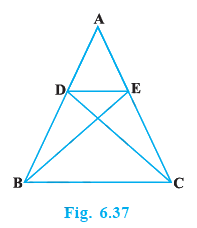
In Fig. 6.37, if $\triangle ABE \cong \triangle ACD$, show that $\triangle ADE \sim \triangle ABC$.
Solution :
Given: $\triangle ABE \cong \triangle ACD$.
To Prove: $\triangle ADE \sim \triangle ABC$.
Visual Representation:
Step 1: Analyze the given congruence.
We are given that $\triangle ABE \cong \triangle ACD$. By the property of Congruent Triangles (CPCT - Corresponding Parts of Congruent Triangles), the corresponding sides and angles are equal.
Therefore, $AB = AC$ --- (Equation 1)
And, $AE = AD$ --- (Equation 2)
Step 2: Formulate ratios from the equations.
From Equation 1, we can write: $\frac{AB}{AC} = 1$
From Equation 2, we can write: $\frac{AD}{AE} = 1$
Equating the two, we get: $\frac{AB}{AC} = \frac{AD}{AE}$
By rearranging the terms to align with the sides of $\triangle ADE$ and $\triangle ABC$, we get:
$\frac{AD}{AB} = \frac{AE}{AC}$ --- (Equation 3)
Step 3: Identify the common angle.
In $\triangle ADE$ and $\triangle ABC$, consider the angle at vertex $A$:
$\angle DAE = \angle BAC$ (Common angle to both triangles)
Step 4: Apply the SAS Similarity Criterion.
The SAS (Side-Angle-Side) Similarity Criterion states that if one angle of a triangle is equal to one angle of the other triangle and the sides including these angles are proportional, then the two triangles are similar.
From Equation 3, we have the ratio of the sides: $\frac{AD}{AB} = \frac{AE}{AC}$.
From Step 3, we have the included angle: $\angle DAE = \angle BAC$.
Therefore, by SAS similarity criterion:
$\triangle ADE \sim \triangle ABC$
Final Answer: Since the ratio of the corresponding sides is equal and the included angle is common, $\triangle ADE \sim \triangle ABC$ is proved.
More Questions from Class 10 Mathematics Triangles EXERCISE 6.3
- Q1(i): State which pairs of triangles in Fig. 6.34 are similar. Write the similarity criterion used by you for answering the question and also write the pairs of similar triangles in the symbolic form : (i)
- Q1(ii): State which pairs of triangles in Fig. 6.34 are similar. Write the similarity criterion used by you for answering the question and also write the pairs of similar triangles in the symbolic form : (ii)
- Q1(iii): State which pairs of triangles in Fig. 6.34 are similar. Write the similarity criterion used by you for answering the question and also write the pairs of similar triangles in the symbolic form : (iii)
- Q1(iv): State which pairs of triangles in Fig. 6.34 are similar. Write the similarity criterion used by you for answering the question and also write the pairs of similar triangles in the symbolic form : (iv)
- Q1(v): State which pairs of triangles in Fig. 6.34 are similar. Write the similarity criterion used by you for answering the question and also write the pairs of similar triangles in the symbolic form : (v)
- Q1(vi): State which pairs of triangles in Fig. 6.34 are similar. Write the similarity criterion used by you for answering the question and also write the pairs of similar triangles in the symbolic form : (vi)
- Q2: In Fig. 6.35, $\triangle ODC \sim \triangle OBA$, $\angle BOC = 125^{\circ}$ and $\angle CDO = 70^{\circ}$. Find $\angle DOC$, $\angle DCO$ and $\angle OAB$.
- Q3: Diagonals $AC$ and $BD$ of a trapezium $ABCD$ with $AB \parallel DC$ intersect each other at the point $O$. Using a similarity criterion for two triangles, show that $\frac{OA}{OC} = \frac{OB}{OD}$.
- Q4: In Fig. 6.36, $\frac{QR}{QS} = \frac{QT}{PR}$ and $\angle 1 = \angle 2$. Show that $\triangle PQS \sim \triangle TQR$.
- Q5: $S$ and $T$ are points on sides $PR$ and $QR$ of $\triangle PQR$ such that $\angle P = \angle RTS$. Show that $\triangle RPQ \sim \triangle RTS$.
- Q7(i): In Fig. 6.38, altitudes $AD$ and $CE$ of $\triangle ABC$ intersect each other at the point $P$. Show that: (i) $\triangle AEP \sim \triangle CDP$
- Q7(ii): In Fig. 6.38, altitudes $AD$ and $CE$ of $\triangle ABC$ intersect each other at the point $P$. Show that: (ii) $\triangle ABD \sim \triangle CBE$
- Q7(iii): In Fig. 6.38, altitudes $AD$ and $CE$ of $\triangle ABC$ intersect each other at the point $P$. Show that: (iii) $\triangle AEP \sim \triangle ADB$
- Q7(iv): In Fig. 6.38, altitudes $AD$ and $CE$ of $\triangle ABC$ intersect each other at the point $P$. Show that: (iv) $\triangle PDC \sim \triangle BEC$
- Q8: $E$ is a point on the side $AD$ produced of a parallelogram $ABCD$ and $BE$ intersects $CD$ at $F$. Show that $\triangle ABE \sim \triangle CFB$.
- Q9(i): In Fig. 6.39, $ABC$ and $AMP$ are two right triangles, right angled at $B$ and $M$ respectively. Prove that: (i) $\triangle ABC \sim \triangle AMP$
- Q9(ii): In Fig. 6.39, $ABC$ and $AMP$ are two right triangles, right angled at $B$ and $M$ respectively. Prove that: (ii) $\frac{CA}{PA} = \frac{BC}{MP}$
- Q10(i): $CD$ and $GH$ are respectively the bisectors of $\angle ACB$ and $\angle EGF$ such that $D$ and $H$ lie on sides $AB$ and $FE$ of $\triangle ABC$ and $\triangle EFG$ respectively. If $\triangle ABC \sim \triangle FEG$, show that: (i) $\frac{CD}{GH} = \frac{AC}{FG}$
- Q10(ii): $CD$ and $GH$ are respectively the bisectors of $\angle ACB$ and $\angle EGF$ such that $D$ and $H$ lie on sides $AB$ and $FE$ of $\triangle ABC$ and $\triangle EFG$ respectively. If $\triangle ABC \sim \triangle FEG$, show that: (ii) $\triangle DCB \sim \triangle HGE$
- Q10(iii): $CD$ and $GH$ are respectively the bisectors of $\angle ACB$ and $\angle EGF$ such that $D$ and $H$ lie on sides $AB$ and $FE$ of $\triangle ABC$ and $\triangle EFG$ respectively. If $\triangle ABC \sim \triangle FEG$, show that: (iii) $\triangle DCA \sim \triangle HGF$
- Q11: In Fig. 6.40, $E$ is a point on side $CB$ produced of an isosceles triangle $ABC$ with $AB = AC$. If $AD \perp BC$ and $EF \perp AC$, prove that $\triangle ABD \sim \triangle ECF$.
- Q12: Sides $AB$ and $BC$ and median $AD$ of a triangle $ABC$ are respectively proportional to sides $PQ$ and $QR$ and median $PM$ of $\triangle PQR$ (see Fig. 6.41). Show that $\triangle ABC \sim \triangle PQR$.
- Q13: $D$ is a point on the side $BC$ of a triangle $ABC$ such that $\angle ADC = \angle BAC$. Show that $CA^2 = CB \cdot CD$.
- Q14: Sides $AB$ and $AC$ and median $AD$ of a triangle $ABC$ are respectively proportional to sides $PQ$ and $PR$ and median $PM$ of another triangle $PQR$. Show that $\triangle ABC \sim \triangle PQR$.
- Q15: A vertical pole of length 6 m casts a shadow 4 m long on the ground and at the same time a tower casts a shadow 28 m long. Find the height of the tower.
- Q16: If $AD$ and $PM$ are medians of triangles $ABC$ and $PQR$, respectively where $\triangle ABC \sim \triangle PQR$, prove that $\frac{AB}{PQ} = \frac{AD}{PM}$.
CBSE Solutions for Class 10 Mathematics Triangles
Chapters in CBSE - Class 10 Mathematics
Top Tutors who teach Triangles

 Indirapuram, Ghaziabad
 8 yrs of
Exp
8 yrs of
Exp
 3 students
 300
per hour
300
per hour
 Online Classes
 Student's Home
I am a teacher of maths and science, having a experience of 8+ years in teaching, done my schooling from CBSe board and degree from IP university.
 Top Tutor
Mathura Road, Delhi
20 yrs of
Exp
14 students
Top Tutor
Mathura Road, Delhi
20 yrs of
Exp
14 students
 1590 hrs of classes completed
1000
per hour
Online Classes
1590 hrs of classes completed
1000
per hour
Online Classes
 Tutor's home
For me, teaching is part of learning. As I am teaching I am also learning from my learners as they are diverse. Each learner in the classroom brings his or her unique background and ability. These are the elements that I invest in my teaching. Moreover, I allow learners to be themselves. This is a way of creating a conducive environment for learning.
Its been a really nice teaching experience with Mr.Amit so far. He is very knowledgeable and a patient teacher. He always clarifies the concepts clearly and ensures good understanding.
 Top Tutor
Shyam Nagar Vivek Vihar, Jaipur
10 yrs of
Exp
3 students
174 hrs of classes completed
150
per hour
Online Classes
Tutor's home
Top Tutor
Shyam Nagar Vivek Vihar, Jaipur
10 yrs of
Exp
3 students
174 hrs of classes completed
150
per hour
Online Classes
Tutor's home
I am a teacher of Mathematics. I am teaching in school since 2013. I have a degree in Education. I have done Masters in Mathematics.



 Super Tutor
New Friends Colony, Delhi
10 yrs of
Exp
41 students
783 hrs of classes completed
500
per hour
Online Classes
Super Tutor
New Friends Colony, Delhi
10 yrs of
Exp
41 students
783 hrs of classes completed
500
per hour
Online Classes
Hi, I'm Ravi Shankar, a Mathematics educator with 10+ years of teaching experience. I help Class 10 students strengthen their concepts, improve application skills, and prepare systematically for important examinations. At this stage, simply knowing formulas isn't enough. Students need to recognise the appropriate method, interpret questions correctly, solve efficiently and avoid losing marks through preventable mistakes. My classes focus on: • Concept mastery • Algebra and functions • Geometry • Trigonometry • Statistics and probability • Application-based problems • Multi-step questions • Past-paper practice • Error analysis • Time management and exam strategy I use regular assessments to identify recurring mistakes and areas requiring additional attention. My approach: Concept → Application → Problem Solving → Exam Practice → Analysis The goal is to help students approach examinations with greater confidence, accuracy, and consistency. Book an introductory session to understand where your child currently stands and what needs to improve.
I highly appreciate Sir’s dedication and clarity in teaching. His systematic approach helped me score confidently in board examinations.


 Top Tutor
Tilak Nagar, Delhi
4 yrs of
Exp
2 students
56 hrs of classes completed
300
per hour
Online Classes
Student's Home
Tutor's home
Top Tutor
Tilak Nagar, Delhi
4 yrs of
Exp
2 students
56 hrs of classes completed
300
per hour
Online Classes
Student's Home
Tutor's home
I am a mathematics expert . I am teaching this subject since a decade . I ve handled thousands of students and bring numerous centum results in past . You will able to learn maths in the most pragmatic approach with me and develop a love for this subject .
Awesome humble best tutor for mathematics you and economic can just close your eyes and select for your class. You doesn't have to follow your kid he will take care of the student.
Find more Tutor for Triangles in your City
- Bangalore Mathematics Tutors
- Delhi Mathematics Tutors
- Chennai Mathematics Tutors
- Gurgaon Mathematics Tutors
- Noida Mathematics Tutors
- Hyderabad Mathematics Tutors
- Mumbai Mathematics Tutors
- Ghaziabad Mathematics Tutors
- Chandigarh Mathematics Tutors
- Pune Mathematics Tutors
- Jaipur Mathematics Tutors
- Surat Mathematics Tutors



