



Find the best tutors and institutes for Class 10 Tuition
Q1(v):
State which pairs of triangles in Fig. 6.34 are similar. Write the similarity criterion used by you for answering the question and also write the pairs of similar triangles in the symbolic form : (v)
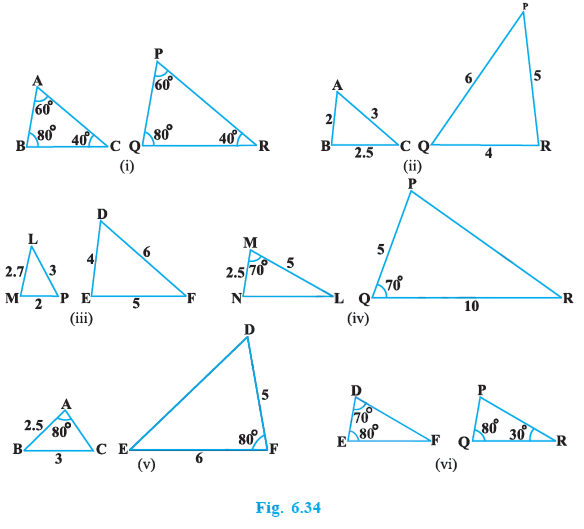
State which pairs of triangles in Fig. 6.34 are similar. Write the similarity criterion used by you for answering the question and also write the pairs of similar triangles in the symbolic form : (v)
Solution :
Given: Two triangles, $\triangle ABC$ and $\triangle DEF$.
In $\triangle ABC$:
- $AB = 2.5$
- $BC = 3$
- $\angle A = 80^\circ$
In $\triangle DEF$:
- $EF = 6$
- $DF = 5$
- $\angle F = 80^\circ$
To Find: Determine if the triangles are similar, state the criterion used, and write the symbolic representation if they are similar.
Step 1: Analyze the sides and angles of the triangles.
We examine the ratios of the sides that include the given angle. In $\triangle ABC$, the angle $80^\circ$ is at vertex $A$. The sides forming this angle are $AB$ and $AC$. However, the length of $AC$ is not provided. In $\triangle DEF$, the angle $80^\circ$ is at vertex $F$. The sides forming this angle are $EF$ and $DF$.
Step 2: Check for similarity criteria.
For two triangles to be similar by the SAS (Side-Angle-Side) criterion, the ratio of the two sides must be equal, and the included angle must be equal.
Let us check the ratios of the given sides:
Ratio 1: $\frac{AB}{DF} = \frac{2.5}{5} = 0.5$
Ratio 2: $\frac{BC}{EF} = \frac{3}{6} = 0.5$
Here, the ratios of the sides are equal ($\frac{AB}{DF} = \frac{BC}{EF} = \frac{1}{2}$).
Step 3: Evaluate the included angle condition.
For SAS similarity, the equal angle must be the included angle between the proportional sides.
In $\triangle ABC$, the sides are $AB$ and $BC$. The included angle is $\angle B$. We are given $\angle A = 80^\circ$.
In $\triangle DEF$, the sides are $DF$ and $EF$. The included angle is $\angle F$. We are given $\angle F = 80^\circ$.
Since the given angle $\angle A$ in $\triangle ABC$ is not the included angle between sides $AB$ and $BC$, and we do not have information about $\angle B$ or $\angle F$ being the included angle for the proportional sides in both triangles, the SAS criterion cannot be applied.
Step 4: Conclusion.
Because the equal angles ($80^\circ$) are not the included angles between the sides that are in the same ratio, the triangles do not satisfy the SAS similarity criterion. There is no other information provided to satisfy AA or SSS criteria.
Final Answer: The triangles are not similar.
More Questions from Class 10 Mathematics Triangles EXERCISE 6.3
- Q1(i): State which pairs of triangles in Fig. 6.34 are similar. Write the similarity criterion used by you for answering the question and also write the pairs of similar triangles in the symbolic form : (i)
- Q1(ii): State which pairs of triangles in Fig. 6.34 are similar. Write the similarity criterion used by you for answering the question and also write the pairs of similar triangles in the symbolic form : (ii)
- Q1(iii): State which pairs of triangles in Fig. 6.34 are similar. Write the similarity criterion used by you for answering the question and also write the pairs of similar triangles in the symbolic form : (iii)
- Q1(iv): State which pairs of triangles in Fig. 6.34 are similar. Write the similarity criterion used by you for answering the question and also write the pairs of similar triangles in the symbolic form : (iv)
- Q1(vi): State which pairs of triangles in Fig. 6.34 are similar. Write the similarity criterion used by you for answering the question and also write the pairs of similar triangles in the symbolic form : (vi)
- Q2: In Fig. 6.35, $\triangle ODC \sim \triangle OBA$, $\angle BOC = 125^{\circ}$ and $\angle CDO = 70^{\circ}$. Find $\angle DOC$, $\angle DCO$ and $\angle OAB$.
- Q3: Diagonals $AC$ and $BD$ of a trapezium $ABCD$ with $AB \parallel DC$ intersect each other at the point $O$. Using a similarity criterion for two triangles, show that $\frac{OA}{OC} = \frac{OB}{OD}$.
- Q4: In Fig. 6.36, $\frac{QR}{QS} = \frac{QT}{PR}$ and $\angle 1 = \angle 2$. Show that $\triangle PQS \sim \triangle TQR$.
- Q5: $S$ and $T$ are points on sides $PR$ and $QR$ of $\triangle PQR$ such that $\angle P = \angle RTS$. Show that $\triangle RPQ \sim \triangle RTS$.
- Q6: In Fig. 6.37, if $\triangle ABE \cong \triangle ACD$, show that $\triangle ADE \sim \triangle ABC$.
- Q7(i): In Fig. 6.38, altitudes $AD$ and $CE$ of $\triangle ABC$ intersect each other at the point $P$. Show that: (i) $\triangle AEP \sim \triangle CDP$
- Q7(ii): In Fig. 6.38, altitudes $AD$ and $CE$ of $\triangle ABC$ intersect each other at the point $P$. Show that: (ii) $\triangle ABD \sim \triangle CBE$
- Q7(iii): In Fig. 6.38, altitudes $AD$ and $CE$ of $\triangle ABC$ intersect each other at the point $P$. Show that: (iii) $\triangle AEP \sim \triangle ADB$
- Q7(iv): In Fig. 6.38, altitudes $AD$ and $CE$ of $\triangle ABC$ intersect each other at the point $P$. Show that: (iv) $\triangle PDC \sim \triangle BEC$
- Q8: $E$ is a point on the side $AD$ produced of a parallelogram $ABCD$ and $BE$ intersects $CD$ at $F$. Show that $\triangle ABE \sim \triangle CFB$.
- Q9(i): In Fig. 6.39, $ABC$ and $AMP$ are two right triangles, right angled at $B$ and $M$ respectively. Prove that: (i) $\triangle ABC \sim \triangle AMP$
- Q9(ii): In Fig. 6.39, $ABC$ and $AMP$ are two right triangles, right angled at $B$ and $M$ respectively. Prove that: (ii) $\frac{CA}{PA} = \frac{BC}{MP}$
- Q10(i): $CD$ and $GH$ are respectively the bisectors of $\angle ACB$ and $\angle EGF$ such that $D$ and $H$ lie on sides $AB$ and $FE$ of $\triangle ABC$ and $\triangle EFG$ respectively. If $\triangle ABC \sim \triangle FEG$, show that: (i) $\frac{CD}{GH} = \frac{AC}{FG}$
- Q10(ii): $CD$ and $GH$ are respectively the bisectors of $\angle ACB$ and $\angle EGF$ such that $D$ and $H$ lie on sides $AB$ and $FE$ of $\triangle ABC$ and $\triangle EFG$ respectively. If $\triangle ABC \sim \triangle FEG$, show that: (ii) $\triangle DCB \sim \triangle HGE$
- Q10(iii): $CD$ and $GH$ are respectively the bisectors of $\angle ACB$ and $\angle EGF$ such that $D$ and $H$ lie on sides $AB$ and $FE$ of $\triangle ABC$ and $\triangle EFG$ respectively. If $\triangle ABC \sim \triangle FEG$, show that: (iii) $\triangle DCA \sim \triangle HGF$
- Q11: In Fig. 6.40, $E$ is a point on side $CB$ produced of an isosceles triangle $ABC$ with $AB = AC$. If $AD \perp BC$ and $EF \perp AC$, prove that $\triangle ABD \sim \triangle ECF$.
- Q12: Sides $AB$ and $BC$ and median $AD$ of a triangle $ABC$ are respectively proportional to sides $PQ$ and $QR$ and median $PM$ of $\triangle PQR$ (see Fig. 6.41). Show that $\triangle ABC \sim \triangle PQR$.
- Q13: $D$ is a point on the side $BC$ of a triangle $ABC$ such that $\angle ADC = \angle BAC$. Show that $CA^2 = CB \cdot CD$.
- Q14: Sides $AB$ and $AC$ and median $AD$ of a triangle $ABC$ are respectively proportional to sides $PQ$ and $PR$ and median $PM$ of another triangle $PQR$. Show that $\triangle ABC \sim \triangle PQR$.
- Q15: A vertical pole of length 6 m casts a shadow 4 m long on the ground and at the same time a tower casts a shadow 28 m long. Find the height of the tower.
- Q16: If $AD$ and $PM$ are medians of triangles $ABC$ and $PQR$, respectively where $\triangle ABC \sim \triangle PQR$, prove that $\frac{AB}{PQ} = \frac{AD}{PM}$.
CBSE Solutions for Class 10 Mathematics Triangles
Chapters in CBSE - Class 10 Mathematics
Top Tutors who teach Triangles


 Top Tutor
 Bavdhan Vidnyan Nagar, Pune
 5 yrs of
Exp
5 yrs of
Exp
 1 student
 54 hrs of classes completed
 250
per hour
250
per hour
 Online Classes
 Tutor's home
I have taught in an institution to state ,ICSE , CBSE kids. Extra-ordinary Results. Ample of Study Material will be provided. We can have a demo class . You would enjoy the interactive and interesting sessions.


 Top Tutor
Jahangirpura, Surat
15 yrs of
Exp
20 students
2093 hrs of classes completed
250
per hour
Online Classes
Top Tutor
Jahangirpura, Surat
15 yrs of
Exp
20 students
2093 hrs of classes completed
250
per hour
Online Classes
I love to teach students the concepts of Maths and Science. I believe in concept clearance rather than rote learning. Teaching is my passion. Many students have achieved 95 % and more in past years and and I believe that if you join and work hard sincerely, you can also achieved such scores.
Sir explains every concept very clearly and makes sure that i understand each and every point. He teaches slowly and patiently, which makes it easy to follow the class. He also clears my doubts using simple and basic words, so even difficult concepts become easier to understand. His way of teaching helps me build a strong understanding of Science.
 Top Tutor
Jayanagar, Bangalore
18 yrs of
Exp
28 students
2336 hrs of classes completed
500
per hour
Online Classes
Top Tutor
Jayanagar, Bangalore
18 yrs of
Exp
28 students
2336 hrs of classes completed
500
per hour
Online Classes
Private teacher. Classes will be taken for science also but only for Physics and Chemistry. I have been teaching for Class 10 for the past 15 years. Focus will be given to each student regarding their difficult concepts. Previous year question papers will be discussed, along with practice worksheets that will be given for each chapter. Coaching will be given to score good marks in respective board exams by giving them tricks to manage the timings
Mam teaches very well. She make sure the student understand the concept clearly and clarify the doubts politely. We are very happy to such a humble teacher.

 Top Tutor
Civil Lines, Prayagraj
6 yrs of
Exp
3 students
232 hrs of classes completed
300
per hour
Online Classes
Top Tutor
Civil Lines, Prayagraj
6 yrs of
Exp
3 students
232 hrs of classes completed
300
per hour
Online Classes
 Student's Home
Tutor's home
Student's Home
Tutor's home
I am a tutor with 6 years experience, academically b.Sc. , b.Ed. , m.A. & ctet qualified. I love to solve problems of students and help them in getting calm and cool. I welcome you with your problems on this account. Wish you a very very nice learning journey.
 Top Tutor
Sector 12, Noida
6 yrs of
Exp
4 students
148 hrs of classes completed
400
per hour
Online Classes
Top Tutor
Sector 12, Noida
6 yrs of
Exp
4 students
148 hrs of classes completed
400
per hour
Online Classes
I have worked as PGT teacher in one of the best CBSE schools and all of my students gained more than 90 percent marks. I have full concept of subjects and can assist students in gaining more than 90 percent marks.
Find more Tutor for Triangles in your City
- Bangalore Mathematics Tutors
- Delhi Mathematics Tutors
- Chennai Mathematics Tutors
- Gurgaon Mathematics Tutors
- Noida Mathematics Tutors
- Hyderabad Mathematics Tutors
- Mumbai Mathematics Tutors
- Ghaziabad Mathematics Tutors
- Chandigarh Mathematics Tutors
- Pune Mathematics Tutors
- Jaipur Mathematics Tutors
- Surat Mathematics Tutors



