



Find the best tutors and institutes for Class 10 Tuition
Q20:
In a potato race, a bucket is placed at the starting point, which is 5 m from the first potato, and the other potatoes are placed 3 m apart in a straight line. There are ten potatoes in the line (see Fig. 5.6).
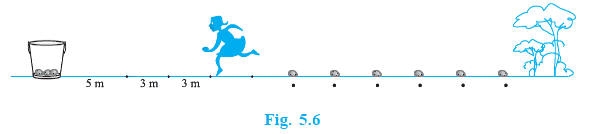
A competitor starts from the bucket, picks up the nearest potato, runs back with it, drops it in the bucket, runs back to pick up the next potato, runs to the bucket to drop it in, and she continues in the same way until all the potatoes are in the bucket. What is the total distance the competitor has to run? [Hint : To pick up the first potato and the second potato, the total distance (in metres) run by a competitor is $2 \times 5 + 2 \times (5 + 3)$]
In a potato race, a bucket is placed at the starting point, which is 5 m from the first potato, and the other potatoes are placed 3 m apart in a straight line. There are ten potatoes in the line (see Fig. 5.6).
A competitor starts from the bucket, picks up the nearest potato, runs back with it, drops it in the bucket, runs back to pick up the next potato, runs to the bucket to drop it in, and she continues in the same way until all the potatoes are in the bucket. What is the total distance the competitor has to run? [Hint : To pick up the first potato and the second potato, the total distance (in metres) run by a competitor is $2 \times 5 + 2 \times (5 + 3)$]
Solution :
Given:
- Distance of the first potato from the bucket = $5$ m.
- Distance between consecutive potatoes = $3$ m.
- Total number of potatoes ($n$) = $10$.
- The competitor must run from the bucket to the potato and back to the bucket for each potato.
To Find:
The total distance the competitor has to run to collect all $10$ potatoes.
Step 1: Determine the distance for each potato run.
The competitor runs to the potato and returns to the bucket. Thus, the distance for each potato is $2 \times (\text{distance from bucket to potato})$.
- Distance for 1st potato: $d_1 = 2 \times 5 = 10$ m.
- Distance for 2nd potato: $d_2 = 2 \times (5 + 3) = 2 \times 8 = 16$ m.
- Distance for 3rd potato: $d_3 = 2 \times (5 + 3 + 3) = 2 \times 11 = 22$ m.
Step 2: Identify the Arithmetic Progression (AP).
The sequence of distances is $10, 16, 22, \dots$
- First term ($a$) = $10$.
- Common difference ($d$) = $16 - 10 = 6$.
- Number of terms ($n$) = $10$.
Step 3: Apply the sum formula for an AP.
The sum of the first $n$ terms of an AP is given by the formula:
$S_n = \frac{n}{2} [2a + (n - 1)d]$
Step 4: Substitute the values into the formula.
$S_{10} = \frac{10}{2} [2(10) + (10 - 1)6]$
$S_{10} = 5 [20 + (9 \times 6)]$
$S_{10} = 5 [20 + 54]$
$S_{10} = 5 [74]$
$S_{10} = 370$
Justification:
Since the distance increases by a constant amount ($2 \times 3 = 6$ m) for each subsequent potato, the sequence of distances forms an arithmetic progression. The sum of these distances represents the total path covered by the competitor.
Final Answer: The total distance the competitor has to run is 370 metres.
More Questions from Class 10 Mathematics Arithmetic Progression EXERCISE 5.3
- Q1(i): Find the sum of the following APs: (i) 2, 7, 12, . . ., to 10 terms.
- Q1(ii): Find the sum of the following APs: (ii) –37, –33, –29, . . ., to 12 terms.
- Q1(iii): Find the sum of the following APs: (iii) 0.6, 1.7, 2.8, . . ., to 100 terms.
- Q1(iv): Find the sum of the following APs: (iv) $\frac{1}{15}, \frac{1}{12}, \frac{1}{10}$, . . ., to 11 terms.
- Q2(i): Find the sums given below : (i) $7 + 10\frac{1}{2} + 14 + . . . + 84$
- Q2(ii): Find the sums given below : (ii) 34 + 32 + 30 + . . . + 10
- Q2(iii): Find the sums given below : (iii) –5 + (–8) + (–11) + . . . + (–230)
- Q3(i): In an AP: (i) given $a = 5, d = 3, a_n = 50$, find $n$ and $S_n$.
- Q3(ii): In an AP: (ii) given $a = 7, a_{13} = 35$, find $d$ and $S_{13}$.
- Q3(iii): In an AP: (iii) given $a_{12} = 37, d = 3$, find $a$ and $S_{12}$.
- Q3(iv): In an AP: (iv) given $a_3 = 15, S_{10} = 125$, find $d$ and $a_{10}$.
- Q3(ix): In an AP: (ix) given $a = 3, n = 8, S = 192$, find $d$.
- Q3(v): In an AP: (v) given $d = 5, S_9 = 75$, find $a$ and $a_9$.
- Q3(vi): In an AP: (vi) given $a = 2, d = 8, S_n = 90$, find $n$ and $a_n$.
- Q3(vii): In an AP: (vii) given $a = 8, a_n = 62, S_n = 210$, find $n$ and $d$.
- Q3(viii): In an AP: (viii) given $a_n = 4, d = 2, S_n = –14$, find $n$ and $a$.
- Q3(x): In an AP: (x) given $l = 28, S = 144$, and there are total 9 terms. Find $a$.
- Q4: How many terms of the AP : 9, 17, 25, . . . must be taken to give a sum of 636?
- Q5: The first term of an AP is 5, the last term is 45 and the sum is 400. Find the number of terms and the common difference.
- Q6: The first and the last terms of an AP are 17 and 350 respectively. If the common difference is 9, how many terms are there and what is their sum?
- Q7: Find the sum of first 22 terms of an AP in which $d = 7$ and 22nd term is 149.
- Q8: Find the sum of first 51 terms of an AP whose second and third terms are 14 and 18 respectively.
- Q9: If the sum of first 7 terms of an AP is 49 and that of 17 terms is 289, find the sum of first $n$ terms.
- Q10(i): Show that $a_1, a_2, . . ., a_n, . . .$ form an AP where $a_n$ is defined as below : (i) $a_n = 3 + 4n$ Also find the sum of the first 15 terms in each case.
- Q10(ii): Show that $a_1, a_2, . . ., a_n, . . .$ form an AP where $a_n$ is defined as below : (ii) $a_n = 9 – 5n$ Also find the sum of the first 15 terms in each case.
- Q11: If the sum of the first $n$ terms of an AP is $4n – n^2$, what is the first term (that is $S_1$)? What is the sum of first two terms? What is the second term? Similarly, find the 3rd, the 10th and the $n$th terms.
- Q12: Find the sum of the first 40 positive integers divisible by 6.
- Q13: Find the sum of the first 15 multiples of 8.
- Q14: Find the sum of the odd numbers between 0 and 50.
- Q15: A contract on construction job specifies a penalty for delay of completion beyond a certain date as follows: ₹ 200 for the first day, ₹ 250 for the second day, ₹ 300 for the third day, etc., the penalty for each succeeding day being ₹ 50 more than for the preceding day. How much money the contractor has to pay as penalty, if he has delayed the work by 30 days?
- Q16: A sum of ₹ 700 is to be used to give seven cash prizes to students of a school for their overall academic performance. If each prize is ₹ 20 less than its preceding prize, find the value of each of the prizes.
- Q17: In a school, students thought of planting trees in and around the school to reduce air pollution. It was decided that the number of trees, that each section of each class will plant, will be the same as the class, in which they are studying, e.g., a section of Class I will plant 1 tree, a section of Class II will plant 2 trees and so on till Class XII. There are three sections of each class. How many trees will be planted by the students?
- Q18: A spiral is made up of successive semicircles, with centres alternately at A and B, starting with centre at A, of radii 0.5 cm, 1.0 cm, 1.5 cm, 2.0 cm, . . . as shown in Fig. 5.4. What is the total length of such a spiral made up of thirteen consecutive semicircles? (Take $\pi = \frac{22}{7}$) [Hint : Length of successive semicircles is $l_1, l_2, l_3, l_4, . . .$ with centres at A, B, A, B, . . ., respectively.]
- Q19: 200 logs are stacked in the following manner: 20 logs in the bottom row, 19 in the next row, 18 in the row next to it and so on (see Fig. 5.5). In how many rows are the 200 logs placed and how many logs are in the top row?
CBSE Solutions for Class 10 Mathematics Arithmetic Progression
Chapters in CBSE - Class 10 Mathematics
Top Tutors who teach Arithmetic Progression


 Top Tutor
 Mohali SAS Nagar, Chandigarh
 15 yrs of
Exp
 18 students
 397 hrs of classes completed
 500
per hour
 Online Classes
 Tutor's home
I have more than 15 years of experience in teaching maths and science for class 10 .. I also prepare students for various competition exams like olympiads, NDA etc
She teaches better than every teacher she does conceptual clarity and gives more homework for practice and she helps me to give occasional tests to improve my score
 Top Tutor
Thane West, Thane
16 yrs of
Exp
17 students
3991 hrs of classes completed
350
per hour
Online Classes
This is Debabrato Chatterjee, an Maths and Science tutor with more than fifteen years of experience. I have been and am teaching students of IB, IGCSE, CBSE, ICSE, and Maharastra State Boards. My teaching style is to learning from concepts and their application. Solving many papers and completing homework helps grasp the concepts. I teach students from grade VI to XII. Please let me know when you would like to schedule a demo.

 Super Tutor
Katira Maharaja Hata, Arrah
4 yrs of
Exp
26 students
1845 hrs of classes completed
700
per hour
Online Classes
Tutor's home
I've been teaching Class 10th students of schools from India and abroad. I primarily work with them to prepare for Olympiad, JEE foundation and school exams. I've been teaching students of class 8th-10th Science and Mathematics for more than 3 years. So far, I have taught more than 100 students from India and abroad. I teach international students Mathematics, Physics and Chemistry. I teach almost all boards of India such as CBSE, ICSE and state boards. I also teach IGCSE and IB students. I've my offline coaching institute where I am teaching students of CBSE and state boards who require help in Science and Mathematics. Fee displayed on my profile is for 1×1 classes. For group classes, the fee is substantially reduced.
Shivam is an outstanding math teacher .His expertise in the subject is exceptional, and he has a unique ability to make difficult concepts easy to understand. Shivam uses a variety of teaching techniques to keep lessons engaging and ensures that every student is actively involved. He is patient, approachable, and always ready to help with any questions or difficulties. His regular assessments and feedback have greatly helped improve grades. I highly recommend Shivam's math classes to anyone looking to excel in mathematics. His passion for teaching and dedication to his students' success are truly commendable.
 Top Tutor
Padmanabhanagar, Bangalore
3 yrs of
Exp
450
per hour
Online Classes
 Student's Home
Tutor's home
I am an experienced tutor with 4 years of experience in this field. I completed my BE in the year 2014. I have tutored students for Spoken English, BTech Tuition, C Language, C++ Language, CAD, CE and COMEDK Coaching. I can conduct classes at Student's Home, My place and Online via a different medium to students from International, CBSE, State, ICSE/ISC Board. I follow different techniques while teaching so, that my students are engaged positively. To make learning fun and easier, I use creative and innovative ideas.


 Top Tutor
Govindpuri Shiva Colony, Jaipur
10 yrs of
Exp
23 students
1480 hrs of classes completed
500
per hour
Online Classes
Tutor's home
I am a teacher of mathematics. I am giving online tuitions and tuitions at my home in Jaipur(Rajasthan). I have done M.Sc. , B.Ed. in mathematics. I have experience of 10 years of teaching mathematics , Vedic Mathematics and Olymiads.
I Shivani. N feel the class handled by Rohit Sir is a lively, interactive and also class room teaching experience with individual attention. I am looking forward to take weekly tests after which I will share my feed back on it. Thank you Sir.
Find more Tutor for Arithmetic Progression in your City
- Bangalore Mathematics Tutors
- Delhi Mathematics Tutors
- Chennai Mathematics Tutors
- Gurgaon Mathematics Tutors
- Noida Mathematics Tutors
- Hyderabad Mathematics Tutors
- Mumbai Mathematics Tutors
- Ghaziabad Mathematics Tutors
- Chandigarh Mathematics Tutors
- Pune Mathematics Tutors
- Jaipur Mathematics Tutors
- Surat Mathematics Tutors

Download free CBSE - Class 10 Mathematics Arithmetic Progression EXERCISE 5.3 worksheets
Download Now

