



Find the best tutors and institutes for Class 10 Tuition
Q19:
200 logs are stacked in the following manner: 20 logs in the bottom row, 19 in the next row, 18 in the row next to it and so on (see Fig. 5.5). In how many rows are the 200 logs placed and how many logs are in the top row?
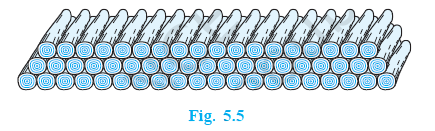
200 logs are stacked in the following manner: 20 logs in the bottom row, 19 in the next row, 18 in the row next to it and so on (see Fig. 5.5). In how many rows are the 200 logs placed and how many logs are in the top row?
Solution :
Given:
Total number of logs ($S_n$) = $200$
Number of logs in the bottom row ($a$) = $20$
Number of logs in the next row = $19$
Number of logs in the row after that = $18$
This forms an Arithmetic Progression (AP) where the common difference ($d$) = $19 - 20 = -1$.
To Find:
1. The number of rows ($n$).
2. The number of logs in the top row ($a_n$).
Step 1: Formulating the Equation
The sum of $n$ terms of an Arithmetic Progression is given by the formula:
$S_n = \frac{n}{2} [2a + (n - 1)d]$
Substituting the given values into the formula:
$200 = \frac{n}{2} [2(20) + (n - 1)(-1)]$
Step 2: Solving for $n$
$200 = \frac{n}{2} [40 - n + 1]$
$200 = \frac{n}{2} [41 - n]$
Multiply both sides by $2$ to eliminate the fraction:
$400 = n(41 - n)$
$400 = 41n - n^2$
Rearranging into a standard quadratic equation form ($ax^2 + bx + c = 0$):
$n^2 - 41n + 400 = 0$
Step 3: Factoring the Quadratic Equation
We need two numbers that multiply to $400$ and add to $-41$. These numbers are $-16$ and $-25$.
$n^2 - 16n - 25n + 400 = 0$
$n(n - 16) - 25(n - 16) = 0$
$(n - 16)(n - 25) = 0$
Therefore, $n = 16$ or $n = 25$.
Step 4: Determining the Valid Value of $n$
Let us check the number of logs in the $n^{th}$ row using the formula $a_n = a + (n - 1)d$.
If $n = 25$:
$a_{25} = 20 + (25 - 1)(-1) = 20 - 24 = -4$
[Since the number of logs cannot be negative, $n = 25$ is rejected.]
If $n = 16$:
$a_{16} = 20 + (16 - 1)(-1) = 20 - 15 = 5$
[This is a valid number of logs.]
Step 5: Final Calculation
The number of rows is $16$.
The number of logs in the top row ($a_{16}$) is $5$.
Final Answer: The 200 logs are placed in 16 rows, and there are 5 logs in the top row.
More Questions from Class 10 Mathematics Arithmetic Progression EXERCISE 5.3
- Q1(i): Find the sum of the following APs: (i) 2, 7, 12, . . ., to 10 terms.
- Q1(ii): Find the sum of the following APs: (ii) –37, –33, –29, . . ., to 12 terms.
- Q1(iii): Find the sum of the following APs: (iii) 0.6, 1.7, 2.8, . . ., to 100 terms.
- Q1(iv): Find the sum of the following APs: (iv) $\frac{1}{15}, \frac{1}{12}, \frac{1}{10}$, . . ., to 11 terms.
- Q2(i): Find the sums given below : (i) $7 + 10\frac{1}{2} + 14 + . . . + 84$
- Q2(ii): Find the sums given below : (ii) 34 + 32 + 30 + . . . + 10
- Q2(iii): Find the sums given below : (iii) –5 + (–8) + (–11) + . . . + (–230)
- Q3(i): In an AP: (i) given $a = 5, d = 3, a_n = 50$, find $n$ and $S_n$.
- Q3(ii): In an AP: (ii) given $a = 7, a_{13} = 35$, find $d$ and $S_{13}$.
- Q3(iii): In an AP: (iii) given $a_{12} = 37, d = 3$, find $a$ and $S_{12}$.
- Q3(iv): In an AP: (iv) given $a_3 = 15, S_{10} = 125$, find $d$ and $a_{10}$.
- Q3(ix): In an AP: (ix) given $a = 3, n = 8, S = 192$, find $d$.
- Q3(v): In an AP: (v) given $d = 5, S_9 = 75$, find $a$ and $a_9$.
- Q3(vi): In an AP: (vi) given $a = 2, d = 8, S_n = 90$, find $n$ and $a_n$.
- Q3(vii): In an AP: (vii) given $a = 8, a_n = 62, S_n = 210$, find $n$ and $d$.
- Q3(viii): In an AP: (viii) given $a_n = 4, d = 2, S_n = –14$, find $n$ and $a$.
- Q3(x): In an AP: (x) given $l = 28, S = 144$, and there are total 9 terms. Find $a$.
- Q4: How many terms of the AP : 9, 17, 25, . . . must be taken to give a sum of 636?
- Q5: The first term of an AP is 5, the last term is 45 and the sum is 400. Find the number of terms and the common difference.
- Q6: The first and the last terms of an AP are 17 and 350 respectively. If the common difference is 9, how many terms are there and what is their sum?
- Q7: Find the sum of first 22 terms of an AP in which $d = 7$ and 22nd term is 149.
- Q8: Find the sum of first 51 terms of an AP whose second and third terms are 14 and 18 respectively.
- Q9: If the sum of first 7 terms of an AP is 49 and that of 17 terms is 289, find the sum of first $n$ terms.
- Q10(i): Show that $a_1, a_2, . . ., a_n, . . .$ form an AP where $a_n$ is defined as below : (i) $a_n = 3 + 4n$ Also find the sum of the first 15 terms in each case.
- Q10(ii): Show that $a_1, a_2, . . ., a_n, . . .$ form an AP where $a_n$ is defined as below : (ii) $a_n = 9 – 5n$ Also find the sum of the first 15 terms in each case.
- Q11: If the sum of the first $n$ terms of an AP is $4n – n^2$, what is the first term (that is $S_1$)? What is the sum of first two terms? What is the second term? Similarly, find the 3rd, the 10th and the $n$th terms.
- Q12: Find the sum of the first 40 positive integers divisible by 6.
- Q13: Find the sum of the first 15 multiples of 8.
- Q14: Find the sum of the odd numbers between 0 and 50.
- Q15: A contract on construction job specifies a penalty for delay of completion beyond a certain date as follows: ₹ 200 for the first day, ₹ 250 for the second day, ₹ 300 for the third day, etc., the penalty for each succeeding day being ₹ 50 more than for the preceding day. How much money the contractor has to pay as penalty, if he has delayed the work by 30 days?
- Q16: A sum of ₹ 700 is to be used to give seven cash prizes to students of a school for their overall academic performance. If each prize is ₹ 20 less than its preceding prize, find the value of each of the prizes.
- Q17: In a school, students thought of planting trees in and around the school to reduce air pollution. It was decided that the number of trees, that each section of each class will plant, will be the same as the class, in which they are studying, e.g., a section of Class I will plant 1 tree, a section of Class II will plant 2 trees and so on till Class XII. There are three sections of each class. How many trees will be planted by the students?
- Q18: A spiral is made up of successive semicircles, with centres alternately at A and B, starting with centre at A, of radii 0.5 cm, 1.0 cm, 1.5 cm, 2.0 cm, . . . as shown in Fig. 5.4. What is the total length of such a spiral made up of thirteen consecutive semicircles? (Take $\pi = \frac{22}{7}$) [Hint : Length of successive semicircles is $l_1, l_2, l_3, l_4, . . .$ with centres at A, B, A, B, . . ., respectively.]
- Q20: In a potato race, a bucket is placed at the starting point, which is 5 m from the first potato, and the other potatoes are placed 3 m apart in a straight line. There are ten potatoes in the line (see Fig. 5.6). A competitor starts from the bucket, picks up the nearest potato, runs back with it, drops it in the bucket, runs back to pick up the next potato, runs to the bucket to drop it in, and she continues in the same way until all the potatoes are in the bucket. What is the total distance the competitor has to run? [Hint : To pick up the first potato and the second potato, the total distance (in metres) run by a competitor is $2 \times 5 + 2 \times (5 + 3)$]
CBSE Solutions for Class 10 Mathematics Arithmetic Progression
Chapters in CBSE - Class 10 Mathematics
Top Tutors who teach Arithmetic Progression


 Top Tutor
 Mohali SAS Nagar, Chandigarh
 15 yrs of
Exp
 18 students
 1139 hrs of classes completed
 500
per hour
 Online Classes
 Tutor's home
I have more than 15 years of experience in teaching maths and science for class 10 .. I also prepare students for various competition exams like olympiads, NDA etc
She teaches better than every teacher she does conceptual clarity and gives more homework for practice and she helps me to give occasional tests to improve my score

 Super Tutor
Katira Maharaja Hata, Arrah
4 yrs of
Exp
27 students
5853 hrs of classes completed
700
per hour
Online Classes
Tutor's home
I've been teaching Class 10th students of schools from India and abroad. I primarily work with them to prepare for Olympiad, JEE foundation and school exams. I've been teaching students of class 8th-10th Science and Mathematics for more than 3 years. So far, I have taught more than 100 students from India and abroad. I teach international students Mathematics, Physics and Chemistry. I teach almost all boards of India such as CBSE, ICSE and state boards. I also teach IGCSE and IB students. I've my offline coaching institute where I am teaching students of CBSE and state boards who require help in Science and Mathematics. Fee displayed on my profile is for 1×1 classes. For group classes, the fee is substantially reduced.
Shivam is an outstanding math teacher .His expertise in the subject is exceptional, and he has a unique ability to make difficult concepts easy to understand. Shivam uses a variety of teaching techniques to keep lessons engaging and ensures that every student is actively involved. He is patient, approachable, and always ready to help with any questions or difficulties. His regular assessments and feedback have greatly helped improve grades. I highly recommend Shivam's math classes to anyone looking to excel in mathematics. His passion for teaching and dedication to his students' success are truly commendable.
 Top Tutor
Nehru Nagar, Belgaum
2 yrs of
Exp
9 students
301 hrs of classes completed
260
per hour
Online Classes
I teach Mathematics to students from Class 7 to Class 10, with 3 years of teaching experience. My focus is on helping students build strong conceptual understanding and develop effective problem-solving skills to excel academically. I have completed my 2nd PUC (Pre-University Course), a Bachelor of Engineering (B.E.) from Visveswaraya Technological University in 2020, and a Bachelor of Education (B.Ed.) from Indira Gandhi National Open University in 2022. I have also completed a program with Cambridge Learning Resources, which has enhanced my teaching techniques and ability to engage students effectively. Over the years, I have guided students to improve their Mathematics understanding and performance, helping them gain confidence in handling both basic and complex problems. My teaching approach emphasizes clarity, practice, and logical reasoning to ensure steady improvement. I have also earned an RPA (Robotic Process Automation) certification in robotics, which reflects my technical skills and commitment to continuous learning. I often incorporate logical thinking and problem-solving strategies inspired by this training into my lessons. I prefer to conduct online classes, offering flexibility in timing and easy access for students. I teach both individual and small group sessions, allowing personalized attention and interactive learning experiences for every student. My classes are interactive, using motivational videos, personal digital pads, and other digital tools to make learning engaging and effective. These resources help students visualize concepts better and retain knowledge more efficiently. I provide custom-prepared notes to support student learning and revision. My ultimate goal is to make Mathematics understandable, enjoyable, and confidence-building, enabling every student to perform at their best and develop a strong foundation for future studies.
This guy is too good at his teaching. He explains the concepts very clear, gets to know about the students, gives his own ideas, own methods, and also gives good advices. He is excellent to consider. I just like him!, he is a great tutor and price is reasonably good.
 Top Tutor
Mathura Road, Delhi
20 yrs of
Exp
14 students
1740 hrs of classes completed
1000
per hour
Online Classes
Tutor's home
For me, teaching is part of learning. As I am teaching I am also learning from my learners as they are diverse. Each learner in the classroom brings his or her unique background and ability. These are the elements that I invest in my teaching. Moreover, I allow learners to be themselves. This is a way of creating a conducive environment for learning.
Its been a really nice teaching experience with Mr.Amit so far. He is very knowledgeable and a patient teacher. He always clarifies the concepts clearly and ensures good understanding.
 Top Tutor
Periyakollappatty, Salem
10 yrs of
Exp
4 students
135 hrs of classes completed
Online Classes
Help students to elevate their marks and knowledge at the same time for past 10 years in teaching
Wonderful class Rajesh sir always clear the doubt without hesitation and help with homework thank you sir.
Find more Tutor for Arithmetic Progression in your City
- Bangalore Mathematics Tutors
- Delhi Mathematics Tutors
- Chennai Mathematics Tutors
- Gurgaon Mathematics Tutors
- Noida Mathematics Tutors
- Hyderabad Mathematics Tutors
- Mumbai Mathematics Tutors
- Chandigarh Mathematics Tutors
- Jaipur Mathematics Tutors
- Pune Mathematics Tutors
- Ghaziabad Mathematics Tutors
- Surat Mathematics Tutors

Download free CBSE - Class 10 Mathematics Arithmetic Progression EXERCISE 5.3 worksheets
Download Now

