A photon of wavelength 4.0 x m strikes on metal surface, the work function of the metal being 2.13 eV. Calculate: i. The energy of the photon (eV). ii. The kinetic energy of the emission. Iii. The velocity of the photoelectron.

Asked by Last Modified  

21 Answers

Learn Physics +1

Follow 20
Answer

Please enter your answer

Great Place To Be Learn

Comments

Tutor

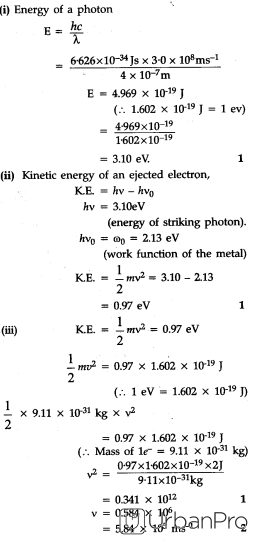
1. 4.97 ×10⁻¹⁹ / 1.602 ×10⁻¹⁹ eV 2. 0.97eV 3. 5084×105 ms-1
Comments

Tutor

I) E = hv/wavelength =(6.626*10^-34)(3*10^8)/4*10^-7 = 4.9695*10^-19J ii)K.E=4.9695*10^-19/1.60*10^-19 =3.105eV
Comments

(i) apply planck's energy equation, E = hc/λ (ii) K.E = E - (work function) (iii) 1/2 m= K.E do calculation yourself to understand,
read more
(i) apply planck's energy equation, E = hc/λ (ii) K.E = E -(work function) (iii) 1/2 m= K.E do calculation yourself to understand, read less
Comments

Tutor

(1) Energy of the photon (E) = hν = hc/λ = (6.626×10-34 Js×3.0×108 ms-1)/4×10-7 m = 4.97×10⁻¹⁹ J= 4.97×10⁻¹⁹/1.602×10-19 eV (2) Kinetic energy of emission (1/2 mv2) = hν- hνo = 3.10-2.13 = 0.97 eV (3) 1/2 mv2 = 0.97 eV = 0.97×1.602×10-19...
read more
(1) Energy of the photon (E) = hν = hc/λ = (6.626×10-34Js×3.0×108ms-1)/4×10-7m = 4.97×10⁻¹⁹J= 4.97×10⁻¹⁹/1.602×10-19eV (2) Kinetic energy of emission (1/2 mv2) = hν- hνo= 3.10-2.13 = 0.97 eV (3) 1/2 mv2= 0.97 eV = 0.97×1.602×10-19J⇒ 1/2×(9.11×10-31 kg)×v2=0.97×1.602×10-19J⇒ v2=0.341×1012= 34.1×10¹⁰⇒ v = 5.84×10⁵ms-1 read less
Comments

First of all we have to find the enenry(E) of Photon by using the Formula E=hc/λ here 'h' is the Plank's constant. 'c' is the Speed of light and λ is the wavelength Now we have to think what is the term "WORK FUNCTION" used in the Question WORK FUNCTION is the MINIMUM amount of...
read more
First of all we have to find the enenry(E) of Photon by using the Formula E=hc/λ here 'h' is the Plank's constant. 'c' is the Speed of light andλ is the wavelength Now we have to think what is the term "WORK FUNCTION" used in the Question WORK FUNCTION is the MINIMUM amount of energy required to release a ELECTRON from the Metal It is given in the Question Now we are able to give the answer of the 2nd part of the Question i.e Kinetic energy of emission== Total energy of photon- Energy required for emission(work function) Now the question is WHAT IS THE VELOCITY OF PHOTOELECTRON?? From 2nd part of Question We know the Kinetic Energy of Photoelectron. Use the formula, K.E=½*mass*(velocity)² for the value of "mass of electron" , "plank's constant" and "velocity of light "use your book. THANK YOU read less
Comments

Excellence Award Winner ( 7 times )

Comments

Maths Expert

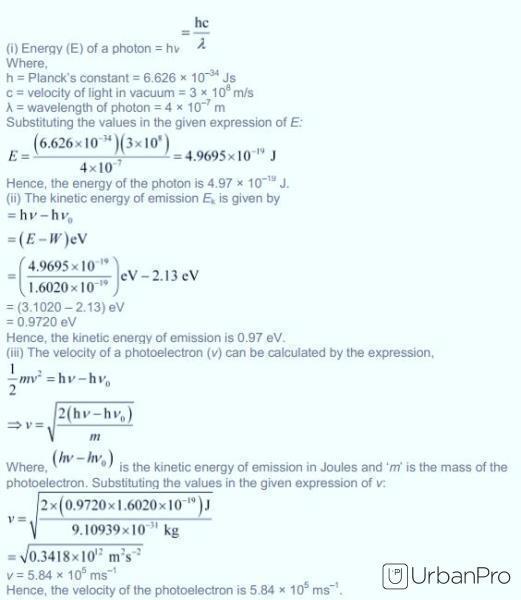
(1)We know λ = 4 × 10⁻⁷ m(given) C = 3 x 10⁸ From the equation E= hv or hc/ λ Where, h = Planck’s constant = 6.626 × 10⁻³⁴ Js c = velocity of light in vacuum = 3 × 10⁸ m/s λ = wavelength of photon = 4 × 10⁻⁷ m Substituting the...
read more
(1)We know λ = 4 × 10⁻⁷m(given) C = 3 x 10⁸ From the equation E= hv or hc/ λ Where, h = Planck’s constant = 6.626 × 10⁻³⁴Js c = velocity of light in vacuum = 3 × 10⁸m/s λ = wavelength of photon = 4 × 10⁻⁷m Substituting the values in the given expression of E: Hence, the energy of the photon is 4.97 × 10⁻¹⁹J. (ii) The kinetic energy of emission Ek is given by = (3.1020 – 2.13) eV = 0.9720 eV Hence, the kinetic energy of emission is 0.97 eV. (iii) The velocity of a photoelectron (ν) can be calculated by the expression, Where, (hv-hv0) is the kinetic energy of emission in Joules and ‘m’ is the mass of the photoelectron. Substituting the values in the given expression of v: v= 5.84 × 10⁵ms–1 Hence, the velocity of the photoelectron is 5.84 × 10⁵ms–1. read less
Comments

Mathematics and science Home Tutor

Energy of photon= hc/λ h=plank constant = 6.63* c=speed of light=3* h*c= 1240 eV λ= wavelength of light E= / joule E=3.102 eV 2.)Kinetic energy of emission= energy of photon- work function =3.102-2.13 eV ...
read more
Energy of photon= hc/λ h=plank constant = 6.63* c=speed of light=3* h*c= 1240 eV λ= wavelength of light E= /joule E=3.102eV 2.)Kinetic energy of emission= energy of photon- work function =3.102-2.13 eV = 0.972 eV 3.)Velocity of free Electrons kinetic energy of electron = 1/2*m*= 0.972 eV v= =5.84m/s read less
Comments

Tutor

E=hc/wavelength=3.10ev K.E. of photoelectron = (KE of incident photon) - (Work Function of Metal)=3.10-2.13=0.87ev Velocity of photoelctron={2*k.E/m}^{0.5}=30um/sec
Comments

View 19 more Answers

Related Questions

What is the best way to master physics?
The best way to master Physics is firstly to understand concepts at a deeper level. Then find out its applications, especially observing the things related to day to day life. For example, when you place...
Aparna
0 0
5

What is modern quantum mechanics 

Modern quantum mechanics is a fundamental branch of physics that provides a comprehensive framework for understanding the behavior of matter and energy at the atomic and subatomic level. It is a theoretical...
Hyperbola

How many physical dimensions do we have?

In everyday life, we inhabit a space of three dimensions. but Generally, there are 4 dimensions (x,y,z:t) 3 axis and 4th is time. Mathematically there is N dimensions.
Souradeep

What is the difference between position vector and displacement vector?

Change in position vector is displacement.
Rahul Srivastava

Now ask question in any of the 1000+ Categories, and get Answers from Tutors and Trainers on UrbanPro.com

Ask a Question

Related Lessons

Vectors
Law of the addition of vectors (1) Parallelogram law of addition of vectors: It states that if two vectors are represented in direction and magnitude by two sides of a parallelogram, then their resultant...

Can there be a physical quantity that has no units and dimensions?
Yes,. Strain is a physical quantity that has no units and dimensions
C

Chandra Mohan Yadavalli

0 0
0


why 200 volt AC is more dangerous than 220 volt DC???
current or voltage we measure for AC are alaways rms(root mean square) value not the actual magnitude so 220 volt ac(rms)= 220*sqrt(2)=311 volt but 220 volt DC alaways gives the magnitude...

Law of Motion physics class 9 by sunil Sir
Law of motion Sir Isaac Newton was one of the greatest scientists and mathematicians that ever lived. He was born in England on December 25, 1643. He was born the same year that Galileo...

Recommended Articles

With the current trend of the world going digital, electronic renaissance is a new movement that is welcomed by the new generation as it helps makes the lives of millions of people easier and convenient. Along with this rapidly changing movement and gaining popularity of Internet, e-Learning is a new tool that emerging...

Read full article >

Appearing for exams could be stressful for students. Even though they might have prepared well, they could suffer from anxiety, tension etc. These are not good for their health and mind. However, following a few exam preparation tips can save them from all these and help them to score good marks. Let’s find out all...

Read full article >

Quality education does not only help children to get a successful career and life, but it also hugely contributes to society. The formal education of every child starts from school. Although there are numerous schools, parents find it challenging to choose the right one that would fit their child. It is difficult for them...

Read full article >

Learning for every child starts from a very young age. While the formal methods include school curriculums and private lessons, the informal methods include dancing, music, drawing, and various fun-filling activities. Playing games and practising these types of activities helps the children get out of boredom and...

Read full article >

Looking for Class 11 Tuition ?

Learn from the Best Tutors on UrbanPro

Are you a Tutor or Training Institute?

Join UrbanPro Today to find students near you