



Find the best tutors and institutes for Class 12 Tuition
Q3.21:
The following data were obtained during the first order thermal decomposition of (SO_{2}Cl_{2}) at a constant volume. ((SO_{2}Cl_{2}(g) \rightarrow SO_{2}(g) + Cl_{2}(g)))
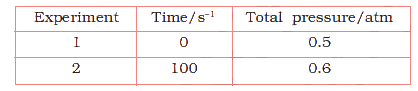
Calculate the rate of the reaction when total pressure is 0.65 atm.
The following data were obtained during the first order thermal decomposition of (SO_{2}Cl_{2}) at a constant volume. ((SO_{2}Cl_{2}(g) \rightarrow SO_{2}(g) + Cl_{2}(g)))
Calculate the rate of the reaction when total pressure is 0.65 atm.
Solution :
Step 1: Establishing the Stoichiometric Table
The thermal decomposition reaction is: $SO_2Cl_2(g) \rightarrow SO_2(g) + Cl_2(g)$
Let $P_0$ be the initial pressure of $SO_2Cl_2$ at $t = 0$. At time $t$, let $x$ be the decrease in pressure of the reactant.
| Time ($s$) | $SO_2Cl_2(g)$ | $SO_2(g)$ | $Cl_2(g)$ | Total Pressure ($P_t$) |
|---|---|---|---|---|
| $t=0$ | $P_0$ | $0$ | $0$ | $P_0$ |
| $t=t$ | $P_0 - x$ | $x$ | $x$ | $P_0 + x$ |
From the table, at any time $t$, $x = P_t - P_0$. The partial pressure of the reactant is $P_{SO_2Cl_2} = P_0 - x = P_0 - (P_t - P_0) = 2P_0 - P_t$.
Step 2: Determining the Rate Constant ($k$)
For a first-order reaction, $k = \frac{2.303}{t} \log\left(\frac{P_0}{P_{SO_2Cl_2}}\right) = \frac{2.303}{t} \log\left(\frac{P_0}{2P_0 - P_t}\right)$.
Given: $P_0 = 0.5$ atm. At $t = 100$ s, $P_t = 0.6$ atm.
$k = \frac{2.303}{100} \log\left(\frac{0.5}{2(0.5) - 0.6}\right) = \frac{2.303}{100} \log\left(\frac{0.5}{0.4}\right)$ $k = \frac{2.303}{100} \times \log(1.25) \approx \frac{2.303 \times 0.0969}{100} = 2.23 \times 10^{-3} \, s^{-1}$.Step 3: Calculating Partial Pressure at $P_t = 0.65$ atm
We need the rate when $P_t = 0.65$ atm. First, find the partial pressure of $SO_2Cl_2$ at this state:
$P_{SO_2Cl_2} = 2P_0 - P_t = 2(0.5) - 0.65 = 1.0 - 0.65 = 0.35$ atm.Step 4: Calculating the Rate of Reaction
Per the first-order rate law: $\text{Rate} = k \cdot P_{SO_2Cl_2}$
Substituting the values derived:
$\text{Rate} = (2.23 \times 10^{-3} \, s^{-1}) \times (0.35 \, atm)$ $\text{Rate} = 7.805 \times 10^{-4} \, atm \cdot s^{-1}$Final Solution: The rate of reaction when the total pressure is 0.65 atm is $7.81 \times 10^{-4} \, atm \cdot s^{-1}$.
More Questions from Class 12 Chemistry Chemical Kinetics Exercises
- Q3.1 (i): From the rate expression for the following reactions, determine their order of reaction and the dimensions of the rate constants. (i) (3NO(g) \rightarrow N_{2}O (g)) Rate = (k[NO]^{2})
- Q3.1 (ii): From the rate expression for the following reactions, determine their order of reaction and the dimensions of the rate constants. (ii) (H_{2}O_{2} (aq) + 3I^{-} (aq) + 2H^{+} \rightarrow 2H_{2}O (l) + I_{3}^{-}) Rate = (k[H_{2}O_{2}][I^{-}])
- Q3.1 (iii): From the rate expression for the following reactions, determine their order of reaction and the dimensions of the rate constants. (iii) (CH_{3}CHO (g) \rightarrow CH_{4} (g) + CO(g)) Rate = (k [CH_{3}CHO]^{3/2})
- Q3.1 (iv): From the rate expression for the following reactions, determine their order of reaction and the dimensions of the rate constants. (iv) (C_{2}H_{5}Cl (g) \rightarrow C_{2}H_{4} (g) + HCl (g)) Rate = (k [C_{2}H_{5}Cl])
- Q3.1(i): From the rate expression for the following reactions, determine their order of reaction and the dimensions of the rate constants. (i) \(3NO(g) \rightarrow N_{2}O (g)\) Rate = \(k[NO]^{2}\)
- Q3.1(ii): From the rate expression for the following reactions, determine their order of reaction and the dimensions of the rate constants. (ii) \(H_{2}O_{2} (aq) + 3I^{-} (aq) + 2H^{+} \rightarrow 2H_{2}O (l) + I_{3}^{-}\) Rate = \(k[H_{2}O_{2}][I^{-}]\)
- Q3.1(iii): From the rate expression for the following reactions, determine their order of reaction and the dimensions of the rate constants. (iii) \(CH_{3}CHO (g) \rightarrow CH_{4} (g) + CO(g)\) Rate = \(k [CH_{3}CHO]^{\frac{3}{2}}\)
- Q3.1(iv): From the rate expression for the following reactions, determine their order of reaction and the dimensions of the rate constants. (iv) \(C_{2}H_{5}Cl (g) \rightarrow C_{2}H_{4} (g) + HCl (g)\) Rate = \(k [C_{2}H_{5}Cl]\)
- Q3.10: In a reaction between (A) and (B), the initial rate of reaction ((r_{0})) was measured for different initial concentrations of (A) and (B) as given below: What is the order of the reaction with respect to (A) and (B)?
- Q3.10: In a reaction between \(A\) and \(B\), the initial rate of reaction (\(r_{0}\)) was measured for different initial concentrations of \(A\) and \(B\) as given below: What is the order of the reaction with respect to \(A\) and \(B\)?
- Q3.11: The following results have been obtained during the kinetic studies of the reaction: (2A + B \rightarrow C + D) Determine the rate law and the rate constant for the reaction.
- Q3.11: The following results have been obtained during the kinetic studies of the reaction: \(2A + B \rightarrow C + D\) Determine the rate law and the rate constant for the reaction.
- Q3.12: The reaction between (A) and (B) is first order with respect to (A) and zero order with respect to (B). Fill in the blanks in the following table:
- Q3.12: The reaction between \(A\) and \(B\) is first order with respect to \(A\) and zero order with respect to \(B\). Fill in the blanks in the following table:
- Q3.13 (i): Calculate the half-life of a first order reaction from their rate constants given below: (i) (200 s^{-1})
- Q3.13 (ii): Calculate the half-life of a first order reaction from their rate constants given below: (ii) (2 min^{-1})
- Q3.13 (iii): Calculate the half-life of a first order reaction from their rate constants given below: (iii) (4 years^{-1})
- Q3.13(i): Calculate the half-life of a first order reaction from their rate constants given below: (i) \(200 s^{-1}\)
- Q3.13(ii): Calculate the half-life of a first order reaction from their rate constants given below: (ii) \(2 min^{-1}\)
- Q3.13(iii): Calculate the half-life of a first order reaction from their rate constants given below: (iii) \(4 years^{-1}\)
- Q3.14: The half-life for radioactive decay of (^{14}C) is 5730 years. An archaeological artifact containing wood had only 80% of the (^{14}C) found in a living tree. Estimate the age of the sample.
- Q3.14: The half-life for radioactive decay of \(^{14}C\) is 5730 years. An archaeological artifact containing wood had only 80% of the \(^{14}C\) found in a living tree. Estimate the age of the sample.
- Q3.15 (i): The experimental data for decomposition of (N_{2}O_{5}) [(2N_{2}O_{5} \rightarrow 4NO_{2} + O_{2})] in gas phase at 318K are given below: t/s 0 400 800 1200 1600 2000 2400 2800 3200 (10^{2} \times [N_{2}O_{5}])/(mol L^{-1}) 1.63 1.36 1.14 0.93 0.78 0.64 0.53 0.43 0.35 (i) Plot ([N_{2}O_{5}]) against (t).
- Q3.15 (ii): The experimental data for decomposition of (N_{2}O_{5}) [(2N_{2}O_{5} \rightarrow 4NO_{2} + O_{2})] in gas phase at 318K are given below: (ii) Find the half-life period for the reaction.
- Q3.15 (iii): The experimental data for decomposition of (N_{2}O_{5}) [(2N_{2}O_{5} \rightarrow 4NO_{2} + O_{2})] in gas phase at 318K are given below: (iii) Draw a graph between (\log[N_{2}O_{5}]) and (t).
- Q3.15 (iv): The experimental data for decomposition of (N_{2}O_{5}) [(2N_{2}O_{5} \rightarrow 4NO_{2} + O_{2})] in gas phase at 318K are given below: (iv) What is the rate law ?
- Q3.15 (v): The experimental data for decomposition of (N_{2}O_{5}) [(2N_{2}O_{5} \rightarrow 4NO_{2} + O_{2})] in gas phase at 318K are given below: (v) Calculate the rate constant.
- Q3.15 (vi): The experimental data for decomposition of (N_{2}O_{5}) [(2N_{2}O_{5} \rightarrow 4NO_{2} + O_{2})] in gas phase at 318K are given below: (vi) Calculate the half-life period from (k) and compare it with (ii).
- Q3.15(i): The experimental data for decomposition of \(N_{2}O_{5}\) [\(2N_{2}O_{5} \rightarrow 4NO_{2} + O_{2}\)] in gas phase at 318K are given below: (i) Plot \([N_{2}O_{5}]\) against \(t\).
- Q3.15(ii): The experimental data for decomposition of \(N_{2}O_{5}\) [\(2N_{2}O_{5} \rightarrow 4NO_{2} + O_{2}\)] in gas phase at 318K are given below: (ii) Find the half-life period for the reaction.
- Q3.15(iii): The experimental data for decomposition of \(N_{2}O_{5}\) [\(2N_{2}O_{5} \rightarrow 4NO_{2} + O_{2}\)] in gas phase at 318K are given below: (iii) Draw a graph between \(log[N_{2}O_{5}]\) and \(t\).
- Q3.15(iv): The experimental data for decomposition of \(N_{2}O_{5}\) [\(2N_{2}O_{5} \rightarrow 4NO_{2} + O_{2}\)] in gas phase at 318K are given below: (iv) What is the rate law ?
- Q3.15(v): The experimental data for decomposition of \(N_{2}O_{5}\) [\(2N_{2}O_{5} \rightarrow 4NO_{2} + O_{2}\)] in gas phase at 318K are given below: (v) Calculate the rate constant.
- Q3.15(vi): The experimental data for decomposition of \(N_{2}O_{5}\) [\(2N_{2}O_{5} \rightarrow 4NO_{2} + O_{2}\)] in gas phase at 318K are given below: (vi) Calculate the half-life period from \(k\) and compare it with (ii).
- Q3.16: The rate constant for a first order reaction is \(60 s^{-1}\). How much time will it take to reduce the initial concentration of the reactant to its \(\frac{1}{16}\)th value?
- Q3.16: The rate constant for a first order reaction is (60 s^{-1}). How much time will it take to reduce the initial concentration of the reactant to its (\frac{1}{16}^{th}) value?
- Q3.17: During nuclear explosion, one of the products is \(^{90}Sr\) with half-life of 28.1 years. If \(1 \mu g\) of \(^{90}Sr\) was absorbed in the bones of a newly born baby instead of calcium, how much of it will remain after 10 years and 60 years if it is not lost metabolically.
- Q3.17: During nuclear explosion, one of the products is (^{90}Sr) with half-life of 28.1 years. If (1\mu g) of (^{90}Sr) was absorbed in the bones of a newly born baby instead of calcium, how much of it will remain after 10 years and 60 years if it is not lost metabolically.
- Q3.18: For a first order reaction, show that time required for 99% completion is twice the time required for the completion of 90% of reaction.
- Q3.18: For a first order reaction, show that time required for 99% completion is twice the time required for the completion of 90% of reaction.
- Q3.19: A first order reaction takes 40 min for 30% decomposition. Calculate \(t_{1/2}\).
- Q3.19: A first order reaction takes 40 min for 30% decomposition. Calculate (t_{1/2}).
- Q3.2: For the reaction: (2A + B \rightarrow A_{2}B) the rate = (k[A][B]^{2}) with (k = 2.0 \times 10^{-6} mol^{-2} L^{2} s^{-1}). Calculate the initial rate of the reaction when ([A] = 0.1 mol L^{-1}), ([B] = 0.2 mol L^{-1}). Calculate the rate of reaction after ([A]) is reduced to (0.06 mol L^{-1}).
- Q3.2: For the reaction: \(2A + B \rightarrow A_{2}B\) the rate = \(k[A][B]^{2}\) with \(k = 2.0 \times 10^{-6} mol^{-2} L^{2} s^{-1}\). Calculate the initial rate of the reaction when \([A] = 0.1 \text{ mol } L^{-1}\), \([B] = 0.2 \text{ mol } L^{-1}\). Calculate the rate of reaction after \([A]\) is reduced to \(0.06 \text{ mol } L^{-1}\).
- Q3.20: For the decomposition of azoisopropane to hexane and nitrogen at 543 K, the following data are obtained. Calculate the rate constant.
- Q3.20: For the decomposition of azoisopropane to hexane and nitrogen at 543 K, the following data are obtained. Calculate the rate constant.
- Q3.21: The following data were obtained during the first order thermal decomposition of \(SO_{2}Cl_{2}\) at a constant volume. \(SO_{2}Cl_{2}(g) \rightarrow SO_{2}(g) + Cl_{2}(g)\) Calculate the rate of the reaction when total pressure is 0.65 atm.
- Q3.22: The rate constant for the decomposition of \(N_{2}O_{5}\) at various temperatures is given below: Draw a graph between \(ln k\) and \(1/T\) and calculate the values of \(A\) and \(E_{a}\). Predict the rate constant at 30° and 50°C.
- Q3.22: The rate constant for the decomposition of (N_{2}O_{5}) at various temperatures is given below: Draw a graph between (\ln k) and (1/T) and calculate the values of (A) and (E_{a}). Predict the rate constant at 30° and 50°C.
- Q3.23: The rate constant for the decomposition of hydrocarbons is (2.418 \times 10^{-5}s^{-1}) at 546 K. If the energy of activation is 179.9 kJ/mol, what will be the value of pre-exponential factor.
- Q3.23: The rate constant for the decomposition of hydrocarbons is \(2.418 \times 10^{-5}s^{-1}\) at 546 K. If the energy of activation is 179.9 kJ/mol, what will be the value of pre-exponential factor.
- Q3.24: Consider a certain reaction (A \rightarrow Products) with (k = 2.0 \times 10^{-2}s^{-1}). Calculate the concentration of (A) remaining after 100 s if the initial concentration of (A) is (1.0 mol L^{-1}).
- Q3.24: Consider a certain reaction \(A \rightarrow Products\) with \(k = 2.0 \times 10^{-2}s^{-1}\). Calculate the concentration of \(A\) remaining after 100 s if the initial concentration of \(A\) is \(1.0 mol L^{-1}\).
- Q3.25: Sucrose decomposes in acid solution into glucose and fructose according to the first order rate law, with \(t_{1/2} = 3.00\) hours. What fraction of sample of sucrose remains after 8 hours ?
- Q3.25: Sucrose decomposes in acid solution into glucose and fructose according to the first order rate law, with (t_{1/2} = 3.00) hours. What fraction of sample of sucrose remains after 8 hours ?
- Q3.26: The decomposition of hydrocarbon follows the equation \(k = (4.5 \times 10^{11}s^{-1}) e^{-28000K/T}\) Calculate \(E_{a}\).
- Q3.26: The decomposition of hydrocarbon follows the equation (k = (4.5 \times 10^{11}s^{-1}) e^{-28000K/T}) Calculate (E_{a}).
- Q3.27: The rate constant for the first order decomposition of \(H_{2}O_{2}\) is given by the following equation: \(log k = 14.34 – \frac{1.25 \times 10^{4}K}{T}\) Calculate \(E_{a}\) for this reaction and at what temperature will its half-period be 256 minutes?
- Q3.27: The rate constant for the first order decomposition of (H_{2}O_{2}) is given by the following equation: (\log k = 14.34 – 1.25 \times 10^{4}K/T) Calculate (E_{a}) for this reaction and at what temperature will its half-period be 256 minutes?
- Q3.28: The decomposition of (A) into product has value of (k) as (4.5 \times 10^{3} s^{-1}) at 10°C and energy of activation (60 kJ mol^{-1}). At what temperature would (k) be (1.5 \times 10^{4}s^{-1})?
- Q3.28: The decomposition of \(A\) into product has value of \(k\) as \(4.5 \times 10^{3} s^{-1}\) at 10°C and energy of activation \(60 kJ mol^{-1}\). At what temperature would \(k\) be \(1.5 \times 10^{4}s^{-1}\)?
- Q3.29: The time required for 10% completion of a first order reaction at 298K is equal to that required for its 25% completion at 308K. If the value of \(A\) is \(4 \times 10^{10}s^{-1}\). Calculate \(k\) at 318K and \(E_{a}\).
- Q3.29: The time required for 10% completion of a first order reaction at 298K is equal to that required for its 25% completion at 308K. If the value of (A) is (4 \times 10^{10}s^{-1}). Calculate (k) at 318K and (E_{a}).
- Q3.3: The decomposition of \(NH_{3}\) on platinum surface is zero order reaction. What are the rates of production of \(N_{2}\) and \(H_{2}\) if \(k = 2.5 \times 10^{-4} mol^{-1} L s^{-1}\)?
- Q3.3: The decomposition of (NH_{3}) on platinum surface is zero order reaction. What are the rates of production of (N_{2}) and (H_{2}) if (k = 2.5 \times 10^{-4} mol^{-1} L s^{-1})?
- Q3.30: The rate of a reaction quadruples when the temperature changes from 293 K to 313 K. Calculate the energy of activation of the reaction assuming that it does not change with temperature.
- Q3.30: The rate of a reaction quadruples when the temperature changes from 293 K to 313 K. Calculate the energy of activation of the reaction assuming that it does not change with temperature.
- Q3.4: The decomposition of dimethyl ether leads to the formation of (CH_{4}), (H_{2}) and (CO) and the reaction rate is given by Rate = (k [CH_{3}OCH_{3}]^{3/2}) The rate of reaction is followed by increase in pressure in a closed vessel, so the rate can also be expressed in terms of the partial pressure of dimethyl ether, i.e., (Rate = p_{CH_{3}OCH_{3}}^{3/2}) If the pressure is measured in bar and time in minutes, then what are the units of rate and rate constants?
- Q3.4: The decomposition of dimethyl ether leads to the formation of \(CH_{4}\), \(H_{2}\) and \(CO\) and the reaction rate is given by Rate = \(k [CH_{3}OCH_{3}]^{\frac{3}{2}} The rate of reaction is followed by increase in pressure in a closed vessel, so the rate can also be expressed in terms of the partial pressure of dimethyl ether, i.e., Rate = \(k(p_{CH_{3}OCH_{3}})^{\frac{3}{2}} If the pressure is measured in bar and time in minutes, then what are the units of rate and rate constants?
- Q3.5: Mention the factors that affect the rate of a chemical reaction.
- Q3.5: Mention the factors that affect the rate of a chemical reaction.
- Q3.6 (i): A reaction is second order with respect to a reactant. How is the rate of reaction affected if the concentration of the reactant is (i) doubled
- Q3.6 (ii): A reaction is second order with respect to a reactant. How is the rate of reaction affected if the concentration of the reactant is (ii) reduced to half ?
- Q3.6(i): A reaction is second order with respect to a reactant. How is the rate of reaction affected if the concentration of the reactant is (i) doubled
- Q3.6(ii): A reaction is second order with respect to a reactant. How is the rate of reaction affected if the concentration of the reactant is (ii) reduced to half ?
- Q3.7: What is the effect of temperature on the rate constant of a reaction? How can this effect of temperature on rate constant be represented quantitatively?
- Q3.7: What is the effect of temperature on the rate constant of a reaction? How can this effect of temperature on rate constant be represented quantitatively?
- Q3.8: In a pseudo first order reaction in water, the following results were obtained: Calculate the average rate of reaction between the time interval 30 to 60 seconds.
- Q3.8: In a pseudo first order reaction in water, the following results were obtained: Calculate the average rate of reaction between the time interval 30 to 60 seconds.
- Q3.9 (i): A reaction is first order in (A) and second order in (B). (i) Write the differential rate equation.
- Q3.9 (ii): A reaction is first order in (A) and second order in (B). (ii) How is the rate affected on increasing the concentration of (B) three times?
- Q3.9 (iii): A reaction is first order in (A) and second order in (B). (iii) How is the rate affected when the concentrations of both (A) and (B) are doubled?
- Q3.9(i): A reaction is first order in \(A\) and second order in \(B\). (i) Write the differential rate equation.
- Q3.9(ii): A reaction is first order in \(A\) and second order in \(B\). (ii) How is the rate affected on increasing the concentration of \(B\) three times?
- Q3.9(iii): A reaction is first order in \(A\) and second order in \(B\). (iii) How is the rate affected when the concentrations of both \(A\) and \(B\) are doubled?
CBSE Solutions for Class 12 Chemistry Chemical Kinetics
Chapters in CBSE - Class 12 Chemistry
Top Tutors who teach Chemical Kinetics



 Top Tutor
 Vaishali Nagar, Jaipur
 9 yrs of
Exp
 31 students
 3087 hrs of classes completed
 500
per hour
 Online Classes
I am a certified and top-ranked tutor on this platform, with over 9 years of teaching experience and 7 years of industry experience in Accounting, Auditing, and Taxation. I specialize in teaching Class 12 Accountancy for CBSE and ISC board students, with a strong focus on conceptual clarity, exam-oriented preparation, and real-world application.
 Top Tutor
Andheri West, Mumbai
10 yrs of
Exp
8 students
106 hrs of classes completed
1000
per hour
Online Classes
 Student's Home
I have over 10 years of teaching experience in reputed schools and colleges, where I have taught students across different academic levels with a strong focus on conceptual clarity and practical understanding. Throughout my career, I have handled diverse classrooms, adapting my teaching methods to suit students’ learning styles and academic needs. In school education, I have taught core subjects aligned with the curriculum, ensuring students build a strong foundation and perform confidently in examinations. I have extensive experience in lesson planning, syllabus completion, exam preparation, conducting assessments, and providing individual attention to students who need additional support.
Experience teacher, the best teacher with the best teaching.
 Top Tutor
Bisrakh, Noida
5 yrs of
Exp
1 student
2 hrs of classes completed
500
per hour
Online Classes
I am counselling psychologist cum PGT Psychology in a leading school in noida. I have worked with prestigious organisations like Ganga ram hospital, apollo hospital, all india women conference as a counselor. As a teacher i have been associated with DPS and other organisations.


 Super Tutor
Bhestan, Surat
5 yrs of
Exp
14 students
1118 hrs of classes completed
500
per hour
Online Classes
I have over 5 years of experience teaching Class 12 CBSE students in Physics, Chemistry, and Mathematics, following the latest CBSE and NCERT curriculum and examination pattern. My teaching approach focuses on building strong conceptual foundations while developing problem-solving skills required for board examinations and competitive-level questions. I explain every topic in a structured and student-friendly manner, starting from basic concepts and gradually moving towards application-based and higher-order questions. Special emphasis is given to NCERT theory, important derivations, numerical problems, diagrams, formulas, reactions, and previous-year examination patterns. Over the years, I have helped many Class 12 students improve their academic performance, with several students scoring 90% and above in their board examinations. I regularly identify individual learning gaps and provide targeted practice, revision, doubt-solving, and exam-oriented guidance. My goal is not only to help students score high marks but also to make Physics, Chemistry, and Mathematics clear, logical, and easy to understand through consistent practice and personalized guidance.
Shivam sir is an amazing teacher who spends enough time helping us understand topics in a fun and easy way. He also gives us practical examples making chemistry seem easier!
 Top Tutor
Patel Nagar, Gurgaon
7 yrs of
Exp
550
per hour
Online Classes
Student's Home
 Tutor's home



