



Find the best tutors and institutes for Class 12 Tuition
Q3.11:
The following results have been obtained during the kinetic studies of the reaction: (2A + B \rightarrow C + D)
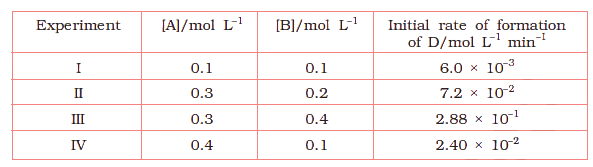
Determine the rate law and the rate constant for the reaction.
The following results have been obtained during the kinetic studies of the reaction: (2A + B \rightarrow C + D)
Determine the rate law and the rate constant for the reaction.
Solution :
Step 1: Establishing the Rate Law Expression
The rate law for the reaction $2A + B \rightarrow C + D$ can be expressed as:
$Rate = k[A]^x[B]^y$
Where $k$ is the rate constant, $x$ is the order with respect to $A$, and $y$ is the order with respect to $B$. [Per the Law of Mass Action and Empirical Kinetics]
Step 2: Tabulating the Experimental Data
| Experiment | $[A] / mol \cdot L^{-1}$ | $[B] / mol \cdot L^{-1}$ | Initial Rate / $mol \cdot L^{-1} \cdot min^{-1}$ |
|---|---|---|---|
| I | $0.1$ | $0.1$ | $6.0 \times 10^{-3}$ |
| II | $0.3$ | $0.2$ | $7.2 \times 10^{-2}$ |
| III | $0.3$ | $0.4$ | $2.88 \times 10^{-1}$ |
| IV | $0.4$ | $0.1$ | $2.40 \times 10^{-2}$ |
Step 3: Determining Order with Respect to B ($y$)
Compare Experiments II and III, where $[A]$ is held constant:
$\frac{Rate_{III}}{Rate_{II}} = \frac{k[0.3]^x[0.4]^y}{k[0.3]^x[0.2]^y}$
$\frac{2.88 \times 10^{-1}}{7.2 \times 10^{-2}} = \left(\frac{0.4}{0.2}\right)^y$
$4 = 2^y \implies y = 2$
Step 4: Determining Order with Respect to A ($x$)
Compare Experiments I and IV, where $[B]$ is held constant:
$\frac{Rate_{IV}}{Rate_{I}} = \frac{k[0.4]^x[0.1]^y}{k[0.1]^x[0.1]^y}$
$\frac{2.40 \times 10^{-2}}{6.0 \times 10^{-3}} = \left(\frac{0.4}{0.1}\right)^x$
$4 = 4^x \implies x = 1$
Step 5: Calculating the Rate Constant ($k$)
Substitute the orders back into the rate law: $Rate = k[A]^1[B]^2$. Using data from Experiment I:
$6.0 \times 10^{-3} = k(0.1)^1(0.1)^2$
$6.0 \times 10^{-3} = k(0.1)(0.01)$
$6.0 \times 10^{-3} = k(0.001)$
$k = \frac{6.0 \times 10^{-3}}{10^{-3}} = 6.0 \ L^2 \cdot mol^{-2} \cdot min^{-1}$
Step 6: Visual Representation of Kinetic Dependency
Final Solution: The rate law is $Rate = k[A][B]^2$ and the rate constant $k = 6.0 \ L^2 \cdot mol^{-2} \cdot min^{-1}$.
More Questions from Class 12 Chemistry Chemical Kinetics Exercises
- Q3.1 (i): From the rate expression for the following reactions, determine their order of reaction and the dimensions of the rate constants. (i) (3NO(g) \rightarrow N_{2}O (g)) Rate = (k[NO]^{2})
- Q3.1 (ii): From the rate expression for the following reactions, determine their order of reaction and the dimensions of the rate constants. (ii) (H_{2}O_{2} (aq) + 3I^{-} (aq) + 2H^{+} \rightarrow 2H_{2}O (l) + I_{3}^{-}) Rate = (k[H_{2}O_{2}][I^{-}])
- Q3.1 (iii): From the rate expression for the following reactions, determine their order of reaction and the dimensions of the rate constants. (iii) (CH_{3}CHO (g) \rightarrow CH_{4} (g) + CO(g)) Rate = (k [CH_{3}CHO]^{3/2})
- Q3.1 (iv): From the rate expression for the following reactions, determine their order of reaction and the dimensions of the rate constants. (iv) (C_{2}H_{5}Cl (g) \rightarrow C_{2}H_{4} (g) + HCl (g)) Rate = (k [C_{2}H_{5}Cl])
- Q3.1(i): From the rate expression for the following reactions, determine their order of reaction and the dimensions of the rate constants. (i) \(3NO(g) \rightarrow N_{2}O (g)\) Rate = \(k[NO]^{2}\)
- Q3.1(ii): From the rate expression for the following reactions, determine their order of reaction and the dimensions of the rate constants. (ii) \(H_{2}O_{2} (aq) + 3I^{-} (aq) + 2H^{+} \rightarrow 2H_{2}O (l) + I_{3}^{-}\) Rate = \(k[H_{2}O_{2}][I^{-}]\)
- Q3.1(iii): From the rate expression for the following reactions, determine their order of reaction and the dimensions of the rate constants. (iii) \(CH_{3}CHO (g) \rightarrow CH_{4} (g) + CO(g)\) Rate = \(k [CH_{3}CHO]^{\frac{3}{2}}\)
- Q3.1(iv): From the rate expression for the following reactions, determine their order of reaction and the dimensions of the rate constants. (iv) \(C_{2}H_{5}Cl (g) \rightarrow C_{2}H_{4} (g) + HCl (g)\) Rate = \(k [C_{2}H_{5}Cl]\)
- Q3.10: In a reaction between (A) and (B), the initial rate of reaction ((r_{0})) was measured for different initial concentrations of (A) and (B) as given below: What is the order of the reaction with respect to (A) and (B)?
- Q3.10: In a reaction between \(A\) and \(B\), the initial rate of reaction (\(r_{0}\)) was measured for different initial concentrations of \(A\) and \(B\) as given below: What is the order of the reaction with respect to \(A\) and \(B\)?
- Q3.11: The following results have been obtained during the kinetic studies of the reaction: \(2A + B \rightarrow C + D\) Determine the rate law and the rate constant for the reaction.
- Q3.12: The reaction between (A) and (B) is first order with respect to (A) and zero order with respect to (B). Fill in the blanks in the following table:
- Q3.12: The reaction between \(A\) and \(B\) is first order with respect to \(A\) and zero order with respect to \(B\). Fill in the blanks in the following table:
- Q3.13 (i): Calculate the half-life of a first order reaction from their rate constants given below: (i) (200 s^{-1})
- Q3.13 (ii): Calculate the half-life of a first order reaction from their rate constants given below: (ii) (2 min^{-1})
- Q3.13 (iii): Calculate the half-life of a first order reaction from their rate constants given below: (iii) (4 years^{-1})
- Q3.13(i): Calculate the half-life of a first order reaction from their rate constants given below: (i) \(200 s^{-1}\)
- Q3.13(ii): Calculate the half-life of a first order reaction from their rate constants given below: (ii) \(2 min^{-1}\)
- Q3.13(iii): Calculate the half-life of a first order reaction from their rate constants given below: (iii) \(4 years^{-1}\)
- Q3.14: The half-life for radioactive decay of (^{14}C) is 5730 years. An archaeological artifact containing wood had only 80% of the (^{14}C) found in a living tree. Estimate the age of the sample.
- Q3.14: The half-life for radioactive decay of \(^{14}C\) is 5730 years. An archaeological artifact containing wood had only 80% of the \(^{14}C\) found in a living tree. Estimate the age of the sample.
- Q3.15 (i): The experimental data for decomposition of (N_{2}O_{5}) [(2N_{2}O_{5} \rightarrow 4NO_{2} + O_{2})] in gas phase at 318K are given below: t/s 0 400 800 1200 1600 2000 2400 2800 3200 (10^{2} \times [N_{2}O_{5}])/(mol L^{-1}) 1.63 1.36 1.14 0.93 0.78 0.64 0.53 0.43 0.35 (i) Plot ([N_{2}O_{5}]) against (t).
- Q3.15 (ii): The experimental data for decomposition of (N_{2}O_{5}) [(2N_{2}O_{5} \rightarrow 4NO_{2} + O_{2})] in gas phase at 318K are given below: (ii) Find the half-life period for the reaction.
- Q3.15 (iii): The experimental data for decomposition of (N_{2}O_{5}) [(2N_{2}O_{5} \rightarrow 4NO_{2} + O_{2})] in gas phase at 318K are given below: (iii) Draw a graph between (\log[N_{2}O_{5}]) and (t).
- Q3.15 (iv): The experimental data for decomposition of (N_{2}O_{5}) [(2N_{2}O_{5} \rightarrow 4NO_{2} + O_{2})] in gas phase at 318K are given below: (iv) What is the rate law ?
- Q3.15 (v): The experimental data for decomposition of (N_{2}O_{5}) [(2N_{2}O_{5} \rightarrow 4NO_{2} + O_{2})] in gas phase at 318K are given below: (v) Calculate the rate constant.
- Q3.15 (vi): The experimental data for decomposition of (N_{2}O_{5}) [(2N_{2}O_{5} \rightarrow 4NO_{2} + O_{2})] in gas phase at 318K are given below: (vi) Calculate the half-life period from (k) and compare it with (ii).
- Q3.15(i): The experimental data for decomposition of \(N_{2}O_{5}\) [\(2N_{2}O_{5} \rightarrow 4NO_{2} + O_{2}\)] in gas phase at 318K are given below: (i) Plot \([N_{2}O_{5}]\) against \(t\).
- Q3.15(ii): The experimental data for decomposition of \(N_{2}O_{5}\) [\(2N_{2}O_{5} \rightarrow 4NO_{2} + O_{2}\)] in gas phase at 318K are given below: (ii) Find the half-life period for the reaction.
- Q3.15(iii): The experimental data for decomposition of \(N_{2}O_{5}\) [\(2N_{2}O_{5} \rightarrow 4NO_{2} + O_{2}\)] in gas phase at 318K are given below: (iii) Draw a graph between \(log[N_{2}O_{5}]\) and \(t\).
- Q3.15(iv): The experimental data for decomposition of \(N_{2}O_{5}\) [\(2N_{2}O_{5} \rightarrow 4NO_{2} + O_{2}\)] in gas phase at 318K are given below: (iv) What is the rate law ?
- Q3.15(v): The experimental data for decomposition of \(N_{2}O_{5}\) [\(2N_{2}O_{5} \rightarrow 4NO_{2} + O_{2}\)] in gas phase at 318K are given below: (v) Calculate the rate constant.
- Q3.15(vi): The experimental data for decomposition of \(N_{2}O_{5}\) [\(2N_{2}O_{5} \rightarrow 4NO_{2} + O_{2}\)] in gas phase at 318K are given below: (vi) Calculate the half-life period from \(k\) and compare it with (ii).
- Q3.16: The rate constant for a first order reaction is \(60 s^{-1}\). How much time will it take to reduce the initial concentration of the reactant to its \(\frac{1}{16}\)th value?
- Q3.16: The rate constant for a first order reaction is (60 s^{-1}). How much time will it take to reduce the initial concentration of the reactant to its (\frac{1}{16}^{th}) value?
- Q3.17: During nuclear explosion, one of the products is \(^{90}Sr\) with half-life of 28.1 years. If \(1 \mu g\) of \(^{90}Sr\) was absorbed in the bones of a newly born baby instead of calcium, how much of it will remain after 10 years and 60 years if it is not lost metabolically.
- Q3.17: During nuclear explosion, one of the products is (^{90}Sr) with half-life of 28.1 years. If (1\mu g) of (^{90}Sr) was absorbed in the bones of a newly born baby instead of calcium, how much of it will remain after 10 years and 60 years if it is not lost metabolically.
- Q3.18: For a first order reaction, show that time required for 99% completion is twice the time required for the completion of 90% of reaction.
- Q3.18: For a first order reaction, show that time required for 99% completion is twice the time required for the completion of 90% of reaction.
- Q3.19: A first order reaction takes 40 min for 30% decomposition. Calculate \(t_{1/2}\).
- Q3.19: A first order reaction takes 40 min for 30% decomposition. Calculate (t_{1/2}).
- Q3.2: For the reaction: (2A + B \rightarrow A_{2}B) the rate = (k[A][B]^{2}) with (k = 2.0 \times 10^{-6} mol^{-2} L^{2} s^{-1}). Calculate the initial rate of the reaction when ([A] = 0.1 mol L^{-1}), ([B] = 0.2 mol L^{-1}). Calculate the rate of reaction after ([A]) is reduced to (0.06 mol L^{-1}).
- Q3.2: For the reaction: \(2A + B \rightarrow A_{2}B\) the rate = \(k[A][B]^{2}\) with \(k = 2.0 \times 10^{-6} mol^{-2} L^{2} s^{-1}\). Calculate the initial rate of the reaction when \([A] = 0.1 \text{ mol } L^{-1}\), \([B] = 0.2 \text{ mol } L^{-1}\). Calculate the rate of reaction after \([A]\) is reduced to \(0.06 \text{ mol } L^{-1}\).
- Q3.20: For the decomposition of azoisopropane to hexane and nitrogen at 543 K, the following data are obtained. Calculate the rate constant.
- Q3.20: For the decomposition of azoisopropane to hexane and nitrogen at 543 K, the following data are obtained. Calculate the rate constant.
- Q3.21: The following data were obtained during the first order thermal decomposition of (SO_{2}Cl_{2}) at a constant volume. ((SO_{2}Cl_{2}(g) \rightarrow SO_{2}(g) + Cl_{2}(g))) Calculate the rate of the reaction when total pressure is 0.65 atm.
- Q3.21: The following data were obtained during the first order thermal decomposition of \(SO_{2}Cl_{2}\) at a constant volume. \(SO_{2}Cl_{2}(g) \rightarrow SO_{2}(g) + Cl_{2}(g)\) Calculate the rate of the reaction when total pressure is 0.65 atm.
- Q3.22: The rate constant for the decomposition of \(N_{2}O_{5}\) at various temperatures is given below: Draw a graph between \(ln k\) and \(1/T\) and calculate the values of \(A\) and \(E_{a}\). Predict the rate constant at 30° and 50°C.
- Q3.22: The rate constant for the decomposition of (N_{2}O_{5}) at various temperatures is given below: Draw a graph between (\ln k) and (1/T) and calculate the values of (A) and (E_{a}). Predict the rate constant at 30° and 50°C.
- Q3.23: The rate constant for the decomposition of hydrocarbons is (2.418 \times 10^{-5}s^{-1}) at 546 K. If the energy of activation is 179.9 kJ/mol, what will be the value of pre-exponential factor.
- Q3.23: The rate constant for the decomposition of hydrocarbons is \(2.418 \times 10^{-5}s^{-1}\) at 546 K. If the energy of activation is 179.9 kJ/mol, what will be the value of pre-exponential factor.
- Q3.24: Consider a certain reaction (A \rightarrow Products) with (k = 2.0 \times 10^{-2}s^{-1}). Calculate the concentration of (A) remaining after 100 s if the initial concentration of (A) is (1.0 mol L^{-1}).
- Q3.24: Consider a certain reaction \(A \rightarrow Products\) with \(k = 2.0 \times 10^{-2}s^{-1}\). Calculate the concentration of \(A\) remaining after 100 s if the initial concentration of \(A\) is \(1.0 mol L^{-1}\).
- Q3.25: Sucrose decomposes in acid solution into glucose and fructose according to the first order rate law, with \(t_{1/2} = 3.00\) hours. What fraction of sample of sucrose remains after 8 hours ?
- Q3.25: Sucrose decomposes in acid solution into glucose and fructose according to the first order rate law, with (t_{1/2} = 3.00) hours. What fraction of sample of sucrose remains after 8 hours ?
- Q3.26: The decomposition of hydrocarbon follows the equation \(k = (4.5 \times 10^{11}s^{-1}) e^{-28000K/T}\) Calculate \(E_{a}\).
- Q3.26: The decomposition of hydrocarbon follows the equation (k = (4.5 \times 10^{11}s^{-1}) e^{-28000K/T}) Calculate (E_{a}).
- Q3.27: The rate constant for the first order decomposition of \(H_{2}O_{2}\) is given by the following equation: \(log k = 14.34 – \frac{1.25 \times 10^{4}K}{T}\) Calculate \(E_{a}\) for this reaction and at what temperature will its half-period be 256 minutes?
- Q3.27: The rate constant for the first order decomposition of (H_{2}O_{2}) is given by the following equation: (\log k = 14.34 – 1.25 \times 10^{4}K/T) Calculate (E_{a}) for this reaction and at what temperature will its half-period be 256 minutes?
- Q3.28: The decomposition of (A) into product has value of (k) as (4.5 \times 10^{3} s^{-1}) at 10°C and energy of activation (60 kJ mol^{-1}). At what temperature would (k) be (1.5 \times 10^{4}s^{-1})?
- Q3.28: The decomposition of \(A\) into product has value of \(k\) as \(4.5 \times 10^{3} s^{-1}\) at 10°C and energy of activation \(60 kJ mol^{-1}\). At what temperature would \(k\) be \(1.5 \times 10^{4}s^{-1}\)?
- Q3.29: The time required for 10% completion of a first order reaction at 298K is equal to that required for its 25% completion at 308K. If the value of \(A\) is \(4 \times 10^{10}s^{-1}\). Calculate \(k\) at 318K and \(E_{a}\).
- Q3.29: The time required for 10% completion of a first order reaction at 298K is equal to that required for its 25% completion at 308K. If the value of (A) is (4 \times 10^{10}s^{-1}). Calculate (k) at 318K and (E_{a}).
- Q3.3: The decomposition of \(NH_{3}\) on platinum surface is zero order reaction. What are the rates of production of \(N_{2}\) and \(H_{2}\) if \(k = 2.5 \times 10^{-4} mol^{-1} L s^{-1}\)?
- Q3.3: The decomposition of (NH_{3}) on platinum surface is zero order reaction. What are the rates of production of (N_{2}) and (H_{2}) if (k = 2.5 \times 10^{-4} mol^{-1} L s^{-1})?
- Q3.30: The rate of a reaction quadruples when the temperature changes from 293 K to 313 K. Calculate the energy of activation of the reaction assuming that it does not change with temperature.
- Q3.30: The rate of a reaction quadruples when the temperature changes from 293 K to 313 K. Calculate the energy of activation of the reaction assuming that it does not change with temperature.
- Q3.4: The decomposition of dimethyl ether leads to the formation of (CH_{4}), (H_{2}) and (CO) and the reaction rate is given by Rate = (k [CH_{3}OCH_{3}]^{3/2}) The rate of reaction is followed by increase in pressure in a closed vessel, so the rate can also be expressed in terms of the partial pressure of dimethyl ether, i.e., (Rate = p_{CH_{3}OCH_{3}}^{3/2}) If the pressure is measured in bar and time in minutes, then what are the units of rate and rate constants?
- Q3.4: The decomposition of dimethyl ether leads to the formation of \(CH_{4}\), \(H_{2}\) and \(CO\) and the reaction rate is given by Rate = \(k [CH_{3}OCH_{3}]^{\frac{3}{2}} The rate of reaction is followed by increase in pressure in a closed vessel, so the rate can also be expressed in terms of the partial pressure of dimethyl ether, i.e., Rate = \(k(p_{CH_{3}OCH_{3}})^{\frac{3}{2}} If the pressure is measured in bar and time in minutes, then what are the units of rate and rate constants?
- Q3.5: Mention the factors that affect the rate of a chemical reaction.
- Q3.5: Mention the factors that affect the rate of a chemical reaction.
- Q3.6 (i): A reaction is second order with respect to a reactant. How is the rate of reaction affected if the concentration of the reactant is (i) doubled
- Q3.6 (ii): A reaction is second order with respect to a reactant. How is the rate of reaction affected if the concentration of the reactant is (ii) reduced to half ?
- Q3.6(i): A reaction is second order with respect to a reactant. How is the rate of reaction affected if the concentration of the reactant is (i) doubled
- Q3.6(ii): A reaction is second order with respect to a reactant. How is the rate of reaction affected if the concentration of the reactant is (ii) reduced to half ?
- Q3.7: What is the effect of temperature on the rate constant of a reaction? How can this effect of temperature on rate constant be represented quantitatively?
- Q3.7: What is the effect of temperature on the rate constant of a reaction? How can this effect of temperature on rate constant be represented quantitatively?
- Q3.8: In a pseudo first order reaction in water, the following results were obtained: Calculate the average rate of reaction between the time interval 30 to 60 seconds.
- Q3.8: In a pseudo first order reaction in water, the following results were obtained: Calculate the average rate of reaction between the time interval 30 to 60 seconds.
- Q3.9 (i): A reaction is first order in (A) and second order in (B). (i) Write the differential rate equation.
- Q3.9 (ii): A reaction is first order in (A) and second order in (B). (ii) How is the rate affected on increasing the concentration of (B) three times?
- Q3.9 (iii): A reaction is first order in (A) and second order in (B). (iii) How is the rate affected when the concentrations of both (A) and (B) are doubled?
- Q3.9(i): A reaction is first order in \(A\) and second order in \(B\). (i) Write the differential rate equation.
- Q3.9(ii): A reaction is first order in \(A\) and second order in \(B\). (ii) How is the rate affected on increasing the concentration of \(B\) three times?
- Q3.9(iii): A reaction is first order in \(A\) and second order in \(B\). (iii) How is the rate affected when the concentrations of both \(A\) and \(B\) are doubled?
CBSE Solutions for Class 12 Chemistry Chemical Kinetics
Chapters in CBSE - Class 12 Chemistry
Top Tutors who teach Chemical Kinetics



 Top Tutor
 Tezpur Airpur Area, Tezpur
 7 yrs of
Exp
 2 students
 421 hrs of classes completed
 450
per hour
 Online Classes
 Tutor's home
I am a mathematics teacher. I have been working in schools from last 6-7 years , and i was giving tutions at my home and even in an insitute in delhi from last 5-7 years. I shifted to tezpur,Assam in April 2021. my last job was in air force school hindan and I currently work at Air force school tezpur. i have a degree in msc mathematics and b.ed. i teach mathematics upto class 12. my key skills are in ms office , mathematics project, calligraphy , and can help out students in their various activities.

 Super Tutor
Bilekahalli, Bangalore
6 yrs of
Exp
9 students
314 hrs of classes completed
500
per hour
Online Classes
I teach Chemistry to students of Class 11 and Class 12 and have been working in the teaching field for the past 7 years. Chemistry has always been a subject that I am passionate about, and I enjoy helping students understand concepts clearly and perform confidently in academics as well as competitive examinations. My goal is to make Chemistry simple, logical, and interesting for students through structured and concept-focused learning. I hold a Master of Science (M.Sc.) degree in Chemistry, which has provided me with strong subject knowledge and a deeper understanding of various chemical concepts. My academic background helps me explain topics in a clear and systematic way so that students can easily understand and apply them while solving numerical and theoretical questions. Over the years, I have worked with students from different learning backgrounds and understanding levels. This experience has taught me the importance of adapting teaching methods according to the student’s requirements. I focus on helping students strengthen their conceptual understanding, improve their analytical and problem-solving skills, and gain confidence in handling Chemistry effectively for both board exams and competitive exams. My teaching methodology is structured, student-centric, and exam-oriented. I follow a well-planned lesson structure where topics progress step by step from basic to advanced levels. Before starting a new topic, I assess the student’s current understanding level so that I can explain concepts in the most effective manner. I also use suitable real-life examples to simplify complex chemical concepts and make learning more relatable and easier to understand. I strongly believe that conceptual clarity is more important than rote learning. During my classes, I encourage students to ask questions freely and clear doubts without hesitation. If a student finds a concept difficult, I patiently re-explain it multiple times until complete understanding is achieved. I also conduct regular revision sessions, exercise practice, and detailed discussions of previous years’ board and competitive examination questions to strengthen preparation and retention. I conduct both online and offline classes depending on the convenience of students. During my sessions, I use PPT presentations and whiteboard explanations to make learning more organized, visual, and engaging. My classes are interactive and focused on building confidence, helping students solve problems independently, and preparing them effectively for examinations. As a teacher, my aim is to help students develop a strong foundation in Chemistry and remove the fear many students have towards the subject. I believe that with the right guidance, regular practice, and conceptual understanding, every student can excel in Chemistry. Helping students improve academically and achieve success in their exams continues to motivate me in my teaching journey.
As per my son's experience, he clears all the concepts and teaches very well, explaining repeatedly until it is fully understood.


 Super Tutor
Kasavanahalli Main Rd Kasavanahalli, Bangalore
2 yrs of
Exp
6 students
882 hrs of classes completed
800
per hour
Online Classes
I am a teacher. I love teaching and want to share my knowledge with my students. I will take online classes. My approach combines clear concepts, regular practice, and student-friendly strategies to make learning effective and enjoyable.
"Found it to be a very intuitive learning methodology, practical approach, helpful in understanding."


 Top Tutor
Zafarpur Mahawan, Karari
10 yrs of
Exp
6 students
287 hrs of classes completed
400
per hour
Online Classes
Tutor's home
I am an experienced, qualified teacher and tutor with over 20 years of experience in teaching accountancy, business studies and English literature in CBSE school. Passionate about communication in English, over the years I have helped thousands of students overcome their stage fright and nervousness in expressing themselves in public. So far, I have worked with Dr. Rizvi Springfield School (Prayagraj) and Global Classroom, Lucknow (branch of CMS) and currently freelancing with Planet Spark as an Expert in Public Speaking & Creating Writing. I specialize in teaching Accountancy and Business Studies to classes 11 and 12, along with Spoken English. With a strong academic background, including a B. Com., M. Com., and an M.Ed., as well as completing a Management Development Program, I bring a wealth of knowledge and expertise to my teaching. With over 22 years of administrative experience and 10 years of teaching, I have had the privilege of holding key roles such as PGT English, Commerce teacher, Headmistress, and Principal. These experiences have helped me develop a profound understanding of education, enabling me to cater to the unique needs of my students effectively. Teaching has been the most enjoyable and fulfilling part of my professional journey. Over the years, I have built strong connections with my students, fostering an environment of trust and growth. My passion for education has been recognized through several accolades, including a prestigious Principal Award in Delhi. I conduct online classes where I follow a structured lesson plan to ensure my sessions are engaging and interactive. I use PPTs and videos to make concepts clear and relatable, catering to the diverse learning styles of my students. I also provide comprehensive notes and content to support my students' learning and revision. These resources are meticulously prepared to align with the curriculum and focus on enhancing students’ understanding and performance. My approach to teaching is rooted in creating a supportive and motivating environment. I am committed to helping my students achieve their academic and personal goals while instilling confidence and a love for learning in them. Teaching is not just my profession; it is my passion and purpose.
 Top Tutor
Sector-40, Chandigarh
10 yrs of
Exp
3 students
12 hrs of classes completed
500
per hour
Online Classes
 Student's Home
Tutor's home
m baljinder kaur professor in punjab university chandigarh. i have 10 years of experience. i taught 4 years in aakash institute to JEE and NEET level students also.



