



Find the best tutors and institutes for Class 12 Tuition
Q3.20:
For the decomposition of azoisopropane to hexane and nitrogen at 543 K, the following data are obtained.
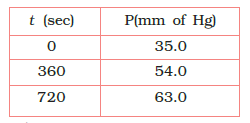
Calculate the rate constant.
For the decomposition of azoisopropane to hexane and nitrogen at 543 K, the following data are obtained.
Calculate the rate constant.
Solution :
Step 1: Identifying the Reaction Mechanism
The decomposition of azoisopropane $(CH_3)_2CHN=NCH(CH_3)_2$ into hexane $(C_6H_{14})$ and nitrogen gas $(N_2)$ follows a first-order kinetic pathway. The stoichiometric equation is:
$(CH_3)_2CHN=NCH(CH_3)_2(g) \rightarrow C_6H_{14}(g) + N_2(g)$
Let $P_0$ be the initial pressure of the reactant at $t=0$, and $P_t$ be the total pressure of the system at time $t$.
Step 2: Deriving the Partial Pressure Equation
At any time $t$, let $x$ be the decrease in the pressure of the reactant. Based on the stoichiometry:
| Time | $(CH_3)_2CHN=NCH(CH_3)_2$ | $\rightarrow$ | $C_6H_{14}$ | $+$ | $N_2$ |
|---|---|---|---|---|---|
| $t=0$ | $P_0$ | $0$ | $0$ | ||
| $t=t$ | $P_0 - x$ | $x$ | $x$ |
The total pressure $P_t = (P_0 - x) + x + x = P_0 + x$.
Therefore, $x = P_t - P_0$. [By Law of Conservation of Mass and Dalton's Law of Partial Pressures].
The pressure of the reactant at time $t$, denoted as $P_A$, is:
$P_A = P_0 - x = P_0 - (P_t - P_0) = 2P_0 - P_t$
Step 3: Calculating Data Points
Given $P_0 = 35.0$ mm Hg at $t=0$.
- For $t = 360$ s, $P_t = 54.0$ mm Hg:
$P_A = 2(35.0) - 54.0 = 70.0 - 54.0 = 16.0$ mm Hg. - For $t = 720$ s, $P_t = 63.0$ mm Hg:
$P_A = 2(35.0) - 63.0 = 70.0 - 63.0 = 7.0$ mm Hg.
Step 4: Applying the First-Order Rate Constant Formula
The first-order rate constant $k$ is given by [Integrated Rate Law for First-Order Reactions]:
$k = \frac{2.303}{t} \log \left( \frac{P_0}{P_A} \right)$
Calculation for $t = 360$ s:
$k_1 = \frac{2.303}{360} \log \left( \frac{35.0}{16.0} \right) = \frac{2.303}{360} \times \log(2.1875) \approx \frac{2.303 \times 0.3400}{360} \approx 2.175 \times 10^{-3} \text{ s}^{-1}$
Calculation for $t = 720$ s:
$k_2 = \frac{2.303}{720} \log \left( \frac{35.0}{7.0} \right) = \frac{2.303}{720} \times \log(5.0) \approx \frac{2.303 \times 0.6990}{720} \approx 2.235 \times 10^{-3} \text{ s}^{-1}$
Step 5: Determining Average Rate Constant
$k_{avg} = \frac{k_1 + k_2}{2} = \frac{(2.175 + 2.235) \times 10^{-3}}{2} = 2.21 \times 10^{-3} \text{ s}^{-1}$
Final Solution: The rate constant for the reaction is $2.21 \times 10^{-3} \text{ s}^{-1}$.
More Questions from Class 12 Chemistry Chemical Kinetics Exercises
- Q3.1 (i): From the rate expression for the following reactions, determine their order of reaction and the dimensions of the rate constants. (i) (3NO(g) \rightarrow N_{2}O (g)) Rate = (k[NO]^{2})
- Q3.1 (ii): From the rate expression for the following reactions, determine their order of reaction and the dimensions of the rate constants. (ii) (H_{2}O_{2} (aq) + 3I^{-} (aq) + 2H^{+} \rightarrow 2H_{2}O (l) + I_{3}^{-}) Rate = (k[H_{2}O_{2}][I^{-}])
- Q3.1 (iii): From the rate expression for the following reactions, determine their order of reaction and the dimensions of the rate constants. (iii) (CH_{3}CHO (g) \rightarrow CH_{4} (g) + CO(g)) Rate = (k [CH_{3}CHO]^{3/2})
- Q3.1 (iv): From the rate expression for the following reactions, determine their order of reaction and the dimensions of the rate constants. (iv) (C_{2}H_{5}Cl (g) \rightarrow C_{2}H_{4} (g) + HCl (g)) Rate = (k [C_{2}H_{5}Cl])
- Q3.1(i): From the rate expression for the following reactions, determine their order of reaction and the dimensions of the rate constants. (i) \(3NO(g) \rightarrow N_{2}O (g)\) Rate = \(k[NO]^{2}\)
- Q3.1(ii): From the rate expression for the following reactions, determine their order of reaction and the dimensions of the rate constants. (ii) \(H_{2}O_{2} (aq) + 3I^{-} (aq) + 2H^{+} \rightarrow 2H_{2}O (l) + I_{3}^{-}\) Rate = \(k[H_{2}O_{2}][I^{-}]\)
- Q3.1(iii): From the rate expression for the following reactions, determine their order of reaction and the dimensions of the rate constants. (iii) \(CH_{3}CHO (g) \rightarrow CH_{4} (g) + CO(g)\) Rate = \(k [CH_{3}CHO]^{\frac{3}{2}}\)
- Q3.1(iv): From the rate expression for the following reactions, determine their order of reaction and the dimensions of the rate constants. (iv) \(C_{2}H_{5}Cl (g) \rightarrow C_{2}H_{4} (g) + HCl (g)\) Rate = \(k [C_{2}H_{5}Cl]\)
- Q3.10: In a reaction between (A) and (B), the initial rate of reaction ((r_{0})) was measured for different initial concentrations of (A) and (B) as given below: What is the order of the reaction with respect to (A) and (B)?
- Q3.10: In a reaction between \(A\) and \(B\), the initial rate of reaction (\(r_{0}\)) was measured for different initial concentrations of \(A\) and \(B\) as given below: What is the order of the reaction with respect to \(A\) and \(B\)?
- Q3.11: The following results have been obtained during the kinetic studies of the reaction: (2A + B \rightarrow C + D) Determine the rate law and the rate constant for the reaction.
- Q3.11: The following results have been obtained during the kinetic studies of the reaction: \(2A + B \rightarrow C + D\) Determine the rate law and the rate constant for the reaction.
- Q3.12: The reaction between (A) and (B) is first order with respect to (A) and zero order with respect to (B). Fill in the blanks in the following table:
- Q3.12: The reaction between \(A\) and \(B\) is first order with respect to \(A\) and zero order with respect to \(B\). Fill in the blanks in the following table:
- Q3.13 (i): Calculate the half-life of a first order reaction from their rate constants given below: (i) (200 s^{-1})
- Q3.13 (ii): Calculate the half-life of a first order reaction from their rate constants given below: (ii) (2 min^{-1})
- Q3.13 (iii): Calculate the half-life of a first order reaction from their rate constants given below: (iii) (4 years^{-1})
- Q3.13(i): Calculate the half-life of a first order reaction from their rate constants given below: (i) \(200 s^{-1}\)
- Q3.13(ii): Calculate the half-life of a first order reaction from their rate constants given below: (ii) \(2 min^{-1}\)
- Q3.13(iii): Calculate the half-life of a first order reaction from their rate constants given below: (iii) \(4 years^{-1}\)
- Q3.14: The half-life for radioactive decay of (^{14}C) is 5730 years. An archaeological artifact containing wood had only 80% of the (^{14}C) found in a living tree. Estimate the age of the sample.
- Q3.14: The half-life for radioactive decay of \(^{14}C\) is 5730 years. An archaeological artifact containing wood had only 80% of the \(^{14}C\) found in a living tree. Estimate the age of the sample.
- Q3.15 (i): The experimental data for decomposition of (N_{2}O_{5}) [(2N_{2}O_{5} \rightarrow 4NO_{2} + O_{2})] in gas phase at 318K are given below: t/s 0 400 800 1200 1600 2000 2400 2800 3200 (10^{2} \times [N_{2}O_{5}])/(mol L^{-1}) 1.63 1.36 1.14 0.93 0.78 0.64 0.53 0.43 0.35 (i) Plot ([N_{2}O_{5}]) against (t).
- Q3.15 (ii): The experimental data for decomposition of (N_{2}O_{5}) [(2N_{2}O_{5} \rightarrow 4NO_{2} + O_{2})] in gas phase at 318K are given below: (ii) Find the half-life period for the reaction.
- Q3.15 (iii): The experimental data for decomposition of (N_{2}O_{5}) [(2N_{2}O_{5} \rightarrow 4NO_{2} + O_{2})] in gas phase at 318K are given below: (iii) Draw a graph between (\log[N_{2}O_{5}]) and (t).
- Q3.15 (iv): The experimental data for decomposition of (N_{2}O_{5}) [(2N_{2}O_{5} \rightarrow 4NO_{2} + O_{2})] in gas phase at 318K are given below: (iv) What is the rate law ?
- Q3.15 (v): The experimental data for decomposition of (N_{2}O_{5}) [(2N_{2}O_{5} \rightarrow 4NO_{2} + O_{2})] in gas phase at 318K are given below: (v) Calculate the rate constant.
- Q3.15 (vi): The experimental data for decomposition of (N_{2}O_{5}) [(2N_{2}O_{5} \rightarrow 4NO_{2} + O_{2})] in gas phase at 318K are given below: (vi) Calculate the half-life period from (k) and compare it with (ii).
- Q3.15(i): The experimental data for decomposition of \(N_{2}O_{5}\) [\(2N_{2}O_{5} \rightarrow 4NO_{2} + O_{2}\)] in gas phase at 318K are given below: (i) Plot \([N_{2}O_{5}]\) against \(t\).
- Q3.15(ii): The experimental data for decomposition of \(N_{2}O_{5}\) [\(2N_{2}O_{5} \rightarrow 4NO_{2} + O_{2}\)] in gas phase at 318K are given below: (ii) Find the half-life period for the reaction.
- Q3.15(iii): The experimental data for decomposition of \(N_{2}O_{5}\) [\(2N_{2}O_{5} \rightarrow 4NO_{2} + O_{2}\)] in gas phase at 318K are given below: (iii) Draw a graph between \(log[N_{2}O_{5}]\) and \(t\).
- Q3.15(iv): The experimental data for decomposition of \(N_{2}O_{5}\) [\(2N_{2}O_{5} \rightarrow 4NO_{2} + O_{2}\)] in gas phase at 318K are given below: (iv) What is the rate law ?
- Q3.15(v): The experimental data for decomposition of \(N_{2}O_{5}\) [\(2N_{2}O_{5} \rightarrow 4NO_{2} + O_{2}\)] in gas phase at 318K are given below: (v) Calculate the rate constant.
- Q3.15(vi): The experimental data for decomposition of \(N_{2}O_{5}\) [\(2N_{2}O_{5} \rightarrow 4NO_{2} + O_{2}\)] in gas phase at 318K are given below: (vi) Calculate the half-life period from \(k\) and compare it with (ii).
- Q3.16: The rate constant for a first order reaction is \(60 s^{-1}\). How much time will it take to reduce the initial concentration of the reactant to its \(\frac{1}{16}\)th value?
- Q3.16: The rate constant for a first order reaction is (60 s^{-1}). How much time will it take to reduce the initial concentration of the reactant to its (\frac{1}{16}^{th}) value?
- Q3.17: During nuclear explosion, one of the products is \(^{90}Sr\) with half-life of 28.1 years. If \(1 \mu g\) of \(^{90}Sr\) was absorbed in the bones of a newly born baby instead of calcium, how much of it will remain after 10 years and 60 years if it is not lost metabolically.
- Q3.17: During nuclear explosion, one of the products is (^{90}Sr) with half-life of 28.1 years. If (1\mu g) of (^{90}Sr) was absorbed in the bones of a newly born baby instead of calcium, how much of it will remain after 10 years and 60 years if it is not lost metabolically.
- Q3.18: For a first order reaction, show that time required for 99% completion is twice the time required for the completion of 90% of reaction.
- Q3.18: For a first order reaction, show that time required for 99% completion is twice the time required for the completion of 90% of reaction.
- Q3.19: A first order reaction takes 40 min for 30% decomposition. Calculate \(t_{1/2}\).
- Q3.19: A first order reaction takes 40 min for 30% decomposition. Calculate (t_{1/2}).
- Q3.2: For the reaction: (2A + B \rightarrow A_{2}B) the rate = (k[A][B]^{2}) with (k = 2.0 \times 10^{-6} mol^{-2} L^{2} s^{-1}). Calculate the initial rate of the reaction when ([A] = 0.1 mol L^{-1}), ([B] = 0.2 mol L^{-1}). Calculate the rate of reaction after ([A]) is reduced to (0.06 mol L^{-1}).
- Q3.2: For the reaction: \(2A + B \rightarrow A_{2}B\) the rate = \(k[A][B]^{2}\) with \(k = 2.0 \times 10^{-6} mol^{-2} L^{2} s^{-1}\). Calculate the initial rate of the reaction when \([A] = 0.1 \text{ mol } L^{-1}\), \([B] = 0.2 \text{ mol } L^{-1}\). Calculate the rate of reaction after \([A]\) is reduced to \(0.06 \text{ mol } L^{-1}\).
- Q3.20: For the decomposition of azoisopropane to hexane and nitrogen at 543 K, the following data are obtained. Calculate the rate constant.
- Q3.21: The following data were obtained during the first order thermal decomposition of (SO_{2}Cl_{2}) at a constant volume. ((SO_{2}Cl_{2}(g) \rightarrow SO_{2}(g) + Cl_{2}(g))) Calculate the rate of the reaction when total pressure is 0.65 atm.
- Q3.21: The following data were obtained during the first order thermal decomposition of \(SO_{2}Cl_{2}\) at a constant volume. \(SO_{2}Cl_{2}(g) \rightarrow SO_{2}(g) + Cl_{2}(g)\) Calculate the rate of the reaction when total pressure is 0.65 atm.
- Q3.22: The rate constant for the decomposition of \(N_{2}O_{5}\) at various temperatures is given below: Draw a graph between \(ln k\) and \(1/T\) and calculate the values of \(A\) and \(E_{a}\). Predict the rate constant at 30° and 50°C.
- Q3.22: The rate constant for the decomposition of (N_{2}O_{5}) at various temperatures is given below: Draw a graph between (\ln k) and (1/T) and calculate the values of (A) and (E_{a}). Predict the rate constant at 30° and 50°C.
- Q3.23: The rate constant for the decomposition of hydrocarbons is (2.418 \times 10^{-5}s^{-1}) at 546 K. If the energy of activation is 179.9 kJ/mol, what will be the value of pre-exponential factor.
- Q3.23: The rate constant for the decomposition of hydrocarbons is \(2.418 \times 10^{-5}s^{-1}\) at 546 K. If the energy of activation is 179.9 kJ/mol, what will be the value of pre-exponential factor.
- Q3.24: Consider a certain reaction (A \rightarrow Products) with (k = 2.0 \times 10^{-2}s^{-1}). Calculate the concentration of (A) remaining after 100 s if the initial concentration of (A) is (1.0 mol L^{-1}).
- Q3.24: Consider a certain reaction \(A \rightarrow Products\) with \(k = 2.0 \times 10^{-2}s^{-1}\). Calculate the concentration of \(A\) remaining after 100 s if the initial concentration of \(A\) is \(1.0 mol L^{-1}\).
- Q3.25: Sucrose decomposes in acid solution into glucose and fructose according to the first order rate law, with \(t_{1/2} = 3.00\) hours. What fraction of sample of sucrose remains after 8 hours ?
- Q3.25: Sucrose decomposes in acid solution into glucose and fructose according to the first order rate law, with (t_{1/2} = 3.00) hours. What fraction of sample of sucrose remains after 8 hours ?
- Q3.26: The decomposition of hydrocarbon follows the equation \(k = (4.5 \times 10^{11}s^{-1}) e^{-28000K/T}\) Calculate \(E_{a}\).
- Q3.26: The decomposition of hydrocarbon follows the equation (k = (4.5 \times 10^{11}s^{-1}) e^{-28000K/T}) Calculate (E_{a}).
- Q3.27: The rate constant for the first order decomposition of \(H_{2}O_{2}\) is given by the following equation: \(log k = 14.34 – \frac{1.25 \times 10^{4}K}{T}\) Calculate \(E_{a}\) for this reaction and at what temperature will its half-period be 256 minutes?
- Q3.27: The rate constant for the first order decomposition of (H_{2}O_{2}) is given by the following equation: (\log k = 14.34 – 1.25 \times 10^{4}K/T) Calculate (E_{a}) for this reaction and at what temperature will its half-period be 256 minutes?
- Q3.28: The decomposition of (A) into product has value of (k) as (4.5 \times 10^{3} s^{-1}) at 10°C and energy of activation (60 kJ mol^{-1}). At what temperature would (k) be (1.5 \times 10^{4}s^{-1})?
- Q3.28: The decomposition of \(A\) into product has value of \(k\) as \(4.5 \times 10^{3} s^{-1}\) at 10°C and energy of activation \(60 kJ mol^{-1}\). At what temperature would \(k\) be \(1.5 \times 10^{4}s^{-1}\)?
- Q3.29: The time required for 10% completion of a first order reaction at 298K is equal to that required for its 25% completion at 308K. If the value of \(A\) is \(4 \times 10^{10}s^{-1}\). Calculate \(k\) at 318K and \(E_{a}\).
- Q3.29: The time required for 10% completion of a first order reaction at 298K is equal to that required for its 25% completion at 308K. If the value of (A) is (4 \times 10^{10}s^{-1}). Calculate (k) at 318K and (E_{a}).
- Q3.3: The decomposition of \(NH_{3}\) on platinum surface is zero order reaction. What are the rates of production of \(N_{2}\) and \(H_{2}\) if \(k = 2.5 \times 10^{-4} mol^{-1} L s^{-1}\)?
- Q3.3: The decomposition of (NH_{3}) on platinum surface is zero order reaction. What are the rates of production of (N_{2}) and (H_{2}) if (k = 2.5 \times 10^{-4} mol^{-1} L s^{-1})?
- Q3.30: The rate of a reaction quadruples when the temperature changes from 293 K to 313 K. Calculate the energy of activation of the reaction assuming that it does not change with temperature.
- Q3.30: The rate of a reaction quadruples when the temperature changes from 293 K to 313 K. Calculate the energy of activation of the reaction assuming that it does not change with temperature.
- Q3.4: The decomposition of dimethyl ether leads to the formation of (CH_{4}), (H_{2}) and (CO) and the reaction rate is given by Rate = (k [CH_{3}OCH_{3}]^{3/2}) The rate of reaction is followed by increase in pressure in a closed vessel, so the rate can also be expressed in terms of the partial pressure of dimethyl ether, i.e., (Rate = p_{CH_{3}OCH_{3}}^{3/2}) If the pressure is measured in bar and time in minutes, then what are the units of rate and rate constants?
- Q3.4: The decomposition of dimethyl ether leads to the formation of \(CH_{4}\), \(H_{2}\) and \(CO\) and the reaction rate is given by Rate = \(k [CH_{3}OCH_{3}]^{\frac{3}{2}} The rate of reaction is followed by increase in pressure in a closed vessel, so the rate can also be expressed in terms of the partial pressure of dimethyl ether, i.e., Rate = \(k(p_{CH_{3}OCH_{3}})^{\frac{3}{2}} If the pressure is measured in bar and time in minutes, then what are the units of rate and rate constants?
- Q3.5: Mention the factors that affect the rate of a chemical reaction.
- Q3.5: Mention the factors that affect the rate of a chemical reaction.
- Q3.6 (i): A reaction is second order with respect to a reactant. How is the rate of reaction affected if the concentration of the reactant is (i) doubled
- Q3.6 (ii): A reaction is second order with respect to a reactant. How is the rate of reaction affected if the concentration of the reactant is (ii) reduced to half ?
- Q3.6(i): A reaction is second order with respect to a reactant. How is the rate of reaction affected if the concentration of the reactant is (i) doubled
- Q3.6(ii): A reaction is second order with respect to a reactant. How is the rate of reaction affected if the concentration of the reactant is (ii) reduced to half ?
- Q3.7: What is the effect of temperature on the rate constant of a reaction? How can this effect of temperature on rate constant be represented quantitatively?
- Q3.7: What is the effect of temperature on the rate constant of a reaction? How can this effect of temperature on rate constant be represented quantitatively?
- Q3.8: In a pseudo first order reaction in water, the following results were obtained: Calculate the average rate of reaction between the time interval 30 to 60 seconds.
- Q3.8: In a pseudo first order reaction in water, the following results were obtained: Calculate the average rate of reaction between the time interval 30 to 60 seconds.
- Q3.9 (i): A reaction is first order in (A) and second order in (B). (i) Write the differential rate equation.
- Q3.9 (ii): A reaction is first order in (A) and second order in (B). (ii) How is the rate affected on increasing the concentration of (B) three times?
- Q3.9 (iii): A reaction is first order in (A) and second order in (B). (iii) How is the rate affected when the concentrations of both (A) and (B) are doubled?
- Q3.9(i): A reaction is first order in \(A\) and second order in \(B\). (i) Write the differential rate equation.
- Q3.9(ii): A reaction is first order in \(A\) and second order in \(B\). (ii) How is the rate affected on increasing the concentration of \(B\) three times?
- Q3.9(iii): A reaction is first order in \(A\) and second order in \(B\). (iii) How is the rate affected when the concentrations of both \(A\) and \(B\) are doubled?
CBSE Solutions for Class 12 Chemistry Chemical Kinetics
Chapters in CBSE - Class 12 Chemistry
Top Tutors who teach Chemical Kinetics

 Top Tutor
 Uttorayon Township, Siliguri
 10 yrs of
Exp
 2 students
 91 hrs of classes completed
 350
per hour
 Online Classes
 Student's Home
 Tutor's home
Ability to connect with children (or with older students), on a personal level. communication and social skills.Teaching can be quite satisfying for people who do it well. I know this because I am a teacher, too. Although I do not think I'm always the best teacher, do I know that the majority of my students love me, and I guess this is partly why good things happen in my classroom. I have spent a lot of time thinking about and done a lot of research in to the question of what characteristics make a teacher effective and how I can succeed in the classroom. Although every great teacher has their own special, unique style, I have found that there are nine specific universal qualities that are necessary for anyone who wants to teach effectively, whether they want to teach in an elementary school or a university. If any teacher possesses the following characteristics and qualities, he/she can become a very good teacher with large fan base.
 Top Tutor
Kota, Kota
1 yrs of
Exp
3 students
61 hrs of classes completed
500
per hour
Online Classes
I have one year of teaching experience at the university level, where I taught PG (M.Com) students in both offline and online modes. I am UGC NET qualified in Commerce, which has strengthened my subject knowledge and conceptual understanding. Teaching at the postgraduate level has helped me develop clarity in core commerce subjects. I am confident that I can explain concepts in a simple and effective manner and adapt my teaching style to suit the learning needs of Class 12 students as per the CBSE syllabus.
Ma’am taught me Accountancy for class 12. Her teaching style is easy to understand and exam-oriented. She provides good notes and practice questions, which helped me improve my performance.”


 Super Tutor
Talwandi Sector-B, Kota
10 yrs of
Exp
15 students
891 hrs of classes completed
1850
per hour
Online Classes
Student's Home
Tutor's home
My teaching exp.11 year in most reputed coaching in india. Mentor of jee top rank air-12 yatis agrawal, 19, 28 many more in top 100 in jee adavnced. Many of students got 100%tile in jee mains along with 100% marks in board exams. I also provide complete relevent study material like worksheet, practice sheet , dpps , assignment etc. Daily quizz based on assignment. Periodically test papers topic wise, minor and major as per shedule. I have helped thousands of students overcome their fear of maths.
Great Teaching Expertise High standard. Experienced Teacher with excellent knowledge. Thank you for reaching my son.


 Top Tutor
Chandralok, Lucknow
20 yrs of
Exp
48 students
2308 hrs of classes completed
400
per hour
Online Classes
Tutor's home
It was fabulous. Class 12 kids are very honest in stating if they understood or not and that helps a lot to teach them.
Ragini ma’am is an amazing teacher who explains every concept in a very clear and simple way. Her guidance, support, and constant motivation helped me score really good marks in my boards. Truly grateful for all her hard work and support throughout the year
 Super Tutor
Varthur, Bangalore
15 yrs of
Exp
11 students
497 hrs of classes completed
1000
per hour
Online Classes
I have over ten years of experience in the field of accounts. I am an IELTS-certified professional and have completed advanced Spoken and General English courses from the British Council. I hold a master's degree in Commerce and am interested in teaching. I have worked for Accenture, Deloitte, AIG, and a government-owned company, National Insurance. These experiences have given me real-time experience and expertise in the field of accounts, which I am eager to share with my students. As an IELTS 9 band scorer, I teach accounts and English to students in grades eleventh and twelfth. I offer Spoken English classes only online, one-on-one and in batches of up to tenth students. Each class lasts two hours a day, the introductory course lasts one and a half months, while the advanced course takes fifteen months to complete. For Spoken English, it takes around twenty to thirty hours to complete the basic level and forty-five to fifty hours for the advanced level. I accept students aged eleven years and above. I design a lesson plan that includes storytelling concepts, real-life examples, and practical exercises. I follow the Cambridge syllabus for accounts, and for English, I use practical-oriented techniques. I also frequently use a whiteboard, video, and audio links to help my students learn, and I provide soft copies of the materials, assignments, and question-and-answer sets for accounts.



