



Find the best tutors and institutes for Class 11 Tuition
Q6.16:
Two identical ball bearings in contact with each other and resting on a frictionless table are hit head-on by another ball bearing of the same mass moving initially with a speed $V$. If the collision is elastic, which of the following (Fig. 6.14) is a possible result after collision ?
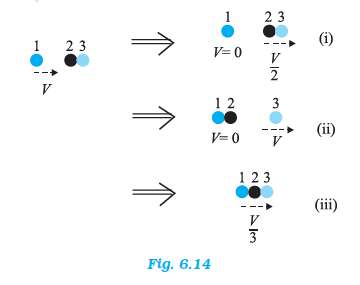
Two identical ball bearings in contact with each other and resting on a frictionless table are hit head-on by another ball bearing of the same mass moving initially with a speed $V$. If the collision is elastic, which of the following (Fig. 6.14) is a possible result after collision ?
Solution :
Initial State Configuration
We consider three identical ball bearings, each of mass $m$. Let the initial state be defined as:
- Ball 1 (moving): Velocity $\vec{u}_1 = V \hat{i}$
- Ball 2 (stationary): Velocity $\vec{u}_2 = 0$
- Ball 3 (stationary): Velocity $\vec{u}_3 = 0$
Total initial momentum $P_i = m(V) + m(0) + m(0) = mV$.
Total initial kinetic energy $K_i = \frac{1}{2}mV^2$.
Conservation Laws in Elastic Collisions
For an elastic collision, both linear momentum and kinetic energy must be conserved [Per the Law of Conservation of Momentum and the Definition of Elastic Collision].
- $\sum \vec{p}_{initial} = \sum \vec{p}_{final}$
- $\sum K_{initial} = \sum K_{final}$
Evaluation of Final State Hypotheses
Let the final velocities of the three balls be $v_1, v_2,$ and $v_3$ respectively.
| Scenario | Final Velocities | Momentum Sum | Kinetic Energy Sum |
|---|---|---|---|
| Case I (Individual motion) | $v_1=0, v_2=0, v_3=V$ | $mV$ (Conserved) | $\frac{1}{2}mV^2$ (Conserved) |
| Case II (Collective motion) | $v_1=0, v_2=V/2, v_3=V/2$ | $mV$ (Conserved) | $\frac{1}{4}mV^2$ (NOT Conserved) |
| Case III (Group motion) | $v_1=V/3, v_2=V/3, v_3=V/3$ | $mV$ (Conserved) | $\frac{1}{6}mV^2$ (NOT Conserved) |
Mathematical Verification of Case I
In Case I, where the first ball comes to rest and the third ball carries the total momentum $V$:
Conservation of Momentum: $mv_1 + mv_2 + mv_3 = m(0) + m(0) + m(V) = mV$. This matches the initial momentum [By Conservation of Momentum Principle].
Conservation of Kinetic Energy: $\frac{1}{2}mv_1^2 + \frac{1}{2}mv_2^2 + \frac{1}{2}mv_3^2 = 0 + 0 + \frac{1}{2}mV^2 = \frac{1}{2}mV^2$. This matches the initial kinetic energy [By Conservation of Energy Principle].
Vector Representation of the Elastic Collision
Conclusion of Analysis
Only the scenario where the third ball (the one on the far right) moves away with velocity $V$ while the others remain stationary satisfies both the conservation of linear momentum and the conservation of kinetic energy simultaneously. Any division of energy among multiple balls results in a loss of total kinetic energy compared to the initial state, which violates the definition of a perfectly elastic collision [Per the definition of elastic collisions in one dimension].
Final Solution: The only possible result is Case I, where the first two balls remain at rest and the third ball moves forward with velocity $V$.
More Questions from Class 11 Physics Work EXERCISES
- Q5.1(a): The sign of work done by a force on a body is important to understand. State carefully if the following quantity is positive or negative: work done by a man in lifting a bucket out of a well by means of a rope tied to the bucket.
- Q5.1(b): The sign of work done by a force on a body is important to understand. State carefully if the following quantity is positive or negative: work done by gravitational force in the above case,
- Q5.1(c): The sign of work done by a force on a body is important to understand. State carefully if the following quantity is positive or negative: work done by friction on a body sliding down an inclined plane,
- Q5.1(d): The sign of work done by a force on a body is important to understand. State carefully if the following quantity is positive or negative: work done by an applied force on a body moving on a rough horizontal plane with uniform velocity,
- Q5.1(e): The sign of work done by a force on a body is important to understand. State carefully if the following quantity is positive or negative: work done by the resistive force of air on a vibrating pendulum in bringing it to rest.
- Q5.10: A body is moving unidirectionally under the influence of a source of constant power. Its displacement in time (t) is proportional to
- Q5.11: A body constrained to move along the z-axis of a coordinate system is subject to a constant force F given by (F = -\hat{i} + 2\hat{j} + 3\hat{k}) N where (\hat{i}, \hat{j}, \hat{k}) are unit vectors along the x-, y- and z-axis of the system respectively. What is the work done by this force in moving the body a distance of 4 m along the z-axis ?
- Q5.12: An electron and a proton are detected in a cosmic ray experiment, the first with kinetic energy 10 keV, and the second with 100 keV. Which is faster, the electron or the proton ? Obtain the ratio of their speeds. (electron mass = (9.11 \times 10^{-31}) kg, proton mass = (1.67 \times 10^{-27}) kg, 1 eV = (1.60 \times 10^{-19}) J).
- Q5.13: A rain drop of radius 2 mm falls from a height of 500 m above the ground. It falls with decreasing acceleration (due to viscous resistance of the air) until at half its original height, it attains its maximum (terminal) speed, and moves with uniform speed thereafter. What is the work done by the gravitational force on the drop in the first and second half of its journey ? What is the work done by the resistive force in the entire journey if its speed on reaching the ground is (10 m s^{-1}) ?
- Q5.14: A molecule in a gas container hits a horizontal wall with speed (200 m s^{-1}) and angle (30^{\circ}) with the normal, and rebounds with the same speed. Is momentum conserved in the collision ? Is the collision elastic or inelastic ?
- Q5.15: A pump on the ground floor of a building can pump up water to fill a tank of volume (30 m^{3}) in 15 min. If the tank is 40 m above the ground, and the efficiency of the pump is 30%, how much electric power is consumed by the pump ?
- Q5.16: Two identical ball bearings in contact with each other and resting on a frictionless table are hit head-on by another ball bearing of the same mass moving initially with a speed V. If the collision is elastic, which of the following is a possible result after collision ?
- Q5.17: The bob A of a pendulum released from (30^{\circ}) to the vertical hits another bob B of the same mass at rest on a table as shown. How high does the bob A rise after the collision ? Neglect the size of the bobs and assume the collision to be elastic.
- Q5.18: The bob of a pendulum is released from a horizontal position. If the length of the pendulum is 1.5 m, what is the speed with which the bob arrives at the lowermost point, given that it dissipated 5% of its initial energy against air resistance ?
- Q5.19: A trolley of mass 300 kg carrying a sandbag of 25 kg is moving uniformly with a speed of 27 km/h on a frictionless track. After a while, sand starts leaking out of a hole on the floor of the trolley at the rate of (0.05 kg s^{-1}). What is the speed of the trolley after the entire sand bag is empty ?
- Q5.2: A body of mass 2 kg initially at rest moves under the action of an applied horizontal force of 7 N on a table with coefficient of kinetic friction = 0.1. Compute the (a) work done by the applied force in 10 s, (b) work done by friction in 10 s, (c) work done by the net force on the body in 10 s, (d) change in kinetic energy of the body in 10 s, and interpret your results.
- Q5.20: A body of mass 0.5 kg travels in a straight line with velocity (v = a x^{3/2}) where (a = 5 m^{-1/2} s^{-1}). What is the work done by the net force during its displacement from (x = 0) to (x = 2 m) ?
- Q5.21(a): The blades of a windmill sweep out a circle of area A. If the wind flows at a velocity (v) perpendicular to the circle, what is the mass of the air passing through it in time (t) ?
- Q5.21(b): The blades of a windmill sweep out a circle of area A. What is the kinetic energy of the air ?
- Q5.21(c): The blades of a windmill sweep out a circle of area A. Assume that the windmill converts 25% of the wind’s energy into electrical energy, and that (A = 30 m^{2}), (v = 36 km/h) and the density of air is (1.2 kg m^{-3}). What is the electrical power produced ?
- Q5.22(a): A person trying to lose weight (dieter) lifts a 10 kg mass, one thousand times, to a height of 0.5 m each time. Assume that the potential energy lost each time she lowers the mass is dissipated. How much work does she do against the gravitational force ?
- Q5.22(b): A person trying to lose weight (dieter) lifts a 10 kg mass, one thousand times, to a height of 0.5 m each time. Assume that the potential energy lost each time she lowers the mass is dissipated. Fat supplies (3.8 \times 10^{7}J) of energy per kilogram which is converted to mechanical energy with a 20% efficiency rate. How much fat will the dieter use up?
- Q5.23(a): A family uses 8 kW of power. Direct solar energy is incident on the horizontal surface at an average rate of 200 W per square meter. If 20% of this energy can be converted to useful electrical energy, how large an area is needed to supply 8 kW?
- Q5.23(b): A family uses 8 kW of power. Compare this area to that of the roof of a typical house.
- Q5.3: Given are examples of some potential energy functions in one dimension. The total energy of the particle is indicated by a cross on the ordinate axis. In each case, specify the regions, if any, in which the particle cannot be found for the given energy. Also, indicate the minimum total energy the particle must have in each case. Think of simple physical contexts for which these potential energy shapes are relevant.
- Q5.4: The potential energy function for a particle executing linear simple harmonic motion is given by (V(x) = \frac{kx^{2}}{2}), where (k) is the force constant of the oscillator. For (k = 0.5 N m^{-1}), the graph of (V(x)) versus (x) is shown. Show that a particle of total energy 1 J moving under this potential must ‘turn back’ when it reaches (x = \pm 2 m).
- Q5.5(a): Answer the following : The casing of a rocket in flight burns up due to friction. At whose expense is the heat energy required for burning obtained? The rocket or the atmosphere?
- Q5.5(b): Answer the following : Comets move around the sun in highly elliptical orbits. The gravitational force on the comet due to the sun is not normal to the comet’s velocity in general. Yet the work done by the gravitational force over every complete orbit of the comet is zero. Why ?
- Q5.5(c): Answer the following : An artificial satellite orbiting the earth in very thin atmosphere loses its energy gradually due to dissipation against atmospheric resistance, however small. Why then does its speed increase progressively as it comes closer and closer to the earth ?
- Q5.5(d): In one case, a man walks 2 m carrying a mass of 15 kg on his hands. In another case, he walks the same distance pulling a rope behind him. The rope goes over a pulley, and a mass of 15 kg hangs at its other end. In which case is the work done greater?
- Q5.6(a): Choose the correct alternative: When a conservative force does positive work on a body, the potential energy of the body increases/decreases/remains unaltered.
- Q5.6(b): Choose the correct alternative: Work done by a body against friction always results in a loss of its kinetic/potential energy.
- Q5.6(c): Choose the correct alternative: The rate of change of total momentum of a many-particle system is proportional to the external force/sum of the internal forces on the system.
- Q5.6(d): Choose the correct alternative: In an inelastic collision of two bodies, the quantities which do not change after the collision are the total kinetic energy/total linear momentum/total energy of the system of two bodies.
- Q5.7(a): State if the following statement is true or false. Give reasons for your answer. In an elastic collision of two bodies, the momentum and energy of each body is conserved.
- Q5.7(b): State if the following statement is true or false. Give reasons for your answer. Total energy of a system is always conserved, no matter what internal and external forces on the body are present.
- Q5.7(c): State if the following statement is true or false. Give reasons for your answer. Work done in the motion of a body over a closed loop is zero for every force in nature.
- Q5.7(d): State if the following statement is true or false. Give reasons for your answer. In an inelastic collision, the final kinetic energy is always less than the initial kinetic energy of the system.
- Q5.8(a): Answer carefully, with reasons : In an elastic collision of two billiard balls, is the total kinetic energy conserved during the short time of collision of the balls (i.e. when they are in contact) ?
- Q5.8(b): Answer carefully, with reasons : Is the total linear momentum conserved during the short time of an elastic collision of two balls ?
- Q5.8(c): Answer carefully, with reasons : For an inelastic collision, state whether the total kinetic energy is conserved during the short time of collision and whether the total linear momentum is conserved during the same period.
- Q5.8(d): Answer carefully, with reasons : If the potential energy of two billiard balls depends only on the separation distance between their centres, is the collision elastic or inelastic ? (Note, we are talking here of potential energy corresponding to the force during collision, not gravitational potential energy).
- Q5.9: A body is initially at rest. It undergoes one-dimensional motion with constant acceleration. The power delivered to it at time (t) is proportional to
- Q6.1(a): The sign of work done by a force on a body is important to understand. State carefully if the following quantities are positive or negative: (a) work done by a man in lifting a bucket out of a well by means of a rope tied to the bucket.
- Q6.1(b): The sign of work done by a force on a body is important to understand. State carefully if the following quantities are positive or negative: (b) work done by gravitational force in the above case,
- Q6.1(c): The sign of work done by a force on a body is important to understand. State carefully if the following quantities are positive or negative: (c) work done by friction on a body sliding down an inclined plane,
- Q6.1(d): The sign of work done by a force on a body is important to understand. State carefully if the following quantities are positive or negative: (d) work done by an applied force on a body moving on a rough horizontal plane with uniform velocity,
- Q6.1(e): The sign of work done by a force on a body is important to understand. State carefully if the following quantities are positive or negative: (e) work done by the resistive force of air on a vibrating pendulum in bringing it to rest.
- Q6.10: A body is moving unidirectionally under the influence of a source of constant power. Its displacement in time $t$ is proportional to
- Q6.11: A body constrained to move along the z-axis of a coordinate system is subject to a constant force $F$ given by $F = (-\hat{i} + 2\hat{j} + 3\hat{k}) N$ where $\hat{i}, \hat{j}, \hat{k}$ are unit vectors along the x-, y- and z-axis of the system respectively. What is the work done by this force in moving the body a distance of 4 m along the z-axis ?
- Q6.12: An electron and a proton are detected in a cosmic ray experiment, the first with kinetic energy 10 keV, and the second with 100 keV. Which is faster, the electron or the proton ? Obtain the ratio of their speeds. (electron mass = $9.11 \times 10^{-31}$ kg, proton mass = $1.67 \times 10^{-27}$ kg, 1 eV = $1.60 \times 10^{-19}$ J).
- Q6.13: A rain drop of radius 2 mm falls from a height of 500 m above the ground. It falls with decreasing acceleration (due to viscous resistance of the air) until at half its original height, it attains its maximum (terminal) speed, and moves with uniform speed thereafter. What is the work done by the gravitational force on the drop in the first and second half of its journey ? What is the work done by the resistive force in the entire journey if its speed on reaching the ground is $10 \text{ m s}^{-1}$ ?
- Q6.14: A molecule in a gas container hits a horizontal wall with speed $200 \text{ m s}^{-1}$ and angle $30^{\circ}$ with the normal, and rebounds with the same speed. Is momentum conserved in the collision ? Is the collision elastic or inelastic ?
- Q6.15: A pump on the ground floor of a building can pump up water to fill a tank of volume $30 \text{ m}^3$ in 15 min. If the tank is 40 m above the ground, and the efficiency of the pump is 30%, how much electric power is consumed by the pump ?
- Q6.17: The bob $A$ of a pendulum released from $30^{\circ}$ to the vertical hits another bob $B$ of the same mass at rest on a table as shown in Fig. 6.15. How high does the bob $A$ rise after the collision ? Neglect the size of the bobs and assume the collision to be elastic.
- Q6.18: The bob of a pendulum is released from a horizontal position. If the length of the pendulum is 1.5 m, what is the speed with which the bob arrives at the lowermost point, given that it dissipated 5% of its initial energy against air resistance ?
- Q6.19: A trolley of mass 300 kg carrying a sandbag of 25 kg is moving uniformly with a speed of 27 km/h on a frictionless track. After a while, sand starts leaking out of a hole on the floor of the trolley at the rate of $0.05 \text{ kg s}^{-1}$. What is the speed of the trolley after the entire sand bag is empty ?
- Q6.2(a): A body of mass 2 kg initially at rest moves under the action of an applied horizontal force of 7 N on a table with coefficient of kinetic friction = 0.1. Compute the (a) work done by the applied force in 10 s,
- Q6.2(b): A body of mass 2 kg initially at rest moves under the action of an applied horizontal force of 7 N on a table with coefficient of kinetic friction = 0.1. Compute the (b) work done by friction in 10 s,
- Q6.2(c): A body of mass 2 kg initially at rest moves under the action of an applied horizontal force of 7 N on a table with coefficient of kinetic friction = 0.1. Compute the (c) work done by the net force on the body in 10 s,
- Q6.2(d): A body of mass 2 kg initially at rest moves under the action of an applied horizontal force of 7 N on a table with coefficient of kinetic friction = 0.1. Compute the (d) change in kinetic energy of the body in 10 s, and interpret your results.
- Q6.20: A body of mass 0.5 kg travels in a straight line with velocity $v = ax^{3/2}$ where $a = 5 \text{ m}^{-1/2} \text{ s}^{-1}$. What is the work done by the net force during its displacement from $x = 0$ to $x = 2$ m ?
- Q6.21(a): The blades of a windmill sweep out a circle of area $A$. (a) If the wind flows at a velocity $v$ perpendicular to the circle, what is the mass of the air passing through it in time $t$ ?
- Q6.21(b): The blades of a windmill sweep out a circle of area $A$. (b) What is the kinetic energy of the air ?
- Q6.21(c): The blades of a windmill sweep out a circle of area $A$. (c) Assume that the windmill converts 25% of the wind’s energy into electrical energy, and that $A = 30 \text{ m}^2$, $v = 36 \text{ km/h}$ and the density of air is $1.2 \text{ kg m}^{-3}$. What is the electrical power produced ?
- Q6.22(a): A person trying to lose weight (dieter) lifts a 10 kg mass, one thousand times, to a height of 0.5 m each time. Assume that the potential energy lost each time she lowers the mass is dissipated. (a) How much work does she do against the gravitational force ?
- Q6.22(b): A person trying to lose weight (dieter) lifts a 10 kg mass, one thousand times, to a height of 0.5 m each time. Assume that the potential energy lost each time she lowers the mass is dissipated. (b) Fat supplies $3.8 \times 10^7 \text{J}$ of energy per kilogram which is converted to mechanical energy with a 20% efficiency rate. How much fat will the dieter use up?
- Q6.23(a): A family uses 8 kW of power. (a) Direct solar energy is incident on the horizontal surface at an average rate of 200 W per square meter. If 20% of this energy can be converted to useful electrical energy, how large an area is needed to supply 8 kW?
- Q6.23(b): A family uses 8 kW of power. (b) Compare this area to that of the roof of a typical house.
- Q6.3: Given in Fig. 6.11 are examples of some potential energy functions in one dimension. The total energy of the particle is indicated by a cross on the ordinate axis. In each case, specify the regions, if any, in which the particle cannot be found for the given energy. Also, indicate the minimum total energy the particle must have in each case. Think of simple physical contexts for which these potential energy shapes are relevant.
- Q6.4: The potential energy function for a particle executing linear simple harmonic motion is given by $V(x) = \frac{kx^2}{2}$, where $k$ is the force constant of the oscillator. For $k = 0.5 \text{ N m}^{-1}$, the graph of $V(x)$ versus $x$ is shown in Fig. 6.12. Show that a particle of total energy 1 J moving under this potential must ‘turn back’ when it reaches $x = \pm 2$ m.
- Q6.5(a): Answer the following : (a) The casing of a rocket in flight burns up due to friction. At whose expense is the heat energy required for burning obtained? The rocket or the atmosphere?
- Q6.5(b): Answer the following : (b) Comets move around the sun in highly elliptical orbits. The gravitational force on the comet due to the sun is not normal to the comet’s velocity in general. Yet the work done by the gravitational force over every complete orbit of the comet is zero. Why ?
- Q6.5(c): Answer the following : (c) An artificial satellite orbiting the earth in very thin atmosphere loses its energy gradually due to dissipation against atmospheric resistance, however small. Why then does its speed increase progressively as it comes closer and closer to the earth ?
- Q6.5(d): Answer the following : (d) In Fig. 6.13(i) the man walks 2 m carrying a mass of 15 kg on his hands. In Fig. 6.13(ii), he walks the same distance pulling the rope behind him. The rope goes over a pulley, and a mass of 15 kg hangs at its other end. In which case is the work done greater ?
- Q6.6(a): Underline the correct alternative : (a) When a conservative force does positive work on a body, the potential energy of the body...
- Q6.6(b): Underline the correct alternative : (b) Work done by a body against friction always results in a loss of its...
- Q6.6(c): Underline the correct alternative : (c) The rate of change of total momentum of a many-particle system is proportional to the...
- Q6.6(d): Underline the correct alternative : (d) In an inelastic collision of two bodies, the quantities which do not change after the collision are the...
- Q6.7(a): State if each of the following statements is true or false. Give reasons for your answer. (a) In an elastic collision of two bodies, the momentum and energy of each body is conserved.
- Q6.7(b): State if each of the following statements is true or false. Give reasons for your answer. (b) Total energy of a system is always conserved, no matter what internal and external forces on the body are present.
- Q6.7(c): State if each of the following statements is true or false. Give reasons for your answer. (c) Work done in the motion of a body over a closed loop is zero for every force in nature.
- Q6.7(d): State if each of the following statements is true or false. Give reasons for your answer. (d) In an inelastic collision, the final kinetic energy is always less than the initial kinetic energy of the system.
- Q6.8(a): Answer carefully, with reasons : (a) In an elastic collision of two billiard balls, is the total kinetic energy conserved during the short time of collision of the balls (i.e. when they are in contact) ?
- Q6.8(b): Answer carefully, with reasons : (b) Is the total linear momentum conserved during the short time of an elastic collision of two balls ?
- Q6.8(c): Answer carefully, with reasons : (c) What are the answers to (a) and (b) for an inelastic collision ?
- Q6.8(d): Answer carefully, with reasons : (d) If the potential energy of two billiard balls depends only on the separation distance between their centres, is the collision elastic or inelastic ? (Note, we are talking here of potential energy corresponding to the force during collision, not gravitational potential energy).
- Q6.9: A body is initially at rest. It undergoes one-dimensional motion with constant acceleration. The power delivered to it at time $t$ is proportional to
CBSE Solutions for Class 11 Physics Work
Chapters in CBSE - Class 11 Physics
Top Tutors who teach Work



 Top Tutor
 Anna Nagar Mullai Nagar, Chennai
 9 yrs of
Exp
 6 students
 420 hrs of classes completed
 600
per hour
 Online Classes
Hi, I'm Kalaiselvi, an M.Sc. Mathematics graduate with 9 years of experience in one-on-one online Maths tutoring. I specialize in teaching Classes 10, 11, and 12 for CBSE and Tamil Nadu State Board. My classes are conducted in both English and Tamil (bilingual), making concepts easy to understand. I focus on concept clarity, problem-solving, regular practice, and exam preparation, with personalized attention for every student.
Great experience with Kalaiselvi Ma'am, her knowledge and skill on the subject are amazing. Thank you for your support and guidance.


 Top Tutor
Mukherjee Nagar, Delhi
5 yrs of
Exp
2057 hrs of classes completed
500
per hour
Online Classes
Hi, I am Neeraj Dwivedi Top Tutor and partner at Urban Pro . Into profession of teaching since last four years. Expertise and specialization in guiding students on subjects like History, Political Science, Economics and Hindi. These subjects were my strength in my journey of Civil Services and later helped in shaping future of students. Apart from teaching guidance I have been doing career counselling of students as to what to pursue/not pursue after school based on individual interests and capabilities.
I scored above in all three subjects and you are good in explaining the details, I really amazed by your teaching style.


 Top Tutor
Vayusenabad, Delhi
5 yrs of
Exp
5 students
118 hrs of classes completed
400
per hour
Online Classes
One of the key challenges in teaching commerce is the diversity of students’ learning styles. Some students may excel in theory, while others may struggle with calculations or interpreting financial statements. As a commerce teacher, you need to be adaptable—using visual aids, group work, and real-world scenarios to make abstract concepts more understandable. For example, showing a video on how a business grows can bring the business theory to life in a way that reading a textbook may not. You might begin a lesson by discussing real-world examples, such as current economic trends, business case studies, or financial news. This helps students connect theoretical concepts to practical situations. For example, when teaching accounting principles, you might ask students to work through a mock company’s balance sheet or profit and loss statement, making the material more tangible. Regular quizzes, assignments, and group projects can be used to assess both theoretical knowledge and practical application of commerce concepts. For instance, group projects in business studies might involve students creating a business plan or analyzing a company’s performance, fostering teamwork and real-world problem-solving.
He classes are really interesting, ma'am makes the classes really fun so that understanding becomes easier.
 Top Tutor
Shastri Colony, Panipat
7 yrs of
Exp
17 students
898 hrs of classes completed
500
per hour
Online Classes
 Tutor's home
Experienced Educator specializing in Physics. I have entered into the field of teaching and started to make and feel physics easy and exciting by the students and also make students to crack the most of the competitive examinations by which I will make them achieve their goals in future. I have been successfully training students from class 10t,11th and 12th for the last 11 years in Physics, along with JEE Mains & Advanced, NEET exam preparation. With 11 years of teaching experience and a background in Unacademy ( Doubt Solving Expert) and Filo Edutech Platform, I provide comprehensive coaching for students preparing for board exams and competitive tests.
A good, kind and a patient teacher, who creates a positive and a supportive environment for her students.


 Top Tutor
Chuna Bhatti, Bhopal
13 yrs of
Exp
1 student
58 hrs of classes completed
800
per hour
Online Classes
"I'm a passionate and experienced educator with a strong background in Accountancy. With 12 years of teaching experience, I've developed a proven track record of helping students achieve their academic goals. My Approach I believe in creating a supportive and engaging learning environment that fosters curiosity, creativity, and critical thinking. My teaching approach is tailored to meet the unique needs and learning styles of each student. Subjects I Teach - Accountancy - Business Studies - Commerce Qualifications - CMA (Cost And Management Accountant - MBA Finance What You Can Expect - Personalised attention and guidance - Customised lesson plans to suit your learning needs - Regular progress tracking and feedback - A safe and encouraging environment to ask questions and learn Let's Connect! If you're looking for a dedicated and experienced educator to help you achieve your academic goals, let's get started! Book a trial session today and see the difference for yourself."
Sir, I still remember your lessons. Whatever I studied, I always studied it in a different way. Your motivation, your way of building confidence, everything was different. Thank you Sir.



