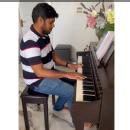
Piano learning pillars 01 — Technique Posture, hand position, finger independence, scales, arpeggios and coordination. 02 — Reading Treble clef, bass clef, rhythm, notation, key signatures and time signatures. 03 — Chords & Harmony Chord construction, progressions and accompaniment. 04 — Repertoire Bollywood, contemporary and structured performance pieces. 05 — Composition Melody writing, harmony, song structure and arrangement. I have experience teaching **Piano, Western Staff Notation, Bollywood Songs, and fundamental Music Reading, Writing, and Composition** to learners at beginner and intermediate levels. My teaching approach combines practical keyboard training with a strong understanding of musical notation, enabling students to develop both performance skills and musical independence. PIANO WESTERN STAFF NOTATION MUSIC READING & WRITING MUSIC COMPOSITION In **Piano**, I teach proper sitting posture, hand position, finger technique, basic scales, chords, arpeggios, rhythm, coordination between both hands, and progressively structured exercises. I help students develop confidence on the keyboard through practical pieces and familiar songs while building a strong technical foundation. For **Western Staff Notation**, I teach students how to identify the treble and bass clefs, read notes on the staff, understand note values and rests, recognize key signatures and time signatures, follow rhythmic patterns, and translate written notation into practical piano playing. I also introduce students to intervals, scales, chords, dynamics, articulation, and other essential musical symbols. I have particular interest in teaching **Bollywood songs on piano**, using familiar melodies to make learning engaging and practical. Students learn melody lines, chord progressions, accompaniment patterns, rhythm, and song structure. Where appropriate, I simplify arrangements according to the student's level while gradually developing the skills required to perform fuller arrangements. In **Music Reading and Writing**, I teach students how to understand musical ideas visually and communicate them through standard Western notation. This includes writing melodies, rhythms, scales, intervals, chords, and basic musical arrangements. I also guide students in **Music Composition**, helping them develop original musical ideas rather than only reproducing existing songs. This includes creating melodies, selecting chords, developing chord progressions, understanding harmony, experimenting with rhythm and song structure, and arranging ideas for piano. My overall teaching philosophy is to connect **theory with practical musicianship**. I encourage students to listen carefully, read accurately, practise systematically, understand what they are playing, and gradually develop the ability to learn, write, arrange, and compose music independently.



 Highly Rated Tutors




 Sector 33, Gurgaon



































































 Free Demo Class


