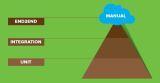
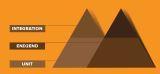
The goal of test automation is to accelerate the feedback cycle. In order to achieve this goal it is important to use the right mix of diferent test types. The testing pyramid is a concept that visualizes this distribution of testing types.
The idea is that on the bottom of the pyramid there is a large base of fast, technology facing tests. Since these tests run fast, and are inexpensive to create, it's no problem to aim for a high coverage in this area.
Higher up the pyramid there is a smaller set of business facing tests. These business facing tests are far more costly to develop, execute and maintain, so aim to keep this set as small as possible.
In practice, it's easy however to deviate from the distribution as depicted above. Below we describe some of the most common anti-patterns.
Do you recognize one of these anti-patterns in your own automation setup?
* ICE-CREAM CONE *
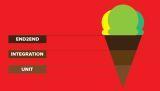
One of the most common anti-patterns is the so called ice-cream cone.
What happens is that the test automation efort is focused on automating manual test scenario's. In nearly all cases this means that the automation is done through the GUI, over the entire application landscape
Tests on more isolated components are rare or non-existent.
The drawback of this approach is that you cannot achieve true fast feedback (there is still a considerable gap between code commits and the test feedback), the tests take long to develop and are difcult to maintain.
Because all the tests require a fully integrated environment to run, test data management becomes increasingly challenging as well.
* CUPCAKE PATTERN *
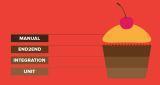
Testing isn't a team efort, everybody is involved but nobody is communicating.
Developers are responsible for Unit and API tests. End2end tests are build by a test automation team. And exploratory tests are done by manual testers.
The teams do not agree on the scenarios that have to be tested or the level of test automation. This results in duplication - the same scenario ends up being automated at many diferent levels.
* HOURGLASS *
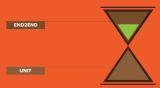
By only using the familiar and easy test mythologies, you will end up with an hourglass model where a few testtypes are overrepresented. For instance, unit tests are made by developers, end2end tests are made by testers, and other testtypes are ignored altogether.
In practice this means that either too much is being tested at the end to end level, or essential coverage is missing. Usually, it's a combination of both.
* DUAL PYRAMID *
Focus on the testing pyramid is going as it is supposed to be.
However, the diferent expertises aren't collaborating. Test professionals are operating in a separate team, which leads to developers and business who won't feel any responsibility for failures.
This scenario will lead to a long feedback cycle because of the walls between the diferent expertises.
Behavior-driven development (BDD) is a popular and acknowledged Software testing methodology. Behavior driven testing (BDT) is not that popular, but is a companion of BDD. BDT can be used without BDD.
BDD...
In this, I'm going to explain types of Software Development Life Cycle methods
In earlier days many organisations follows these model:
1. Waterfall Model
2. Prototype Model
3. Incremental Model
4....
Hi I am Rajesh,
Here we have three types of wait methods in Selenium:
1.Implicitly Wait: Wait if required, otherwise, if the accuracy will good program will move to next level In General most of the...
After listening to many testers who want to learn Selenium, I wanted to provide some guidelines which will help learning Selenium.
Some of the very much popular questions I saw on Selenium forums are:
I...
Software testing course.
Software testing training course
What is software testing?
Why is testing necessary?
Testing Participants
Testing Principles
Best Practices in Testing
Skills For Testing
Software...