



 You have successfully registered

About this Class
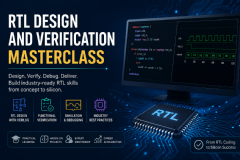
This RTL Design class is designed to provide a strong foundation in digital hardware design using Verilog HDL. You will learn how to convert digital system specifications into synthesizable Register Transfer Level (RTL) code by following industry-standard coding practices.
Through hands-on examples, coding exercises, simulations, and mini-projects, you'll gain practical experience in designing combinational and sequential circuits, finite state machines (FSMs), counters, shift registers, memories, and other essential digital components.
By the end of this class, you will be able to write clean, synthesizable RTL code, debug designs using simulation tools, and build a solid foundation for advanced VLSI Design and Verification.
What You'll Learn:
-
RTL Design Fundamentals
-
Verilog HDL Syntax and Coding
-
Combinational & Sequential Logic Design
-
Multiplexers, Encoders, Decoders, and ALUs
-
Counters, Shift Registers, and Memories
-
Finite State Machine (FSM) Design
-
Coding Guidelines & Best Practices
-
RTL Simulation and Debugging
-
Hands-on RTL Design Projects
Who Should Join?
-
ECE/EEE students
-
Fresh graduates preparing for VLSI careers
-
FPGA and ASIC design enthusiasts
-
Engineers looking to strengthen their RTL design skills
Prerequisites:
Basic knowledge of Digital Electronics and Boolean Algebra is recommended, but the course begins with the fundamentals, making it suitable for beginners.







 View this Course





 Certified



