



Find the best tutors and institutes for Class 12 Tuition
Q8.1(c):
Figure 8.5 shows a capacitor made of two circular plates each of radius 12 cm, and separated by 5.0 cm. The capacitor is being charged by an external source (not shown in the figure). The charging current is constant and equal to 0.15A. (c) Is Kirchhoff’s first rule (junction rule) valid at each plate of the capacitor? Explain.
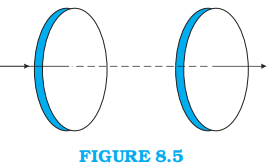
Figure 8.5 shows a capacitor made of two circular plates each of radius 12 cm, and separated by 5.0 cm. The capacitor is being charged by an external source (not shown in the figure). The charging current is constant and equal to 0.15A. (c) Is Kirchhoff’s first rule (junction rule) valid at each plate of the capacitor? Explain.
Solution :
Step 1: Analyzing the Current Flow in the Capacitor Circuit
To determine the validity of Kirchhoff’s Junction Rule, we must analyze the conduction current ($I_c$) and the displacement current ($I_d$). Per the definition of conduction current, the current $I = 0.15 \, \text{A}$ flows through the connecting wires to the plates. However, there is no physical wire connecting the two plates across the gap of $5.0 \, \text{cm}$.
According to Maxwell’s modification of Ampere’s Law, the total current $I_{\text{total}}$ flowing through any surface is the sum of conduction current and displacement current: $I_{\text{total}} = I_c + \epsilon_0 \frac{d\Phi_E}{dt}$, where $\Phi_E$ is the electric flux [Per Ampere-Maxwell Law].
Step 2: Evaluating the Junction Rule at the Plates
Kirchhoff’s First Rule (Junction Rule) states that the sum of currents entering a junction must equal the sum of currents leaving it ($\sum I = 0$).
- At the external terminal of a capacitor plate: The wire carries a conduction current $I_c = 0.15 \, \text{A}$ toward the plate.
- Inside the capacitor gap: There is no conduction current ($I_c = 0$), but there is a time-varying electric field due to the accumulation of charge ($q$) on the plates, which generates a displacement current $I_d = \frac{dq}{dt}$.
- By charge conservation, the rate at which charge accumulates on the plate ($\frac{dq}{dt}$) must equal the conduction current entering the plate ($I_c = 0.15 \, \text{A}$).
Step 3: Synthesis of Displacement Current
Since the displacement current $I_d$ is mathematically equivalent to the rate of change of electric flux, $I_d = \epsilon_0 \frac{d\Phi_E}{dt}$. For a parallel plate capacitor, this displacement current is exactly equal to the conduction current $I_c$ supplied by the external circuit: $I_d = I_c = 0.15 \, \text{A}$.
Step 4: Conclusion on Kirchhoff's Junction Rule
If we treat the plate of a capacitor as a junction and include the displacement current alongside the conduction current, Kirchhoff’s junction rule remains valid. The conduction current flowing into the plate is exactly accounted for by the displacement current continuing across the gap. If we restrict the definition of "current" to only conduction current, the rule would appear to fail; however, in the generalized sense of Maxwell's electrodynamics, the total current (conduction + displacement) is conserved at every point in the circuit.
Final Solution: Yes, Kirchhoff’s first rule is valid at the plates of the capacitor, provided that the displacement current ($I_d = 0.15 \, \text{A}$) is included in the junction calculation to account for the total current flow between the plates.
More Questions from Class 12 Physics Electromagnetic Waves EXERCISES
- Q8.1(a): Figure 8.5 shows a capacitor made of two circular plates each of radius 12 cm, and separated by 5.0 cm. The capacitor is being charged by an external source (not shown in the figure). The charging current is constant and equal to 0.15A. (a) Calculate the capacitance and the rate of change of potential difference between the plates.
- Q8.1(a): Figure 8.5 shows a capacitor made of two circular plates each of radius 12 cm, and separated by 5.0 cm. The capacitor is being charged by an external source (not shown in the figure). The charging current is constant and equal to 0.15A. (a) Calculate the capacitance and the rate of change of potential difference between the plates.
- Q8.1(b): Figure 8.5 shows a capacitor made of two circular plates each of radius 12 cm, and separated by 5.0 cm. The capacitor is being charged by an external source (not shown in the figure). The charging current is constant and equal to 0.15A. (b) Obtain the displacement current across the plates.
- Q8.1(b): Figure 8.5 shows a capacitor made of two circular plates each of radius 12 cm, and separated by 5.0 cm. The capacitor is being charged by an external source (not shown in the figure). The charging current is constant and equal to 0.15A. (b) Obtain the displacement current across the plates.
- Q8.1(c): Figure 8.5 shows a capacitor made of two circular plates each of radius 12 cm, and separated by 5.0 cm. The capacitor is being charged by an external source (not shown in the figure). The charging current is constant and equal to 0.15A. (c) Is Kirchhoff’s first rule (junction rule) valid at each plate of the capacitor? Explain.
- Q8.10(a): In a plane electromagnetic wave, the electric field oscillates sinusoidally at a frequency of $2.0 \times 10^{10}$ Hz and amplitude $48 \text{ V m}^{-1}$. (a) What is the wavelength of the wave?
- Q8.10(a): In a plane electromagnetic wave, the electric field oscillates sinusoidally at a frequency of $(2.0 \times 10^{10} \text{ Hz})$ and amplitude $(48 \text{ V m}^{-1})$. (a) What is the wavelength of the wave?
- Q8.10(b): In a plane electromagnetic wave, the electric field oscillates sinusoidally at a frequency of $2.0 \times 10^{10}$ Hz and amplitude $48 \text{ V m}^{-1}$. (b) What is the amplitude of the oscillating magnetic field?
- Q8.10(b): In a plane electromagnetic wave, the electric field oscillates sinusoidally at a frequency of $(2.0 \times 10^{10} \text{ Hz})$ and amplitude $(48 \text{ V m}^{-1})$. (b) What is the amplitude of the oscillating magnetic field?
- Q8.10(c): In a plane electromagnetic wave, the electric field oscillates sinusoidally at a frequency of $2.0 \times 10^{10}$ Hz and amplitude $48 \text{ V m}^{-1}$. (c) Show that the average energy density of the $E$ field equals the average energy density of the $B$ field. [$c = 3 \times 10^8 \text{ m s}^{-1}$.]
- Q8.10(c): In a plane electromagnetic wave, the electric field oscillates sinusoidally at a frequency of $(2.0 \times 10^{10} \text{ Hz})$ and amplitude $(48 \text{ V m}^{-1})$. (c) Show that the average energy density of the $(E)$ field equals the average energy density of the $(B)$ field. [$(c = 3 \times 10^{8} \text{ m s}^{-1})$.]
- Q8.2(a): A parallel plate capacitor (Fig. 8.6) made of circular plates each of radius $R = 6.0$ cm has a capacitance $C = 100$ pF. The capacitor is connected to a $230$ V ac supply with a (angular) frequency of $300 \text{ rad s}^{-1}$. (a) What is the rms value of the conduction current?
- Q8.2(a): A parallel plate capacitor (Fig. 8.6) made of circular plates each of radius $(R = 6.0 \text{ cm})$ has a capacitance $(C = 100 \text{ pF})$. The capacitor is connected to a 230 V ac supply with a (angular) frequency of $(300 \text{ rad s}^{-1})$. (a) What is the rms value of the conduction current?
- Q8.2(b): A parallel plate capacitor (Fig. 8.6) made of circular plates each of radius $R = 6.0$ cm has a capacitance $C = 100$ pF. The capacitor is connected to a $230$ V ac supply with a (angular) frequency of $300 \text{ rad s}^{-1}$. (b) Is the conduction current equal to the displacement current?
- Q8.2(b): A parallel plate capacitor (Fig. 8.6) made of circular plates each of radius $(R = 6.0 \text{ cm})$ has a capacitance $(C = 100 \text{ pF})$. The capacitor is connected to a 230 V ac supply with a (angular) frequency of $(300 \text{ rad s}^{-1})$. (b) Is the conduction current equal to the displacement current?
- Q8.2(c): A parallel plate capacitor (Fig. 8.6) made of circular plates each of radius $R = 6.0$ cm has a capacitance $C = 100$ pF. The capacitor is connected to a $230$ V ac supply with a (angular) frequency of $300 \text{ rad s}^{-1}$. (c) Determine the amplitude of $B$ at a point 3.0 cm from the axis between the plates.
- Q8.2(c): A parallel plate capacitor (Fig. 8.6) made of circular plates each of radius $(R = 6.0 \text{ cm})$ has a capacitance $(C = 100 \text{ pF})$. The capacitor is connected to a 230 V ac supply with a (angular) frequency of $(300 \text{ rad s}^{-1})$. (c) Determine the amplitude of $(B)$ at a point 3.0 cm from the axis between the plates.
- Q8.3: What physical quantity is the same for X-rays of wavelength $10^{-10}$ m, red light of wavelength $6800$ Å and radiowaves of wavelength $500$m?
- Q8.3: What physical quantity is the same for X-rays of wavelength $(10^{-10} \text{ m})$, red light of wavelength $(6800 \text{ Å})$ and radiowaves of wavelength 500m?
- Q8.4: A plane electromagnetic wave travels in vacuum along $z$-direction. What can you say about the directions of its electric and magnetic field vectors? If the frequency of the wave is $30$ MHz, what is its wavelength?
- Q8.4: A plane electromagnetic wave travels in vacuum along z-direction. What can you say about the directions of its electric and magnetic field vectors? If the frequency of the wave is 30 MHz, what is its wavelength?
- Q8.5: A radio can tune in to any station in the $7.5$ MHz to $12$ MHz band. What is the corresponding wavelength band?
- Q8.5: A radio can tune in to any station in the 7.5 MHz to 12 MHz band. What is the corresponding wavelength band?
- Q8.6: A charged particle oscillates about its mean equilibrium position with a frequency of $10^9$ Hz. What is the frequency of the electromagnetic waves produced by the oscillator?
- Q8.6: A charged particle oscillates about its mean equilibrium position with a frequency of $(10^{9} \text{ Hz})$. What is the frequency of the electromagnetic waves produced by the oscillator?
- Q8.7: The amplitude of the magnetic field part of a harmonic electromagnetic wave in vacuum is $B_0 = 510$ nT. What is the amplitude of the electric field part of the wave?
- Q8.7: The amplitude of the magnetic field part of a harmonic electromagnetic wave in vacuum is $(B_{0} = 510 \text{ nT})$. What is the amplitude of the electric field part of the wave?
- Q8.8(a): Suppose that the electric field amplitude of an electromagnetic wave is $E_0 = 120$ N/C and that its frequency is $\nu = 50.0$ MHz. (a) Determine, $B_0, \omega, k$, and $\lambda$.
- Q8.8(a): Suppose that the electric field amplitude of an electromagnetic wave is $(E_{0} = 120 \text{ N/C})$ and that its frequency is $(n = 50.0 \text{ MHz})$. (a) Determine, $(B_{0})$, $(\omega)$, $(k)$, and $(\lambda)$.
- Q8.8(b): Suppose that the electric field amplitude of an electromagnetic wave is $E_0 = 120$ N/C and that its frequency is $\nu = 50.0$ MHz. (b) Find expressions for $E$ and $B$.
- Q8.8(b): Suppose that the electric field amplitude of an electromagnetic wave is $(E_{0} = 120 \text{ N/C})$ and that its frequency is $(n = 50.0 \text{ MHz})$. (b) Find expressions for $(E)$ and $(B)$.
- Q8.9: The terminology of different parts of the electromagnetic spectrum is given in the text. Use the formula $E = h\nu$ (for energy of a quantum of radiation: photon) and obtain the photon energy in units of eV for different parts of the electromagnetic spectrum. In what way are the different scales of photon energies that you obtain related to the sources of electromagnetic radiation?
- Q8.9: The terminology of different parts of the electromagnetic spectrum is given in the text. Use the formula $(E = h\nu)$ (for energy of a quantum of radiation: photon) and obtain the photon energy in units of eV for different parts of the electromagnetic spectrum. In what way are the different scales of photon energies that you obtain related to the sources of electromagnetic radiation?
CBSE Solutions for Class 12 Physics Electromagnetic Waves
Chapters in CBSE - Class 12 Physics
- Electric Charges and Fields
- Electrostatic Potential and Capacitance
- Current Electricity
- Moving Charges and Magnetism
- Magnetism and Matter
- Electromagnetic Induction
- Alternating Current
- Ray Optics and Optical Instruments
- Wave Optics
- Dual Nature of Radiation and Matter
- Atoms
- Nuclei
- Semiconductor Electronics
- Communication Systems
Top Tutors who teach Electromagnetic Waves

 Top Tutor
 Rajarajeshwari Nagar, Bangalore
 12 yrs of
Exp
 51 students
 1960 hrs of classes completed
 500
per hour
 Online Classes
 Student's Home
I have been training students for 12th Board examinations for more than a decade now.
He is outstanding as a teacher, knowledgeable and dedicated. He has helped my daughter so much with his knowledge, that the girl who was just running away from accounts is getting more than 90 percent

 Super Tutor
Arrah Chowk, Arrah
11 yrs of
Exp
23 students
839 hrs of classes completed
400
per hour
Online Classes
A Highly talented Chemistry teacher with excellent communication skills demonstrated by 11 years of teaching experience. Strong theoretical and good knowledge of Chemistry. A good Communication skills to maintain great relationship with students and ability to work well with others. You Can also watch me on my YouTube channel L.k.Soni Chemistry Classes. During live classes developed an approach where students can focus on the classes without any Distraction.
I had the opportunity to attend one-on-one Classes for class 12 CBSE Chemistry with him, and the experience was excellent. His way of explaining concepts is very clear, simple, and easy to understand. He makes sure that every doubt is addressed patiently and focuses not just on memorising reactions and formulas, but on developing a proper understanding of the concepts. I especially appreciated his exam-oriented approach, which makes difficult topics feel much more manageable and helps build confidence for the CBSE Board exams. He is very knowledgeable, supportive, and genuinely dedicated to his students. I would highly recommend his classes to any Class 12 CBSE Chemistry student looking for strong conceptual clarity and effective preparation.


 Top Tutor
Vijay Nagar Colony Sector 9, Ghaziabad
7 yrs of
Exp
55 students
1067 hrs of classes completed
400
per hour
Online Classes
Founder of knowledge park classes. I am a graduate in corporate affairs and administration and CS Final too. I have experience of more than 10 years. Our results have been extra ordinary and one of our student from DPS greater Noida scored 100 marks in accounts in 2021-22 session. Over all all our students have been scoring 95 plus consistently from many years. I have successfully taught students of Amity, DPS, Ryan, gurukul among many others. I teach: Company account Financial management Business studies Mathematics Economics Taxation And all other subjects of Bcom,mcom,CA/CS/CMA.
It was an amazing experience learning with sir .He is absolutely amazing teacher he teaches everything in detail very nicely.
 Top Tutor
Madhurawada, Visakhapatnam
20 yrs of
Exp
87 students
5210 hrs of classes completed
400
per hour
Online Classes
Student's Home
 Tutor's home
I mentored several students for CBSE/ICSE/STATE/NIOS CLASS 12 in PHYSICS for the last 24 years.
Good teaching and knowledge and fun to learn not strict and a fun teacher everything is good with him
 Top Tutor
Karampura, Delhi
10 yrs of
Exp
1 student
5 hrs of classes completed
2500
per hour
Online Classes
Student's Home
I teach and help students to achieve immediate and long term goals. My experience as a personal tutor and the founder of an online educational startup 'MinDely' has helped him gain knowledge of child psychology and understanding students needs and takes measures accordingly. I plan the lessons as per the students ability to cope up and moreover upon their needs. My teaching technique is student friendly and easy to understand which helps students understand it better. Weekly test conducted by him helps the parents to know the students performance.
Awesome, Sir is knowledgeable and experienced he keeps his lessons engaging, effective and fun highly recommended.



