



Find the best tutors and institutes for Class 12 Tuition
Q8.2(c):
A parallel plate capacitor (Fig. 8.6) made of circular plates each of radius $(R = 6.0 \text{ cm})$ has a capacitance $(C = 100 \text{ pF})$. The capacitor is connected to a 230 V ac supply with a (angular) frequency of $(300 \text{ rad s}^{-1})$. (c) Determine the amplitude of $(B)$ at a point 3.0 cm from the axis between the plates.
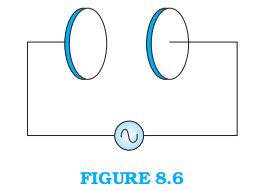
A parallel plate capacitor (Fig. 8.6) made of circular plates each of radius $(R = 6.0 \text{ cm})$ has a capacitance $(C = 100 \text{ pF})$. The capacitor is connected to a 230 V ac supply with a (angular) frequency of $(300 \text{ rad s}^{-1})$. (c) Determine the amplitude of $(B)$ at a point 3.0 cm from the axis between the plates.
Solution :
Step 1: Identifying Given Variables
- Radius of plates, $R = 6.0 \text{ cm} = 6.0 \times 10^{-2} \text{ m}$
- Capacitance, $C = 100 \text{ pF} = 100 \times 10^{-12} \text{ F} = 10^{-10} \text{ F}$
- Supply voltage amplitude, $V_{rms} = 230 \text{ V}$ (Assuming AC supply value is RMS)
- Angular frequency, $\omega = 300 \text{ rad s}^{-1}$
- Radial distance of point from axis, $r = 3.0 \text{ cm} = 3.0 \times 10^{-2} \text{ m}$
Step 2: Calculating Voltage Amplitude ($V_0$)
The supply voltage is typically given as an RMS value. The amplitude $V_0$ is derived as follows:
$V_0 = V_{rms} \times \sqrt{2} = 230 \times 1.414 \approx 325.27 \text{ V}$ [Per standard AC circuit definitions]Step 3: Calculating Displacement Current Amplitude ($I_{d0}$ or $I_0$)
In a capacitor, the displacement current $I_d$ equals the conduction current in the connecting wires. The current amplitude $I_0$ is related to voltage amplitude by the capacitive reactance $X_C = \frac{1}{\omega C}$:
$I_0 = \frac{V_0}{X_C} = V_0 \omega C$ $I_0 = (325.27) \times (300) \times (10^{-10})$ $I_0 = 9.758 \times 10^{-6} \text{ A} \approx 9.76 \times 10^{-6} \text{ A}$Step 4: Applying Modified Ampere-Maxwell Law
According to the Maxwell-Ampere Law for a region between the plates of a circular capacitor, the magnetic field $B$ at a radial distance $r < R$ is given by:
$\oint B \cdot dl = \mu_0 I_d(r)$ $B(2\pi r) = \mu_0 \left( \frac{I_0 \pi r^2}{\pi R^2} \right)$ [Since current density is uniform, $I_d(r) = I_0 \frac{r^2}{R^2}$] $B = \frac{\mu_0 I_0 r}{2\pi R^2}$Step 5: Final Substitution and Calculation
Using $\mu_0 = 4\pi \times 10^{-7} \text{ T m A}^{-1}$:
$B_0 = \frac{(4\pi \times 10^{-7}) \times (9.76 \times 10^{-6}) \times (3.0 \times 10^{-2})}{2\pi \times (6.0 \times 10^{-2})^2}$ $B_0 = \frac{2 \times 10^{-7} \times 9.76 \times 10^{-6} \times 3.0 \times 10^{-2}}{36 \times 10^{-4}}$ $B_0 = \frac{58.56 \times 10^{-15}}{36 \times 10^{-4}}$ $B_0 \approx 1.626 \times 10^{-11} \text{ T}$Final Solution: The amplitude of the magnetic field $B$ at $r = 3.0 \text{ cm}$ is approximately $1.63 \times 10^{-11} \text{ T}$.
More Questions from Class 12 Physics Electromagnetic Waves EXERCISES
- Q8.1(a): Figure 8.5 shows a capacitor made of two circular plates each of radius 12 cm, and separated by 5.0 cm. The capacitor is being charged by an external source (not shown in the figure). The charging current is constant and equal to 0.15A. (a) Calculate the capacitance and the rate of change of potential difference between the plates.
- Q8.1(a): Figure 8.5 shows a capacitor made of two circular plates each of radius 12 cm, and separated by 5.0 cm. The capacitor is being charged by an external source (not shown in the figure). The charging current is constant and equal to 0.15A. (a) Calculate the capacitance and the rate of change of potential difference between the plates.
- Q8.1(b): Figure 8.5 shows a capacitor made of two circular plates each of radius 12 cm, and separated by 5.0 cm. The capacitor is being charged by an external source (not shown in the figure). The charging current is constant and equal to 0.15A. (b) Obtain the displacement current across the plates.
- Q8.1(b): Figure 8.5 shows a capacitor made of two circular plates each of radius 12 cm, and separated by 5.0 cm. The capacitor is being charged by an external source (not shown in the figure). The charging current is constant and equal to 0.15A. (b) Obtain the displacement current across the plates.
- Q8.1(c): Figure 8.5 shows a capacitor made of two circular plates each of radius 12 cm, and separated by 5.0 cm. The capacitor is being charged by an external source (not shown in the figure). The charging current is constant and equal to 0.15A. (c) Is Kirchhoff’s first rule (junction rule) valid at each plate of the capacitor? Explain.
- Q8.1(c): Figure 8.5 shows a capacitor made of two circular plates each of radius 12 cm, and separated by 5.0 cm. The capacitor is being charged by an external source (not shown in the figure). The charging current is constant and equal to 0.15A. (c) Is Kirchhoff’s first rule (junction rule) valid at each plate of the capacitor? Explain.
- Q8.10(a): In a plane electromagnetic wave, the electric field oscillates sinusoidally at a frequency of $2.0 \times 10^{10}$ Hz and amplitude $48 \text{ V m}^{-1}$. (a) What is the wavelength of the wave?
- Q8.10(a): In a plane electromagnetic wave, the electric field oscillates sinusoidally at a frequency of $(2.0 \times 10^{10} \text{ Hz})$ and amplitude $(48 \text{ V m}^{-1})$. (a) What is the wavelength of the wave?
- Q8.10(b): In a plane electromagnetic wave, the electric field oscillates sinusoidally at a frequency of $2.0 \times 10^{10}$ Hz and amplitude $48 \text{ V m}^{-1}$. (b) What is the amplitude of the oscillating magnetic field?
- Q8.10(b): In a plane electromagnetic wave, the electric field oscillates sinusoidally at a frequency of $(2.0 \times 10^{10} \text{ Hz})$ and amplitude $(48 \text{ V m}^{-1})$. (b) What is the amplitude of the oscillating magnetic field?
- Q8.10(c): In a plane electromagnetic wave, the electric field oscillates sinusoidally at a frequency of $2.0 \times 10^{10}$ Hz and amplitude $48 \text{ V m}^{-1}$. (c) Show that the average energy density of the $E$ field equals the average energy density of the $B$ field. [$c = 3 \times 10^8 \text{ m s}^{-1}$.]
- Q8.10(c): In a plane electromagnetic wave, the electric field oscillates sinusoidally at a frequency of $(2.0 \times 10^{10} \text{ Hz})$ and amplitude $(48 \text{ V m}^{-1})$. (c) Show that the average energy density of the $(E)$ field equals the average energy density of the $(B)$ field. [$(c = 3 \times 10^{8} \text{ m s}^{-1})$.]
- Q8.2(a): A parallel plate capacitor (Fig. 8.6) made of circular plates each of radius $R = 6.0$ cm has a capacitance $C = 100$ pF. The capacitor is connected to a $230$ V ac supply with a (angular) frequency of $300 \text{ rad s}^{-1}$. (a) What is the rms value of the conduction current?
- Q8.2(a): A parallel plate capacitor (Fig. 8.6) made of circular plates each of radius $(R = 6.0 \text{ cm})$ has a capacitance $(C = 100 \text{ pF})$. The capacitor is connected to a 230 V ac supply with a (angular) frequency of $(300 \text{ rad s}^{-1})$. (a) What is the rms value of the conduction current?
- Q8.2(b): A parallel plate capacitor (Fig. 8.6) made of circular plates each of radius $R = 6.0$ cm has a capacitance $C = 100$ pF. The capacitor is connected to a $230$ V ac supply with a (angular) frequency of $300 \text{ rad s}^{-1}$. (b) Is the conduction current equal to the displacement current?
- Q8.2(b): A parallel plate capacitor (Fig. 8.6) made of circular plates each of radius $(R = 6.0 \text{ cm})$ has a capacitance $(C = 100 \text{ pF})$. The capacitor is connected to a 230 V ac supply with a (angular) frequency of $(300 \text{ rad s}^{-1})$. (b) Is the conduction current equal to the displacement current?
- Q8.2(c): A parallel plate capacitor (Fig. 8.6) made of circular plates each of radius $R = 6.0$ cm has a capacitance $C = 100$ pF. The capacitor is connected to a $230$ V ac supply with a (angular) frequency of $300 \text{ rad s}^{-1}$. (c) Determine the amplitude of $B$ at a point 3.0 cm from the axis between the plates.
- Q8.3: What physical quantity is the same for X-rays of wavelength $10^{-10}$ m, red light of wavelength $6800$ Å and radiowaves of wavelength $500$m?
- Q8.3: What physical quantity is the same for X-rays of wavelength $(10^{-10} \text{ m})$, red light of wavelength $(6800 \text{ Å})$ and radiowaves of wavelength 500m?
- Q8.4: A plane electromagnetic wave travels in vacuum along $z$-direction. What can you say about the directions of its electric and magnetic field vectors? If the frequency of the wave is $30$ MHz, what is its wavelength?
- Q8.4: A plane electromagnetic wave travels in vacuum along z-direction. What can you say about the directions of its electric and magnetic field vectors? If the frequency of the wave is 30 MHz, what is its wavelength?
- Q8.5: A radio can tune in to any station in the $7.5$ MHz to $12$ MHz band. What is the corresponding wavelength band?
- Q8.5: A radio can tune in to any station in the 7.5 MHz to 12 MHz band. What is the corresponding wavelength band?
- Q8.6: A charged particle oscillates about its mean equilibrium position with a frequency of $10^9$ Hz. What is the frequency of the electromagnetic waves produced by the oscillator?
- Q8.6: A charged particle oscillates about its mean equilibrium position with a frequency of $(10^{9} \text{ Hz})$. What is the frequency of the electromagnetic waves produced by the oscillator?
- Q8.7: The amplitude of the magnetic field part of a harmonic electromagnetic wave in vacuum is $B_0 = 510$ nT. What is the amplitude of the electric field part of the wave?
- Q8.7: The amplitude of the magnetic field part of a harmonic electromagnetic wave in vacuum is $(B_{0} = 510 \text{ nT})$. What is the amplitude of the electric field part of the wave?
- Q8.8(a): Suppose that the electric field amplitude of an electromagnetic wave is $E_0 = 120$ N/C and that its frequency is $\nu = 50.0$ MHz. (a) Determine, $B_0, \omega, k$, and $\lambda$.
- Q8.8(a): Suppose that the electric field amplitude of an electromagnetic wave is $(E_{0} = 120 \text{ N/C})$ and that its frequency is $(n = 50.0 \text{ MHz})$. (a) Determine, $(B_{0})$, $(\omega)$, $(k)$, and $(\lambda)$.
- Q8.8(b): Suppose that the electric field amplitude of an electromagnetic wave is $E_0 = 120$ N/C and that its frequency is $\nu = 50.0$ MHz. (b) Find expressions for $E$ and $B$.
- Q8.8(b): Suppose that the electric field amplitude of an electromagnetic wave is $(E_{0} = 120 \text{ N/C})$ and that its frequency is $(n = 50.0 \text{ MHz})$. (b) Find expressions for $(E)$ and $(B)$.
- Q8.9: The terminology of different parts of the electromagnetic spectrum is given in the text. Use the formula $E = h\nu$ (for energy of a quantum of radiation: photon) and obtain the photon energy in units of eV for different parts of the electromagnetic spectrum. In what way are the different scales of photon energies that you obtain related to the sources of electromagnetic radiation?
- Q8.9: The terminology of different parts of the electromagnetic spectrum is given in the text. Use the formula $(E = h\nu)$ (for energy of a quantum of radiation: photon) and obtain the photon energy in units of eV for different parts of the electromagnetic spectrum. In what way are the different scales of photon energies that you obtain related to the sources of electromagnetic radiation?
CBSE Solutions for Class 12 Physics Electromagnetic Waves
Chapters in CBSE - Class 12 Physics
- Electric Charges and Fields
- Electrostatic Potential and Capacitance
- Current Electricity
- Moving Charges and Magnetism
- Magnetism and Matter
- Electromagnetic Induction
- Alternating Current
- Ray Optics and Optical Instruments
- Wave Optics
- Dual Nature of Radiation and Matter
- Atoms
- Nuclei
- Semiconductor Electronics
- Communication Systems
Top Tutors who teach Electromagnetic Waves


 Top Tutor
 Choolissery, Thrissur
 20 yrs of
Exp
 1 student
 447 hrs of classes completed
 600
per hour
 Online Classes
I'm Sini Jayaraj, and I'm excited to hear about your interest in Class 12 tuition. With over 20 years of experience teaching subjects like Mathematics, Physics, Chemistry, and Science, Teaching is my passion.... Enjoyed well in highschool and higher secondary level.. l'm confident I can help you excel, especially given your immediate start timeline.My background includes a B.Sc., B.Ed., and M.Sc., allowing me to provide a comprehensive understanding of the subjects. I have taught for 214 hours.I focus on making complex topics easy to grasp, perfectly aligning with your goal of simplifying the learning process.Would you be interested in booking a free demo class with me to discuss your specific needs and how I can support you? Or feel free to connect with me to discuss further.Warm regards,Sini Jayaraj secondary levels
Sini mam is very responsible and sinsere teaches. She knows how to teach kids actively &make undestand them concepts clearly.
 Top Tutor
Srinagar, Tirupathi
20 yrs of
Exp
10 students
160 hrs of classes completed
400
per hour
Online Classes
 Tutor's home
I am working as Professor in an engineering college. Due to the passion of teaching I am also working as a Tutor. I have 20 years of teaching experience in engineering as well as 11 and 12 levels. I can build strong fundamentals in physics among the young minds.
The teaching style is clear, engaging, and focused on making complex concepts easy to understand; she clarifies doubts patiently and clearly.


 Top Tutor
Nerul, Mumbai
10 yrs of
Exp
5 students
733 hrs of classes completed
500
per hour
Online Classes
 Student's Home
Tutor's home
For classes 11 and 12, I have experience in teaching core mathematics subjects such as Relations & Functions, Calculus, Vectors, Probability, and more, under the CBSE curriculum. I ensure clarity in concepts, regular practice, and step-wise problem-solving strategies. I emphasize board exam preparation along with competitive exam orientation (CUET, NDA, JEE Main basics). My classes are known for being structured, student-friendly, and focused on individual doubt clearance. Regular assessments, feedback, and revision help students gain confidence and improve performance. I also coordinate with parents and provide progress updates to ensure consistent academic growth.
Sir focuses directly on the specific key topics you need. Instead of overwhelming you with broad concepts all at once, he goes method-by-method. This clear, step-by-step approach makes everything easy to understand and is incredibly useful when you are practicing the problems on your own. Overall, the sessions are fast and productive.
 Top Tutor
Sukhlia, Indore
4 yrs of
Exp
2 students
109 hrs of classes completed
500
per hour
Online Classes
I am pursuing a Ph.D. in Economics from DAVV Indore. I have completed Master of Business Administration. I have also completed a Bachelor of Engineering in Computer Science. I am UGC NET qualified in Economics. and I have more than 4 years of experience in teaching.
Very good. Focuses on conceptual and practical learning. Sir helped me to get better in macroeconomics
 Top Tutor
Padmanabhanagar, Bangalore
3 yrs of
Exp
550
per hour
Online Classes
Student's Home
Tutor's home
I am an experienced tutor with 4 years of experience in this field. I completed my BE in the year 2014. I have tutored students for Spoken English, BTech Tuition, C Language, C++ Language, CAD, CE and COMEDK Coaching. I can conduct classes at Student's Home, My place and Online via a different medium to students from International, CBSE, State, ICSE/ISC Board. I follow different techniques while teaching so, that my students are engaged positively. To make learning fun and easier, I use creative and innovative ideas.
I found Naveen on UrbanPro and he is such a nice person. I called him to ask few general maths questions and he explained it so well over the phone. He is an excellent tutor and moreover a very good hearted person. I would definitely recommended Mr.Naveen to everyone.



