



Find the best tutors and institutes for Class 12 Tuition
Q8.1(b):
Figure 8.5 shows a capacitor made of two circular plates each of radius 12 cm, and separated by 5.0 cm. The capacitor is being charged by an external source (not shown in the figure). The charging current is constant and equal to 0.15A. (b) Obtain the displacement current across the plates.
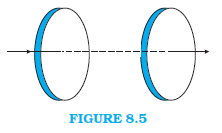
Figure 8.5 shows a capacitor made of two circular plates each of radius 12 cm, and separated by 5.0 cm. The capacitor is being charged by an external source (not shown in the figure). The charging current is constant and equal to 0.15A. (b) Obtain the displacement current across the plates.
Solution :
Given Variables & Initial Setup
To determine the displacement current across the plates of a parallel plate capacitor, we identify the following parameters provided by the problem statement:
- Radius of circular plates ($r$): $12\text{ cm} = 0.12\text{ m}$
- Separation between plates ($d$): $5.0\text{ cm} = 0.05\text{ m}$
- Charging current ($I_c$): $0.15\text{ A}$
Step 1: Theoretical Foundation of Displacement Current
The concept of displacement current ($I_d$) was introduced by James Clerk Maxwell to resolve the inconsistency in Ampere’s circuital law. According to the Maxwell-Ampere Law, the displacement current is defined as the current that arises due to the time-varying electric field between the capacitor plates [Per Maxwell’s modification of Ampere’s Law].
The displacement current is given by the relation:
$I_d = \epsilon_0 \frac{d\Phi_E}{dt}$
Where $\Phi_E$ is the electric flux through the surface between the plates.
Step 2: Establishing the Continuity of Current
In a charging capacitor, the conduction current ($I_c$) flowing through the external circuit must be equal to the displacement current ($I_d$) flowing between the plates to maintain the principle of continuity of charge [Based on the Law of Conservation of Charge and Maxwell’s Equation].
Mathematically, for a parallel plate capacitor:
$I_d = I_c$
Step 3: Logical Deduction
Since the charging current $I_c$ is provided as a constant value of $0.15\text{ A}$, and the capacitor plates are charging such that the charge $q$ on the plates increases at a rate $dq/dt = I_c$, the displacement current must equal the charging current at every instant during the charging process.
Calculation:
$I_d = \frac{dq}{dt} = 0.15\text{ A}$
Visual Representation of Displacement Current
Summary of Variables Analysis
| Variable | Value |
|---|---|
| Conduction Current ($I_c$) | $0.15\text{ A}$ |
| Displacement Current ($I_d$) | $0.15\text{ A}$ |
Final Solution: The displacement current across the plates is 0.15 A.
More Questions from Class 12 Physics Electromagnetic Waves EXERCISES
- Q8.1(a): Figure 8.5 shows a capacitor made of two circular plates each of radius 12 cm, and separated by 5.0 cm. The capacitor is being charged by an external source (not shown in the figure). The charging current is constant and equal to 0.15A. (a) Calculate the capacitance and the rate of change of potential difference between the plates.
- Q8.1(a): Figure 8.5 shows a capacitor made of two circular plates each of radius 12 cm, and separated by 5.0 cm. The capacitor is being charged by an external source (not shown in the figure). The charging current is constant and equal to 0.15A. (a) Calculate the capacitance and the rate of change of potential difference between the plates.
- Q8.1(b): Figure 8.5 shows a capacitor made of two circular plates each of radius 12 cm, and separated by 5.0 cm. The capacitor is being charged by an external source (not shown in the figure). The charging current is constant and equal to 0.15A. (b) Obtain the displacement current across the plates.
- Q8.1(c): Figure 8.5 shows a capacitor made of two circular plates each of radius 12 cm, and separated by 5.0 cm. The capacitor is being charged by an external source (not shown in the figure). The charging current is constant and equal to 0.15A. (c) Is Kirchhoff’s first rule (junction rule) valid at each plate of the capacitor? Explain.
- Q8.1(c): Figure 8.5 shows a capacitor made of two circular plates each of radius 12 cm, and separated by 5.0 cm. The capacitor is being charged by an external source (not shown in the figure). The charging current is constant and equal to 0.15A. (c) Is Kirchhoff’s first rule (junction rule) valid at each plate of the capacitor? Explain.
- Q8.10(a): In a plane electromagnetic wave, the electric field oscillates sinusoidally at a frequency of $2.0 \times 10^{10}$ Hz and amplitude $48 \text{ V m}^{-1}$. (a) What is the wavelength of the wave?
- Q8.10(a): In a plane electromagnetic wave, the electric field oscillates sinusoidally at a frequency of $(2.0 \times 10^{10} \text{ Hz})$ and amplitude $(48 \text{ V m}^{-1})$. (a) What is the wavelength of the wave?
- Q8.10(b): In a plane electromagnetic wave, the electric field oscillates sinusoidally at a frequency of $2.0 \times 10^{10}$ Hz and amplitude $48 \text{ V m}^{-1}$. (b) What is the amplitude of the oscillating magnetic field?
- Q8.10(b): In a plane electromagnetic wave, the electric field oscillates sinusoidally at a frequency of $(2.0 \times 10^{10} \text{ Hz})$ and amplitude $(48 \text{ V m}^{-1})$. (b) What is the amplitude of the oscillating magnetic field?
- Q8.10(c): In a plane electromagnetic wave, the electric field oscillates sinusoidally at a frequency of $2.0 \times 10^{10}$ Hz and amplitude $48 \text{ V m}^{-1}$. (c) Show that the average energy density of the $E$ field equals the average energy density of the $B$ field. [$c = 3 \times 10^8 \text{ m s}^{-1}$.]
- Q8.10(c): In a plane electromagnetic wave, the electric field oscillates sinusoidally at a frequency of $(2.0 \times 10^{10} \text{ Hz})$ and amplitude $(48 \text{ V m}^{-1})$. (c) Show that the average energy density of the $(E)$ field equals the average energy density of the $(B)$ field. [$(c = 3 \times 10^{8} \text{ m s}^{-1})$.]
- Q8.2(a): A parallel plate capacitor (Fig. 8.6) made of circular plates each of radius $R = 6.0$ cm has a capacitance $C = 100$ pF. The capacitor is connected to a $230$ V ac supply with a (angular) frequency of $300 \text{ rad s}^{-1}$. (a) What is the rms value of the conduction current?
- Q8.2(a): A parallel plate capacitor (Fig. 8.6) made of circular plates each of radius $(R = 6.0 \text{ cm})$ has a capacitance $(C = 100 \text{ pF})$. The capacitor is connected to a 230 V ac supply with a (angular) frequency of $(300 \text{ rad s}^{-1})$. (a) What is the rms value of the conduction current?
- Q8.2(b): A parallel plate capacitor (Fig. 8.6) made of circular plates each of radius $R = 6.0$ cm has a capacitance $C = 100$ pF. The capacitor is connected to a $230$ V ac supply with a (angular) frequency of $300 \text{ rad s}^{-1}$. (b) Is the conduction current equal to the displacement current?
- Q8.2(b): A parallel plate capacitor (Fig. 8.6) made of circular plates each of radius $(R = 6.0 \text{ cm})$ has a capacitance $(C = 100 \text{ pF})$. The capacitor is connected to a 230 V ac supply with a (angular) frequency of $(300 \text{ rad s}^{-1})$. (b) Is the conduction current equal to the displacement current?
- Q8.2(c): A parallel plate capacitor (Fig. 8.6) made of circular plates each of radius $R = 6.0$ cm has a capacitance $C = 100$ pF. The capacitor is connected to a $230$ V ac supply with a (angular) frequency of $300 \text{ rad s}^{-1}$. (c) Determine the amplitude of $B$ at a point 3.0 cm from the axis between the plates.
- Q8.2(c): A parallel plate capacitor (Fig. 8.6) made of circular plates each of radius $(R = 6.0 \text{ cm})$ has a capacitance $(C = 100 \text{ pF})$. The capacitor is connected to a 230 V ac supply with a (angular) frequency of $(300 \text{ rad s}^{-1})$. (c) Determine the amplitude of $(B)$ at a point 3.0 cm from the axis between the plates.
- Q8.3: What physical quantity is the same for X-rays of wavelength $10^{-10}$ m, red light of wavelength $6800$ Å and radiowaves of wavelength $500$m?
- Q8.3: What physical quantity is the same for X-rays of wavelength $(10^{-10} \text{ m})$, red light of wavelength $(6800 \text{ Å})$ and radiowaves of wavelength 500m?
- Q8.4: A plane electromagnetic wave travels in vacuum along $z$-direction. What can you say about the directions of its electric and magnetic field vectors? If the frequency of the wave is $30$ MHz, what is its wavelength?
- Q8.4: A plane electromagnetic wave travels in vacuum along z-direction. What can you say about the directions of its electric and magnetic field vectors? If the frequency of the wave is 30 MHz, what is its wavelength?
- Q8.5: A radio can tune in to any station in the $7.5$ MHz to $12$ MHz band. What is the corresponding wavelength band?
- Q8.5: A radio can tune in to any station in the 7.5 MHz to 12 MHz band. What is the corresponding wavelength band?
- Q8.6: A charged particle oscillates about its mean equilibrium position with a frequency of $10^9$ Hz. What is the frequency of the electromagnetic waves produced by the oscillator?
- Q8.6: A charged particle oscillates about its mean equilibrium position with a frequency of $(10^{9} \text{ Hz})$. What is the frequency of the electromagnetic waves produced by the oscillator?
- Q8.7: The amplitude of the magnetic field part of a harmonic electromagnetic wave in vacuum is $B_0 = 510$ nT. What is the amplitude of the electric field part of the wave?
- Q8.7: The amplitude of the magnetic field part of a harmonic electromagnetic wave in vacuum is $(B_{0} = 510 \text{ nT})$. What is the amplitude of the electric field part of the wave?
- Q8.8(a): Suppose that the electric field amplitude of an electromagnetic wave is $E_0 = 120$ N/C and that its frequency is $\nu = 50.0$ MHz. (a) Determine, $B_0, \omega, k$, and $\lambda$.
- Q8.8(a): Suppose that the electric field amplitude of an electromagnetic wave is $(E_{0} = 120 \text{ N/C})$ and that its frequency is $(n = 50.0 \text{ MHz})$. (a) Determine, $(B_{0})$, $(\omega)$, $(k)$, and $(\lambda)$.
- Q8.8(b): Suppose that the electric field amplitude of an electromagnetic wave is $E_0 = 120$ N/C and that its frequency is $\nu = 50.0$ MHz. (b) Find expressions for $E$ and $B$.
- Q8.8(b): Suppose that the electric field amplitude of an electromagnetic wave is $(E_{0} = 120 \text{ N/C})$ and that its frequency is $(n = 50.0 \text{ MHz})$. (b) Find expressions for $(E)$ and $(B)$.
- Q8.9: The terminology of different parts of the electromagnetic spectrum is given in the text. Use the formula $E = h\nu$ (for energy of a quantum of radiation: photon) and obtain the photon energy in units of eV for different parts of the electromagnetic spectrum. In what way are the different scales of photon energies that you obtain related to the sources of electromagnetic radiation?
- Q8.9: The terminology of different parts of the electromagnetic spectrum is given in the text. Use the formula $(E = h\nu)$ (for energy of a quantum of radiation: photon) and obtain the photon energy in units of eV for different parts of the electromagnetic spectrum. In what way are the different scales of photon energies that you obtain related to the sources of electromagnetic radiation?
CBSE Solutions for Class 12 Physics Electromagnetic Waves
Chapters in CBSE - Class 12 Physics
- Electric Charges and Fields
- Electrostatic Potential and Capacitance
- Current Electricity
- Moving Charges and Magnetism
- Magnetism and Matter
- Electromagnetic Induction
- Alternating Current
- Ray Optics and Optical Instruments
- Wave Optics
- Dual Nature of Radiation and Matter
- Atoms
- Nuclei
- Semiconductor Electronics
- Communication Systems
Top Tutors who teach Electromagnetic Waves

 Top Tutor
 Tilakwadi, Belgaum
 6 yrs of
Exp
 33 students
 1000 hrs of classes completed
 450
per hour
 Online Classes
I am a retired Executive Engineer from Karnataka Power Corporation. I was giving tuition at my project quarters to Children of my colleagues, for 1st and 2nd Pre-University level(Class 11 & 12 Level), at Sharavathi Hydro Electric Project, Karnataka, for 6 years. I was teaching Physics, Chemistry and Maths. I am a BE (Electrical) Graduate, from Bangalore University during April 1970. I have a very strong passion for Teaching. I used to give practical examples from my field of service, to develop their fundamental concepts/interest and enthuse them to gain a deeper insight into the in the subject. I used to purchase books of foreign authors to portray the lessons through explanatory photos and diagrams, as there were no electronic educational aids, available during that period (1993 to 1998). Throughout my service in Hydel and Thermal Generating Stations, in design, construction, erection, commissioning and maintenance divisions, I was very much involved/got opportunities in imparting the subject knowledge relevant to the work to, orient my subordinates and colleagues. With the present electronic educational aids , I am confident that I will be able to better justice in teaching the subject.
Mukundan Sir is a really sincere and reliable teacher with wide knowledge. I strongly believe his teaching can make understanding a topic very easy. He pays close attention to what the student needs and teaches in a progressive manner. His dedication towards students can be seen by the notes provided. I am fortunate to have such a teacher. Thank you Sir !



 Super Tutor
Ambala, Ambala
10 yrs of
Exp
4 students
298 hrs of classes completed
185
per hour
Online Classes
I am a History and law graduate, specializing in coaching students appearing for their board exams. From clearing concepts to teaching how to efficiently write answers, I do it all. For Class 12, I focus on: * Clear understanding of concepts, thinkers & case studies * Answer writing practice as per board requirements * Important questions, PYQs & expected topics * Smart revision techniques to improve scores My classes are one-on-one and tailored to your pace so that you feel confident before exams.
I had a great experience with Kanika Ma’am. She taught me political science for my boards. She is a very knowledgeable and kind teacher. Must recommend.



 Top Tutor
Diplana, Diplana
5 yrs of
Exp
4 students
59 hrs of classes completed
300
per hour
Online Classes
 Tutor's home
I have over 5 years of teaching experience in Class 12th Biology and chemistry as well, helping students build a strong foundation for both board exams and NEET preparation. My teaching method is concept-driven, where I explain each topic with clarity, real-life examples, and visual representation using a whiteboard setup, creating a true classroom-like environment. I cover the full Class 12 CBSE syllabus, including all core chapters such as: Reproduction (Human and Plants) Genetics and Evolution Biotechnology Human Health and Disease Ecology and Environment I focus on: NCERT line-by-line explanation Diagram-based questions Important previous year board and NEET questions Tips for writing high-scoring answers in board exams Clarifying complex concepts with simple analogies Many of my students have improved significantly in both their conceptual understanding and exam performance, and some have even scored above 90% in boards and qualified for NEET. My aim is to make Biology interesting and scoring — not just something to memorize, but something to truly understand.
Best tutor for NEET Physics prep! His tricks and concept clarity helped me solve questions faster in mock tests.


 Top Tutor
HSR Layout, Bangalore
6 yrs of
Exp
1 student
850
per hour
Online Classes
 Student's Home
Tutor's home
I have started tutoring from my fist year of engineering. I have given classes in coaching centers for those who prepare for AIEEE and IIT keep. I have scored 97 percent in PUC and 1353 rank in engineering in first attempt. I have given classes for engineering students too.
Ameen sir, i seriously don't have words to express how amazing your session was.I have boosted that enthusiasm which was lacking in me to love what we do or study. Your just mind boggling. I am literally feeling very lucky to be your student sir, thank you so much. Your helping the future youths, for sure we gonna remember you because you will be a part of our success.
 Top Tutor
Agara Village, Bangalore
3 yrs of
Exp
33 hrs of classes completed
950
per hour
Online Classes
Have trained students for NEET and JEE MAINS and now my students are placed in reputated colleges.
I like the way she teach and elaborate aspects. She is the one simplifies complex subject into detailed and understandable thing.



