



Find the best tutors and institutes for Class 11 Tuition
Q14.9(iii):
A spring having with a spring constant $1200 N m^{-1}$ is mounted on a horizontal table as shown in Fig. 14.24. A mass of 3 kg is attached to the free end of the spring. The mass is then pulled sideways to a distance of 2.0 cm and released. Determine (iii) the maximum speed of the mass.
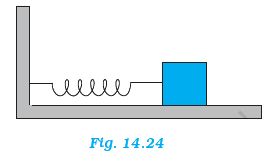
A spring having with a spring constant $1200 N m^{-1}$ is mounted on a horizontal table as shown in Fig. 14.24. A mass of 3 kg is attached to the free end of the spring. The mass is then pulled sideways to a distance of 2.0 cm and released. Determine (iii) the maximum speed of the mass.
Solution :
Step 1: Identifying Given Parameters and Physical Principles
To determine the maximum speed ($v_{max}$) of the oscillating mass-spring system, we define the parameters provided:
- Spring constant, $k = 1200 \, \text{N m}^{-1}$
- Mass attached, $m = 3 \, \text{kg}$
- Amplitude of oscillation, $A = 2.0 \, \text{cm} = 0.02 \, \text{m}$
[Per the principle of Conservation of Mechanical Energy, the total mechanical energy in a simple harmonic oscillator is constant and is given by $E = \frac{1}{2}kA^2$. At the equilibrium position, the potential energy is zero and the kinetic energy is maximum, where $E = \frac{1}{2}mv_{max}^2$.]
Step 2: Mathematical Derivation of Maximum Speed
Equating the maximum potential energy at the amplitude position to the maximum kinetic energy at the equilibrium position:
$\frac{1}{2}mv_{max}^2 = \frac{1}{2}kA^2$
Solving for $v_{max}$:
$v_{max}^2 = \frac{k}{m} A^2$
$v_{max} = A \sqrt{\frac{k}{m}}$
[Since angular frequency $\omega = \sqrt{\frac{k}{m}}$, the expression simplifies to $v_{max} = A\omega$.]
Step 3: Numerical Computation
Substitute the given values into the derived formula:
$v_{max} = 0.02 \, \text{m} \times \sqrt{\frac{1200 \, \text{N m}^{-1}}{3 \, \text{kg}}}$
$v_{max} = 0.02 \times \sqrt{400} \, \text{m s}^{-1}$
$v_{max} = 0.02 \times 20 \, \text{m s}^{-1}$
$v_{max} = 0.4 \, \text{m s}^{-1}$
Visual Representation of Phase Space
| Parameter | Value | Unit |
|---|---|---|
| Amplitude ($A$) | 0.02 | m |
| Angular Frequency ($\omega$) | 20 | rad s$^{-1}$ |
| Max Speed ($v_{max}$) | 0.4 | m s$^{-1}$ |
Final Solution: The maximum speed of the mass is 0.4 m s$^{-1}$.
More Questions from Class 11 Physics Oscillations Exercises
- Q13.1 (a): Which of the following examples represent periodic motion? A swimmer completing one (return) trip from one bank of a river to the other and back.
- Q13.1 (b): Which of the following examples represent periodic motion? A freely suspended bar magnet displaced from its N-S direction and released.
- Q13.1 (c): Which of the following examples represent periodic motion? A hydrogen molecule rotating about its centre of mass.
- Q13.1 (d): Which of the following examples represent periodic motion? An arrow released from a bow.
- Q13.10 (a): Let us take the position of mass when the spring is unstreched as (x = 0), and the direction from left to right as the positive direction of (x)-axis. Give (x) as a function of time (t) for the oscillating mass if at the moment we start the stopwatch ((t = 0)), the mass is at the mean position. In what way do these functions for SHM differ from each other, in frequency, in amplitude or the initial phase?
- Q13.10 (b): Let us take the position of mass when the spring is unstreched as (x = 0), and the direction from left to right as the positive direction of (x)-axis. Give (x) as a function of time (t) for the oscillating mass if at the moment we start the stopwatch ((t = 0)), the mass is at the maximum stretched position. In what way do these functions for SHM differ from each other, in frequency, in amplitude or the initial phase?
- Q13.10 (c): Let us take the position of mass when the spring is unstreched as (x = 0), and the direction from left to right as the positive direction of (x)-axis. Give (x) as a function of time (t) for the oscillating mass if at the moment we start the stopwatch ((t = 0)), the mass is at the maximum compressed position. In what way do these functions for SHM differ from each other, in frequency, in amplitude or the initial phase?
- Q13.11: Figures 13.20 correspond to two circular motions. The radius of the circle, the period of revolution, the initial position, and the sense of revolution (i.e. clockwise or anti-clockwise) are indicated on each figure. Obtain the corresponding simple harmonic motions of the (x)-projection of the radius vector of the revolving particle P, in each case.
- Q13.12 (a): Plot the corresponding reference circle for each of the following simple harmonic motions. Indicate the initial ((t =0)) position of the particle, the radius of the circle, and the angular speed of the rotating particle. For simplicity, the sense of rotation may be fixed to be anticlockwise in every case: ((x) is in cm and (t) is in s). (x = -2 \sin (3t + \pi/3))
- Q13.12 (b): Plot the corresponding reference circle for each of the following simple harmonic motions. Indicate the initial ((t =0)) position of the particle, the radius of the circle, and the angular speed of the rotating particle. For simplicity, the sense of rotation may be fixed to be anticlockwise in every case: ((x) is in cm and (t) is in s). (x = \cos (\pi/6 - t))
- Q13.12 (c): Plot the corresponding reference circle for each of the following simple harmonic motions. Indicate the initial ((t =0)) position of the particle, the radius of the circle, and the angular speed of the rotating particle. For simplicity, the sense of rotation may be fixed to be anticlockwise in every case: ((x) is in cm and (t) is in s). (x = 3 \sin (2\pi t + \pi/4))
- Q13.12 (d): Plot the corresponding reference circle for each of the following simple harmonic motions. Indicate the initial ((t =0)) position of the particle, the radius of the circle, and the angular speed of the rotating particle. For simplicity, the sense of rotation may be fixed to be anticlockwise in every case: ((x) is in cm and (t) is in s). (x = 2 \cos \pi t)
- Q13.13 (a): Figure 13.21(a) shows a spring of force constant (k) clamped rigidly at one end and a mass (m) attached to its free end. A force (F) applied at the free end stretches the spring. Figure 13.21 (b) shows the same spring with both ends free and attached to a mass (m) at either end. Each end of the spring in Fig. 13.21(b) is stretched by the same force (F). What is the maximum extension of the spring in the two cases ?
- Q13.13 (b): Figure 13.21(a) shows a spring of force constant (k) clamped rigidly at one end and a mass (m) attached to its free end. A force (F) applied at the free end stretches the spring. Figure 13.21 (b) shows the same spring with both ends free and attached to a mass (m) at either end. Each end of the spring in Fig. 13.21(b) is stretched by the same force (F). If the mass in Fig. (a) and the two masses in Fig. (b) are released, what is the period of oscillation in each case ?
- Q13.14: The piston in the cylinder head of a locomotive has a stroke (twice the amplitude) of 1.0 m. If the piston moves with simple harmonic motion with an angular frequency of 200 rad/min, what is its maximum speed ?
- Q13.15: The acceleration due to gravity on the surface of moon is 1.7 m s\(^{-2}\). What is the time period of a simple pendulum on the surface of moon if its time period on the surface of earth is 3.5 s ? ((g) on the surface of earth is 9.8 m s\(^{-2}\))
- Q13.16: A simple pendulum of length (l) and having a bob of mass (M) is suspended in a car. The car is moving on a circular track of radius (R) with a uniform speed (v). If the pendulum makes small oscillations in a radial direction about its equilibrium position, what will be its time period ?
- Q13.17: A cylindrical piece of cork of density of base area (A) and height (h) floats in a liquid of density (\rho_{l}). The cork is depressed slightly and then released. Show that the cork oscillates up and down simple harmonically with a period (T = 2\pi \sqrt{\frac{h\rho}{\rho_{l}g}}) where (\rho) is the density of cork. (Ignore damping due to viscosity of the liquid).
- Q13.18: One end of a U-tube containing mercury is connected to a suction pump and the other end to atmosphere. A small pressure difference is maintained between the two columns. Show that, when the suction pump is removed, the column of mercury in the U-tube executes simple harmonic motion.
- Q13.2 (a): Which of the following examples represent (nearly) simple harmonic motion and which represent periodic but not simple harmonic motion? the rotation of earth about its axis.
- Q13.2 (b): Which of the following examples represent (nearly) simple harmonic motion and which represent periodic but not simple harmonic motion? motion of an oscillating mercury column in a U-tube.
- Q13.2 (c): Which of the following examples represent (nearly) simple harmonic motion and which represent periodic but not simple harmonic motion? motion of a ball bearing inside a smooth curved bowl, when released from a point slightly above the lower most point.
- Q13.2 (d): Which of the following examples represent (nearly) simple harmonic motion and which represent periodic but not simple harmonic motion? general vibrations of a polyatomic molecule about its equilibrium position.
- Q13.3: Below fig. depicts four (x-t) plots for linear motion of a particle. Which of the plots represent periodic motion? What is the period of motion (in case of periodic motion) ?
- Q13.4 (a): Which of the following functions of time represent (a) simple harmonic, (b) periodic but not simple harmonic, and (c) non-periodic motion? Give period for each case of periodic motion ((ω) is any positive constant): (\sin \omega t - \cos \omega t)
- Q13.4 (b): Which of the following functions of time represent (a) simple harmonic, (b) periodic but not simple harmonic, and (c) non-periodic motion? Give period for each case of periodic motion ((ω) is any positive constant): (\sin^{3} \omega t)
- Q13.4 (c): Which of the following functions of time represent (a) simple harmonic, (b) periodic but not simple harmonic, and (c) non-periodic motion? Give period for each case of periodic motion ((ω) is any positive constant): (3 \cos (\pi/4 - 2\omega t))
- Q13.4 (d): Which of the following functions of time represent (a) simple harmonic, (b) periodic but not simple harmonic, and (c) non-periodic motion? Give period for each case of periodic motion ((ω) is any positive constant): (\cos \omega t + \cos 3\omega t + \cos 5\omega t)
- Q13.4 (e): Which of the following functions of time represent (a) simple harmonic, (b) periodic but not simple harmonic, and (c) non-periodic motion? Give period for each case of periodic motion ((ω) is any positive constant): (\exp (-\omega^{2}t^{2}))
- Q13.4 (f): Which of the following functions of time represent (a) simple harmonic, (b) periodic but not simple harmonic, and (c) non-periodic motion? Give period for each case of periodic motion ((ω) is any positive constant): (1 + \omega t + \omega^{2}t^{2})
- Q13.5 (a): A particle is in linear simple harmonic motion between two points, A and B, 10 cm apart. Take the direction from A to B as the positive direction and give the signs of velocity, acceleration and force on the particle when it is at the end A,
- Q13.5 (b): A particle is in linear simple harmonic motion between two points, A and B, 10 cm apart. Take the direction from A to B as the positive direction and give the signs of velocity, acceleration and force on the particle when it is at the end B,
- Q13.5 (c): A particle is in linear simple harmonic motion between two points, A and B, 10 cm apart. Take the direction from A to B as the positive direction and give the signs of velocity, acceleration and force on the particle when it is at the mid-point of AB going towards A,
- Q13.5 (d): A particle is in linear simple harmonic motion between two points, A and B, 10 cm apart. Take the direction from A to B as the positive direction and give the signs of velocity, acceleration and force on the particle when it is at 2 cm away from B going towards A,
- Q13.5 (e): A particle is in linear simple harmonic motion between two points, A and B, 10 cm apart. Take the direction from A to B as the positive direction and give the signs of velocity, acceleration and force on the particle when it is at 3 cm away from A going towards B, and
- Q13.5 (f): A particle is in linear simple harmonic motion between two points, A and B, 10 cm apart. Take the direction from A to B as the positive direction and give the signs of velocity, acceleration and force on the particle when it is at 4 cm away from B going towards A.
- Q13.6 (a): Which of the following relationships between the acceleration (a) and the displacement (x) of a particle involve simple harmonic motion? (a = 0.7x)
- Q13.6 (b): Which of the following relationships between the acceleration (a) and the displacement (x) of a particle involve simple harmonic motion? (a = -200x^{2})
- Q13.6 (c): Which of the following relationships between the acceleration (a) and the displacement (x) of a particle involve simple harmonic motion? (a = -10x)
- Q13.6 (d): Which of the following relationships between the acceleration (a) and the displacement (x) of a particle involve simple harmonic motion? (a = 100x^{3})
- Q13.7: The motion of a particle executing simple harmonic motion is described by the displacement function, (x(t) = A \cos (\omega t + \phi)). If the initial ((t = 0)) position of the particle is 1 cm and its initial velocity is (\omega) cm/s, what are its amplitude and initial phase angle ? The angular frequency of the particle is (\pi \text{ s}^{-1}). If instead of the cosine function, we choose the sine function to describe the SHM : (x = B \sin (\omega t + \alpha)), what are the amplitude and initial phase of the particle with the above initial conditions.
- Q13.8: A spring balance has a scale that reads from 0 to 50 kg. The length of the scale is 20 cm. A body suspended from this balance, when displaced and released, oscillates with a period of 0.6 s. What is the weight of the body ?
- Q13.9 (i): A spring having with a spring constant 1200 N m\(^{-1}\) is mounted on a horizontal table as shown in Fig. 13.19. A mass of 3 kg is attached to the free end of the spring. The mass is then pulled sideways to a distance of 2.0 cm and released. Determine the frequency of oscillations,
- Q13.9 (ii): A spring having with a spring constant 1200 N m\(^{-1}\) is mounted on a horizontal table as shown in Fig. 13.19. A mass of 3 kg is attached to the free end of the spring. The mass is then pulled sideways to a distance of 2.0 cm and released. Determine maximum acceleration of the mass,
- Q13.9 (iii): A spring having with a spring constant 1200 N m\(^{-1}\) is mounted on a horizontal table as shown in Fig. 13.19. A mass of 3 kg is attached to the free end of the spring. The mass is then pulled sideways to a distance of 2.0 cm and released. Determine the maximum speed of the mass.
- Q14.1(a): Which of the following examples represent periodic motion? (a) A swimmer completing one (return) trip from one bank of a river to the other and back.
- Q14.1(b): Which of the following examples represent periodic motion? (b) A freely suspended bar magnet displaced from its N-S direction and released.
- Q14.1(c): Which of the following examples represent periodic motion? (c) A hydrogen molecule rotating about its centre of mass.
- Q14.1(d): Which of the following examples represent periodic motion? (d) An arrow released from a bow.
- Q14.10(a): Let us take the position of mass when the spring is unstreched as $x = 0$, and the direction from left to right as the positive direction of x-axis. Give $x$ as a function of time $t$ for the oscillating mass if at the moment we start the stopwatch ($t = 0$), the mass is (a) at the mean position,
- Q14.10(b): Let us take the position of mass when the spring is unstreched as $x = 0$, and the direction from left to right as the positive direction of x-axis. Give $x$ as a function of time $t$ for the oscillating mass if at the moment we start the stopwatch ($t = 0$), the mass is (b) at the maximum stretched position, and
- Q14.10(c): Let us take the position of mass when the spring is unstreched as $x = 0$, and the direction from left to right as the positive direction of x-axis. Give $x$ as a function of time $t$ for the oscillating mass if at the moment we start the stopwatch ($t = 0$), the mass is (c) at the maximum compressed position. In what way do these functions for SHM differ from each other, in frequency, in amplitude or the initial phase?
- Q14.11: Figures 14.25 correspond to two circular motions. The radius of the circle, the period of revolution, the initial position, and the sense of revolution (i.e. clockwise or anti-clockwise) are indicated on each figure. Obtain the corresponding simple harmonic motions of the x-projection of the radius vector of the revolving particle P, in each case.
- Q14.12(a): Plot the corresponding reference circle for each of the following simple harmonic motions. Indicate the initial ($t =0$) position of the particle, the radius of the circle, and the angular speed of the rotating particle. For simplicity, the sense of rotation may be fixed to be anticlockwise in every case: ($x$ is in cm and $t$ is in s). (a) $x = –2 sin (3t + \pi/3)$
- Q14.12(b): Plot the corresponding reference circle for each of the following simple harmonic motions. Indicate the initial ($t =0$) position of the particle, the radius of the circle, and the angular speed of the rotating particle. For simplicity, the sense of rotation may be fixed to be anticlockwise in every case: ($x$ is in cm and $t$ is in s). (b) $x = cos (\pi/6 – t)$
- Q14.12(c): Plot the corresponding reference circle for each of the following simple harmonic motions. Indicate the initial ($t =0$) position of the particle, the radius of the circle, and the angular speed of the rotating particle. For simplicity, the sense of rotation may be fixed to be anticlockwise in every case: ($x$ is in cm and $t$ is in s). (c) $x = 3 sin (2\pi t + \pi/4)$
- Q14.12(d): Plot the corresponding reference circle for each of the following simple harmonic motions. Indicate the initial ($t =0$) position of the particle, the radius of the circle, and the angular speed of the rotating particle. For simplicity, the sense of rotation may be fixed to be anticlockwise in every case: ($x$ is in cm and $t$ is in s). (d) $x = 2 cos \pi t$
- Q14.13(a): Figure 14.26 (a) shows a spring of force constant $k$ clamped rigidly at one end and a mass $m$ attached to its free end. A force $F$ applied at the free end stretches the spring. Figure 14.26 (b) shows the same spring with both ends free and attached to a mass $m$ at either end. Each end of the spring in Fig. 14.26(b) is stretched by the same force $F$. (a) What is the maximum extension of the spring in the two cases ?
- Q14.13(b): Figure 14.26 (a) shows a spring of force constant $k$ clamped rigidly at one end and a mass $m$ attached to its free end. A force $F$ applied at the free end stretches the spring. Figure 14.26 (b) shows the same spring with both ends free and attached to a mass $m$ at either end. Each end of the spring in Fig. 14.26(b) is stretched by the same force $F$. (b) If the mass in Fig. (a) and the two masses in Fig. (b) are released, what is the period of oscillation in each case ?
- Q14.14: The piston in the cylinder head of a locomotive has a stroke (twice the amplitude) of 1.0 m. If the piston moves with simple harmonic motion with an angular frequency of 200 rad/min, what is its maximum speed ?
- Q14.15: The acceleration due to gravity on the surface of moon is $1.7 m s^{-2}$. What is the time period of a simple pendulum on the surface of moon if its time period on the surface of earth is 3.5 s ? ($g$ on the surface of earth is $9.8 m s^{-2}$)
- Q14.16(a): Answer the following questions : (a) Time period of a particle in SHM depends on the force constant $k$ and mass $m$ of the particle: $T = 2\pi \sqrt{\frac{m}{k}}$. A simple pendulum executes SHM approximately. Why then is the time period of a pendulum independent of the mass of the pendulum?
- Q14.16(b): Answer the following questions : (b) The motion of a simple pendulum is approximately simple harmonic for small angle oscillations. For larger angles of oscillation, a more involved analysis shows that $T$ is greater than $2\pi \sqrt{\frac{l}{g}}$. Think of a qualitative argument to appreciate this result.
- Q14.16(c): Answer the following questions : (c) A man with a wristwatch on his hand falls from the top of a tower. Does the watch give correct time during the free fall ?
- Q14.16(d): Answer the following questions : (d) What is the frequency of oscillation of a simple pendulum mounted in a cabin that is freely falling under gravity ?
- Q14.17: A simple pendulum of length $l$ and having a bob of mass $M$ is suspended in a car. The car is moving on a circular track of radius $R$ with a uniform speed $v$. If the pendulum makes small oscillations in a radial direction about its equilibrium position, what will be its time period ?
- Q14.18: A cylindrical piece of cork of density of base area $A$ and height $h$ floats in a liquid of density $\rho_l$. The cork is depressed slightly and then released. Show that the cork oscillates up and down simple harmonically with a period $T = 2\pi \sqrt{\frac{h\rho}{g\rho_l}}$ where $\rho$ is the density of cork. (Ignore damping due to viscosity of the liquid).
- Q14.19: One end of a U-tube containing mercury is connected to a suction pump and the other end to atmosphere. A small pressure difference is maintained between the two columns. Show that, when the suction pump is removed, the column of mercury in the U-tube executes simple harmonic motion.
- Q14.2(a): Which of the following examples represent (nearly) simple harmonic motion and which represent periodic but not simple harmonic motion? (a) the rotation of earth about its axis.
- Q14.2(b): Which of the following examples represent (nearly) simple harmonic motion and which represent periodic but not simple harmonic motion? (b) motion of an oscillating mercury column in a U-tube.
- Q14.2(c): Which of the following examples represent (nearly) simple harmonic motion and which represent periodic but not simple harmonic motion? (c) motion of a ball bearing inside a smooth curved bowl, when released from a point slightly above the lower most point.
- Q14.2(d): Which of the following examples represent (nearly) simple harmonic motion and which represent periodic but not simple harmonic motion? (d) general vibrations of a polyatomic molecule about its equilibrium position.
- Q14.3: Fig. 14.23 depicts four x-t plots for linear motion of a particle. Which of the plots represent periodic motion? What is the period of motion (in case of periodic motion) ?
- Q14.4(a): Which of the following functions of time represent (a) simple harmonic, (b) periodic but not simple harmonic, and (c) non-periodic motion? Give period for each case of periodic motion ($\omega$ is any positive constant): (a) $sin \omega t – cos \omega t$
- Q14.4(b): Which of the following functions of time represent (a) simple harmonic, (b) periodic but not simple harmonic, and (c) non-periodic motion? Give period for each case of periodic motion ($\omega$ is any positive constant): (b) $sin^3 \omega t$
- Q14.4(c): Which of the following functions of time represent (a) simple harmonic, (b) periodic but not simple harmonic, and (c) non-periodic motion? Give period for each case of periodic motion ($\omega$ is any positive constant): (c) $3 cos (\frac{\pi}{4} – 2\omega t)$
- Q14.4(d): Which of the following functions of time represent (a) simple harmonic, (b) periodic but not simple harmonic, and (c) non-periodic motion? Give period for each case of periodic motion ($\omega$ is any positive constant): (d) $cos \omega t + cos 3\omega t + cos 5\omega t$
- Q14.4(e): Which of the following functions of time represent (a) simple harmonic, (b) periodic but not simple harmonic, and (c) non-periodic motion? Give period for each case of periodic motion ($\omega$ is any positive constant): (e) $exp (–\omega^2t^2)$
- Q14.4(f): Which of the following functions of time represent (a) simple harmonic, (b) periodic but not simple harmonic, and (c) non-periodic motion? Give period for each case of periodic motion ($\omega$ is any positive constant): (f) $1 + \omega t + \omega^2t^2$
- Q14.5(a): A particle is in linear simple harmonic motion between two points, A and B, 10 cm apart. Take the direction from A to B as the positive direction and give the signs of velocity, acceleration and force on the particle when it is (a) at the end A,
- Q14.5(b): A particle is in linear simple harmonic motion between two points, A and B, 10 cm apart. Take the direction from A to B as the positive direction and give the signs of velocity, acceleration and force on the particle when it is (b) at the end B,
- Q14.5(c): A particle is in linear simple harmonic motion between two points, A and B, 10 cm apart. Take the direction from A to B as the positive direction and give the signs of velocity, acceleration and force on the particle when it is (c) at the mid-point of AB going towards A,
- Q14.5(d): A particle is in linear simple harmonic motion between two points, A and B, 10 cm apart. Take the direction from A to B as the positive direction and give the signs of velocity, acceleration and force on the particle when it is (d) at 2 cm away from B going towards A,
- Q14.5(e): A particle is in linear simple harmonic motion between two points, A and B, 10 cm apart. Take the direction from A to B as the positive direction and give the signs of velocity, acceleration and force on the particle when it is (e) at 3 cm away from A going towards B, and
- Q14.5(f): A particle is in linear simple harmonic motion between two points, A and B, 10 cm apart. Take the direction from A to B as the positive direction and give the signs of velocity, acceleration and force on the particle when it is (f) at 4 cm away from B going towards A.
- Q14.6(a): Which of the following relationships between the acceleration $a$ and the displacement $x$ of a particle involve simple harmonic motion? (a) $a = 0.7x$
- Q14.6(b): Which of the following relationships between the acceleration $a$ and the displacement $x$ of a particle involve simple harmonic motion? (b) $a = –200x^2$
- Q14.6(c): Which of the following relationships between the acceleration $a$ and the displacement $x$ of a particle involve simple harmonic motion? (c) $a = –10x$
- Q14.6(d): Which of the following relationships between the acceleration $a$ and the displacement $x$ of a particle involve simple harmonic motion? (d) $a = 100x^3$
- Q14.7: The motion of a particle executing simple harmonic motion is described by the displacement function, $x(t) = A cos (\omega t + \phi)$. If the initial ($t = 0$) position of the particle is 1 cm and its initial velocity is $\omega$ cm/s, what are its amplitude and initial phase angle ? The angular frequency of the particle is $\pi s^{-1}$. If instead of the cosine function, we choose the sine function to describe the SHM : $x = B sin (\omega t + \alpha)$, what are the amplitude and initial phase of the particle with the above initial conditions.
- Q14.8: A spring balance has a scale that reads from 0 to 50 kg. The length of the scale is 20 cm. A body suspended from this balance, when displaced and released, oscillates with a period of 0.6 s. What is the weight of the body ?
- Q14.9(i): A spring having with a spring constant $1200 N m^{-1}$ is mounted on a horizontal table as shown in Fig. 14.24. A mass of 3 kg is attached to the free end of the spring. The mass is then pulled sideways to a distance of 2.0 cm and released. Determine (i) the frequency of oscillations,
- Q14.9(ii): A spring having with a spring constant $1200 N m^{-1}$ is mounted on a horizontal table as shown in Fig. 14.24. A mass of 3 kg is attached to the free end of the spring. The mass is then pulled sideways to a distance of 2.0 cm and released. Determine (ii) maximum acceleration of the mass,
CBSE Solutions for Class 11 Physics Oscillations
Chapters in CBSE - Class 11 Physics
Top Tutors who teach Oscillations

 Super Tutor
 Besant Nagar, Chennai
 20 yrs of
Exp
 18 students
 898 hrs of classes completed
 750
per hour
 Online Classes
My class will be focused on strengthening the basic concepts and foundation that is essential to break down complex problems by using simple methods. I focus on clearing all the doubts step by step and conducting test papers after the completion of every lesson which will make it easier for the students to crack their school quarterly, half-yearly, and final exams with ease.
My son is very happy and satisfied with the class. Thank you very much. Let your knowledge help more and more kids.

 Top Tutor
Karampura, Delhi
10 yrs of
Exp
5 hrs of classes completed
2500
per hour
Online Classes
 Student's Home
I teach and help students to achieve immediate and long term goals. My experience as a personal tutor and the founder of an online educational startup 'MinDely' has helped him gain knowledge of child psychology and understanding students needs and takes measures accordingly. I plan the lessons as per the students ability to cope up and moreover upon their needs. My teaching technique is student friendly and easy to understand which helps students understand it better. Weekly test conducted by him helps the parents to know the students performance.
Sir explains concepts clearly and makes an effort to make sure that i understand the logic behind formulas rather than just memorising them.The examples discussed in class are helpful,which makes the subject easier to understand. He is patient with doubts which creates a positive learning environment. Since this subject is relatively new and has no official NCERT textbook his self prepared material helps alot.
 Top Tutor
South Extension II, Delhi
20 yrs of
Exp
5 students
292 hrs of classes completed
1000
per hour
Student's Home
I have taught in Cambridge School, Delhi as a PGT PHYSICS, coaching Institutes like Aakash and FIIT-JEE for NEET & IIT-JEE. Worked as a Senior Evaluator, CBSE. Many students got a perfect hundred in class 11th. My teaching methodology for this section is to teach the CONCEPTs very well and apply them to problem-solving. Derivations are also important in class 11th. Make sure you know the important derivations.


 Top Tutor
Indira Nagar Gachibowli, Hyderabad
5 yrs of
Exp
8 students
1353 hrs of classes completed
1000
per hour
Online Classes
Hi, I’m Pranjal Mishra, a passionate mathematics educator with a strong belief in making learning engaging and meaningful for students. I currently teach IB DP Math at Shiv Nadar School, where I’ve had the opportunity to work in a dynamic and innovative educational environment. At Shiv Nadar, I’ve been part of a culture that emphasizes holistic development, creativity, and critical thinking, which aligns perfectly with my teaching philosophy. My experience here has allowed me to design and deliver lessons that go beyond textbooks, incorporating real-world applications and interactive activities to make math relatable and enjoyable. I’ve also been involved in mentoring students, organizing math clubs, and participating in school events that foster a love for learning. The collaborative and forward-thinking approach at Shiv Nadar has greatly influenced my teaching style, encouraging me to continuously innovate and adapt to the needs of my students.Outside the classroom, I actively engage in professional development to stay updated with the latest teaching methodologies. My goal is to inspire students to see math not just as a subject, but as a tool for problem-solving and logical thinking. Teaching at Shiv Nadar has been a rewarding journey, and I look forward to continuing to make a positive impact on my students’ lives.
Teachers' teaching method is really good. His classes are also fun and interactive.Concepts are also explained in a simple manner.
 Top Tutor
Kalyan East, Thane
5 yrs of
Exp
6 students
328 hrs of classes completed
700
per hour
Online Classes
Student's Home
I have 5 years of teaching experience in class 11 and 12 mathematics.
The classes are always very very engaging, never a dull moment. Sir makes sure the student actually understood the concept before moving on and it's so reassuring to know you won't be judged even if you're slow in understanding. It was exactly what I needed to get my maths basics strong for eleventh.



