



Find the best tutors and institutes for Class 11 Tuition
Q9.3(a):
The stress-strain graphs for materials A and B are shown in Fig. 9.12. The graphs are drawn to the same scale. (a) Which of the materials has the greater Young’s modulus?
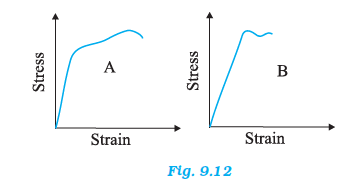
The stress-strain graphs for materials A and B are shown in Fig. 9.12. The graphs are drawn to the same scale. (a) Which of the materials has the greater Young’s modulus?
Solution :
Theoretical Foundation: Young's Modulus
Young’s Modulus ($Y$) is defined as the ratio of longitudinal stress ($\sigma$) to longitudinal strain ($\epsilon$) within the elastic limit [Per Hooke's Law]. Mathematically, it is expressed as:
$Y = \frac{\text{Stress}}{\text{Strain}} = \frac{\sigma}{\epsilon}$
On a stress-strain graph where stress is plotted on the $y$-axis and strain on the $x$-axis, the Young’s Modulus corresponds to the slope of the linear portion of the curve:
$\text{Slope} = \tan(\theta) = \frac{\Delta \sigma}{\Delta \epsilon} = Y$
where $\theta$ is the angle the graph makes with the strain axis ($x$-axis).
Visual Representation of Stress-Strain Relationship
Step 1: Analyzing the Slope
By visual inspection and geometric analysis of the stress-strain graph:
- The slope of the graph for Material A ($\theta_A$) is greater than the slope of the graph for Material B ($\theta_B$).
- Since $\theta_A > \theta_B$, it follows that $\tan(\theta_A) > \tan(\theta_B)$ for the region within the elastic limit [By Trigonometric Identity].
Step 2: Comparative Deduction
Applying the relation $Y = \tan(\theta)$:
$Y_A = \tan(\theta_A)$
$Y_B = \tan(\theta_B)$
Because the vertical displacement (stress) for Material A occurs over a smaller horizontal displacement (strain) compared to Material B, the gradient of the curve for A is steeper.
| Material | Relative Slope | Young's Modulus Value |
|---|---|---|
| Material A | Higher | Higher ($Y_A > Y_B$) |
| Material B | Lower | Lower ($Y_B < Y_A$) |
Final Solution: Material A has the greater Young's modulus because its stress-strain graph has a steeper slope, indicating a higher resistance to elastic deformation per unit strain.
More Questions from Class 11 Physics Mechanical Properties of Solids EXERCISES
- Q8.1: A steel wire of length 4.7 m and cross-sectional area \(3.0 \times 10^{-5} \text{ m}^{2}\) stretches by the same amount as a copper wire of length 3.5 m and cross-sectional area of \(4.0 \times 10^{–5} \text{ m}^{2}\) under a given load. What is the ratio of the Young’s modulus of steel to that of copper?
- Q8.10: A rigid bar of mass 15 kg is supported symmetrically by three wires each 2.0 m long. Those at each end are of copper and the middle one is of iron. Determine the ratios of their diameters if each is to have the same tension.
- Q8.11: A 14.5 kg mass, fastened to the end of a steel wire of unstretched length 1.0 m, is whirled in a vertical circle with an angular velocity of 2 rev/s at the bottom of the circle. The cross-sectional area of the wire is \(0.065 \text{ cm}^{2}\). Calculate the elongation of the wire when the mass is at the lowest point of its path.
- Q8.12: Compute the bulk modulus of water from the following data: Initial volume = 100.0 litre, Pressure increase = 100.0 atm (\(1 \text{ atm} = 1.013 \times 10^{5} \text{ Pa}\)), Final volume = 100.5 litre. Compare the bulk modulus of water with that of air (at constant temperature). Explain in simple terms why the ratio is so large.
- Q8.13: What is the density of water at a depth where pressure is 80.0 atm, given that its density at the surface is \(1.03 \times 10^{3} \text{ kg m}^{–3}\)?
- Q8.14: Compute the fractional change in volume of a glass slab, when subjected to a hydraulic pressure of 10 atm.
- Q8.15: Determine the volume contraction of a solid copper cube, 10 cm on an edge, when subjected to a hydraulic pressure of \(7.0 \times 10^{6} \text{ Pa}\).
- Q8.16: How much should the pressure on a litre of water be changed to compress it by 0.10%? carry one quarter of the load.
- Q8.2 (a): Figure 8.9 shows the strain-stress curve for a given material. What are (a) Young’s modulus for this material?
- Q8.2 (b): Figure 8.9 shows the strain-stress curve for a given material. What are (b) approximate yield strength for this material?
- Q8.3 (a): The stress-strain graphs for materials A and B are shown in Fig. 8.10. The graphs are drawn to the same scale. (a) Which of the materials has the greater Young’s modulus?
- Q8.3 (b): The stress-strain graphs for materials A and B are shown in Fig. 8.10. The graphs are drawn to the same scale. (b) Which of the two is the stronger material?
- Q8.4 (a): Read the following two statements below carefully and state, with reasons, if it is true or false. (a) The Young’s modulus of rubber is greater than that of steel;
- Q8.4 (b): Read the following two statements below carefully and state, with reasons, if it is true or false. (b) The stretching of a coil is determined by its shear modulus.
- Q8.5: Two wires of diameter 0.25 cm, one made of steel and the other made of brass are loaded as shown in Fig. 8.11. The unloaded length of steel wire is 1.5 m and that of brass wire is 1.0 m. Compute the elongations of the steel and the brass wires.
- Q8.6: The edge of an aluminium cube is 10 cm long. One face of the cube is firmly fixed to a vertical wall. A mass of 100 kg is then attached to the opposite face of the cube. The shear modulus of aluminium is 25 GPa. What is the vertical deflection of this face?
- Q8.7: Four identical hollow cylindrical columns of mild steel support a big structure of mass 50,000 kg. The inner and outer radii of each column are 30 and 60 cm respectively. Assuming the load distribution to be uniform, calculate the compressional strain of each column.
- Q8.8: A piece of copper having a rectangular cross-section of \(15.2 \text{ mm} \times 19.1 \text{ mm}\) is pulled in tension with 44,500 N force, producing only elastic deformation. Calculate the resulting strain?
- Q8.9: A steel cable with a radius of 1.5 cm supports a chairlift at a ski area. If the maximum stress is not to exceed \(10^{8} \text{ N m}^{–2}\), what is the maximum load the cable can support ?
- Q9.1: A steel wire of length 4.7 m and cross-sectional area $3.0 \times 10^{-5} m^2$ stretches by the same amount as a copper wire of length 3.5 m and cross-sectional area of $4.0 \times 10^{-5} m^2$ under a given load. What is the ratio of the Young’s modulus of steel to that of copper?
- Q9.10: A rigid bar of mass 15 kg is supported symmetrically by three wires each 2.0 m long. Those at each end are of copper and the middle one is of iron. Determine the ratios of their diameters if each is to have the same tension.
- Q9.11: A 14.5 kg mass, fastened to the end of a steel wire of unstretched length 1.0 m, is whirled in a vertical circle with an angular velocity of 2 rev/s at the bottom of the circle. The cross-sectional area of the wire is $0.065 \text{ cm}^2$. Calculate the elongation of the wire when the mass is at the lowest point of its path.
- Q9.12: Compute the bulk modulus of water from the following data: Initial volume = 100.0 litre, Pressure increase = 100.0 atm (1 atm = $1.013 \times 10^5$ Pa), Final volume = 100.5 litre. Compare the bulk modulus of water with that of air (at constant temperature). Explain in simple terms why the ratio is so large.
- Q9.13: What is the density of water at a depth where pressure is 80.0 atm, given that its density at the surface is $1.03 \times 10^3 \text{ kg m}^{-3}$?
- Q9.14: Compute the fractional change in volume of a glass slab, when subjected to a hydraulic pressure of 10 atm.
- Q9.15: Determine the volume contraction of a solid copper cube, 10 cm on an edge, when subjected to a hydraulic pressure of $7.0 \times 10^6$ Pa.
- Q9.16: How much should the pressure on a litre of water be changed to compress it by 0.10%?
- Q9.2(a): Figure 9.11 shows the strain-stress curve for a given material. What are (a) Young’s modulus for this material?
- Q9.2(b): Figure 9.11 shows the strain-stress curve for a given material. What are (b) approximate yield strength for this material?
- Q9.3(b): The stress-strain graphs for materials A and B are shown in Fig. 9.12. The graphs are drawn to the same scale. (b) Which of the two is the stronger material?
- Q9.4(a): Read the following two statements below carefully and state, with reasons, if it is true or false. (a) The Young’s modulus of rubber is greater than that of steel;
- Q9.4(b): Read the following two statements below carefully and state, with reasons, if it is true or false. (b) The stretching of a coil is determined by its shear modulus.
- Q9.5: Two wires of diameter 0.25 cm, one made of steel and the other made of brass are loaded as shown in Fig. 9.13. The unloaded length of steel wire is 1.5 m and that of brass wire is 1.0 m. Compute the elongations of the steel and the brass wires.
- Q9.6: The edge of an aluminium cube is 10 cm long. One face of the cube is firmly fixed to a vertical wall. A mass of 100 kg is then attached to the opposite face of the cube. The shear modulus of aluminium is 25 GPa. What is the vertical deflection of this face?
- Q9.7: Four identical hollow cylindrical columns of mild steel support a big structure of mass 50,000 kg. The inner and outer radii of each column are 30 and 60 cm respectively. Assuming the load distribution to be uniform, calculate the compressional strain of each column.
- Q9.8: A piece of copper having a rectangular cross-section of $15.2 \text{ mm} \times 19.1 \text{ mm}$ is pulled in tension with 44,500 N force, producing only elastic deformation. Calculate the resulting strain?
- Q9.9: A steel cable with a radius of 1.5 cm supports a chairlift at a ski area. If the maximum stress is not to exceed $10^8 \text{ N m}^{-2}$, what is the maximum load the cable can support ?
CBSE Solutions for Class 11 Physics Mechanical Properties of Solids
Chapters in CBSE - Class 11 Physics
Top Tutors who teach Mechanical Properties of Solids

 Top Tutor
 Hijli, Kharagpur
 6 yrs of
Exp
 5 students
 428 hrs of classes completed
 300
per hour
 Online Classes
I have taken tuition for class 11 Physics students of ISC AND CBSE board students.



 Top Tutor
Ashok Nagar D' Souza Layout, Bangalore
13 yrs of
Exp
4 students
1060 hrs of classes completed
700
per hour
Online Classes
13+ years of experience teaching Mathematics for grades 10 to 12. • Consistent record of 100% academic results. • Very friendly and supportive learning environment. • Encourages students to ask questions freely and confidently. • Strong focus on conceptual clarity and problem-solving skills. • Helps students build confidence and excel in Mathematics. • Fee structure for one-to-one classes: ₹800 per hour.
He is a very good and experienced teacher who helps he improve at maths significantly. I used to get really bad marks earlier and then I started doing classes with him and I saw a significant improvement in my marks. He is one of the best maths teachers I have ever had.


 Top Tutor
Laxmi Vihar, Hisar
4 yrs of
Exp
3 students
267 hrs of classes completed
800
per hour
Online Classes
I've taught Mathematics of class 11th and 12th in an academy for 2 years. And now teaching on UrbanPro from last 4 years. I focus on letting the student reach the deepest level of concept and then do problems of reference books like RD Sharma and others. My main target is to make student learn how to approach a question so that he can do by himself should he face any new problem.
Saurabh sir is a good teacher, and is clearly very knowledgeable in Mathematics. He takes time to clarify each and every concept, and caters to any schedule requirements, etc. The classes are interactive and super helpful.


 Top Tutor
Saroornagar Saroor Nagar East, Hyderabad
15 yrs of
Exp
8 students
1508 hrs of classes completed
1200
per hour
Online Classes
I teach students of Classes 10,11 and 12, specializing in MATHS, PHYSICS & CHEMISTRY. I have completed my M.Sc. in Physics along with a B.Ed., which has given me both strong subject expertise and professional pedagogical training. I have qualified several competitive exams myself, including SET, TET, and JL, which further enriches my teaching approach. ..WHY CHOOSE ME?.... -Customized Strategic approach in Teaching undergraduate Competitive Exams like IITJEE MAINS & ADVANCED ,NEET(PHY & CHEM),SAT with consistency in scores - Post graduate exams like IISER, NEST, GATE PHYSICS, CSIR PHYSICAL SCIENCES,EMRS EXAM , KV PGT PHYSICS EXAM -Customized Counselling as per the course and student educational needs -I have also worked as a Content Writer, designing academic material, worksheets, and problem banks for competitive exam preparation. This experience has helped me develop innovative, student-centric teaching methods that make even the toughest topics easier to understand. -Able to create customized Curriculum & Content as per the student's future goals - My classes focus on building strong fundamentals, developing speed and accuracy, and mastering exam-oriented strategies that enable students to perform confidently even under time pressure. -I conduct only online classes, ensuring flexibility and accessibility for students. Each session is planned with a structured lesson approach, interactive discussions, and step-by-step problem-solving. I use PPTs and a whiteboard during my classes to make explanations clear, organized, and visually engaging. -I also provide study materials and additional support whenever required, helping students navigate their preparation with the right resources and guidance throughout their learning journey. -Chapter wise Doubt Sessions -Chapter wise tests -EXAM ANALYSIS & Follow up in Student Counselling -Flexible scheduling ...WHAT I OFFER?... * Small group classes less than 10 students *Individual DOUBT SESSIONS * IITJEE -MAINS & ADVANCED * NEET-PHYSICS & CHEMISTRY * SAT * ADVANCED PLACEMENTS- MATHS-(CALUCLUS,ALGEBRA), PHYSICS-(MEHANICS & E&M) * STATE BOARDS (KARNATAKA, JKBOSE,BENGAL,TELANGANA,- 10th ,11th & 12th grades * NATIONAL BOARDS(CBSE,ISC,ICSE)-10th,11th &12th grades *INTERNATIONAL BOARDS(UK,GERMANY,CANADA, USA,UAE)-IBDP *INTERNATIONAL UNIVERSITY GRADUATE COURSES-(THWS, GERMANY-BBE COURSE) ...RESULTS & SUCCESS... + Students consistently score above 85 to 95 percentile in IITJEE + NATIONAL BOARDS students scored 86% to 95% + STATE BOARDS students scores above 90%
Mam explains complex Physics, Chemistry, and Math concepts with clarity, using real-world examples to make online learning engaging. Her structured problem-solving sessions and personalized feedback have helped my child's confidence and performance in PCM subjects.


 Super Tutor
Malkajgiri D.D.Colony, Hyderabad
20 yrs of
Exp
7 students
1600 hrs of classes completed
500
per hour
Online Classes
I was teaching SSC and CBSE students of Grade 11. I have more than 12 years of experiance in teaching Class 11 Mathematics. Prepared additional resources using various other state syllabus course contents. Conducted regular tests at the end of each topic. Conducted additional quizzes and examinations for each term. Slow-learners are given special attention through providing additional learning materials and resources.
The tutor's explanation is clear, concise and relatable. Greatly improved my understanding and confidence in math. Highly recommended for anyone looking to boost their math skills!
Other Subjects in CBSE - Class 11

Download free CBSE - Class 11 Physics Mechanical Properties of Solids EXERCISES worksheets
Download Now

