0
0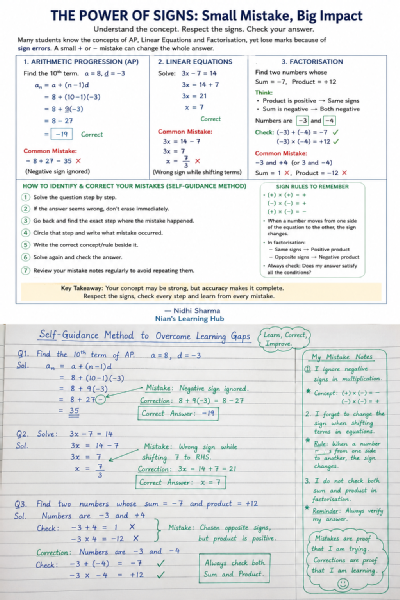
The Minus Sign Didn't Cost You One Mark. It Cost You the Whole Question.
Many students say,
«"Ma'am, I knew the concept. I don't know how the answer became wrong."»
And when we look carefully, the culprit is often not the concept.
It is the sign (+ or −).
A tiny symbol changes the entire mathematical journey.
Example 1: Arithmetic Progression (AP)
Suppose,
a = 8, d = -3
Find the 10th term.
Formula:
aₙ = a + (n − 1)d
Correct solution:
= 8 + (10 − 1)(−3)
= 8 + 9(−3)
= 8 − 27
= −19
Now imagine a student accidentally writes:
8 + 27 = 35
The formula was correct.
The substitution was correct.
The multiplication was correct.
Only the negative sign disappeared.
One tiny mistake changed the entire answer.
---
Example 2: Linear Equations
Solve:
3x − 7 = 14
Correct steps:
3x = 14 + 7
3x = 21
x = 7
Now suppose a student writes:
3x = 14 − 7
3x = 7
x = 7/3
Again, the method was correct.
The mistake happened while shifting the number across the equal sign without changing the operation correctly.
---
Example 3: Factorisation
Find two numbers whose:
Sum = −7
Product = +12
Many students immediately write:
−3 and +4
Let's verify.
Sum:
−3 + 4 = 1 ✗
Product:
−3 × 4 = −12 ✗
Both conditions fail.
Now try:
−3 and −4
Sum:
−3 + (−4) = −7 ✓
Product:
(−3)(−4) = +12 ✓
This is the correct pair.
A Simple Rule
If the product is positive, both numbers have the same sign.
If the sum is negative, both numbers must be negative.
If the sum is positive, both numbers must be positive.
If the product is negative, the numbers must have opposite signs.
Before moving to the next step, ask yourself:
- Does my pair satisfy the sum?
- Does it satisfy the product?
A 10-second check can save the entire question.
---
The Self-Guidance Technique
Whenever you make a mistake, don't just erase it.
Circle the exact step where it happened.
Then write a short note beside it.
For example:
"Mistake: Negative sign ignored."
or
"Mistake: Wrong sign chosen while factorising."
or
"Mistake: Forgot to change the operation while transposing."
After solving five or six questions, read only these notes.
Soon, you will notice a pattern.
You are not making ten different mistakes.
You are repeating one mistake in ten different chapters.
That is called a learning gap.
Once that gap is repaired, your performance improves not only in Arithmetic Progressions but also in Linear Equations, Factorisation, Polynomials, Coordinate Geometry, and many other topics.
The problem was never your intelligence.
The problem was a tiny concept that kept travelling with you from one chapter to the next.
The best learners are not those who never make mistakes.
They are the ones who learn to diagnose their mistakes before someone else points them out.