


 You have successfully registered
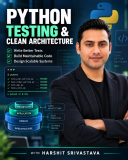

This course teaches you how to write Python software that remains reliable and maintainable as requirements and development teams grow. It connects automated testing with clean architecture so that quality is built into an application rather than added at the end.
You will begin with the purpose of testing and the characteristics of useful test cases. Lessons cover unit tests, integration tests, end-to-end tests, assertions, fixtures, parametrisation, exception testing, test doubles, mocking, patching, and code-coverage analysis using Pytest.
The course then examines how software design affects testability. You will learn about separation of concerns, dependency inversion, dependency injection, interfaces, immutability, pure functions, domain modelling, and the SOLID principles.
You will organise an application into domain, application, infrastructure, and presentation layers. Through practical refactoring exercises, you will identify tightly coupled code and progressively transform it into modular components with clear responsibilities and controlled dependencies.
The class also covers testing databases, APIs, repositories, services, asynchronous functions, and external integrations. You will learn when mocking is appropriate, when it becomes harmful, and how integration tests can validate important system boundaries.
Additional topics include type hints, static analysis, formatting, linting, test naming, reusable test data, continuous integration, and preventing regressions.
The final project involves designing or refactoring a Python application using clean architectural boundaries and a meaningful automated test suite. By the end, you will be able to structure applications for change, diagnose design problems, and confidently modify software without repeatedly breaking existing functionality.

 View this Course



 Top Tutor


 Certified




