



 You have successfully registered



 Certified
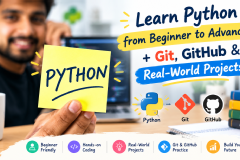
This course is designed to help learners develop strong Python programming skills from the fundamentals to advanced concepts through practical coding and real-world examples. It is suitable for beginners, students, fresh graduates, and working professionals who want to learn Python for software development, automation, backend development, data processing, or career growth.
The course begins with the fundamentals of Python programming, including Python installation, development environment setup, variables, data types, operators, input and output, conditional statements, loops, functions, and basic problem-solving techniques.
You will then learn Python's important data structures such as lists, tuples, sets, dictionaries, strings, and collections, along with practical techniques for searching, sorting, filtering, and manipulating data.
The course covers functions, modules, packages, scope, lambda expressions, comprehensions, recursion, decorators, generators, iterators, and reusable code development.
You will learn object-oriented programming in Python, including classes, objects, constructors, inheritance, encapsulation, polymorphism, abstraction, static methods, class methods, and practical OOP design principles.
The course also covers file handling, JSON processing, CSV files, exception handling, logging, debugging, and error management to help you build reliable Python applications.
As the course progresses, you will work with REST APIs, HTTP requests, JSON data, authentication, API integration, and third-party Python libraries.
Database concepts include connecting Python applications with SQL databases, executing queries, inserting and retrieving data, updating records, and integrating database operations into applications.
You will also learn practical Python automation, including file automation, data-processing scripts, repetitive-task automation, and building small utilities that solve real-world problems.
Professional development practices are covered throughout the training, including Git and version control, virtual environments, package management with pip, clean coding standards, debugging, code organisation, testing, and reusable application design.
The training is strongly project-oriented. Learners will complete coding exercises and build practical Python applications involving data processing, API integration, automation, and database operations.
By the end of the course, learners should be able to independently write, debug, test, and structure Python programs, solve programming problems, integrate APIs and databases, automate routine tasks, and build practical Python applications using clean and maintainable coding practices.

 View this Course


 Top Tutor


 Certified




