


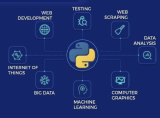

Unlock the power of Python — the world’s most versatile programming language!
In Python Basics for Web and AI, you’ll learn to code from the ground up and discover how Python drives the technologies behind dynamic websites and cutting-edge AI systems. Whether you’re a beginner or switching into tech, this course gives you the skills to start building real web apps and experimenting with machine learning models right away.
Lessons:
-
Introduction to Python and its ecosystem
-
Why Python for Web and AI
-
Installing Python and setting up VS Code / Jupyter / PyCharm
-
Understanding the Python REPL and virtual environments
-
-
Basic Syntax and Data Types
-
Variables, comments, input/output
-
Data types: integers, floats, strings, booleans
-
Type conversion and formatted strings
-
-
Operators and Expressions
-
Arithmetic, comparison, logical, and assignment operators
-
Operator precedence and short-circuiting
-
-
Control Flow
-
if,elif,else -
Loops (
for,while) andbreak/continue -
Iteration patterns and common pitfalls
-
Outcomes:
Write small interactive scripts using conditions and loops.
Module 2: Core Python Programming
Goal: Build comfort with structured and modular programming in Python.
Lessons:
-
Functions and Scope
-
Defining functions
-
Parameters, return values, default and keyword arguments
-
Variable scope and lambda functions
-
-
Data Structures
-
Lists, tuples, sets, and dictionaries
-
Indexing, slicing, and comprehensions
-
Mutability and common methods
-
-
Working with Strings
-
String methods and manipulation
-
f-strings, regex basics
-
File handling: reading and writing text files
-
-
Error Handling and Debugging
-
try/except/finally -
Raising exceptions
-
Debugging with
pdband print statements
-
Outcomes:
Build modular scripts and handle common runtime errors gracefully.
Module 3: Python for the Web
Goal: Introduce how Python powers the web using lightweight frameworks.
Lessons:
-
Understanding Web Basics
-
HTTP requests and responses
-
REST APIs and JSON format
-
Python libraries for HTTP (
requests)
-
-
Intro to Flask (or FastAPI / Django Lite)
-
Setting up a Flask app
-
Routes and templates
-
Handling GET and POST requests
-
Using HTML templates and static files
-
-
Working with Databases
-
SQLite basics
-
CRUD operations with Python
-
Integrating database with Flask
-
-
Mini Project #1 — Web Project: “Task Tracker App”
-
A simple Flask-based app where users can:
-
Add and delete daily tasks
-
Store tasks in SQLite
-
View tasks in a styled HTML page
-
-
Deploy on Render / PythonAnywhere
-
Outcomes:
Build and deploy a working Python web app accessible via browser.
Module 4: Python for AI and Data
Goal: Learn foundational AI-related Python skills for handling and analyzing data.
Lessons:
-
Working with Data
-
Intro to
NumPyandPandas -
Arrays, DataFrames, importing CSVs
-
Basic descriptive statistics and visualization (
matplotlib)
-
-
Intro to Machine Learning Concepts
-
What is AI/ML and where Python fits
-
Understanding datasets, features, and models
-
Using
scikit-learnfor simple models
-
-
Basic AI Workflow
-
Data preprocessing (cleaning and normalization)
-
Training a simple model (e.g., linear regression or classifier)
-
Evaluating model performance
-
-
Mini Project #2 — AI Project: “Student Score Predictor”
-
Use
Pandas+scikit-learnto predict exam scores from study hours -
Steps:
-
Load and visualize dataset
-
Train a regression model
-
Predict new values and visualize results
-
-
Optional: expose as a small web API via Flask
-
Outcomes:
Create a simple end-to-end AI prototype with basic prediction capability.
Module 5: Integration and Next Steps
Goal: Connect both worlds (web + AI) and prepare learners for real-world expansion.
Lessons:
-
Connecting AI to Web (conceptual overview)
-
Turning models into APIs
-
Example: serving an ML model in a Flask route
-
-
Version Control & Project Structuring
-
Using Git and GitHub
-
Virtual environments and requirements.txt
-
-
Where to Go Next
-
Suggested paths: Django, FastAPI, Deep Learning, AWS Lambda, etc.
-
🧩 Capstone Deliverables
-
Web Project: Task Tracker App (Flask + SQLite)
-
AI Project: Student Score Predictor (Pandas + scikit-learn)
Optional Integration: deploy the AI model behind a small web interface.
Final Learning Outcomes
By the end of this course, learners will:
-
Understand Python’s syntax, logic, and ecosystem.
-
Build interactive programs and debug effectively.
-
Develop a working web app and a small AI model.
-
Gain confidence to move into full-stack or AI development.


 View this Course
 Top Tutor




 Certified
 You have successfully registered



