



 You have successfully registered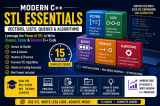

 Certified
The Standard Template Library (STL) is one of the most powerful features of Modern C++, enabling programmers to write efficient, reusable, and concise code. This course introduces the most commonly used STL containers and algorithms through practical coding examples and hands-on exercises.
Rather than covering every STL component, the course focuses on the containers and algorithms that students are most likely to use in academic projects and day-to-day C++ programming. Students will gain practical experience with vectors, lists, queues, iterators, and commonly used STL algorithms while learning how these features simplify programming and improve code quality.
Course Curriculum (15 Hours)
Module 1: Introduction to STL & Vectors (3 Hours)
• Introduction to the Standard Template Library (STL)
• STL Components (Containers, Iterators & Algorithms)
• Creating and Using Vectors
• Common Vector Operations
• Practical Coding Exercises
Module 2: Working with Lists & Queues (3 Hours)
• Introduction to Lists
• Common List Operations
• Queue Container and Operations
• Choosing the Right Container
• Practical Programming Examples
Module 3: Iterators & Traversing Containers (3 Hours)
• Introduction to Iterators
• begin(), end(), rbegin() & rend()
• Iterator-based Traversal
• Range-Based for Loops & auto
• Practical Coding Exercises
Module 4: STL Algorithms (3 Hours)
• Sorting with sort()
• Searching with find() & binary_search()
• Counting & Finding Min/Max Elements
• Reversing and Removing Duplicates
• Practical Algorithm Examples
Module 5: STL Mini Project (3 Hours)
• Combining Containers and Algorithms
• Student Record Management using STL
• Code Optimization using STL
• Debugging & Best Practices
• Project Review & Practice Exercises
By the end of the course, students will be able to:
• Understand the architecture of the Standard Template Library.
• Use vectors, lists, and queues effectively in C++ programs.
• Traverse STL containers using iterators and range-based loops.
• Apply commonly used STL algorithms to simplify programming tasks.
• Build practical C++ applications using Modern C++ programming techniques.
Prerequisite
Students should be comfortable with C++ fundamentals, Object-Oriented Programming (OOP), and functions before enrolling.

 View this Course




 Certified



