


 You have successfully registered
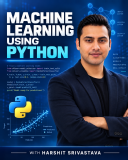

This practical course introduces machine learning through Python-based implementation and real-world problem-solving. It is designed for students, developers, analysts, and technology professionals who want to understand how data can be transformed into reliable predictive models.
We begin with the machine-learning workflow, Python data-processing libraries, exploratory data analysis, and essential statistical concepts. You will learn how to clean datasets, handle missing values, encode categorical variables, scale features, identify useful patterns, and divide data correctly for training and evaluation.
The course then covers supervised-learning techniques, including linear regression, logistic regression, decision trees, random forests, support vector machines, and ensemble models. You will also explore unsupervised learning through clustering, dimensionality reduction, and pattern discovery.
Special attention is given to model evaluation and responsible experimentation. You will work with metrics such as accuracy, precision, recall, F1-score, ROC-AUC, and mean squared error. You will also learn cross-validation, hyperparameter tuning, feature selection, overfitting prevention, and reproducible pipeline construction.
Every major concept is supported by coding exercises and practical datasets. Instead of simply calling machine-learning libraries, you will understand why an algorithm works, when to use it, and how to interpret its output.
By the end of the class, you will be able to prepare data, select appropriate algorithms, train and compare models, diagnose performance problems, and build an end-to-end machine-learning project suitable for your portfolio or professional work.


 View this Course



 Top Tutor


 Certified