


 You have successfully registered
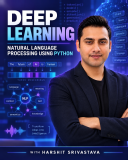

This course teaches you how to build intelligent applications that understand and process human language using Python and deep learning. It combines essential NLP concepts with practical implementation so that learners can progress from raw text to working language-based systems.
You will begin with text cleaning, tokenization, vocabulary construction, stop-word handling, stemming, lemmatization, n-grams, and numerical text representation. The class then examines traditional representations such as bag-of-words and TF-IDF before moving to distributed word embeddings.
You will learn how neural networks process sequential data through recurrent neural networks, LSTMs, and GRUs. These foundations lead into attention mechanisms and transformer architectures, helping you understand the technology behind modern language models.
Practical assignments cover text classification, sentiment analysis, sequence labeling, named-entity recognition, semantic similarity, and basic text generation. You will work with modern Python libraries and learn how to prepare datasets, train models, evaluate results, and perform error analysis.
The course explains important NLP metrics, including precision, recall, F1-score, BLEU, ROUGE, and perplexity. It also discusses class imbalance, sequence length, unknown words, data leakage, bias, hallucination, and other challenges that affect real-world NLP systems.
Rather than treating transformers as a black box, the class helps you understand token embeddings, positional information, self-attention, contextual representations, and fine-tuning.
By the end, you will be able to build, assess, and improve a complete NLP application and will possess a strong foundation for progressing into large language models, generative AI, and retrieval-augmented systems.


 View this Course





 Certified