Find the best tutors and institutes for Class 10 Tuition
Search in
Find the area of the shaded region in Fig. 12.21, if ABCD is a square of side 14 cm and APD and BPC are semicircles.
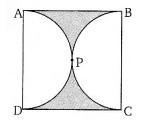
It can be observed from the figure that the radius of each semi-circle is 7 cm.

Area of each semi-circle = 

Area of square ABCD = (Side)2 = (14)2 = 196 cm2
Area of the shaded region
= Area of square ABCD − Area of semi-circle APD − Area of semi-circle BPC
= 196 − 77 − 77 = 196 − 154 = 42 cm2
On a square handkerchief, nine circular designs each of radius 7 cm are made (see the figure). Find the area of the remaining portion of the handkerchief.
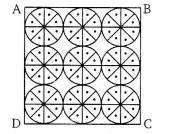

From the figure, it can be observed that the side of the square is 42 cm.
Area of square = (Side)2 = (42)2 = 1764 cm2
Area of each circle = πr2 
Area of 9 circles = 9 × 154 = 1386 cm2
Area of the remaining portion of the handkerchief = 1764 − 1386 = 378 cm2
In the figure, OACB is a quadrant of a circle with centre O and radius 3.5 cm. If OD = 2 cm, find the area of the:
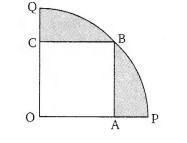
(i) quadrant OACB, (ii) shaded region.

(i) Since OACB is a quadrant, it will subtend 90° angle at O.
Area of quadrant OACB 

(ii) Area of ΔOBD 

Area of the shaded region = Area of quadrant OACB − Area of ΔOBD

Find the area of the shaded region in the figure, if PQ = 24 cm, PR = 7 cm and O is the centre of the circle.
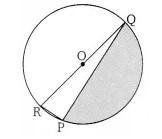
It can be observed that RQ is the diameter of the circle. Therefore, ∠RPQ will be 90º.
By applying Pythagoras theorem in ΔPQR,
RP2 + PQ2 = RQ2
(7)2 + (24)2 = RQ2

Radius of circle, 
Since RQ is the diameter of the circle, it divides the circle in two equal parts.

Area of ΔPQR 

Area of shaded region = Area of semi-circle RPQOR − Area of ΔPQR
= 
= 
=  cm2
cm2
Find the area of the shaded region in the figure, if radii of the two concentric circles with centre O are 7 cm and 14 cm respectively and .
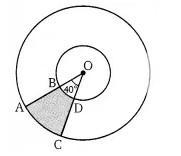

Radius of inner circle = 7 cm
Radius of outer circle = 14 cm
Area of shaded region = Area of sector OAFC − Area of sector OBED
Find the area of the shaded region in the figure, where a circular arc of radius 6 cm has been drawn with vertex O of an equilateral triangle OAB of side 12 cm as centre.
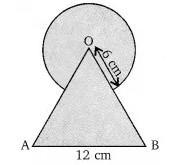
We know that each interior angle of an equilateral triangle is of measure 60°.

Area of sector OCDE 

Area of 

Area of circle = πr2 
Area of shaded region = Area of ΔOAB + Area of circle − Area of sector OCDE

From each corner of a square of side 4 cm a quadrant of a circle of radius 1 cm is cut and also a circle of diameter 2 cm is cut as shown in the figure. Find the area of the remaining portion of the square.
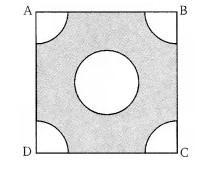

Each quadrant is a sector of 90° in a circle of 1 cm radius.
Area of each quadrant 

Area of square = (Side)2 = (4)2 = 16 cm2
Area of circle = πr2 = π (1)2

Area of the shaded region = Area of square − Area of circle − 4 × Area of quadrant

In a circular table cover of radius 32 cm, a design is formed leaving an equilateral triangle ABC in the middle as shown in the figure. Find the area of the design.
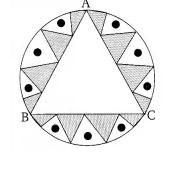

Radius (r) of circle = 32 cm
AD is the median of  ABC.
ABC.

AD = 48 cm
In ΔABD,
AB2 = AD2 + BD2

Area of equilateral triangle, 

Area of circle = πr2

Area of design = Area of circle − Area of ΔABC

In the figure, ABCD is a square of side 14 cm. With centres A, B, C and D, four circles are drawn such that each circle touch externally two of the remaining three circles. Find the area of the shaded region.
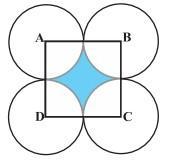

Area of each of the 4 sectors is equal to each other and is a sector of 90° in a circle of 7 cm radius.
Area of each sector 

Area of square ABCD = (Side)2 = (14)2 = 196 cm2
Area of shaded portion = Area of square ABCD − 4 × Area of each sector

Therefore, the area of shaded portion is 42 cm2.
The figure depicts a racing track whose left and right ends are semicircular.
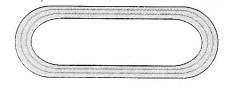
The distance between the two inner parallel line segments is 60 m and they are each 106 m long. If the track is 10 m wide, find:
(i) the distance around the track along its inner edge (ii) the area of the track.

Distance around the track along its inner edge = AB + arc BEC + CD + arc DFA

Area of the track = (Area of GHIJ − Area of ABCD) + (Area of semi-circle HKI − Area of semi-circle BEC) + (Area of semi-circle GLJ − Area of semi-circle AFD) 
Therefore, the area of the track is 4320 m2.
In the figure, AB and CD are two diameters of a circle (with centre O) perpendicular to each other and OD is the diameter of the smaller circle. If OA = 7 cm, find the area of the shaded region.
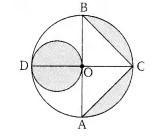

Radius (r1) of larger circle = 7 cm
Radius (r2) of smaller circle 
Area of smaller circle 

Area of semi-circle AECFB of larger circle 

Area of 

Area of the shaded region
= Area of smaller circle + Area of semi-circle AECFB − Area of ΔABC

The area of an equilateral triangle ABC is 17320.5 . With each vertex of the triangle as centre, a circle is drawn with radius equal to half the length of the side of the triangle (see the figure). Find the area of the shaded region. (Use
and
= 1.73205)
Let the side of the equilateral triangle be a.
Area of equilateral triangle = 17320.5 cm2


Each sector is of measure 60°.
Area of sector ADEF 

Area of shaded region = Area of equilateral triangle − 3 × Area of each sector

AB and CD are respectively arcs of two concentric circles of radii 21 cm and 7 cm and centre O (see the figure). If , find the area of the shaded region.
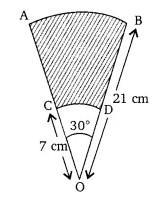

Area of the shaded region = Area of sector OAEB − Area of sector OCFD

In the figure, ABC is a quadrant of a circle of radius 14 cm and a semicircle is drawn with BC as diameter. Find the area of the shaded region.
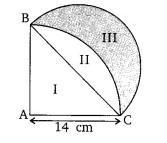

As ABC is a quadrant of the circle, ∠BAC will be of measure 90º.
In ΔABC,
BC2 = AC2 + AB2
= (14)2 + (14)2

Radius (r1) of semi-circle drawn on 
Area of 

Area of sector 


 = 154 − (154 − 98)
= 98 cm2
Calculate the area of the designed region in the figure common between the two quadrants of circles of radius 8 cm each.
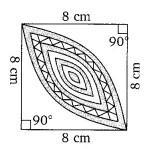

The designed area is the common region between two sectors BAEC and DAFC.
Area of sector 

Area of ΔBAC 

Area of the designed portion = 2 × (Area of segment AEC)
= 2 × (Area of sector BAEC − Area of ΔBAC)

How helpful was it?
How can we Improve it?
Please tell us how it changed your life *
Please enter your feedback
UrbanPro.com helps you to connect with the best Class 10 Tuition in India. Post Your Requirement today and get connected.
Find best tutors for Class 10 Tuition Classes by posting a requirement.


Get started now, by booking a Free Demo Class