



Find the best tutors and institutes for Class 11 Tuition
Q3.26:
Two stones are thrown up simultaneously from the edge of a cliff $200 m$ high with initial speeds of $15 m s^{-1}$ and $30 m s^{-1}$. Verify that the graph shown in Fig. 3.27 correctly represents the time variation of the relative position of the second stone with respect to the first. Neglect air resistance and assume that the stones do not rebound after hitting the ground. Take $g = 10 m s^{-2}$. Give the equations for the linear and curved parts of the plot.
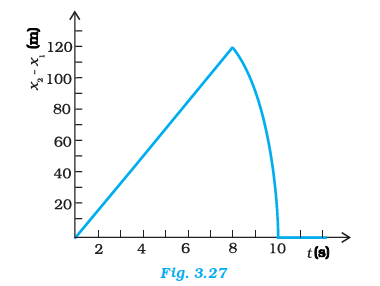
Two stones are thrown up simultaneously from the edge of a cliff $200 m$ high with initial speeds of $15 m s^{-1}$ and $30 m s^{-1}$. Verify that the graph shown in Fig. 3.27 correctly represents the time variation of the relative position of the second stone with respect to the first. Neglect air resistance and assume that the stones do not rebound after hitting the ground. Take $g = 10 m s^{-2}$. Give the equations for the linear and curved parts of the plot.
Solution :
Step 1: Establishing Kinematic Equations
Let the top of the cliff be the origin ($y = 0$) and the upward direction be positive. The position $y(t)$ of an object under gravity is given by: $y(t) = u_i t - \frac{1}{2}gt^2$ [Per the Second Equation of Motion].
For Stone 1 ($u_1 = 15 \text{ m/s}$): $y_1(t) = 15t - 5t^2$
For Stone 2 ($u_2 = 30 \text{ m/s}$): $y_2(t) = 30t - 5t^2$
Step 2: Defining Relative Position ($x_{rel}$)
The relative position of the second stone with respect to the first is defined as: $x_{rel} = y_2(t) - y_1(t)$
$x_{rel} = (30t - 5t^2) - (15t - 5t^2) = 15t$
This linear relationship holds as long as both stones are in the air [Algebraic simplification].
Step 3: Calculating Time of Flight ($T$)
Stones hit the ground at $y = -200 \text{ m}$. For Stone 1: $-200 = 15t_1 - 5t_1^2 \implies t_1^2 - 3t_1 - 40 = 0$. Using the quadratic formula $t = \frac{-b \pm \sqrt{b^2 - 4ac}}{2a}$: $t_1 = \frac{3 + \sqrt{9 + 160}}{2} \approx 7.9 \text{ s}$ (Taking positive root).
For Stone 2: $-200 = 30t_2 - 5t_2^2 \implies t_2^2 - 6t_2 - 40 = 0$. $t_2 = \frac{6 + \sqrt{36 + 160}}{2} \approx 10.2 \text{ s}$.
Step 4: Analyzing the Motion Phases
| Time Interval | Relative Position ($x_{rel}$) | Justification |
|---|---|---|
| $0 \leq t \leq 7.9 \text{ s}$ | $15t$ | Both stones in flight. |
| $7.9 < t \leq 10.2 \text{ s}$ | $y_2(t) - (-200) = 30t - 5t^2 + 200$ | Stone 1 stationary at base. |
| $t > 10.2 \text{ s}$ | $0$ | Both stones stationary at base. |
Step 5: Visual Representation
Final Analysis
The graph consists of two distinct segments:
1. Linear Segment ($0 \leq t \leq 7.9 \text{ s}$): $x_{rel} = 15t$. This is a straight line passing through the origin with a slope of $15 \text{ m/s}$.
2. Parabolic Segment ($7.9 < t \leq 10.2 \text{ s}$): $x_{rel} = -5t^2 + 30t + 200$. This represents the position of the second stone relative to the grounded first stone.
Final Solution: The relative position is defined by $x_{rel} = 15t$ for $0 \leq t \leq 7.9$ s and $x_{rel} = -5t^2 + 30t + 200$ for $7.9 < t \leq 10.2$ s.
More Questions from Class 11 Physics Motion in a Straight Line Additional Exercises
- Q3.23: A three-wheeler starts from rest, accelerates uniformly with $1 m s^{-2}$ on a straight road for $10 s$, and then moves with uniform velocity. Plot the distance covered by the vehicle during the nth second ($n$ = 1,2,3….) versus $n$. What do you expect this plot to be during accelerated motion : a straight line or a parabola ?
- Q3.24: A boy standing on a stationary lift (open from above) throws a ball upwards with the maximum initial speed he can, equal to $49 m s^{-1}$. How much time does the ball take to return to his hands? If the lift starts moving up with a uniform speed of $5 m s^{-1}$ and the boy again throws the ball up with the maximum speed he can, how long does the ball take to return to his hands ?
- Q3.25(a): On a long horizontally moving belt (Fig. 3.26), a child runs to and fro with a speed $9 km h^{-1}$ (with respect to the belt) between his father and mother located $50 m$ apart on the moving belt. The belt moves with a speed of $4 km h^{-1}$. For an observer on a stationary platform outside, what is the (a) speed of the child running in the direction of motion of the belt ?.
- Q3.25(b): On a long horizontally moving belt (Fig. 3.26), a child runs to and fro with a speed $9 km h^{-1}$ (with respect to the belt) between his father and mother located $50 m$ apart on the moving belt. The belt moves with a speed of $4 km h^{-1}$. For an observer on a stationary platform outside, what is the (b) speed of the child running opposite to the direction of motion of the belt ?
- Q3.25(c): On a long horizontally moving belt (Fig. 3.26), a child runs to and fro with a speed $9 km h^{-1}$ (with respect to the belt) between his father and mother located $50 m$ apart on the moving belt. The belt moves with a speed of $4 km h^{-1}$. For an observer on a stationary platform outside, what is the (c) time taken by the child in (a) speed of the child running in the direction of motion of the belt ? and (b) speed of the child running opposite to the direction of motion of the belt ? Which of the answers alter if motion is viewed by one of the parents ?
- Q3.27(a): The speed-time graph of a particle moving along a fixed direction is shown in Fig. 3.28. Obtain the distance traversed by the particle between (a) $t = 0 s$ to $10 s$.
- Q3.27(b): The speed-time graph of a particle moving along a fixed direction is shown in Fig. 3.28. Obtain the distance traversed by the particle between (b) $t = 2 s$ to $6 s$.
- Q3.27(c): The speed-time graph of a particle moving along a fixed direction is shown in Fig. 3.28. What is the average speed of the particle over the interval in (a) $t = 0 s$ to $10 s$?
- Q3.27(d): The speed-time graph of a particle moving along a fixed direction is shown in Fig. 3.28. What is the average speed of the particle over the interval in (b) $t = 2 s$ to $6 s$?
- Q3.28(a): The velocity-time graph of a particle in one-dimensional motion is shown in Fig. 3.29 : Which of the following formulae are correct for describing the motion of the particle over the time-interval $t_1$ to $t_2$: (a) $x(t_2) = x(t_1) + v(t_1) (t_2 - t_1) +(\frac{1}{2}) a (t_2 - t_1)^2$
- Q3.28(b): The velocity-time graph of a particle in one-dimensional motion is shown in Fig. 3.29 : Which of the following formulae are correct for describing the motion of the particle over the time-interval $t_1$ to $t_2$: (b) $v(t_2) = v(t_1) + a (t_2 - t_1)$
- Q3.28(c): The velocity-time graph of a particle in one-dimensional motion is shown in Fig. 3.29 : Which of the following formulae are correct for describing the motion of the particle over the time-interval $t_1$ to $t_2$: (c) $v_{average} = \frac{x(t_2) - x(t_1)}{t_2 - t_1}$
- Q3.28(d): The velocity-time graph of a particle in one-dimensional motion is shown in Fig. 3.29 : Which of the following formulae are correct for describing the motion of the particle over the time-interval $t_1$ to $t_2$: (d) $a_{average} = \frac{v(t_2) - v(t_1)}{t_2 - t_1}$
- Q3.28(e): The velocity-time graph of a particle in one-dimensional motion is shown in Fig. 3.29 : Which of the following formulae are correct for describing the motion of the particle over the time-interval $t_1$ to $t_2$: (e) $x(t_2) = x(t_1) + v_{average} (t_2 - t_1) + (\frac{1}{2}) a_{average} (t_2 - t_1)^2$
- Q3.28(f): The velocity-time graph of a particle in one-dimensional motion is shown in Fig. 3.29 : Which of the following formulae are correct for describing the motion of the particle over the time-interval $t_1$ to $t_2$: (f) $x(t_2) - x(t_1)$ = area under the $v-t$ curve bounded by the $t$-axis and the dotted line shown.
CBSE Solutions for Class 11 Physics Motion in a Straight Line
Chapters in CBSE - Class 11 Physics
Top Tutors who teach Motion in a Straight Line



 Top Tutor
 Anna Nagar Mullai Nagar, Chennai
 9 yrs of
Exp
 6 students
 420 hrs of classes completed
 600
per hour
 Online Classes
Hi, I'm Kalaiselvi, an M.Sc. Mathematics graduate with 9 years of experience in one-on-one online Maths tutoring. I specialize in teaching Classes 10, 11, and 12 for CBSE and Tamil Nadu State Board. My classes are conducted in both English and Tamil (bilingual), making concepts easy to understand. I focus on concept clarity, problem-solving, regular practice, and exam preparation, with personalized attention for every student.
Great experience with Kalaiselvi Ma'am, her knowledge and skill on the subject are amazing. Thank you for your support and guidance.


 Top Tutor
Mukherjee Nagar, Delhi
5 yrs of
Exp
2057 hrs of classes completed
500
per hour
Online Classes
Hi, I am Neeraj Dwivedi Top Tutor and partner at Urban Pro . Into profession of teaching since last four years. Expertise and specialization in guiding students on subjects like History, Political Science, Economics and Hindi. These subjects were my strength in my journey of Civil Services and later helped in shaping future of students. Apart from teaching guidance I have been doing career counselling of students as to what to pursue/not pursue after school based on individual interests and capabilities.
I scored above in all three subjects and you are good in explaining the details, I really amazed by your teaching style.


 Top Tutor
Vayusenabad, Delhi
5 yrs of
Exp
5 students
118 hrs of classes completed
400
per hour
Online Classes
One of the key challenges in teaching commerce is the diversity of students’ learning styles. Some students may excel in theory, while others may struggle with calculations or interpreting financial statements. As a commerce teacher, you need to be adaptable—using visual aids, group work, and real-world scenarios to make abstract concepts more understandable. For example, showing a video on how a business grows can bring the business theory to life in a way that reading a textbook may not. You might begin a lesson by discussing real-world examples, such as current economic trends, business case studies, or financial news. This helps students connect theoretical concepts to practical situations. For example, when teaching accounting principles, you might ask students to work through a mock company’s balance sheet or profit and loss statement, making the material more tangible. Regular quizzes, assignments, and group projects can be used to assess both theoretical knowledge and practical application of commerce concepts. For instance, group projects in business studies might involve students creating a business plan or analyzing a company’s performance, fostering teamwork and real-world problem-solving.
He classes are really interesting, ma'am makes the classes really fun so that understanding becomes easier.
 Top Tutor
Shastri Colony, Panipat
7 yrs of
Exp
17 students
898 hrs of classes completed
500
per hour
Online Classes
 Tutor's home
Experienced Educator specializing in Physics. I have entered into the field of teaching and started to make and feel physics easy and exciting by the students and also make students to crack the most of the competitive examinations by which I will make them achieve their goals in future. I have been successfully training students from class 10t,11th and 12th for the last 11 years in Physics, along with JEE Mains & Advanced, NEET exam preparation. With 11 years of teaching experience and a background in Unacademy ( Doubt Solving Expert) and Filo Edutech Platform, I provide comprehensive coaching for students preparing for board exams and competitive tests.
A good, kind and a patient teacher, who creates a positive and a supportive environment for her students.


 Top Tutor
Chuna Bhatti, Bhopal
13 yrs of
Exp
1 student
58 hrs of classes completed
800
per hour
Online Classes
"I'm a passionate and experienced educator with a strong background in Accountancy. With 12 years of teaching experience, I've developed a proven track record of helping students achieve their academic goals. My Approach I believe in creating a supportive and engaging learning environment that fosters curiosity, creativity, and critical thinking. My teaching approach is tailored to meet the unique needs and learning styles of each student. Subjects I Teach - Accountancy - Business Studies - Commerce Qualifications - CMA (Cost And Management Accountant - MBA Finance What You Can Expect - Personalised attention and guidance - Customised lesson plans to suit your learning needs - Regular progress tracking and feedback - A safe and encouraging environment to ask questions and learn Let's Connect! If you're looking for a dedicated and experienced educator to help you achieve your academic goals, let's get started! Book a trial session today and see the difference for yourself."
Sir, I still remember your lessons. Whatever I studied, I always studied it in a different way. Your motivation, your way of building confidence, everything was different. Thank you Sir.
Other Subjects in CBSE - Class 11

Download free CBSE - Class 11 Physics Motion in a Straight Line Additional Exercises worksheets
Download Now

