



Find the best tutors and institutes for Class 11 Tuition
Q3.28(f):
The velocity-time graph of a particle in one-dimensional motion is shown in Fig. 3.29 : Which of the following formulae are correct for describing the motion of the particle over the time-interval $t_1$ to $t_2$: (f) $x(t_2) - x(t_1)$ = area under the $v-t$ curve bounded by the $t$-axis and the dotted line shown.
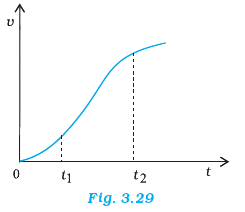
The velocity-time graph of a particle in one-dimensional motion is shown in Fig. 3.29 : Which of the following formulae are correct for describing the motion of the particle over the time-interval $t_1$ to $t_2$: (f) $x(t_2) - x(t_1)$ = area under the $v-t$ curve bounded by the $t$-axis and the dotted line shown.
Solution :
Step 1: Theoretical Foundation of Velocity-Time Graphs
The motion of a particle in one dimension is defined by the instantaneous velocity $v(t)$, which is the derivative of position $x(t)$ with respect to time $t$: $v(t) = \frac{dx}{dt}$ [Per the definition of instantaneous velocity].
Step 2: Deriving the Integral Form
To determine the change in position (displacement) over a time interval $[t_1, t_2]$, we rearrange the differential equation: $dx = v(t) dt$.
Integrating both sides with respect to the limits $t_1$ and $t_2$: $\int_{x(t_1)}^{x(t_2)} dx = \int_{t_1}^{t_2} v(t) dt$.
This yields: $x(t_2) - x(t_1) = \int_{t_1}^{t_2} v(t) dt$. [By the Fundamental Theorem of Calculus].
Step 3: Geometric Interpretation
In a Cartesian coordinate system where the ordinate is $v$ and the abscissa is $t$, the definite integral $\int_{t_1}^{t_2} v(t) dt$ represents the net signed area enclosed between the curve $v(t)$, the horizontal axis ($t$-axis), and the vertical lines $t = t_1$ and $t = t_2$.
Visual Representation of Displacement
Step 4: Analytical Validation
The expression $x(t_2) - x(t_1)$ represents the displacement of the particle between $t_1$ and $t_2$. Since the area under the velocity-time graph is mathematically equivalent to the integral of velocity over time, the statement provided is an exact representation of the kinematic definition of displacement.
| Physical Quantity | Mathematical Representation |
|---|---|
| Displacement | $\Delta x = x(t_2) - x(t_1)$ |
| Area under $v-t$ curve | $\int_{t_1}^{t_2} v(t) dt$ |
Final Solution: The formula $x(t_2) - x(t_1) = \int_{t_1}^{t_2} v(t) dt$ is correct, as the displacement of a particle is identically defined by the area bounded by the velocity-time graph, the time axis, and the time interval boundaries.
More Questions from Class 11 Physics Motion in a Straight Line Additional Exercises
- Q3.23: A three-wheeler starts from rest, accelerates uniformly with $1 m s^{-2}$ on a straight road for $10 s$, and then moves with uniform velocity. Plot the distance covered by the vehicle during the nth second ($n$ = 1,2,3….) versus $n$. What do you expect this plot to be during accelerated motion : a straight line or a parabola ?
- Q3.24: A boy standing on a stationary lift (open from above) throws a ball upwards with the maximum initial speed he can, equal to $49 m s^{-1}$. How much time does the ball take to return to his hands? If the lift starts moving up with a uniform speed of $5 m s^{-1}$ and the boy again throws the ball up with the maximum speed he can, how long does the ball take to return to his hands ?
- Q3.25(a): On a long horizontally moving belt (Fig. 3.26), a child runs to and fro with a speed $9 km h^{-1}$ (with respect to the belt) between his father and mother located $50 m$ apart on the moving belt. The belt moves with a speed of $4 km h^{-1}$. For an observer on a stationary platform outside, what is the (a) speed of the child running in the direction of motion of the belt ?.
- Q3.25(b): On a long horizontally moving belt (Fig. 3.26), a child runs to and fro with a speed $9 km h^{-1}$ (with respect to the belt) between his father and mother located $50 m$ apart on the moving belt. The belt moves with a speed of $4 km h^{-1}$. For an observer on a stationary platform outside, what is the (b) speed of the child running opposite to the direction of motion of the belt ?
- Q3.25(c): On a long horizontally moving belt (Fig. 3.26), a child runs to and fro with a speed $9 km h^{-1}$ (with respect to the belt) between his father and mother located $50 m$ apart on the moving belt. The belt moves with a speed of $4 km h^{-1}$. For an observer on a stationary platform outside, what is the (c) time taken by the child in (a) speed of the child running in the direction of motion of the belt ? and (b) speed of the child running opposite to the direction of motion of the belt ? Which of the answers alter if motion is viewed by one of the parents ?
- Q3.26: Two stones are thrown up simultaneously from the edge of a cliff $200 m$ high with initial speeds of $15 m s^{-1}$ and $30 m s^{-1}$. Verify that the graph shown in Fig. 3.27 correctly represents the time variation of the relative position of the second stone with respect to the first. Neglect air resistance and assume that the stones do not rebound after hitting the ground. Take $g = 10 m s^{-2}$. Give the equations for the linear and curved parts of the plot.
- Q3.27(a): The speed-time graph of a particle moving along a fixed direction is shown in Fig. 3.28. Obtain the distance traversed by the particle between (a) $t = 0 s$ to $10 s$.
- Q3.27(b): The speed-time graph of a particle moving along a fixed direction is shown in Fig. 3.28. Obtain the distance traversed by the particle between (b) $t = 2 s$ to $6 s$.
- Q3.27(c): The speed-time graph of a particle moving along a fixed direction is shown in Fig. 3.28. What is the average speed of the particle over the interval in (a) $t = 0 s$ to $10 s$?
- Q3.27(d): The speed-time graph of a particle moving along a fixed direction is shown in Fig. 3.28. What is the average speed of the particle over the interval in (b) $t = 2 s$ to $6 s$?
- Q3.28(a): The velocity-time graph of a particle in one-dimensional motion is shown in Fig. 3.29 : Which of the following formulae are correct for describing the motion of the particle over the time-interval $t_1$ to $t_2$: (a) $x(t_2) = x(t_1) + v(t_1) (t_2 - t_1) +(\frac{1}{2}) a (t_2 - t_1)^2$
- Q3.28(b): The velocity-time graph of a particle in one-dimensional motion is shown in Fig. 3.29 : Which of the following formulae are correct for describing the motion of the particle over the time-interval $t_1$ to $t_2$: (b) $v(t_2) = v(t_1) + a (t_2 - t_1)$
- Q3.28(c): The velocity-time graph of a particle in one-dimensional motion is shown in Fig. 3.29 : Which of the following formulae are correct for describing the motion of the particle over the time-interval $t_1$ to $t_2$: (c) $v_{average} = \frac{x(t_2) - x(t_1)}{t_2 - t_1}$
- Q3.28(d): The velocity-time graph of a particle in one-dimensional motion is shown in Fig. 3.29 : Which of the following formulae are correct for describing the motion of the particle over the time-interval $t_1$ to $t_2$: (d) $a_{average} = \frac{v(t_2) - v(t_1)}{t_2 - t_1}$
- Q3.28(e): The velocity-time graph of a particle in one-dimensional motion is shown in Fig. 3.29 : Which of the following formulae are correct for describing the motion of the particle over the time-interval $t_1$ to $t_2$: (e) $x(t_2) = x(t_1) + v_{average} (t_2 - t_1) + (\frac{1}{2}) a_{average} (t_2 - t_1)^2$
CBSE Solutions for Class 11 Physics Motion in a Straight Line
Chapters in CBSE - Class 11 Physics
Top Tutors who teach Motion in a Straight Line


 Top Tutor
 Sakinaka East, Mumbai
 5 yrs of
Exp
 47 hrs of classes completed
 1500
per hour
 Online Classes
 Student's Home
 Tutor's home
Starting from fundamentals of the subject and explaining in such a way that the student feels comfortable with the subject. Repeating the difficult topics and conducting weekly tests so that the student gets the confident over the subject.
Heâ??s really nice, and is easy to get along with. He also explains answers to questions in a very straight forward, simple way.
 Top Tutor
Jayanagar 4th block, Bangalore
11 yrs of
Exp
 1 student
293 hrs of classes completed
400
per hour
Online Classes
- Helping the student gain confidence in themselves and with respect to the subject. - Thorough preparation with the help of model and previous year question papers. - Understanding the student's learning style and adapting my teaching style accordingly. - Making lessons interesting by using different methods of teaching (Sharing relevant YouTube links and weblinks).
I like the faculty and I feel I had the best environment for my studies . I learned the new things from my teachers who were very helpful in every way they could. You have been a great lecturer to me, and I fully enjoyed your lectures, you explained everything in detail about the media and early childhood education and way of storytelling etc, referring the notes given to us , it made it easier for me to understand. I'm beyond thankful to have you as one of my lecturer in my Masters. Thank you


 Top Tutor
Anna Nagar Mullai Nagar, Chennai
9 yrs of
Exp
6 students
420 hrs of classes completed
600
per hour
Online Classes
Hi, I'm Kalaiselvi, an M.Sc. Mathematics graduate with 9 years of experience in one-on-one online Maths tutoring. I specialize in teaching Classes 10, 11, and 12 for CBSE and Tamil Nadu State Board. My classes are conducted in both English and Tamil (bilingual), making concepts easy to understand. I focus on concept clarity, problem-solving, regular practice, and exam preparation, with personalized attention for every student.
Great experience with Kalaiselvi Ma'am, her knowledge and skill on the subject are amazing. Thank you for your support and guidance.
 Top Tutor
HMT Estate 2nd Stage, Bangalore
20 yrs of
Exp
32 students
2767 hrs of classes completed
550
per hour
Online Classes
I am a teacher. Teaching chemistry for the past 20+ years. I also have some experience in research in applied chemistry. I have a masters degree in chemistry and a bachelors degree in education. In addition to teaching I have experience in school administration and content development. My key skills are to train the students for various competitive exams like JEE, NEET, BITSAT, CET.
She is patient , understanding and then times the classes as per the students requirements. Gentle and slow. The right kind of teacher for chemistry subject.


 Top Tutor
Mukherjee Nagar, Delhi
5 yrs of
Exp
2057 hrs of classes completed
500
per hour
Online Classes
Hi, I am Neeraj Dwivedi Top Tutor and partner at Urban Pro . Into profession of teaching since last four years. Expertise and specialization in guiding students on subjects like History, Political Science, Economics and Hindi. These subjects were my strength in my journey of Civil Services and later helped in shaping future of students. Apart from teaching guidance I have been doing career counselling of students as to what to pursue/not pursue after school based on individual interests and capabilities.
I scored above in all three subjects and you are good in explaining the details, I really amazed by your teaching style.
Other Subjects in CBSE - Class 11

Download free CBSE - Class 11 Physics Motion in a Straight Line Additional Exercises worksheets
Download Now

