



Find the best tutors and institutes for Class 11 Tuition
Q10.22(b):
A manometer reads the pressure of a gas in an enclosure as shown in Fig. 10.25 (a) When a pump removes some of the gas, the manometer reads as in Fig. 10.25 (b) The liquid used in the manometers is mercury and the atmospheric pressure is 76 cm of mercury. (b) How would the levels change in case (b) if 13.6 cm of water (immiscible with mercury) are poured into the right limb of the manometer ? (Ignore the small change in the volume of the gas).
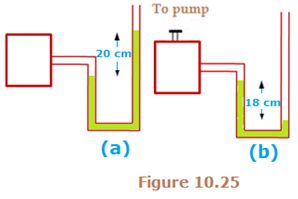
A manometer reads the pressure of a gas in an enclosure as shown in Fig. 10.25 (a) When a pump removes some of the gas, the manometer reads as in Fig. 10.25 (b) The liquid used in the manometers is mercury and the atmospheric pressure is 76 cm of mercury. (b) How would the levels change in case (b) if 13.6 cm of water (immiscible with mercury) are poured into the right limb of the manometer ? (Ignore the small change in the volume of the gas).
Solution :
Step 1: Establishing Initial Parameters and Hydrostatic Equilibrium
From the problem statement and Figure 10.25 (b), let the initial pressure of the gas in the enclosure be $P_g$. In the right limb, the column of mercury is exposed to the atmosphere ($P_{atm} = 76 \text{ cm of Hg}$). In the left limb, the mercury column is connected to the gas enclosure. Let $h$ be the height difference between the mercury levels in the two limbs. According to the law of hydrostatics [Per the Law of Communicating Vessels], the pressure at a horizontal level in a continuous static fluid is equal.
The equilibrium condition for the manometer in state (b) is given by:
$P_g + h_{left} \cdot \rho_{Hg} \cdot g = P_{atm} + h_{right} \cdot \rho_{Hg} \cdot g$
$P_g = P_{atm} - h \cdot \rho_{Hg} \cdot g$ (where $h$ is the difference in mercury levels).
Step 2: Analysis of Adding Immiscible Water
We add $h_w = 13.6 \text{ cm}$ of water to the right limb. Since water is immiscible with mercury and $\rho_w < \rho_{Hg}$, the water floats on top of the mercury in the right limb. This increases the total pressure on the mercury surface in the right limb. The density of water is $\rho_w = 1 \text{ g/cm}^3$ and the density of mercury is $\rho_{Hg} = 13.6 \text{ g/cm}^3$.
The equivalent pressure head of water in terms of mercury is calculated as:
$h_{eq} = h_w \times \frac{\rho_w}{\rho_{Hg}}$
$h_{eq} = 13.6 \text{ cm} \times \frac{1 \text{ g/cm}^3}{13.6 \text{ g/cm}^3} = 1 \text{ cm of Hg}$
Step 3: Calculating the Shift in Mercury Levels
Let the new difference in mercury levels be $h'$. The new pressure equilibrium equation at the common interface level in the left limb becomes:
$P_g + h_1 \rho_{Hg} g = P_{atm} + h_2 \rho_{Hg} g + h_w \rho_w g$
Because the gas volume is assumed constant and the tube cross-section is uniform, if the mercury level in the right limb drops by $x$, the level in the left limb rises by $x$. The new difference $h'$ relates to the previous difference $h$ as $h' = h + 2x$. However, the hydrostatic balance dictates that the added 1 cm of mercury pressure equivalent must be distributed across the two columns.
When 13.6 cm of water is added, it exerts a pressure equivalent to 1 cm of Hg. This pressure pushes the mercury in the right limb down. Consequently, the mercury level in the left limb rises. By the principle of displacement in U-tubes:
- Pressure increment on right side = $1 \text{ cm Hg}$.
- Since the pressure must balance, the mercury column height difference $h'$ must adjust to compensate for the additional $1 \text{ cm}$ of head.
- The mercury level in the right limb will descend by $0.5 \text{ cm}$, and the mercury level in the left limb will rise by $0.5 \text{ cm}$.
Summary of Level Changes
| Limb | Direction of Change | Magnitude |
|---|---|---|
| Right Limb (Water side) | Downward | $0.5 \text{ cm}$ |
| Left Limb (Gas side) | Upward | $0.5 \text{ cm}$ |
Final Solution: Upon pouring 13.6 cm of water into the right limb, the mercury level in the right limb will fall by 0.5 cm, and the mercury level in the left limb will rise by 0.5 cm, resulting in a net increase of 1 cm in the mercury level difference between the two limbs.
More Questions from Class 11 Physics Mechanical Properties of Fluids Additional Exercises
- Q10.21: A tank with a square base of area $1.0 m^2$ is divided by a vertical partition in the middle. The bottom of the partition has a small-hinged door of area $20 cm^2$. The tank is filled with water in one compartment, and an acid (of relative density 1.7) in the other, both to a height of 4.0 m. compute the force necessary to keep the door close.
- Q10.22(a): A manometer reads the pressure of a gas in an enclosure as shown in Fig. 10.25 (a) When a pump removes some of the gas, the manometer reads as in Fig. 10.25 (b) The liquid used in the manometers is mercury and the atmospheric pressure is 76 cm of mercury. (a) Give the absolute and gauge pressure of the gas in the enclosure for cases (a) and (b), in units of cm of mercury.
- Q10.23: Two vessels have the same base area but different shapes. The first vessel takes twice the volume of water that the second vessel requires to fill upto a particular common height. Is the force exerted by the water on the base of the vessel the same in the two cases ? If so, why do the vessels filled with water to that same height give different readings on a weighing scale ?
- Q10.24: During blood transfusion the needle is inserted in a vein where the gauge pressure is 2000 Pa. At what height must the blood container be placed so that blood may just enter the vein ? [Use the density of whole blood from Table 10.1].
- Q10.25(a): In deriving Bernoulli’s equation, we equated the work done on the fluid in the tube to its change in the potential and kinetic energy. (a) What is the largest average velocity of blood flow in an artery of diameter $2 \times 10^{-3} m$ if the flow must remain laminar ?
- Q10.25(b): In deriving Bernoulli’s equation, we equated the work done on the fluid in the tube to its change in the potential and kinetic energy. (b) Do the dissipative forces become more important as the fluid velocity increases ? Discuss qualitatively.
- Q10.26(a): (a) What is the largest average velocity of blood flow in an artery of radius $2 \times 10^{-3}m$ if the flow must remain lanimar?
- Q10.26(b): (b) What is the corresponding flow rate ? (Take viscosity of blood to be $2.084 \times 10^{-3} Pa s$).
- Q10.27: A plane is in level flight at constant speed and each of its two wings has an area of $25 m^2$. If the speed of the air is 180 km/h over the lower wing and 234 km/h over the upper wing surface, determine the plane’s mass. (Take air density to be $1 kg m^{-3}$).
- Q10.28: In Millikan’s oil drop experiment, what is the terminal speed of an uncharged drop of radius $2.0 \times 10^{-5} m$ and density $1.2 \times 10^3 kg m^{-3}$. Take the viscosity of air at the temperature of the experiment to be $1.8 \times 10^{-5} Pa s$. How much is the viscous force on the drop at that speed ? Neglect buoyancy of the drop due to air.
- Q10.29: Mercury has an angle of contact equal to $140^{\circ}$ with soda lime glass. A narrow tube of radius 1.00 mm made of this glass is dipped in a trough containing mercury. By what amount does the mercury dip down in the tube relative to the liquid surface outside ? Surface tension of mercury at the temperature of the experiment is $0.465 N m^{-1}$. Density of mercury = $13.6 \times 10^3 kg m^{-3}$.
- Q10.30: Two narrow bores of diameters 3.0 mm and 6.0 mm are joined together to form a U-tube open at both ends. If the U-tube contains water, what is the difference in its levels in the two limbs of the tube ? Surface tension of water at the temperature of the experiment is $7.3 \times 10^{-2} N m^{-1}$. Take the angle of contact to be zero and density of water to be $1.0 \times 10^3 kg m^{-3}$ ($g = 9.8 m s^{-2}$) .
- Q10.31(a): (a) It is known that density $\rho$ of air decreases with height $y$ as $\rho = \rho_0 e^{-y/y_0}$ where $\rho_0 = 1.25 kg m^{-3}$ is the density at sea level, and $y_0$ is a constant. This density variation is called the law of atmospheres. Obtain this law assuming that the temperature of atmosphere remains a constant (isothermal conditions). Also assume that the value of $g$ remains constant.
- Q10.31(b): (b) A large He balloon of volume $1425 m^3$ is used to lift a payload of 400 kg. Assume that the balloon maintains constant radius as it rises. How high does it rise ? [Take $y_0 = 8000$ m and $\rho_{He} = 0.18 kg m^{-3}$].
CBSE Solutions for Class 11 Physics Mechanical Properties of Fluids
Chapters in CBSE - Class 11 Physics
Top Tutors who teach Mechanical Properties of Fluids


 Top Tutor
 Medchal, Hyderabad
 8 yrs of
Exp
 9 students
 1982 hrs of classes completed
 Online Classes
Students are used to listen each and every lecture carefully n practically too. I teach them theory part by taking examples. Doing more practice sessions so that their logical part will get more clear. Online teaching provides 1. Personal attention to each and every student. 2. Their practical session always b free of doubts. 3. Online classes provide teachers with a number of online learning tools including videos, audio, animations, virtual whiteboards. 4. Time to time notes will b provided
 Top Tutor
Sector 61 Block E, Noida
20 yrs of
Exp
2 students
1139 hrs of classes completed
 400
per hour
Online Classes
 Student's Home
 Tutor's home
I have extensive teaching experience providing personalized 1:1 Python training to students. My teaching approach focuses on building strong Python fundamentals through interactive lessons, practical examples, and regular coding practice. In 1:1 sessions, I adapt my teaching methods to suit each student's learning pace and individual needs, ensuring concepts are clearly understood. I encourage logical thinking, problem-solving, and hands-on coding, helping students gain confidence, strengthen their Python programming skills, and achieve academic and professional success.
 Top Tutor
Banswara, Banswara
17 yrs of
Exp
1 student
6 hrs of classes completed
400
per hour
Online Classes
Teaching learners is an imaginative world in itself in which you actually don't teach but let the learners visualize everything in their mind and see how world and everything works. It is different from primary classes which are mostly non interesting. I have been teaching to class 8 - 10 tuitions students since 2010. As my Husband is having transferable job I have got a opportunity to teach in more than one state boards eventually. But due to Covid, Currently I am taking online classes also along with my regular ICSE school classes I assure that I have wonderful methods and learning techniques so student don't need to murmur any question .Students generally got serious in December time when board exam are near. But results are not making in 2-3 months. Little bit struggle daily do the magic’s i have seen in my previous student’s experience. Even the normal student can score 90 if he/she join at earlier and 2 hour self-study daily will bring tremendous change .I just want to say that my teachings are not forgettable teachings as because in my teaching class I make my students to see the things practically and deeply so it should be made non forgettable by learning and make good percent so in future you don't have to regret. Whatever the teachings are the learners try to incorporate it in future in many things and this is what I want my learners to learn and experience practically as it happens in science subject always.
The way she teaches is amazing and we are able to understand the lesson properly and we are able to do the problems.
 Top Tutor
Ekta Nagar, Ferozepur
20 yrs of
Exp
1 student
11 hrs of classes completed
400
per hour
Online Classes
Tutor's home
I am a Mathematics Teacher with 20 years of teaching experience currently teaching at Paradise School, Zira. I speak English, Hindi and Punjabi. I teach classes 10-12 and I am able to provide both group sessions and online one to one classes. I am qualified in M.Sc of Mathematics, B.Ed, MCA.
Sir was very helpful throughout my class, he teaches very good and explains every question again and again if we don't understand. Overall it was very good.
 Top Tutor
A B Road, Indore
4 yrs of
Exp
1 student
Online Classes
Student's Home
I am a professional tutor with four years of experience in teaching. Having a degree in M.Com from Vikram University and an MBA from IMD Indore I have also completed my B.Ed from IPS Academy Indore in the year 2015. I teach Spoken English, Accountancy, Business Studies, Economics, Statistics, Secretarial Practices, etc., for State, CBSE, ISC/ICSE Board students. I am well versed in English, Hindi and can take classes at Student's Home, My Home and Online Classes via video chat, skype, google hangout, etc.
Other Subjects in CBSE - Class 11

Download free CBSE - Class 11 Physics Mechanical Properties of Fluids Additional Exercises worksheets
Download Now

