



Find the best tutors and institutes for Class 11 Tuition
Q5.24:
Figure 5.17 shows the position-time graph of a body of mass 0.04 kg. Suggest a suitable physical context for this motion. What is the time between two consecutive impulses received by the body ? What is the magnitude of each impulse ?
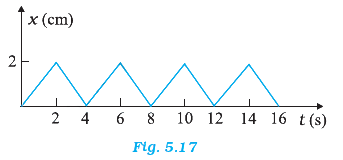
Figure 5.17 shows the position-time graph of a body of mass 0.04 kg. Suggest a suitable physical context for this motion. What is the time between two consecutive impulses received by the body ? What is the magnitude of each impulse ?
Solution :
Step 1: Analyzing the Position-Time ($x$-$t$) Graph
Based on the provided motion profile, the particle undergoes periodic motion where the position $x$ varies linearly with time $t$ between fixed bounds. The slope of the $x$-$t$ graph represents velocity $v = \frac{dx}{dt}$.
- For $0 < t < 2$ s: Slope $v = \frac{2 - 0}{2 - 0} = 1\text{ m/s}$.
- For $2 < t < 4$ s: Slope $v = \frac{0 - 2}{4 - 2} = -1\text{ m/s}$.
- This pattern repeats every $4$ seconds.
Step 2: Suggesting a Physical Context
The motion corresponds to a particle of mass $m = 0.04\text{ kg}$ undergoing one-dimensional elastic collisions against a rigid wall at $x = 2\text{ cm}$ (or $0.02\text{ m}$) and a reflecting surface at $x = 0\text{ m}$. Alternatively, it represents a ball bouncing vertically between two horizontal plates or a particle constrained to move between two elastic buffers.
Step 3: Calculating Time Between Consecutive Impulses
An impulse is received whenever the direction of velocity changes instantaneously. From the graph, the velocity changes from $1\text{ m/s}$ to $-1\text{ m/s}$ at $t = 2\text{ s}$, $6\text{ s}$, $10\text{ s}$, etc., and from $-1\text{ m/s}$ to $1\text{ m/s}$ at $t = 4\text{ s}$, $8\text{ s}$, $12\text{ s}$.
The time interval $\Delta t$ between two consecutive impulses is:
$\Delta t = 4\text{ s} - 2\text{ s} = 2\text{ s}$ [Observation of periodicity from graph].Step 4: Calculating the Magnitude of Impulse
Impulse ($J$) is defined as the change in linear momentum ($\Delta p$):
$J = |\Delta p| = m |v_f - v_i|$ [Per the Impulse-Momentum Theorem].- Initial velocity $v_i = 1\text{ m/s}$
- Final velocity $v_f = -1\text{ m/s}$
- Mass $m = 0.04\text{ kg}$
Step 5: Visual Representation
| Parameter | Value |
|---|---|
| Mass ($m$) | $0.04\text{ kg}$ |
| Velocity change ($\Delta v$) | $2\text{ m/s}$ |
| Impulse ($J$) | $0.08\text{ N}\cdot\text{s}$ |
Final Solution: The motion represents a body undergoing elastic collisions between two rigid walls. The time between consecutive impulses is $2\text{ s}$, and the magnitude of each impulse is $0.08\text{ kg}\cdot\text{m/s}$ (or $0.08\text{ N}\cdot\text{s}$).
More Questions from Class 11 Physics Laws of Motion Additional Exercises
- Q5.25: Figure 5.18 shows a man standing stationary with respect to a horizontal conveyor belt that is accelerating with $1 m s^{-2}$. What is the net force on the man? If the coefficient of static friction between the man’s shoes and the belt is 0.2, up to what acceleration of the belt can the man continue to be stationary relative to the belt ? (Mass of the man = 65 kg.)
- Q5.26: A stone of mass m tied to the end of a string revolves in a vertical circle of radius R. The net forces at the lowest and highest points of the circle directed vertically downwards are : [Choose the correct alternative] $T_1$ and $v_1$ denote the tension and speed at the lowest point. $T_2$ and $v_2$ denote corresponding values at the highest point.
- Q5.27(a): A helicopter of mass 1000 kg rises with a vertical acceleration of $15 m s^{-2}$. The crew and the passengers weigh 300 kg. Give the magnitude and direction of the (a) force on the floor by the crew and passengers,
- Q5.27(b): A helicopter of mass 1000 kg rises with a vertical acceleration of $15 m s^{-2}$. The crew and the passengers weigh 300 kg. Give the magnitude and direction of the (b) action of the rotor of the helicopter on the surrounding air,
- Q5.27(c): A helicopter of mass 1000 kg rises with a vertical acceleration of $15 m s^{-2}$. The crew and the passengers weigh 300 kg. Give the magnitude and direction of the (c) force on the helicopter due to the surrounding air.
- Q5.28: A stream of water flowing horizontally with a speed of $15 m s^{-1}$ gushes out of a tube of cross-sectional area $10^{-2} m^2$, and hits a vertical wall nearby. What is the force exerted on the wall by the impact of water, assuming it does not rebound ?
- Q5.29(a): Ten one-rupee coins are put on top of each other on a table. Each coin has a mass m. Give the magnitude and direction of (a) the force on the 7th coin (counted from the bottom) due to all the coins on its top,
- Q5.29(b): Ten one-rupee coins are put on top of each other on a table. Each coin has a mass m. Give the magnitude and direction of (b) the force on the 7th coin by the eighth coin,
- Q5.29(c): Ten one-rupee coins are put on top of each other on a table. Each coin has a mass m. Give the magnitude and direction of (c) the reaction of the 6th coin on the 7th coin.
- Q5.30: An aircraft executes a horizontal loop at a speed of 720 km/h with its wings banked at 15°. What is the radius of the loop ?
- Q5.31: A train runs along an unbanked circular track of radius 30 m at a speed of 54 km/h. The mass of the train is $10^6$ kg. What provides the centripetal force required for this purpose — The engine or the rails ? What is the angle of banking required to prevent wearing out of the rail ?
- Q5.32: A block of mass 25 kg is raised by a 50 kg man in two different ways as shown in Fig. 5.19. What is the action on the floor by the man in the two cases ? If the floor yields to a normal force of 700 N, which mode should the man adopt to lift the block without the floor yielding ?
- Q5.33(a): A monkey of mass 40 kg climbs on a rope (Fig. 5.20) which can stand a maximum tension of 600 N. In which of the following cases will the rope break: the monkey (a) climbs up with an acceleration of $6 m s^{-2}$
- Q5.33(b): A monkey of mass 40 kg climbs on a rope (Fig. 5.20) which can stand a maximum tension of 600 N. In which of the following cases will the rope break: the monkey (b) climbs down with an acceleration of $4 m s^{-2}$
- Q5.33(c): A monkey of mass 40 kg climbs on a rope (Fig. 5.20) which can stand a maximum tension of 600 N. In which of the following cases will the rope break: the monkey (c) climbs up with a uniform speed of $5 m s^{-1}$
- Q5.33(d): A monkey of mass 40 kg climbs on a rope (Fig. 5.20) which can stand a maximum tension of 600 N. In which of the following cases will the rope break: the monkey (d) falls down the rope nearly freely under gravity? (Ignore the mass of the rope).
- Q5.34(a): Two bodies A and B of masses 5 kg and 10 kg in contact with each other rest on a table against a rigid wall (Fig. 5.21). The coefficient of friction between the bodies and the table is 0.15. A force of 200 N is applied horizontally to A. What are (a) the reaction of the partition
- Q5.34(b): Two bodies A and B of masses 5 kg and 10 kg in contact with each other rest on a table against a rigid wall (Fig. 5.21). The coefficient of friction between the bodies and the table is 0.15. A force of 200 N is applied horizontally to A. What are (b) the action-reaction forces between A and B ? What happens when the wall is removed? Does the answer to (b) change, when the bodies are in motion? Ignore the difference between $\mu_s$ and $\mu_k$.
- Q5.35(a): A block of mass 15 kg is placed on a long trolley. The coefficient of static friction between the block and the trolley is 0.18. The trolley accelerates from rest with $0.5 m s^{-2}$ for 20 s and then moves with uniform velocity. Discuss the motion of the block as viewed by (a) a stationary observer on the ground,
- Q5.35(b): A block of mass 15 kg is placed on a long trolley. The coefficient of static friction between the block and the trolley is 0.18. The trolley accelerates from rest with $0.5 m s^{-2}$ for 20 s and then moves with uniform velocity. Discuss the motion of the block as viewed by (b) an observer moving with the trolley.
- Q5.36: The rear side of a truck is open and a box of 40 kg mass is placed 5 m away from the open end as shown in Fig. 5.22. The coefficient of friction between the box and the surface below it is 0.15. On a straight road, the truck starts from rest and accelerates with $2 m s^{-2}$. At what distance from the starting point does the box fall off the truck? (Ignore the size of the box).
- Q5.37: A disc revolves with a speed of $33\frac{1}{3}$ rev/min, and has a radius of 15 cm. Two coins are placed at 4 cm and 14 cm away from the centre of the record. If the co-efficient of friction between the coins and the record is 0.15, which of the coins will revolve with the record ?
- Q5.38: You may have seen in a circus a motorcyclist driving in vertical loops inside a ‘death-well’ (a hollow spherical chamber with holes, so the spectators can watch from outside). Explain clearly why the motorcyclist does not drop down when he is at the uppermost point, with no support from below. What is the minimum speed required at the uppermost position to perform a vertical loop if the radius of the chamber is 25 m ?
- Q5.39: A 70 kg man stands in contact against the inner wall of a hollow cylindrical drum of radius 3 m rotating about its vertical axis with 200 rev/min. The coefficient of friction between the wall and his clothing is 0.15. What is the minimum rotational speed of the cylinder to enable the man to remain stuck to the wall (without falling) when the floor is suddenly removed ?
- Q5.40: A thin circular loop of radius R rotates about its vertical diameter with an angular frequency $\omega$. Show that a small bead on the wire loop remains at its lowermost point for $\omega \leq \sqrt{g / R}$. What is the angle made by the radius vector joining the centre to the bead with the vertical downward direction for $\omega = \sqrt{2g / R}$ ? Neglect friction.
CBSE Solutions for Class 11 Physics Laws of Motion
Chapters in CBSE - Class 11 Physics
Top Tutors who teach Laws of Motion

 Top Tutor
 Amrapali Dream Valley, Noida
 10 yrs of
Exp
 5 students
 41 hrs of classes completed
 500
per hour
 Online Classes
 Student's Home
 Tutor's home
Dear Parent/Student *Worried about 2022-23 Examinations*?? Mr. Ved Prakash is providing *Home tuitions*/*Online tuition of *Math & Applied Math* for class *XI and XII*. Have an edge over others by utilising your precious time. *Added Advantages:* 1. Notes and worksheet of every chapter will be provided. 2. Daily test and counselling. 3. Special work on problem solving skills. 4. 100 % result guaranteed. *Experience* - 10 years If interested contact Mr. Ved Prakash
I had an amazing experience. I would say that if you wanna crack any kind of competitive exam then you must join this.

 Top Tutor
Sector 92, Gurgaon
20 yrs of
Exp
4 students
1392 hrs of classes completed
1000
per hour
Online Classes
Student's Home
Tutor's home
Teaching since last 20 years
Very patient. Makes learning fun and productive. A seasoned and competent teacher. Makes a subject as mind-bogging as Math very easy to understand. Awesome experience!
 Top Tutor
Maan, Pimpri-Chinchwad
10 yrs of
Exp
1 student
263 hrs of classes completed
1200
per hour
Online Classes
Student's Home
Tutor's home
I have been teaching students for the past 6 years and have guided many to students in getting excellent results, showcasing their best performance. Concept-based teaching and an extra emphasis on every student needs has helped me provide a quality teaching environment to my students.
He is one of those teachers who always helps his students with all his doubts even if it is out of syllabus.
 Top Tutor
Dilshad Garden, Delhi
4 yrs of
Exp
3 students
969 hrs of classes completed
260
per hour
Online Classes
I am a Chartered Accountant by profession and have been teaching Commerce subjects—primarily Accounting and Economics—for the past 4 years. I work with BCom/BSc students and CA aspirants, helping them build strong conceptual clarity and practical understanding. Teaching is my passion and hobby, and I focus on delivering quality education by maintaining small group sizes (2–3 students at a time). This allows me to give individual attention, ensuring that every student understands the concepts thoroughly and gains confidence. My teaching approach is practical-based, designed to bridge the gap between academic theories and real-world industry applications. I emphasize how concepts are applied in actual business environments—both in private and public sectors—so students can connect textbook knowledge to real scenarios. I prefer conducting online, individual sessions to provide personalized support and address each student’s learning style and pace. I teach using a whiteboard for clear and visual explanations. For CA students, I recommend specific books aligned with the syllabus. For Class 11 and 12, I rely on their existing school books but provide additional notes or references on request to avoid overloading them. While I haven't pursued awards in teaching, the positive feedback from my students and their academic success bring me immense satisfaction. My goal is to make learning effective, relevant, and engaging for every student I teach.
 Top Tutor
Anora Kala, Lucknow
20 yrs of
Exp
2 students
2148 hrs of classes completed
400
per hour
Online Classes
Students enjoyed & learnt the subject. Programming in Java is thaught in a way that students understand the logic & also learn to apply it on similar problems. They fared well in various software competitions.
Very committed and focused on the concepts. My child benefited a lot with Mrs. Shilvanti's classes. Highly recommend using her as a tutor in case any child is facing challenges with Computers.



