0
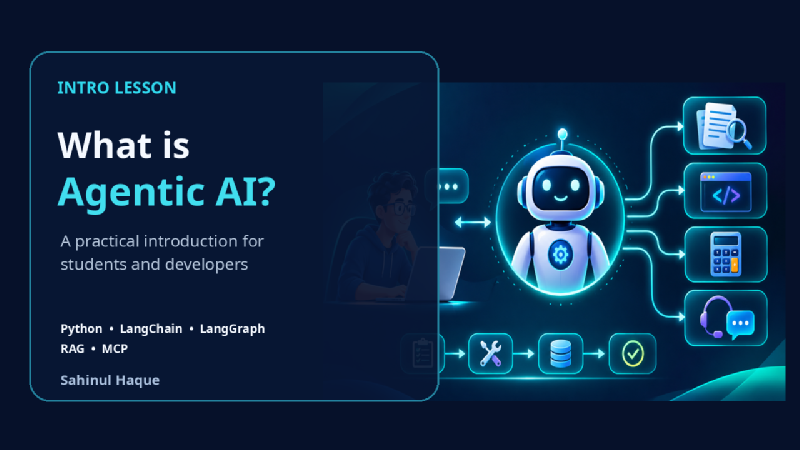
What Is Agentic AI? – A Practical Introduction
Agentic AI is a way of building AI applications in which a model can help direct the next steps of a task and decide when to use available tools. The exact behaviour depends on the application, its instructions, its tools and the controls built around it.
1. What Makes a System an Agent?
An agent is more than a model call in isolation. OpenAI's Agents SDK documentation describes an agent as a model configured with instructions and optional runtime features such as tools, guardrails, handoffs and structured outputs.
Instructions define the work and its boundaries. Tools provide capabilities the application makes available. Guardrails help check inputs, outputs or tool behaviour.
2. How Does an Agent Run?
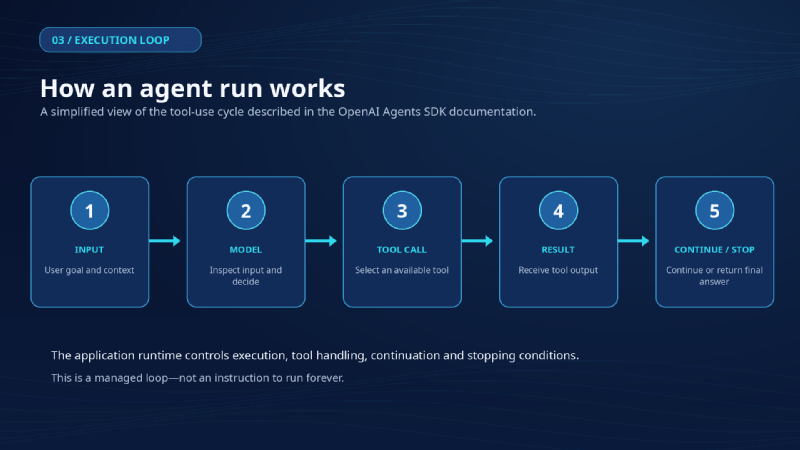
A simplified run follows this pattern:
-
The application supplies the user's goal and relevant context.
-
The model examines the input and decides what it needs to do next.
-
If a tool is needed, the model requests a tool call.
-
The application executes the tool and returns the result to the model.
-
The model uses the result, may request another tool, or returns a final answer.
This is a controlled runtime loop. The application defines what tools exist, how they are executed, and when the run must stop.
3. Agents and Workflows Are Not the Same Design
Anthropic distinguishes predefined workflows, where models and tools follow fixed code paths, from agents, where models dynamically direct their processes and tool use.
Neither design is automatically best. A predictable, well-defined task may be better served by a simpler workflow. An agent may be useful when the next step or tool choice needs to adapt to the task.
Flexibility can bring additional latency and cost, so the design should justify the extra complexity.
4. Where Does MCP Fit?
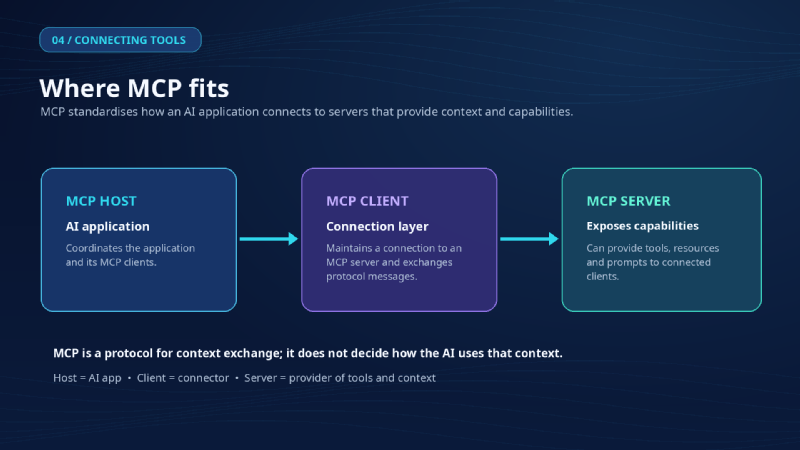
The Model Context Protocol (MCP) standardises how an AI application connects to servers that provide context and capabilities.
Its architecture has three main participants:
-
Host: The AI application that coordinates connections.
-
Client: The component that maintains a connection to an MCP server.
-
Server: The program that can provide tools, resources and prompts to connected clients.
MCP is a protocol for context exchange. It does not define how an AI application reasons or how it must use the context it receives.
5. Design with Safety in Mind
Tools can interact with external systems.
Guardrails help validate inputs, outputs and tool behaviour. For sensitive actions, an application can pause execution until a person approves or rejects the proposed tool call.
A model suggesting an action is not the same as that action being approved or completed.
In This Course
We take these concepts into practical development using Python, RAG, LangChain, LangGraph, and MCP Server and Client development.
The course project is a hands-on Customer Support Bot.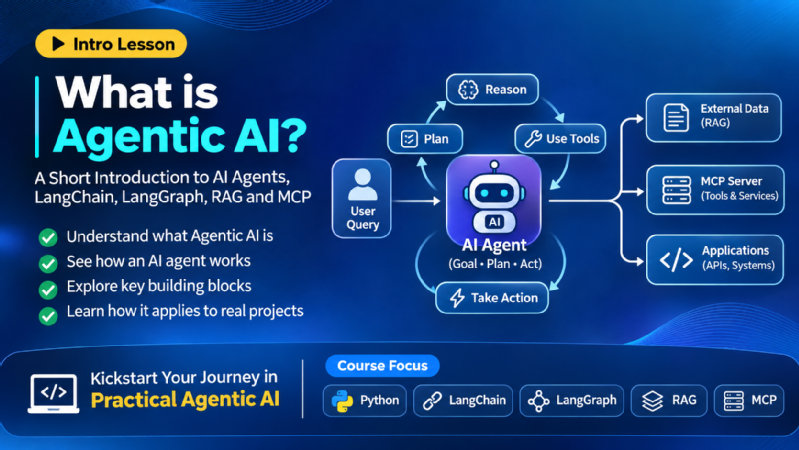
🚀 Curious about Agentic AI?
What makes an AI agent different from a traditional chatbot?
Explore this short introductory lesson and learn:
✅ What Agentic AI means
✅ How AI agents use tools
✅ How an agent execution loop works
✅ Where LangChain, LangGraph and MCP fit
✅ Why guardrails and human approval matter
Learn the concepts behind modern AI applications and discover how they come together in practical development.
🎓 Explore hands-on Agentic AI training with Python, RAG, LangChain, LangGraph, MCP Server and Client development.
Instructor: Sahinul Haque
Senior Technical Architect | 21+ Years IT Experience