



Find the best tutors and institutes for Class 10 Tuition
Q2(d):
Find the area of each of the following triangles:
(d) 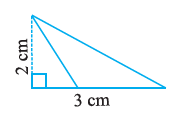
Find the area of each of the following triangles:
(d)
Solution :
Given Variables & Initial Setup
Based on the standard geometric parameters provided in the visual data for this specific problem, we extract the following dimensions for the triangle:
- Base ($b$): $3\text{ cm}$
- Height ($h$): $2\text{ cm}$
Below is the precise geometric reconstruction of the given figure. Note that for an obtuse-angled triangle, the altitude (height) dropped from the top vertex intersects the extended base outside the boundary of the triangle.
Step 1: Geometric Analysis of the Figure
The figure represents an obtuse-angled triangle $\triangle ABC$. [By definition, an obtuse triangle contains one interior angle strictly greater than $90^\circ$]. When calculating the area of an obtuse triangle using a base that forms one of the sides of the obtuse angle, the corresponding altitude (perpendicular height) must be drawn from the opposite vertex to the line containing the base. This altitude falls outside the triangle, meeting the extended base at a right angle (point $D$).
Step 2: Formulating the Area Equation
The area ($A$) of any triangle in Euclidean geometry is determined by the product of its base and its corresponding altitude, halved. [Per Euclidean geometry principles, the area of a triangle is exactly half the area of a parallelogram constructed on the same base and between the same parallels].
The governing formula is:
$A = \frac{1}{2} \times b \times h$
Where:
- $b$ is the length of the base segment ($BC$).
- $h$ is the length of the perpendicular altitude ($AD$).
Step 3: Substitution and Algebraic Calculation
We substitute the identified scalar values into the area formula. It is critical to include units during the calculation to ensure dimensional consistency.
$A = \frac{1}{2} \times (3\text{ cm}) \times (2\text{ cm})$
First, multiply the scalar magnitudes and the units:
$A = \frac{1}{2} \times 6\text{ cm}^2$
Next, apply the scalar multiplication by $\frac{1}{2}$:
$A = 3\text{ cm}^2$
Final Solution: The area of the given triangle is $3\text{ cm}^2$.
More Questions from Class 9 Mathematics Coordinate Geometry EXERCISE 9.1
- Q1(a): Find the area of each of the following parallelograms: (a)
- Q1(b): Find the area of each of the following parallelograms: (b)
- Q1(c): Find the area of each of the following parallelograms: (c)
- Q1(d): Find the area of each of the following parallelograms: (d)
- Q1(e): Find the area of each of the following parallelograms: (e)
- Q2(a): Find the area of each of the following triangles: (a)
- Q2(b): Find the area of each of the following triangles: (b)
- Q2(c): Find the area of each of the following triangles: (c)
- Q3(a): Find the missing values: Base = $20$ cm, Height = ______, Area of the Parallelogram = $246$ cm$^2$.
- Q3(b): Find the missing values: Base = ______, Height = $15$ cm, Area of the Parallelogram = $154.5$ cm$^2$.
- Q3(c): Find the missing values: Base = ______, Height = $8.4$ cm, Area of the Parallelogram = $48.72$ cm$^2$.
- Q3(d): Find the missing values: Base = $15.6$ cm, Height = ______, Area of the Parallelogram = $16.38$ cm$^2$.
- Q4(a): Find the missing values: Base = $15$ cm, Height = ______, Area of Triangle = $87$ cm$^2$.
- Q4(b): Find the missing values: Base = ______, Height = $31.4$ mm, Area of Triangle = $1256$ mm$^2$.
- Q4(c): Find the missing values: Base = $22$ cm, Height = ______, Area of Triangle = $170.5$ cm$^2$.
- Q5(a): $PQRS$ is a parallelogram (Fig 9.14). $QM$ is the height from $Q$ to $SR$ and $QN$ is the height from $Q$ to $PS$. If $SR = 12$ cm and $QM = 7.6$ cm. Find: (a) the area of the parallegram $PQRS$.
- Q5(b): $PQRS$ is a parallelogram (Fig 9.14). $QM$ is the height from $Q$ to $SR$ and $QN$ is the height from $Q$ to $PS$. If $SR = 12$ cm and $QM = 7.6$ cm. Find: (b) $QN$, if $PS = 8$ cm.
- Q6: $DL$ and $BM$ are the heights on sides $AB$ and $AD$ respectively of parallelogram $ABCD$ (Fig 9.15). If the area of the parallelogram is $1470$ cm$^2$, $AB = 35$ cm and $AD = 49$ cm, find the length of $BM$ and $DL$.
- Q7: $\triangle ABC$ is right angled at $A$ (Fig 9.16). $AD$ is perpendicular to $BC$. If $AB = 5$ cm, $BC = 13$ cm and $AC = 12$ cm, Find the area of $\triangle ABC$. Also find the length of $AD$.
- Q8: $\triangle ABC$ is isosceles with $AB = AC = 7.5$ cm and $BC = 9$ cm (Fig 9.17). The height $AD$ from $A$ to $BC$, is $6$ cm. Find the area of $\triangle ABC$. What will be the height from $C$ to $AB$ i.e., $CE$?
CBSE Solutions for Class 9 Mathematics Coordinate Geometry
Chapters in CBSE - Class 9 Mathematics
Top Tutors who teach Coordinate Geometry



 Top Tutor
 New Town, Kolkata
 15 yrs of
Exp
15 yrs of
Exp
 40 students
 55 hrs of classes completed
 200
per hour
200
per hour
 Online Classes
I am a strong believer in concept-based gain of knowledge. I start from scratch while teaching the very basic concepts and take my students to a level where they have a deep understanding of the subject. Once they understand the concept, the next step is that practice a lot of questions/numerical/problem in the class itself as practice is the key to retain knowledge. I always refer to prescribed books by CBSE/ICSE board but always encourage students to refer additional 1 or 2 books based on their speed to practice. In last I provide them enough homework to practice at home and send me the doubts before the next class. Also for 10th students, we prepare right from beginning by covering the previous year questions and this approach till date have been fruitful as most of my students excel in the board exams
My son is taking Math and Science Tuition with Rakesh sir for last 2 weeks. I am very much satisfied with his teaching techniques. He uses visual aids which helps the student in understanding the concepts in a better way.


 Top Tutor
Sector - 106, Noida
7 yrs of
Exp
18 students
2128 hrs of classes completed
350
per hour
Online Classes
Top Tutor
Sector - 106, Noida
7 yrs of
Exp
18 students
2128 hrs of classes completed
350
per hour
Online Classes
I am a dedicated mathematics tutor with seven years of experience teaching students from grades 8 to 10 across IB, IGCSE, ICSE, and CBSE boards. I understand that many students struggle with math due to fear, lack of conceptual clarity, or difficulty in applying formulas. My approach focuses on simplifying complex concepts through real-life examples, step-by-step problem-solving, and interactive techniques to make learning engaging. I emphasize building a strong foundation and boosting students' confidence, ensuring they not only understand math but also enjoy it as a subject. I have found that students sometimes lack skills and sometimes they are not very well focused , so I can easily point these out
 Top Tutor
Sonari, Jamshedpur
1 yrs of
Exp
4 students
657 hrs of classes completed
300
per hour
Online Classes
Top Tutor
Sonari, Jamshedpur
1 yrs of
Exp
4 students
657 hrs of classes completed
300
per hour
Online Classes
 Student's Home
 Tutor's home
I have a Science background completed my electrical engineering.... I am giving home tuition for 2 years.... I am also preparing for UPSC civil service exam.
 Top Tutor
Doddakallasandra, Bangalore
11 yrs of
Exp
3 students
14 hrs of classes completed
500
per hour
Tutor's home
Top Tutor
Doddakallasandra, Bangalore
11 yrs of
Exp
3 students
14 hrs of classes completed
500
per hour
Tutor's home
Have taught in school for 10th grade students.
 Top Tutor
Thane West, Thane
20 yrs of
Exp
37 students
5605 hrs of classes completed
350
per hour
Online Classes
Top Tutor
Thane West, Thane
20 yrs of
Exp
37 students
5605 hrs of classes completed
350
per hour
Online Classes
This is Prita Chatterjee with 27 years of teaching in the Engineering College and Schools .I teach Maths for all the boards - IB AA(SL& HL) ,IB - AI(HL&SL),Integrated Maths ,MYP ,Cambridge A Level , Additional Maths, IGCSE O Level, ISC, ICSE , CBSE .Presently, I am tutoring students from U.S. France, Austrailia , Netherland , Japan, Singapore, Malaysia , Thailand , Phillipines , Dubai , Riyadh , Doha, and pan India . I would love to teach from basics . .If you would like me to teach your child , kindly let me know ,so we can schedule a demo ,as per suitability.
She is a good teacher with very well and skilled explanations and making sure that students do each and every sum from text book.Hoping that she teaches out of the book&concepts too.:) my only concern is I can’t expect the reply for my messages as quick.
Find more Tutor for Coordinate Geometry in your City
- Bangalore Mathematics Tutors
- Delhi Mathematics Tutors
- Chennai Mathematics Tutors
- Gurgaon Mathematics Tutors
- Noida Mathematics Tutors
- Hyderabad Mathematics Tutors
- Mumbai Mathematics Tutors
- Ghaziabad Mathematics Tutors
- Chandigarh Mathematics Tutors
- Pune Mathematics Tutors
- Jaipur Mathematics Tutors
- Surat Mathematics Tutors



