



Find the best tutors and institutes for Class 11 Tuition
Q8(b):
Figure 11.10 shows the effect of light on the rate of photosynthesis. Based on the graph, answer the following questions: (b) What could be the limiting factor/s in region A?
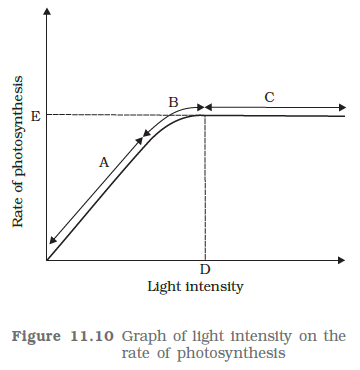
Figure 11.10 shows the effect of light on the rate of photosynthesis. Based on the graph, answer the following questions: (b) What could be the limiting factor/s in region A?
Solution :
Analysis of Region A: Limiting Factors in Photosynthesis
In the standard representation of the light-response curve of photosynthesis, the graph plots the Rate of Photosynthesis (y-axis) against Light Intensity (x-axis). Region A represents the initial, linear portion of the curve where the photosynthetic rate increases proportionally with light intensity.
Step 1: Application of Blackman’s Law of Limiting Factors
Per Blackman’s Law of Limiting Factors (1905), if a chemical process is affected by more than one factor, then its rate will be determined by the factor which is nearest to its minimal value; it is the factor which directly affects the process if its quantity is changed.
Step 2: Identification of Constraints in Region A
In Region A, the rate of photosynthesis is strictly dependent on the light intensity. As light intensity increases, the rate of production of $ATP$ and $NADPH$ (the products of the light-dependent reactions) increases proportionally. Consequently, the rate of $CO_2$ fixation is directly limited by the availability of these light-generated products [Per the Light-Dependent Reaction stoichiometry].
- Primary Limiting Factor: Light Intensity. Because the curve is linear and rising, the enzymatic machinery ($RuBisCO$) and $CO_2$ concentrations are in excess relative to the photon flux density.
- Secondary Potential Limiting Factors: While light is the dominant limiting factor, if conditions were altered, factors such as $CO_2$ concentration or ambient temperature could also become limiting if they are held at non-saturating levels. However, in the context of standard light-response dynamics, Light Intensity is the governing parameter for Region A.
Visual Representation of Light Saturation Dynamics
Summary Analysis
The linearity of the graph in Region A indicates that the system has not yet reached light saturation. Therefore, any increment in light intensity results in a proportional increment in the photosynthetic rate. If the rate were limited by other factors (such as $CO_2$ or enzymes), the curve would deviate from this linear trajectory before the light saturation point is reached.
Final Solution: The limiting factor in region A is Light Intensity. As the light intensity increases, the rate of photosynthesis increases linearly, confirming that light is the factor nearest to its minimum value per Blackman's Law of Limiting Factors.
More Questions from Class 11 Biology Photosynthesis EXERCISES
- Q1: By looking at a plant externally, can you tell whether a plant is $C_3$ or $C_4$? Why and how?
- Q2: By looking at which internal structure of a plant you can tell whether a plant is $C_3$ or $C_4$? Explain.
- Q3: Even though a very few cells in a $C_4$ plant carry out the biosynthetic – Calvin pathway, yet they are highly productive. Can you discuss why?
- Q4: RuBisCO is an enzyme that acts both as a carboxylase and oxygenase. Why do you think RuBisCO carries out more carboxylation in $C_4$ plants?
- Q5: Suppose there were plants that had a high concentration of Chlorophyll $b$, but lacked chlorophyll $a$, would it carry out photosynthesis? Then why do plants have chlorophyll $b$ and other accessory pigments?
- Q6: Why is the colour of a leaf kept in the dark frequently becomes yellow, or pale green? Which pigment do you think is more stable?
- Q7: Look at leaves of the same plant on the shady side and compare it with the leaves on the sunny side. Or, compare the potted plants kept in the sunlight with those in the shade. Which of them has leaves that are darker green ? Why?
- Q8(a): Figure 11.10 shows the effect of light on the rate of photosynthesis. Based on the graph, answer the following questions: (a) At which point/s (A, B or C) in the curve light is a limiting factor?
- Q8(c): Figure 11.10 shows the effect of light on the rate of photosynthesis. Based on the graph, answer the following questions: (c) What do C and D represent on the curve?
- Q9(a): Give comparison between the following: (a) $C_3$ and $C_4$ pathways
- Q9(b): Give comparison between the following: (b) Cyclic and non-cyclic photophosphorylation
- Q9(c): Give comparison between the following: (c) Anatomy of leaf in $C_3$ and $C_4$ plants
CBSE Solutions for Class 11 Biology Photosynthesis
Chapters in CBSE - Class 11 Biology
- The Living World
- Biological Classification
- Plant Kingdom
- Animal Kingdom
- Morphology of Flowering Plants
- Anatomy of Flowering Plants
- Structural Organisation in Animals
- Cell – The Unit of Life
- Biomolecules
- Cell Cycle and Division
- Transport in Plants
- Mineral Nutrition
- Respiration in Plants
- Plant Growth and Development
- Digestion and Absorption
- Breathing and Exchange of Gases
- Body Fluids and Circulation
- Excretory Products and Elimination
- Locomotion and Movement
- Neural Control and Coordination
- Chemical Coordination and Integration
Top Tutors who teach Photosynthesis


 Top Tutor
 HSR Layout, Bangalore
 20 yrs of
Exp
 32 students
 1746 hrs of classes completed
 600
per hour
 Online Classes
 Tutor's home
With a distinguished Doctorate in Chemistry, I bring 28 years of expertise, seamlessly integrating profound knowledge and unparalleled teaching prowess. As a Chemistry Teacher for CBSE and IBDP Chemistry Faculty, I've significantly contributed to intellectual growth in prestigious institutions like Kendriya Vidyalaya, Ecole Mondiale World School, and Singapore International School etc. Recognized as a trailblazer, I've served as an Assistant Examiner and Moderator for Internal Assessment in IBDP Chemistry for six years, upholding the highest evaluation standards and showcasing a deep understanding of curriculum intricacies. My extensive experiences beyond conventional teaching establish me as a luminary in Chemistry education, leaving an enduring legacy in the annals of education. I remain dedicated to inspiring future generations to achieve unparalleled heights in scientific inquiry and knowledge.
Dr. Anupa is a great teacher. She is patient and is interested in the learning and growth of the student.
 Top Tutor
BARASAT, Kolkata
13 yrs of
Exp
2 students
37 hrs of classes completed
400
per hour
Online Classes
Tutor's home
I have total 13 years of teaching experience in the field of engineering education in various capacity in different best private engineering colleges and universities in West Bengal. Currently I am working as an Associate Professor in the Department of Computer Science and Engineering and also worked as the HOD of the Department in a renowned private University in Eastern India.

 Super Tutor
Kharghar, Mumbai
20 yrs of
Exp
5 students
199 hrs of classes completed
500
per hour
Online Classes
Tutor's home
I am an M.Sc. in Physics and B.Ed. with over 22 years of teaching experience. I have extensive experience teaching CBSE/NCERT Physics, particularly Classes 11 and 12, with a strong focus on conceptual clarity, numerical problem-solving and examination preparation. I have taught at the secondary and senior-secondary levels and have also worked in the corporate sector. My professional certifications include Microsoft Certified Educator, DOEACC PGDCA, and certification in “A to Z of Online Teaching” from upEducators. I am also CBSE-certified in Design Thinking. I secured 3rd rank in the CENTA Teaching Professionals’ Olympiad in 2018, reflecting my strong subject knowledge and teaching expertise. My teaching approach combines clear explanations, real-life applications, structured practice, regular assessments and personalised feedback to help students develop confidence and perform consistently well in Physics
Her teaching is nice and understand the subject with easy way for children. I will refer her to some of my circle friend for their children
 Top Tutor
Narasapur, Gadag
10 yrs of
Exp
1 student
67 hrs of classes completed
350
per hour
Online Classes
I specialize in breaking down complex mathematical derivations, interpreting complex velocity-time or field graphs, and explaining the physical significance behind equations.Step-by-step algorithmic breakdown of complex integrals, visualizing 3D space geometries, and teaching the underlying logic of proofs.I break down intimidating, high-weightage topics into digestible sub-concepts. For example, before diving into complex Electromagnetic Induction problems, I ensure the student thoroughly grips Lenz's Law and magnetic flux concepts.

 Top Tutor
Bhestan, Surat
5 yrs of
Exp
2 students
1139 hrs of classes completed
500
per hour
Online Classes
I have over 5 years of experience teaching Class 11 CBSE students in Physics, Chemistry, and Mathematics, following the latest CBSE and NCERT curriculum and examination pattern. My teaching approach focuses on building strong conceptual foundations while developing problem-solving skills required for board examinations and competitive-level questions. I explain every topic in a structured and student-friendly manner, starting from basic concepts and gradually moving towards application-based and higher-order questions. Special emphasis is given to NCERT theory, important derivations, numerical problems, diagrams, formulas, reactions, and previous-year examination patterns. Over the years, I have helped many Class 12 students improve their academic performance, with several students scoring 90% and above in their board examinations. I regularly identify individual learning gaps and provide targeted practice, revision, doubt-solving, and exam-oriented guidance. My goal is not only to help students score high marks but also to make Physics, Chemistry, and Mathematics clear, logical, and easy to understand through consistent practice and personalized guidance.
As a parent of an 11th-grade student, I am very happy with the teaching provided by Shivam Sir. He teaches every topic in a simple, clear, and easy-to-understand way, making even difficult concepts much easier for my son to grasp. His classes are interactive, well-structured, and focused on building strong conceptual understanding rather than just memorization. I have noticed a significant improvement in my son's confidence, problem-solving skills, and academic performance since he started learning from Shivam Sir. He is always patient, encourages students to ask questions, and ensures that every doubt is cleared before moving ahead.



