



Find the best tutors and institutes for Class 12 Tuition
Q6.1(e):
Predict the direction of induced current in the situation described by the following Fig. 6.15(e).
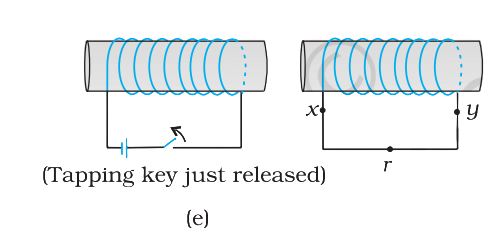
Predict the direction of induced current in the situation described by the following Fig. 6.15(e).
Solution :
Step 1: Identification of Physical Configuration
The system consists of a closed metallic loop situated in the plane of the page and a straight current-carrying wire placed in the same plane. The wire carries a steady current $I$. According to the problem setup, the wire is moved towards the loop (perpendicular to its own length). The objective is to determine the direction of the induced current in the loop, if any, using Lenz’s Law and the Right-Hand Thumb Rule.
Step 2: Analysis of Magnetic Field Orientation
By applying the Right-Hand Thumb Rule, we determine the direction of the magnetic field $\mathbf{B}$ generated by the straight wire. For a current flowing upward (as depicted in standard schematic representations for this configuration), the magnetic field lines emerge from the plane of the page to the left of the wire and enter the plane of the page to the right of the wire. [Per Biot-Savart Law, $\mathbf{B} = \frac{\mu_0 I}{2\pi r}$].
Step 3: Determination of Magnetic Flux Change
The loop is located to the right of the wire. Consequently, the magnetic field lines passing through the loop are directed into the page. As the wire (or the loop) moves such that the distance $r$ decreases, the magnetic field intensity $B$ at the location of the loop increases. [Since $B \propto \frac{1}{r}$].
Therefore, the total magnetic flux $\Phi_B = \int \mathbf{B} \cdot d\mathbf{A}$ through the loop is increasing into the page.
Step 4: Application of Lenz’s Law
According to Lenz’s Law, the induced current in the loop will flow in a direction such that it opposes the change in magnetic flux that produced it. Since the flux into the page is increasing, the induced current must create a magnetic field that points out of the page to counteract the increase. [Per Faraday-Lenz Law of Induction: $\mathcal{E} = -\frac{d\Phi_B}{dt}$].
Step 5: Determining Current Direction via Right-Hand Grip Rule
To produce a magnetic field directed out of the page (the "upward" direction relative to the loop surface), the induced current must circulate in the counter-clockwise direction. Using the Right-Hand Grip Rule, if the fingers of the right hand curl in the counter-clockwise direction, the thumb points out of the page.
Final Solution: The induced current in the loop will flow in the counter-clockwise direction.
More Questions from Class 12 Physics Electromagnetic Induction EXERCISES
- Q6.1(a): Predict the direction of induced current in the situation described by the following Fig. 6.15(a).
- Q6.1(b): Predict the direction of induced current in the situation described by the following Fig. 6.15(b).
- Q6.1(c): Predict the direction of induced current in the situation described by the following Fig. 6.15(c).
- Q6.1(d): Predict the direction of induced current in the situation described by the following Fig. 6.15(d).
- Q6.1(f): Predict the direction of induced current in the situation described by the following Fig. 6.15(f).
- Q6.2(a): Use Lenz’s law to determine the direction of induced current in the situations described by Fig. 6.16: A wire of irregular shape turning into a circular shape;
- Q6.2(b): Use Lenz’s law to determine the direction of induced current in the situations described by Fig. 6.16: A circular loop being deformed into a narrow straight wire.
- Q6.3: A long solenoid with 15 turns per cm has a small loop of area (2.0 cm^{2}) placed inside the solenoid normal to its axis. If the current carried by the solenoid changes steadily from 2.0 A to 4.0 A in 0.1 s, what is the induced emf in the loop while the current is changing?
- Q6.4(a): A rectangular wire loop of sides 8 cm and 2 cm with a small cut is moving out of a region of uniform magnetic field of magnitude 0.3 T directed normal to the loop. What is the emf developed across the cut if the velocity of the loop is (1 cm s^{-1}) in a direction normal to the longer side of the loop? For how long does the induced voltage last in each case?
- Q6.4(b): A rectangular wire loop of sides 8 cm and 2 cm with a small cut is moving out of a region of uniform magnetic field of magnitude 0.3 T directed normal to the loop. What is the emf developed across the cut if the velocity of the loop is (1 cm s^{-1}) in a direction normal to the shorter side of the loop? For how long does the induced voltage last in each case?
- Q6.5: A 1.0 m long metallic rod is rotated with an angular frequency of (400 rad s^{-1}) about an axis normal to the rod passing through its one end. The other end of the rod is in contact with a circular metallic ring. A constant and uniform magnetic field of 0.5 T parallel to the axis exists everywhere. Calculate the emf developed between the centre and the ring.
- Q6.6(a): A horizontal straight wire 10 m long extending from east to west is falling with a speed of (5.0 m s^{-1}), at right angles to the horizontal component of the earth’s magnetic field, (0.30 \times 10^{-4} Wb m^{-2}). What is the instantaneous value of the emf induced in the wire?
- Q6.6(b): A horizontal straight wire 10 m long extending from east to west is falling with a speed of (5.0 m s^{-1}), at right angles to the horizontal component of the earth’s magnetic field, (0.30 \times 10^{-4} Wb m^{-2}). What is the direction of the emf?
- Q6.6(c): A horizontal straight wire 10 m long extending from east to west is falling with a speed of (5.0 m s^{-1}), at right angles to the horizontal component of the earth’s magnetic field, (0.30 \times 10^{-4} Wb m^{-2}). Which end of the wire is at the higher electrical potential?
- Q6.7: Current in a circuit falls from 5.0 A to 0.0 A in 0.1 s. If an average emf of 200 V induced, give an estimate of the self-inductance of the circuit.
- Q6.8: A pair of adjacent coils has a mutual inductance of 1.5 H. If the current in one coil changes from 0 to 20 A in 0.5 s, what is the change of flux linkage with the other coil?
CBSE Solutions for Class 12 Physics Electromagnetic Induction
Chapters in CBSE - Class 12 Physics
- Electric Charges and Fields
- Electrostatic Potential and Capacitance
- Current Electricity
- Moving Charges and Magnetism
- Magnetism and Matter
- Alternating Current
- Electromagnetic Waves
- Ray Optics and Optical Instruments
- Wave Optics
- Dual Nature of Radiation and Matter
- Atoms
- Nuclei
- Semiconductor Electronics
- Communication Systems
Top Tutors who teach Electromagnetic Induction

 Top Tutor
 Sector 49, Gurgaon
 12 yrs of
Exp
 1 student
 1 hrs of classes completed
 1400
per hour
 Student's Home
Focus is on building the fundamentals of both Accounting and economics and making it easy to understand. Have been delivering excellent and above anticipated results. A good score follows with better understanding of the concepts. Learning is fun with the way we do our classes. Must take a demo before making up the mind for starting or not to start the classes.
Sudhanshu Sir is an excellent economics teacher who explains every concept in a very simple and clear way. His teaching style makes even difficult topics easy to understand, and he is always patient while solving doubts. Thanks to his guidance, my interest and confidence in economics have improved a lot.
 Top Tutor
Sukhlia, Indore
4 yrs of
Exp
2 students
109 hrs of classes completed
500
per hour
 Online Classes
I am pursuing a Ph.D. in Economics from DAVV Indore. I have completed Master of Business Administration. I have also completed a Bachelor of Engineering in Computer Science. I am UGC NET qualified in Economics. and I have more than 4 years of experience in teaching.
Very good. Focuses on conceptual and practical learning. Sir helped me to get better in macroeconomics
 Top Tutor
Aganampudi, Visakhapatnam
7 yrs of
Exp
2 students
65 hrs of classes completed
500
per hour
Online Classes
Student's Home
Since from last seven years i am doing for 10, 11 and 12 th class chemistry students and i am efficient in doubt solving of students.
Very nice explanation of each chapter without any doubts and easy to understand all concepts and easy to solve questions.


 Top Tutor
C V Raman Nagar Viswa Vihar, Bangalore
20 yrs of
Exp
4 students
312 hrs of classes completed
1600
per hour
Online Classes
Education can not be forced onto a student. Teaching, more than imparting knowledge, is inspiring a change. Learning, more than just reading or memorising facts, is gaining knowledge or acquiring skills by studying. My way of teaching is conceptual, analytical, simplified and problem solving. Having worked as HOD for engineering college, I also counsel students in the areas of career development and motivation towards achieving their goals. I mentored several students to achieve good results in academic and competitive exams. I worked as a professor of Physics for Engineering college for 30 years and now taking online classes since 2018. I can teach Physics and Chemistry for 10th, 11th, 12th, UG and physics for all. Currently taking online tuitions for US, Canada and Indian students in Physics and Organic chemistry My students from US are from Heritage High School, Frisco, Texas;University of Dallas, Texas, University of Wisconsin, and Simon Fraser University, B. C. Canada.
Dr Mamatha is an extremely patient and diligent teacher. She broke down each concept in simple terms and helped me understand it in the easiest way possible. She was always willing to teach me again in case I stumbled or faced difficulty in any concept. I really started to understand physics beyond the textbook and approach the concepts in an informed way, after taking classes with her!


 Top Tutor
Laxmi Vihar, Hisar
4 yrs of
Exp
11 students
267 hrs of classes completed
800
per hour
Online Classes
I'm a mathematics' teacher. My goal is to teach you how you can think out a solution rather than roboting your way out. We will dive deep into concepts of mathematics and come out as a well learned and scrupulous student. I am ready to clear your hurdles with most accurate way. I have taught at many academies for JEE preparations. In addition to it I have taught online in UrbanPro from past 4 years.
Suman is an awesome teacher and connects well with the student and gets them to grasp concepts and be interested in the subject. Highly recommend him for math.



