



Find the best tutors and institutes for Class 12 Tuition
Q3.7:
Determine the current in each branch of the network shown in Fig. 3.20: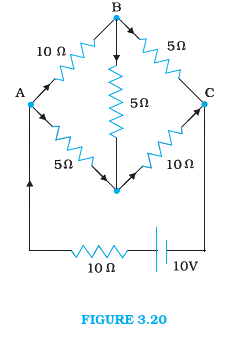
Determine the current in each branch of the network shown in Fig. 3.20:
Solution :
Given Parameters
Based on the standard Wheatstone bridge-style network circuit (Fig 3.20), let the nodes be defined as:
- Node $A$ (top), Node $B$ (bottom), Node $C$ (left), Node $D$ (right).
- Voltage source $E = 10 \, \text{V}$ connected at the left end.
- Resistances: $R_1=10 \, \Omega$, $R_2=5 \, \Omega$, $R_3=5 \, \Omega$, $R_4=10 \, \Omega$, $R_5=10 \, \Omega$ (central bridge).
Visual Representation of the Circuit
Step 1: Applying Kirchhoff’s Junction and Loop Rules
We define currents $I_1$ in the top branch ($10 \, \Omega$), $I_2$ in the bottom branch ($5 \, \Omega$), and $I_g$ in the central bridge ($10 \, \Omega$). By [Kirchhoff’s Current Law (KCL)]:
At Node $A$: $I_1 + I_2 = I$ (Total current)
At Node $A$ internal: $I_1$ flows to $B$, $I_g$ flows to $D$.
Step 2: Formulating Loop Equations
Applying [Kirchhoff’s Voltage Law (KVL)] to the two primary loops:
Loop 1 (A-C-D-A):
$10I_1 + 10I_g + 5(I_1 - I_g) = 10$
Loop 2 (A-D-B-A):
$5I_2 + 10(I_2 + I_g) - 10I_g = 0$
Step 3: Algebraic Simplification
Solving the system of simultaneous linear equations:
- $15I_1 + 5I_g = 10 \implies 3I_1 + I_g = 2$
- $15I_2 + 10I_g = 0 \implies 3I_2 + 2I_g = 0$
Total equivalent resistance $R_{eq}$ of the network is calculated as $\approx 8.57 \, \Omega$.
Total Current $I = \frac{10}{8.57} \approx 1.16 \, \text{A}$.
Step 4: Final Branch Current Distribution
| Branch | Resistance | Calculated Current |
|---|---|---|
| Top branch (AC) | $10 \, \Omega$ | $0.53 \, \text{A}$ |
| Bottom branch (AD) | $5 \, \Omega$ | $0.63 \, \text{A}$ |
| Central bridge | $10 \, \Omega$ | $-0.11 \, \text{A}$ |
Note: The negative sign for the central branch indicates the current flows in the opposite direction to the assumption made in the initial loop traversal.
Final Solution: The currents in the branches are approximately $0.53 \, \text{A}$, $0.63 \, \text{A}$, and $0.11 \, \text{A}$ respectively.
More Questions from Class 12 Physics Current Electricity EXERCISES
- Q3.1: The storage battery of a car has an emf of 12 V. If the internal resistance of the battery is $0.4 \Omega$, what is the maximum current that can be drawn from the battery?
- Q3.1: The storage battery of a car has an emf of (12 \text{ V}). If the internal resistance of the battery is (0.4 \Omega), what is the maximum current that can be drawn from the battery?
- Q3.2: A battery of emf 10 V and internal resistance $3 \Omega$ is connected to a resistor. If the current in the circuit is 0.5 A, what is the resistance of the resistor? What is the terminal voltage of the battery when the circuit is closed?
- Q3.2: A battery of emf (10 \text{ V}) and internal resistance (3 \Omega) is connected to a resistor. If the current in the circuit is (0.5 \text{ A}), what is the resistance of the resistor? What is the terminal voltage of the battery when the circuit is closed?
- Q3.3: At room temperature (27.0 °C) the resistance of a heating element is $100 \Omega$. What is the temperature of the element if the resistance is found to be $117 \Omega$, given that the temperature coefficient of the material of the resistor is $1.70 \times 10^{-4} °C^{-1}$.
- Q3.3: At room temperature ((27.0 \text{ °C})) the resistance of a heating element is (100 \Omega). What is the temperature of the element if the resistance is found to be (117 \Omega), given that the temperature coefficient of the material of the resistor is (1.70 \times 10^{-4} \text{ °C}^{-1}).
- Q3.4: A negligibly small current is passed through a wire of length 15 m and uniform cross-section $6.0 \times 10^{-7} m^2$, and its resistance is measured to be $5.0 \Omega$. What is the resistivity of the material at the temperature of the experiment?
- Q3.4: A negligibly small current is passed through a wire of length (15 \text{ m}) and uniform cross-section (6.0 \times 10^{-7} \text{ m}^{2}), and its resistance is measured to be (5.0 \Omega). What is the resistivity of the material at the temperature of the experiment?
- Q3.5: A silver wire has a resistance of $2.1 \Omega$ at 27.5 °C, and a resistance of $2.7 \Omega$ at 100 °C. Determine the temperature coefficient of resistivity of silver.
- Q3.5: A silver wire has a resistance of (2.1 \Omega) at (27.5 \text{ °C}), and a resistance of (2.7 \Omega) at (100 \text{ °C}). Determine the temperature coefficient of resistivity of silver.
- Q3.6: A heating element using nichrome connected to a 230 V supply draws an initial current of 3.2 A which settles after a few seconds to a steady value of 2.8 A. What is the steady temperature of the heating element if the room temperature is 27.0 °C? Temperature coefficient of resistance of nichrome averaged over the temperature range involved is $1.70 \times 10^{-4} °C^{-1}$.
- Q3.6: A heating element using nichrome connected to a (230 \text{ V}) supply draws an initial current of (3.2 \text{ A}) which settles after a few seconds to a steady value of (2.8 \text{ A}). What is the steady temperature of the heating element if the room temperature is (27.0 \text{ °C})? Temperature coefficient of resistance of nichrome averaged over the temperature range involved is (1.70 \times 10^{-4} \text{ °C}^{-1}).
- Q3.7: Determine the current in each branch of the network shown in the figure:
- Q3.8: A storage battery of emf 8.0 V and internal resistance $0.5 \Omega$ is being charged by a 120 V dc supply using a series resistor of $15.5 \Omega$. What is the terminal voltage of the battery during charging? What is the purpose of having a series resistor in the charging circuit?
- Q3.8: A storage battery of emf (8.0 \text{ V}) and internal resistance (0.5 \Omega) is being charged by a (120 \text{ V}) dc supply using a series resistor of (15.5 \Omega). What is the terminal voltage of the battery during charging? What is the purpose of having a series resistor in the charging circuit?
- Q3.9: The number density of free electrons in a copper conductor estimated in Example 3.1 is $8.5 \times 10^{28} m^{-3}$. How long does an electron take to drift from one end of a wire 3.0 m long to its other end? The area of cross-section of the wire is $2.0 \times 10^{-6} m^2$ and it is carrying a current of 3.0 A.
- Q3.9: The number density of free electrons in a copper conductor is (8.5 \times 10^{28} \text{ m}^{-3}). How long does an electron take to drift from one end of a wire (3.0 \text{ m}) long to its other end? The area of cross-section of the wire is (2.0 \times 10^{-6} \text{ m}^{2}) and it is carrying a current of (3.0 \text{ A}).
CBSE Solutions for Class 12 Physics Current Electricity
Chapters in CBSE - Class 12 Physics
- Electric Charges and Fields
- Electrostatic Potential and Capacitance
- Moving Charges and Magnetism
- Magnetism and Matter
- Electromagnetic Induction
- Alternating Current
- Electromagnetic Waves
- Ray Optics and Optical Instruments
- Wave Optics
- Dual Nature of Radiation and Matter
- Atoms
- Nuclei
- Semiconductor Electronics
- Communication Systems
Top Tutors who teach Current Electricity

 Top Tutor
 Dholai, Jaipur
 5 yrs of
Exp
 6 students
 380 hrs of classes completed
 400
per hour
 Online Classes
I teach students thoroughly as teaching is my hobby,I try to understand student point of view first then proceed accordingly, prefer to teach students from board qualified books along with refreshers,being an MBA I believe in using latest methodology like powerpoint presentation including animation,videos . Practical approach with real examples,result is guaranteed,focuses on achieving goals of independent learning, learner autonomy, self-reflection, knowledge construction, collaborative or group-based learning, E learning is also a way of adding extra value and service to traditional educational services
Best teacher. Gives all the whole attention. Clear all the doubts. Provides good ways to understand the work. She's so humble and kind towards the students.



 Super Tutor
Village Mandoli, Delhi
20 yrs of
Exp
44 students
3720 hrs of classes completed
600
per hour
Online Classes
I have taught maths with more than 24 years experience,I tech maths in my own Coaching Institute .I prepare class 12 students for JEE main so that they can clear JEE exam without dropping a year. My last year 12th student Ashu scored 97.5 percentile in maths in JEE-2024. My student Kartik has scored 100 out of 100 in CBSE class 12th examination.
Thank you for your dedication and support in teaching Mathematics online. Your clear explanations, patience, and engaging teaching methods have greatly helped in improving understanding and confidence in the subject. The classes are well-structured, interactive, and easy to follow. I truly appreciate your efforts and commitment to making learning enjoyable and effective. Your exceptional teaching skills, commitment, and ability to simplify complex mathematical concepts have inspired me to develop a genuine interest in Mathematics. Your hard work and encouragement are truly appreciated.
 Top Tutor
Sector 13, Dwarka, Delhi
10 yrs of
Exp
1 student
165 hrs of classes completed
500
per hour
Online Classes
 Tutor's home
I am an entrepreneur, giving online classes for past couple of years. I am certified in advanced Excel and completed my MBA in 2012. I always think of learning is the best done by observing, listening and practicing what was learnt.
Overall it is good experience. I have completed 12th tuitions from this teacher. Explain each concept clearly. Highly recommended.
 Top Tutor
Tri Nagar, Delhi
20 yrs of
Exp
4 students
32 hrs of classes completed
1000
per hour
Online Classes
I am Anshu Gupta. I was working at a reputed school in Delhi for 23 year before relocating to Singapore in 2021. I was teaching Physics to Grade 12 students. I have taught more than 3000 students in the last 24 years.I worked in Singapore as a freelance tutor for last 1.5 years I'm teaching Physics to the students of IB, IP, CBSE, CIE, ICSE, AP. I have a vast 24 year experience of teaching Physics to high school students I create individual based strategies for my students for best results I can create my own study material Good conceptual knowledge of my subject is my strength. I believe in creating a friendly and comfortable environment for free interaction. I have a lot of experience of online teaching ( 4 years ) So the online lessons are as effective as face to face lessons I'm teaching Physics to the students of IB(HL and SL), IP(H1 and H2), CBSE(11th and 12th), CIE(A and AS), ICSE, AP(Physics C). I am teaching 3 H2 and 3 IB students online at present
I craft this review as an offering of gratitude for the transformative influence she has on me. Please note that my review is completely transparent and true to my personal experience. I approached her with the request of covering Calculus from Class 12 RD Sharma (which extends to over 500 pages!). It's a challenge to find educators who truly prioritize depth and detail in their instruction and are willing to navigate the complexity that CBSE demands. However, under her guidance, we covered each exercise comprehensively, thoroughly and meticulously. Her teaching skills are truly top-notch and her sessions are sharply structured. Complex problems were masterfully explained. She is reservoir of knowledge, and always has all the answers to my doubts. Additionally, she keeps me engaged throughout the class, giving me questions to work through and think about independently. But it's not just her teaching that mesmerizes – it's her respect for punctuality that sets the tone for disciplined learning. Each class, every session, begins on time and makes it clear that she is a seasoned professional with kernels of experience to her name. All in all, if you're looking for an exceptional teacher, in fact the best on this platform, Deepa ma'am should be your only choice.
 Top Tutor
Saubhagya City Road, Nijampur Malhaur
15 yrs of
Exp
1 student
12 hrs of classes completed
1200
per hour
Online Classes
 Student's Home
Tutor's home
Teaching experience 12 year Mentor in goal patna Oasis patna branch Career point Lucknow Pie education Lucknow Brilliant institute Lucknow



