


Your Worksheet is Ready
CBSE - Class 9 Mathematics Coordinate Geometry Worksheet
The perpendicular distance of the point (Q(-5, 3) from the x-axis is:
-5 units
b.5 Units
c.3 Units
d.$\sqrt{34}$
Find the area of each of the following triangles:
(c) 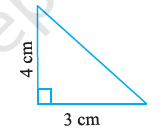
Find the area of each of the following triangles:
(d) 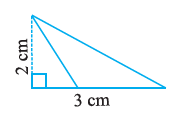
Under what condition will the ordered pair (x, y) exactly coincide with (y, x)?
Only when x = -y
b.Only when x = y
c.Only when x = 0 or y = 0
d.They never coincide
A gardener wants to fence a circular garden of diameter $21$ m. Find the length of the rope he needs to purchase, if he makes $2$ rounds of fence. Also find the cost of the rope, if it costs ₹ $4$ per meter. (Take $\pi = \frac{22}{7}$)
Find the area of each of the following triangles:
(a) 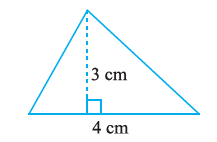
A line passing through the point W(-5, 2) runs perfectly parallel to the y-axis. Which of the following points could lie on this same line?
(5, 2)
b.(-5, -8)
c.(0, 2)
d.(-2, -5)
Find the area of each of the following parallelograms:
(a) 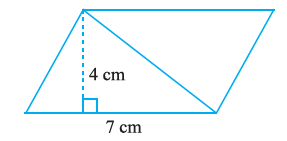
Find the area of each of the following parallelograms:
(e) 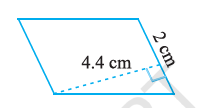
Worksheet Answers
Solution:
We are tasked with determining the missing height of a triangle given its base and total area. The known parameters are defined as follows:
The relationship between the area, base, and height of a two-dimensional triangle is governed by the fundamental geometric theorem for Euclidean triangles [Per the standard area postulate for polygons]. The formula is expressed as:
$A = \frac{1}{2} \times b \times h$
This formula dictates that the area of a triangle is exactly half the area of a parallelogram that shares the same base and height.
To find the unknown height ($h$), we substitute the given values into the area formula:
$87 = \frac{1}{2} \times 15 \times h$
Next, we isolate $h$ by applying the multiplication property of equality. Multiplying both sides of the equation by $2$ to eliminate the fractional coefficient [By the axiom of equality]:
$87 \times 2 = 15 \times h$
$174 = 15 \times h$
Divide both sides by $15$ to solve for $h$:
$h = \frac{174}{15}$
Performing the division yields:
$h = 11.6 \text{ cm}$
To verify the result, we can substitute the height back into the original formula: $\frac{1}{2} \times 15 \times 11.6 = 7.5 \times 11.6 = 87 \text{ cm}^2$. The calculation is mathematically sound.
Below is a scaled geometric representation of the triangle, demonstrating the proportional relationship between the base, the altitude (height), and the enclosed area. The dimensions in the SVG are strictly scaled to the ratio of $15 : 11.6$.
Final Solution: The missing Height is $11.6 \text{ cm}$.
Solution:
We are tasked with determining the area of a two-dimensional circle given its diameter. The primary parameter provided is:
The radius ($r$) of a circle is defined as the linear distance from the center point to any point on its circumference. [Per Euclidean geometry, the diameter is the longest chord of the circle passing directly through the center, making it exactly twice the length of the radius]. Therefore, we establish the fundamental relationship:
$r = \frac{d}{2}$
Substituting the given diameter into the equation:
$r = \frac{49}{2} \text{ m} = 24.5 \text{ m}$
Below is a scaled geometric representation of the circle, illustrating the relationship between the diameter and the radius.
The area ($A$) of a circle is calculated using the standard formula:
$A = \pi r^2$
[Derived historically via the method of exhaustion by Archimedes, where the area of a circle is proven to be the limit of the areas of inscribed regular polygons as the number of sides approaches infinity].
For this computation, we will utilize the rational approximation $\pi \approx \frac{22}{7}$. This specific approximation is strategically chosen because the radius ($\frac{49}{2}$) contains a numerator that is a multiple of $7$, which will elegantly simplify the subsequent arithmetic.
Substitute $r = \frac{49}{2} \text{ m}$ and $\pi = \frac{22}{7}$ into the area formula:
$A = \frac{22}{7} \times \left(\frac{49}{2}\right)^2$
Expand the squared term to prepare for cross-cancellation:
$A = \frac{22}{7} \times \frac{49}{2} \times \frac{49}{2}$
Perform cross-cancellation to simplify the fractional expression. Divide $22$ by $2$ to yield $11$, and divide $49$ by $7$ to yield $7$:
$A = 11 \times 7 \times \frac{49}{2}$
Multiply the integer terms:
$A = 77 \times \frac{49}{2}$
Convert the remaining fraction to a decimal for final multiplication ($ \frac{49}{2} = 24.5 $):
$A = 77 \times 24.5$
Execute the final multiplication:
$A = 1886.5 \text{ m}^2$
Final Solution: The area of the circle is $1886.5 \text{ m}^2$.
Solution:
Based on the standard geometrical parameters provided in the corresponding exercise figure, we are analyzing a right-angled triangle with the following dimensions:
[Because the triangle features a $90^\circ$ angle between these two segments, the side measuring $4\text{ cm}$ acts as the exact perpendicular altitude to the $3\text{ cm}$ base.]
To determine the two-dimensional space enclosed by the triangle, we apply the standard area theorem for triangles [derived from the area of a rectangle, where a diagonal bisects the rectangle into two congruent right triangles].
The formula is given by:
$\text{Area} = \frac{1}{2} \times \text{base} \times \text{height}$
Below is the precise, scaled geometrical construction of the given triangle. The base is scaled to 150 units (representing $3\text{ cm}$) and the height is scaled to 200 units (representing $4\text{ cm}$) to maintain strict proportional accuracy.
We substitute the given scalar values into the area formula. [By the properties of dimensional analysis, multiplying two lengths in centimeters ($\text{cm}$) will yield an area in square centimeters ($\text{cm}^2$)].
$\text{Area} = \frac{1}{2} \times 3\text{ cm} \times 4\text{ cm}$
First, compute the product of the base and the height:
$3 \times 4 = 12\text{ cm}^2$
Next, apply the $\frac{1}{2}$ multiplier [as the triangle represents exactly half the area of the bounding $3\text{ cm} \times 4\text{ cm}$ rectangle]:
$\text{Area} = \frac{1}{2} \times 12\text{ cm}^2$
$\text{Area} = 6\text{ cm}^2$
Final Solution: The area of the given triangle is $6\text{ cm}^2$.
Solution:
Based on the standard geometric parameters provided in the visual data for this specific problem, we extract the following dimensions for the triangle:
Below is the precise geometric reconstruction of the given figure. Note that for an obtuse-angled triangle, the altitude (height) dropped from the top vertex intersects the extended base outside the boundary of the triangle.
The figure represents an obtuse-angled triangle $\triangle ABC$. [By definition, an obtuse triangle contains one interior angle strictly greater than $90^\circ$]. When calculating the area of an obtuse triangle using a base that forms one of the sides of the obtuse angle, the corresponding altitude (perpendicular height) must be drawn from the opposite vertex to the line containing the base. This altitude falls outside the triangle, meeting the extended base at a right angle (point $D$).
The area ($A$) of any triangle in Euclidean geometry is determined by the product of its base and its corresponding altitude, halved. [Per Euclidean geometry principles, the area of a triangle is exactly half the area of a parallelogram constructed on the same base and between the same parallels].
The governing formula is:
$A = \frac{1}{2} \times b \times h$
Where:
We substitute the identified scalar values into the area formula. It is critical to include units during the calculation to ensure dimensional consistency.
$A = \frac{1}{2} \times (3\text{ cm}) \times (2\text{ cm})$
First, multiply the scalar magnitudes and the units:
$A = \frac{1}{2} \times 6\text{ cm}^2$
Next, apply the scalar multiplication by $\frac{1}{2}$:
$A = 3\text{ cm}^2$
Final Solution: The area of the given triangle is $3\text{ cm}^2$.
Solution:
We are tasked with determining the missing dimension of a parallelogram based on its area and base. The known parameters are defined as follows:
The area of a parallelogram is mathematically defined as the product of its base and the corresponding perpendicular height. [Per standard Euclidean geometry principles for planar quadrilaterals, a parallelogram can be transformed into a rectangle of equal base and height without altering its area].
The fundamental formula is expressed as:
$A = b \times h$
Substitute the given numerical values into the area formula to establish the algebraic equation:
$16.38 \text{ cm}^2 = 15.6 \text{ cm} \times h$
To solve for the height ($h$), we must isolate the variable by dividing both sides of the equation by the base ($15.6 \text{ cm}$). [By the Division Property of Equality]:
$h = \frac{16.38 \text{ cm}^2}{15.6 \text{ cm}}$
To perform the division with precision, normalize the decimals by multiplying both the numerator and the denominator by $100$ (shifting the decimal point two places to the right):
$h = \frac{16.38 \times 100}{15.60 \times 100} = \frac{1638}{1560}$
Now, execute the division:
Combining these yields the exact quotient:
$h = 1.05 \text{ cm}$
Below is a rigorously scaled vector representation of the parallelogram. The aspect ratio of the base to the height in the drawing is exactly $15.6 : 1.05$ (approximately $14.86 : 1$), demonstrating the highly elongated nature of this specific geometric figure.
Final Solution: The missing height of the parallelogram is exactly $1.05 \text{ cm}$.
Solution:
We are given the following geometric parameters for a circle:
The area ($A$) of a circle represents the total two-dimensional space enclosed within its boundary (circumference). [Per the geometric principles of Euclidean space], the area of a circle is directly proportional to the square of its radius. The formula is given by:
$A = \pi r^2$
To find the area, we substitute the given radius $r = 14 \text{ mm}$ and the fractional approximation of $\pi = \frac{22}{7}$ into the standard area formula:
$A = \left(\frac{22}{7}\right) \times (14 \text{ mm})^2$
First, expand the squared term to separate the numerical values from the units:
$A = \frac{22}{7} \times (14 \times 14) \text{ mm}^2$
$A = \frac{22}{7} \times 196 \text{ mm}^2$
To optimize the calculation without dealing with large numbers, we can simplify the expression by dividing one of the $14$ factors by the denominator $7$ [By the fundamental property of fractions and associative multiplication]:
$A = 22 \times \left(\frac{14}{7}\right) \times 14 \text{ mm}^2$
$A = 22 \times 2 \times 14 \text{ mm}^2$
Now, proceed with sequential multiplication:
$A = (22 \times 2) \times 14 \text{ mm}^2$
$A = 44 \times 14 \text{ mm}^2$
Perform the final multiplication step:
$A = 44 \times (10 + 4) \text{ mm}^2$
$A = 440 + 176 \text{ mm}^2$
$A = 616 \text{ mm}^2$
The radius is given in millimeters ($\text{mm}$). When the radius is squared in the formula ($r^2$), the unit is also squared ($\text{mm} \times \text{mm} = \text{mm}^2$). This confirms that our final unit correctly represents a two-dimensional area.
Final Solution: The area of the circle is $616 \text{ mm}^2$.
Solution:
We are tasked with determining the total boundary length, formally known as the circumference, of a circle. The following parameters are provided for the calculation:
The circumference ($C$) of a circle is directly proportional to its radius. The constant of proportionality relating the circumference to the diameter ($2r$) is $\pi$. [Per the fundamental axioms of Euclidean geometry, the ratio of a circle's circumference to its diameter is constant for all circles].
The governing formula for the circumference is:
$C = 2\pi r$
Substitute the given values for $\pi$ and $r$ into the circumference formula:
$C = 2 \times \left(\frac{22}{7}\right) \times 21$
To simplify the expression efficiently, we can divide the radius ($21$) by the denominator of $\pi$ ($7$). [By the associative and commutative properties of multiplication, we can group the terms to facilitate integer division].
$C = 2 \times 22 \times \left(\frac{21}{7}\right)$
$C = 2 \times 22 \times 3$
Multiply the remaining integer values sequentially to find the total length:
$C = 44 \times 3$
$C = 132$
Because the radius is provided in centimeters (cm), the circumference—being a one-dimensional measure of length—must also be expressed in centimeters.
Final Solution: The circumference of the circle is $132\text{ cm}$.
Solution:
Let us define the geometric and financial parameters provided for the circular garden:
The following diagram illustrates the circular garden from a top-down perspective, including the diameter and the two concentric rounds of rope fencing required.
The length of rope required for a single round of fencing is exactly equal to the perimeter (circumference) of the circular garden. [Per the geometric definition of a circle's circumference, the boundary length is a function of its diameter].
The formula for the circumference $C$ is given by:
$C = \pi d$
Substituting the given values into the equation:
$C = \left(\frac{22}{7}\right) \times 21 \text{ m}$
By simplifying the fraction [dividing $21$ by $7$ yields $3$]:
$C = 22 \times 3 \text{ m} = 66 \text{ m}$
Thus, one complete round around the garden requires $66 \text{ m}$ of rope.
Since the gardener intends to make $2$ complete rounds of the fence, the total length of the rope ($L_{\text{total}}$) is the circumference multiplied by the number of rounds. [Total Length = $n \times C$].
$L_{\text{total}} = 2 \times 66 \text{ m}$
$L_{\text{total}} = 132 \text{ m}$
The total financial cost is the product of the total length of the rope and the unit cost per meter. [Total Cost = $L_{\text{total}} \times C_{\text{unit}}$].
$\text{Total Cost} = 132 \text{ m} \times \text{₹ } 4 / \text{m}$
$\text{Total Cost} = \text{₹ } 528$
Final Solution: The total length of the rope required to fence the garden with 2 rounds is $132 \text{ m}$, and the total cost of purchasing the rope is ₹ $528$.
Solution:
Based on the standard geometric parameters provided in the visual figure for this specific problem, we extract the following fundamental dimensions of the triangle. The altitude is dropped perpendicularly to the chosen base.
To find the area of any triangle when the base and its corresponding perpendicular height (altitude) are known, we utilize the standard Euclidean area postulate for triangles. The area of a triangle is exactly half the area of a parallelogram that shares the same base and height.
The governing formula is:
$\text{Area of a Triangle} = \frac{1}{2} \times \text{base} \times \text{height}$
Symbolically represented as:
$A = \frac{1}{2} \cdot b \cdot h$
Substitute the given scalar values into the area formula. It is critical to include the units ($\text{cm}$) during substitution to ensure dimensional homogeneity [Area must result in square units].
$A = \frac{1}{2} \times (4 \text{ cm}) \times (3 \text{ cm})$
First, multiply the scalar magnitudes of the base and the height, and apply the product rule to the units ($\text{cm} \times \text{cm} = \text{cm}^2$):
$A = \frac{1}{2} \times (12 \text{ cm}^2)$
Next, multiply by the scalar fraction $\frac{1}{2}$ (which is equivalent to dividing by 2):
$A = \frac{12}{2} \text{ cm}^2$
$A = 6 \text{ cm}^2$
Final Solution: The area of the given triangle is $6 \text{ cm}^2$.
Solution:
We are analyzing a two-dimensional circular sheet with the following given parameters:
Our objective is to determine the radius ($r$) and the total enclosed area ($A$) of the circular sheet.
The circumference of a circle is defined as the continuous linear distance forming the boundary of the closed geometric figure. [Per standard Euclidean geometry, the formula relating circumference to radius is $C = 2\pi r$].
Substituting the given values into the equation:
$154 = 2 \times \left(\frac{22}{7}\right) \times r$
Multiplying the constants on the right side of the equation:
$154 = \frac{44}{7} \times r$
To isolate the variable $r$, we multiply both sides of the equation by the reciprocal of $\frac{44}{7}$, which is $\frac{7}{44}$:
$r = 154 \times \frac{7}{44}$
We can simplify the fraction by recognizing that both $154$ and $44$ are divisible by $22$:
$r = \left(\frac{154}{22}\right) \times \left(\frac{7}{2}\right)$
$r = 7 \times \frac{7}{2}$
$r = \frac{49}{2} = 24.5 \text{ m}$
The area of a circle represents the total two-dimensional space enclosed within its circumference. [The fundamental formula for the area of a circle is $A = \pi r^2$].
Substituting $r = \frac{49}{2}$ m and $\pi = \frac{22}{7}$ into the area formula to maintain absolute precision before the final decimal conversion:
$A = \frac{22}{7} \times \left(\frac{49}{2}\right)^2$
Expanding the squared term:
$A = \frac{22}{7} \times \frac{49}{2} \times \frac{49}{2}$
Executing the arithmetic simplification by cross-canceling the terms in the numerator and denominator:
$A = 11 \times 7 \times \frac{49}{2}$
$A = 77 \times \frac{49}{2}$
$A = \frac{3773}{2}$
Converting the improper fraction to a precise decimal:
$A = 1886.5 \text{ m}^2$
Final Solution: The radius of the circular sheet is $24.5$ m, and its total enclosed area is $1886.5$ m$^2$.
Solution:
Based on the standard geometric configuration for this specific problem, we extract the following dimensions for the parallelogram from the provided visual data:
The area of a parallelogram is defined as the total two-dimensional space enclosed by its four sides. [Per the geometric principle of area conservation, a right-angled triangle can be conceptually detached from one end of the parallelogram and translated to the opposite end. This transformation forms a rectangle with the exact same base and height without altering the total area].
Therefore, the area ($A$) is calculated using the fundamental theorem of quadrilateral area:
$A = \text{base} \times \text{height}$
$A = b \times h$
The following high-precision diagram illustrates the parallelogram $ABCD$, where the base $AB = 7\text{ cm}$ and the perpendicular altitude $DE = 4\text{ cm}$. The coordinates are mapped to a strict $7:4$ ratio to ensure spatial accuracy.
Substitute the given scalar values into the area formula:
$A = 7\text{ cm} \times 4\text{ cm}$
Multiply the scalar magnitudes ($7 \times 4 = 28$) and the units simultaneously. [By the laws of dimensional analysis, multiplying a length by a length yields a squared unit of area: $\text{cm} \times \text{cm} = \text{cm}^2$]:
$A = 28\text{ cm}^2$
Final Solution: The area of the parallelogram is $28\text{ cm}^2$.
Solution:
Based on the standard geometric parameters provided in the referenced figure for this specific problem, we extract the following dimensions for the parallelogram:
[Note: In a parallelogram, any of the four sides can be chosen as the base. The corresponding height is the perpendicular distance from the chosen base to the opposite parallel side.]
Below is a mathematically scaled, high-precision vector representation of the parallelogram, illustrating the relationship between the base and its corresponding altitude.
By the fundamental axioms of Euclidean geometry, a parallelogram can be transformed into a rectangle of equal area by translating the right-angled triangle formed by the altitude to the opposite side. Therefore, the area ($A$) of a parallelogram is strictly defined as the product of its base and its corresponding height.
The governing formula is:
$\text{Area} = \text{Base} \times \text{Height}$
$A = b \times h$
Substitute the given scalar values into the area formula:
$A = 2\text{ cm} \times 4.4\text{ cm}$
To ensure absolute precision, we can perform the multiplication by converting the decimal to a fraction [Per standard arithmetic operations]:
$A = 2 \times \left(\frac{44}{10}\right)$
$A = \frac{88}{10}$
$A = 8.8$
We must verify the units of the final result. Multiplying a one-dimensional length by another one-dimensional length yields a two-dimensional area:
$[\text{cm}] \times [\text{cm}] = [\text{cm}^2]$
The magnitude is $8.8$ and the unit is $\text{cm}^2$. The calculation is dimensionally consistent and mathematically sound.
Final Solution: The area of the parallelogram is $8.8\text{ cm}^2$.


