


Your Worksheet is Ready
CBSE - Class 10 Mathematics Coordinate geometry Worksheet
Let P and Q be the points of trisection of the line segment joining the point A(-2,2) and B(-7,4) such that P is nearer to A. Find the coordinates of P and Q.
If the radius and height of a cone are both increased by 100%, then its volume is increased by..
400%
b.300%
c.200%
d.100%
The points (1,1), (-2, 7) and (3, -3) are
vertices of an equilateral triangle
b.collinear
c.vertices of an isosceles triangle
d.none of these
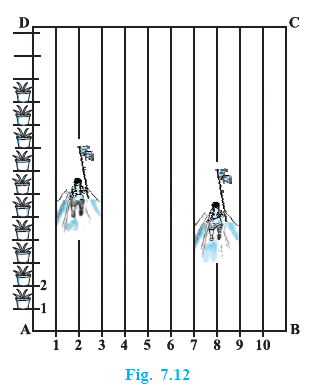
To conduct Sports Day activities, in your rectangular shaped school ground ABCD, lines have been drawn with chalk powder at a distance of 1m each. 100 flower pots have been placed at a distance of 1m from each other along AD, as shown in Fig. 7.12. Niharika runs $\frac{1}{4}$th the distance AD on the 2nd line and posts a green flag. Preet runs $\frac{1}{5}$th the distance AD on the eighth line and posts a red flag. What is the distance between both the flags? If Rashmi has to post a blue flag exactly halfway between the line segment joining the two flags, where should she post her flag?
If the distance between the points (x, -1) and (3, 2) is 5, then the value of x is
-7 or -1
b.-7 or 1
c. 7 or 1
7 or -1
The area of a triangle with vertices A (3, 0), B (7, 0) and C (8, 4) is:
14
b.28
c.8
d.6
Express 98 as a product of its primes
(a) 2² × 7
(b) 2² × 7²
(c) 2 × 7²
(d) 23 × 7
If the coordinates of points A and B are (-2,-2) and (2,-4) find the coordinates of P such that AP = 3/7 AB, where P lies on the line segment AB.
The point (5,a) lies on X axis when
a=0
b.a=5
c.a<0
d.a<5
Find the distance between the points (0, 0) and (36, 15). Can you now find the distance between the two towns A and B.
Find the ratio in which (-3, q) divides the line segment joining the points (-5,-4) and (-2, 3). Find the value of q.
Worksheet Answers
Q(x2, y2) = (-4,2)
Solution:
Given: The coordinates of the four points forming a quadrilateral are $A(-1, -2)$, $B(1, 0)$, $C(-1, 2)$, and $D(-3, 0)$.
To Find: The type of quadrilateral formed by these points, with supporting reasons.
Step 1: Distance Formula Application
To determine the type of quadrilateral, we calculate the lengths of the four sides ($AB, BC, CD, DA$) and the two diagonals ($AC, BD$) using the distance formula: $d = \sqrt{(x_2 - x_1)^2 + (y_2 - y_1)^2}$.
Step 2: Calculating Side Lengths
For $A(-1, -2)$ and $B(1, 0)$:
$AB = \sqrt{(1 - (-1))^2 + (0 - (-2))^2} = \sqrt{(2)^2 + (2)^2} = \sqrt{4 + 4} = \sqrt{8} = 2\sqrt{2}$ units.
For $B(1, 0)$ and $C(-1, 2)$:
$BC = \sqrt{(-1 - 1)^2 + (2 - 0)^2} = \sqrt{(-2)^2 + (2)^2} = \sqrt{4 + 4} = \sqrt{8} = 2\sqrt{2}$ units.
For $C(-1, 2)$ and $D(-3, 0)$:
$CD = \sqrt{(-3 - (-1))^2 + (0 - 2)^2} = \sqrt{(-2)^2 + (-2)^2} = \sqrt{4 + 4} = \sqrt{8} = 2\sqrt{2}$ units.
For $D(-3, 0)$ and $A(-1, -2)$:
$DA = \sqrt{(-1 - (-3))^2 + (-2 - 0)^2} = \sqrt{(2)^2 + (-2)^2} = \sqrt{4 + 4} = \sqrt{8} = 2\sqrt{2}$ units.
Step 3: Calculating Diagonal Lengths
For $A(-1, -2)$ and $C(-1, 2)$:
$AC = \sqrt{(-1 - (-1))^2 + (2 - (-2))^2} = \sqrt{0^2 + 4^2} = \sqrt{16} = 4$ units.
For $B(1, 0)$ and $D(-3, 0)$:
$BD = \sqrt{(-3 - 1)^2 + (0 - 0)^2} = \sqrt{(-4)^2 + 0^2} = \sqrt{16} = 4$ units.
Step 4: Conclusion based on Properties
Since all four sides are equal ($AB = BC = CD = DA = 2\sqrt{2}$) and both diagonals are equal ($AC = BD = 4$), the quadrilateral satisfies the necessary and sufficient conditions for a square.
Final Answer: The quadrilateral formed is a square.
Solution:
Given:
1. The school ground is rectangular, represented by a coordinate plane where the x-axis represents the lines (1 to 10) and the y-axis represents the distance along AD (in meters).
2. Total distance along AD = $100$ meters (since there are 100 flower pots placed 1m apart).
3. Niharika runs on the 2nd line ($x_1 = 2$) and covers $\frac{1}{4}$ of the distance AD.
4. Preet runs on the 8th line ($x_2 = 8$) and covers $\frac{1}{5}$ of the distance AD.
To Find:
1. The distance between the green flag (Niharika) and the red flag (Preet).
2. The coordinates where Rashmi should post her blue flag (the midpoint of the two flags).
Step 1: Determine the coordinates of the flags.
Let the position of the green flag be $G(x_1, y_1)$.
$x_1 = 2$
$y_1 = \frac{1}{4} \times 100 = 25$
So, $G = (2, 25)$.
Let the position of the red flag be $R(x_2, y_2)$.
$x_2 = 8$
$y_2 = \frac{1}{5} \times 100 = 20$
So, $R = (8, 20)$.
Step 2: Calculate the distance between the two flags.
Using the Distance Formula: $d = \sqrt{(x_2 - x_1)^2 + (y_2 - y_1)^2}$
$d = \sqrt{(8 - 2)^2 + (20 - 25)^2}$
$d = \sqrt{(6)^2 + (-5)^2}$
$d = \sqrt{36 + 25}$
$d = \sqrt{61}$
$d \approx 7.81$ meters.
Step 3: Determine the position of the blue flag.
The blue flag is at the midpoint $M(x, y)$ of the line segment joining $G(2, 25)$ and $R(8, 20)$.
Using the Midpoint Formula: $M = \left( \frac{x_1 + x_2}{2}, \frac{y_1 + y_2}{2} \right)$
$x = \frac{2 + 8}{2} = \frac{10}{2} = 5$
$y = \frac{25 + 20}{2} = \frac{45}{2} = 22.5$
Therefore, the blue flag should be posted on the 5th line at a distance of 22.5 meters from AD.
Final Answer: The distance between the two flags is $\sqrt{61}$ m (approx 7.81 m). Rashmi should post her blue flag at the coordinates (5, 22.5).
Solution:
Given:
The coordinates of two points are $A(x_1, y_1) = (-1, 7)$ and $B(x_2, y_2) = (4, -3)$.
The ratio in which the point divides the line segment $AB$ is $m : n = 2 : 3$.
To Find:
The coordinates of the point $P(x, y)$ that divides the line segment joining $A$ and $B$ in the ratio $2 : 3$.
Step 1: Applying the Section Formula
The Section Formula states that the coordinates of a point $P(x, y)$ dividing the line segment joining points $(x_1, y_1)$ and $(x_2, y_2)$ internally in the ratio $m : n$ are given by:
$x = \frac{mx_2 + nx_1}{m + n}$
$y = \frac{my_2 + ny_1}{m + n}$
Step 2: Identifying the variables
From the given information:
$x_1 = -1, y_1 = 7$
$x_2 = 4, y_2 = -3$
$m = 2, n = 3$
Step 3: Calculating the x-coordinate
Substituting the values into the formula for $x$:
$x = \frac{(2)(4) + (3)(-1)}{2 + 3}$
$x = \frac{8 - 3}{5}$ [Performing multiplication and addition]
$x = \frac{5}{5}$
$x = 1$
Step 4: Calculating the y-coordinate
Substituting the values into the formula for $y$:
$y = \frac{(2)(-3) + (3)(7)}{2 + 3}$
$y = \frac{-6 + 21}{5}$ [Performing multiplication and addition]
$y = \frac{15}{5}$
$y = 3$
Final Answer:
The coordinates of the point which divides the join of (-1, 7) and (4, -3) in the ratio 2 : 3 are (1, 3).
Solution:
Given:
1. A circle with center $O$ at coordinates $(2, -3)$.
2. $AB$ is the diameter of the circle.
3. The coordinates of point $B$ are $(1, 4)$.
To Find:
The coordinates of point $A$, let us denote them as $(x, y)$.
Step 1: Theoretical Basis
In a circle, the center $O$ is the midpoint of any diameter $AB$. According to the Midpoint Formula, if a line segment has endpoints $(x_1, y_1)$ and $(x_2, y_2)$, the midpoint $(x_m, y_m)$ is given by:
$x_m = \frac{x_1 + x_2}{2}$
$y_m = \frac{y_1 + y_2}{2}$
Step 2: Assigning Variables
Let the coordinates of point $A$ be $(x, y)$.
Let the coordinates of point $B$ be $(x_2, y_2) = (1, 4)$.
Let the coordinates of the center $O$ be $(x_m, y_m) = (2, -3)$.
Step 3: Calculating the x-coordinate of A
Using the midpoint formula for the x-coordinate:
$2 = \frac{x + 1}{2}$
[Multiplying both sides by 2]
$4 = x + 1$
[Subtracting 1 from both sides]
$x = 4 - 1$
$x = 3$
Step 4: Calculating the y-coordinate of A
Using the midpoint formula for the y-coordinate:
$-3 = \frac{y + 4}{2}$
[Multiplying both sides by 2]
$-6 = y + 4$
[Subtracting 4 from both sides]
$y = -6 - 4$
$y = -10$
Final Answer: The coordinates of point A are (3, -10).
P = (-2/7, -20/7)
Solution:
Given: Two points in a Cartesian plane, $P(x_1, y_1) = (0, 0)$ and $Q(x_2, y_2) = (36, 15)$.
To Find: The distance between points $P$ and $Q$, and subsequently, the distance between two towns $A$ and $B$ represented by these coordinates.
Step 1: State the Distance Formula
The distance $d$ between any two points $(x_1, y_1)$ and $(x_2, y_2)$ in a coordinate plane is given by the Euclidean distance formula:
$d = \sqrt{(x_2 - x_1)^2 + (y_2 - y_1)^2}$
[This formula is derived from the Pythagorean Theorem applied to the right-angled triangle formed by the horizontal and vertical differences of the coordinates.]
Step 2: Substitute the Given Values
Assign the coordinates:
$x_1 = 0, y_1 = 0$
$x_2 = 36, y_2 = 15$
Substituting these into the formula:
$d = \sqrt{(36 - 0)^2 + (15 - 0)^2}$
Step 3: Perform Algebraic Simplification
Calculate the squares of the differences:
$d = \sqrt{(36)^2 + (15)^2}$
Calculate $36^2$: $36 \times 36 = 1296$
Calculate $15^2$: $15 \times 15 = 225$
Sum the squares:
$d = \sqrt{1296 + 225}$
$d = \sqrt{1521}$
Step 4: Extract the Square Root
To find $\sqrt{1521}$, we look for a number which, when multiplied by itself, equals $1521$.
Since $30^2 = 900$ and $40^2 = 1600$, the value must be between 30 and 40.
Testing $39$: $39 \times 39 = 1521$.
$d = 39$
Step 5: Application to Towns A and B
If town $A$ is located at $(0, 0)$ and town $B$ is located at $(36, 15)$, the distance between them is equivalent to the distance calculated between points $P$ and $Q$.
Therefore, the distance between town $A$ and town $B$ is $39$ units.
Final Answer: The distance between the points (0, 0) and (36, 15) is 39 units. Consequently, the distance between town A and town B is 39 units.
q= 2/3


