


Your Worksheet is Ready
CBSE - Class 12 Physics Nuclei Worksheet
EXERCISES
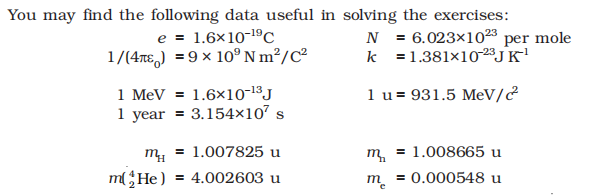
How long can an electric lamp of 100W be kept glowing by fusion of 2.0 kg of deuterium? Take the fusion reaction as \(^{2}_{1}H+ ^{2}_{1}H \rightarrow ^{3}_{2}He+n+3.27 MeV\)
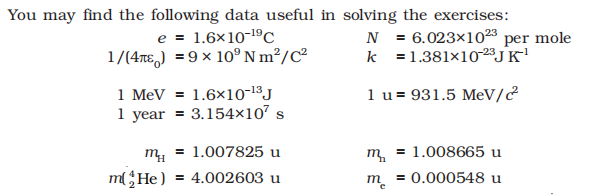
Obtain the binding energy of the nuclei \(^{56}_{26}Fe\) and \(^{209}_{83}Bi\) in units of MeV from the following data: \(m (\(^{56}_{26}Fe\)) = 55.934939 u\) \(m (\(^{209}_{83}Bi\)) = 208.980388 u\)
Worksheet Answers
Solution:
To calculate the electrostatic potential energy (potential barrier) between two deuterons at the moment of contact, we define the following parameters:
The potential barrier height ($V$) is equal to the electrostatic potential energy of the system at the distance $r$, according to the principle of conservation of energy [Per Coulomb's Law for point charges]:
$V = \frac{1}{4\pi\epsilon_0} \cdot \frac{q_1 q_2}{r}$
Substituting the known values into the equation:
$V = \frac{(9 \times 10^9 \text{ N}\cdot\text{m}^2/\text{C}^2) \times (1.6 \times 10^{-19} \text{ C})^2}{4.0 \times 10^{-15} \text{ m}}$
Calculating the numerator:
$(1.6 \times 10^{-19})^2 = 2.56 \times 10^{-38} \text{ C}^2$
$9 \times 10^9 \times 2.56 \times 10^{-38} = 23.04 \times 10^{-29} \text{ J}\cdot\text{m}$
Dividing by the separation distance:
$V = \frac{23.04 \times 10^{-29}}{4.0 \times 10^{-15}} = 5.76 \times 10^{-14} \text{ J}$
To express the energy in standard nuclear units, we divide by $1.6 \times 10^{-19} \text{ J/eV}$:
$V(\text{eV}) = \frac{5.76 \times 10^{-14} \text{ J}}{1.6 \times 10^{-19} \text{ J/eV}} = 3.6 \times 10^5 \text{ eV} = 0.36 \text{ MeV}$
Final Solution: The height of the potential barrier for a head-on collision of two deuterons is 0.36 MeV.
Solution:
To find the total number of deuterium atoms ($N$) in 2.0 kg, we use the molar mass of deuterium ($M = 2.014 \text{ g/mol} \approx 2.0 \text{ g/mol}$) and Avogadro’s number ($N_A = 6.022 \times 10^{23} \text{ mol}^{-1}$).
Given mass $m = 2000 \text{ g}$.
Number of atoms $N = \frac{m}{M} \times N_A$
$N = \frac{2000}{2} \times 6.022 \times 10^{23} = 6.022 \times 10^{26} \text{ atoms}$ [By definition of Mole concept]
The given reaction is: $_{1}^{2}H + _{1}^{2}H \rightarrow _{2}^{3}He + n + 3.27 \text{ MeV}$.
In this reaction, two nuclei of deuterium are consumed per fusion event. Therefore, the total number of fusion events is $\frac{N}{2}$.
Total fusion events = $\frac{6.022 \times 10^{26}}{2} = 3.011 \times 10^{26}$ events.
Total energy released ($E_{total}$) = $(\text{Number of events}) \times (\text{Energy per event})$
$E_{total} = 3.011 \times 10^{26} \times 3.27 \text{ MeV}$
$E_{total} = 9.846 \times 10^{26} \text{ MeV}$
Using the conversion factor $1 \text{ MeV} = 1.602 \times 10^{-13} \text{ J}$ [Standard constant]:
$E_{total} = 9.846 \times 10^{26} \times 1.602 \times 10^{-13} \text{ J}$
$E_{total} \approx 1.577 \times 10^{14} \text{ J}$
The power of the lamp $P = 100 \text{ W} = 100 \text{ J/s}$.
The time $t$ for which the lamp can glow is given by $t = \frac{E_{total}}{P}$ [Per the definition of Power as Energy per unit time].
$t = \frac{1.577 \times 10^{14} \text{ J}}{100 \text{ J/s}} = 1.577 \times 10^{12} \text{ seconds}$.
To provide a more intuitive scale, convert seconds to years:
$1 \text{ year} \approx 365.25 \times 24 \times 3600 = 3.15 \times 10^7 \text{ seconds}$.
$t (\text{years}) = \frac{1.577 \times 10^{12}}{3.15 \times 10^7} \approx 5.0 \times 10^4 \text{ years}$.
Final Solution: The electric lamp can be kept glowing for approximately $1.577 \times 10^{12} \text{ seconds}$, which is equivalent to roughly 50,000 years.
Solution:
The nuclear reaction is given as: $^{12}_{6}C + ^{12}_{6}C \rightarrow ^{20}_{10}Ne + ^{4}_{2}He$.
From the problem statement and standard physical constants, we identify the following atomic masses:
The mass defect is calculated by finding the difference between the total mass of the reactants and the total mass of the products [Per the definition of binding energy and mass-energy equivalence]:
$\Delta m = [ (m_A + m_b) - (m_C + m_d) ]$
$\Delta m = [ (12.000000 + 12.000000) - (19.992439 + 4.002603) ] \, u$
$\Delta m = [ 24.000000 - 23.995042 ] \, u$
$\Delta m = 0.004958 \, u$
The Q-value is given by $Q = \Delta m \times c^{2}$. Given that $1 \, u \approx 931.5 \, MeV/c^{2}$ [By Einstein's Mass-Energy Equivalence Principle]:
$Q = 0.004958 \, u \times 931.5 \, MeV/u$
$Q \approx 4.6183 \, MeV$
The reaction type is determined by the sign of the Q-value:
| Condition | Classification |
|---|---|
| $Q > 0$ | Exothermic (Energy released) |
| $Q < 0$ | Endothermic (Energy absorbed) |
Since the calculated $Q = +4.6183 \, MeV$, which is greater than zero, the reaction releases energy to the surroundings.
Final Solution: The Q-value is $4.6183 \, MeV$. Since $Q > 0$, the reaction is exothermic.
Solution:
The nuclear reaction provided is: $^{1}_{1}H + ^{3}_{1}H \rightarrow ^{2}_{1}H + ^{2}_{1}H$.
The reactants are $A = ^{1}_{1}H$ and $b = ^{3}_{1}H$. The products are $C = ^{2}_{1}H$ and $d = ^{2}_{1}H$.
Note: The mass of $m(^{1}_{1}H)$ (hydrogen nucleus/proton) is required. Standard physical data provides $m(^{1}_{1}H) = 1.007825 \text{ u}$.
According to the Q-value definition $Q = [m_{A} + m_{b} - m_{C} - m_{d}]c^{2}$, we first calculate the total initial and final mass.
| Component | Mass (u) |
|---|---|
| $m(^{1}_{1}H)$ | $1.007825$ |
| $m(^{3}_{1}H)$ | $3.016049$ |
| Total Reactant Mass ($\sum m_{initial}$) | $4.023874$ |
| $m(^{2}_{1}H)$ | $2.014102$ |
| $m(^{2}_{1}H)$ | $2.014102$ |
| Total Product Mass ($\sum m_{final}$) | $4.028204$ |
The mass defect is defined as the difference between the total initial mass and total final mass [Per the Mass-Energy Equivalence Principle]:
$\Delta m = \sum m_{initial} - \sum m_{final}$
$\Delta m = 4.023874 \text{ u} - 4.028204 \text{ u}$
$\Delta m = -0.004330 \text{ u}$
Using the conversion factor $1 \text{ u} = 931.5 \text{ MeV}/c^{2}$ [By Einstein's Mass-Energy Equivalence $E = \Delta m c^{2}$]:
$Q = (-0.004330 \text{ u}) \times (931.5 \text{ MeV/u})$
$Q = -4.0334 \text{ MeV}$
Since the calculated $Q$ value is negative ($Q < 0$), the reaction consumes energy to proceed. In nuclear physics, such reactions are classified as endothermic [Per the First Law of Thermodynamics applied to nuclear binding energy].
Final Solution: The Q-value of the reaction is $-4.0334 \text{ MeV}$. Because the Q-value is negative, the reaction is endothermic.
Solution:
Given the empirical relationship for the radius of a nucleus as a function of the mass number $A$: $R = R_{0}A^{\frac{1}{3}}$ where $R_{0} \approx 1.2 \times 10^{-15} \, \text{m}$ (or $1.2 \, \text{fm}$).
Assuming the nucleus to be a sphere of volume $V$, we apply the geometric formula for the volume of a sphere: $V = \frac{4}{3}\pi R^3$ [By geometric definition of a sphere]
Substituting the expression for $R$: $V = \frac{4}{3}\pi (R_{0}A^{\frac{1}{3}})^3$ $V = \frac{4}{3}\pi R_{0}^3 A$ [Algebraic simplification using $(x^a)^b = x^{ab}$]
The mass of a nucleus $M$ is approximately equal to the product of the mass number $A$ and the mass of a single nucleon $m$ (where $m \approx 1.67 \times 10^{-27} \, \text{kg}$): $M \approx A \cdot m$
Density $\rho$ is defined as mass per unit volume: $\rho = \frac{M}{V}$
Substituting the expressions derived in Step 1 and Step 2: $\rho = \frac{A \cdot m}{\frac{4}{3}\pi R_{0}^3 A}$
Observe that the term $A$ appears in both the numerator and the denominator. By canceling $A$: $\rho = \frac{m}{\frac{4}{3}\pi R_{0}^3}$ [Canceling common variable $A \neq 0$]
Since $m$ (nucleon mass), $\pi$, and $R_{0}$ (constant) are all fundamental constants independent of the specific nucleus chosen, the resulting expression for $\rho$ contains no dependence on the mass number $A$.
| Variable | Physical Significance |
|---|---|
| $A$ | Mass Number (Total Nucleons) |
| $R$ | Nuclear Radius $\propto A^{1/3}$ |
| $V$ | Nuclear Volume $\propto A$ |
| $\rho$ | Nuclear Density (Mass/Volume) |
Final Solution: Because the nuclear volume is directly proportional to the mass number ($V \propto A$), the mass number cancels out when calculating density, proving that nuclear matter density $\rho = \frac{3m}{4\pi R_{0}^3}$ is independent of $A$ and is nearly constant for all nuclei.
Solution:
The nuclear fission process is represented as:
$^{56}_{26}\text{Fe} \rightarrow ^{28}_{13}\text{Al} + ^{28}_{13}\text{Al} + Q$
The energy released (or required) in a nuclear reaction is determined by the mass defect, defined as the difference between the mass of the reactants and the mass of the products [Per Einstein’s mass-energy equivalence principle, $Q = (\Delta m)c^2$].
The mass defect is given by the formula:
$\Delta m = [m(^{56}_{26}\text{Fe}) - 2 \times m(^{28}_{13}\text{Al})]$
Given values:
Substitute the values into the equation:
$\Delta m = 55.93494 \text{ u} - 2 \times (27.98191 \text{ u})$
$\Delta m = 55.93494 \text{ u} - 55.96382 \text{ u}$
$\Delta m = -0.02888 \text{ u}$
To convert the mass defect in atomic mass units (u) to energy in MeV, we use the conversion factor $1 \text{ u} \approx 931.5 \text{ MeV/c}^2$ [Based on the energy equivalent of one atomic mass unit].
$Q = \Delta m \times 931.5 \text{ MeV/u}$
$Q = -0.02888 \text{ u} \times 931.5 \text{ MeV/u}$
$Q \approx -26.9 \text{ MeV}$
Since the calculated $Q$ value is negative ($Q < 0$), the reaction is endothermic [Per the Laws of Thermodynamics regarding energy balance in nuclear systems]. This implies that energy must be supplied to the system for the fission to occur; it does not happen spontaneously nor does it release energy.
Final Solution: The fission of $^{56}_{26}\text{Fe}$ into two $^{28}_{13}\text{Al}$ fragments is not energetically possible because the Q-value is $-26.9 \text{ MeV}$, indicating that the process is endothermic and requires an external energy input of 26.9 MeV to proceed.
Solution:
The binding energy ($BE$) of a nucleus is the energy equivalent of the mass defect ($\Delta m$), which represents the difference between the sum of the masses of individual nucleons and the actual mass of the nucleus. The relationship is defined by Einstein’s mass-energy equivalence principle [Per $E = \Delta m c^2$]:
$\Delta m = [Z m_p + (A - Z) m_n] - m_{nucleus}$
Where:
Given: $Z = 26$, $A = 56$, $N = (A - Z) = 30$, $m(^{56}_{26}Fe) = 55.934939\ u$.
Mass of constituents:
$26(m_p) + 30(m_n) = 26(1.007825) + 30(1.008665)$
$= 26.20345 + 30.25995 = 56.46340\ u$
Mass defect ($\Delta m_{Fe}$):
$\Delta m_{Fe} = 56.46340\ u - 55.934939\ u = 0.528461\ u$
Binding Energy ($BE_{Fe}$):
$BE_{Fe} = 0.528461 \times 931.5\ MeV \approx 492.26\ MeV$
Given: $Z = 83$, $A = 209$, $N = (A - Z) = 126$, $m(^{209}_{83}Bi) = 208.980388\ u$.
Mass of constituents:
$83(m_p) + 126(m_n) = 83(1.007825) + 126(1.008665)$
$= 83.649475 + 127.091790 = 210.741265\ u$
Mass defect ($\Delta m_{Bi}$):
$\Delta m_{Bi} = 210.741265\ u - 208.980388\ u = 1.760877\ u$
Binding Energy ($BE_{Bi}$):
$BE_{Bi} = 1.760877 \times 931.5\ MeV \approx 1640.26\ MeV$
| Nucleus | Mass Defect ($\Delta m$) | Binding Energy ($MeV$) |
|---|---|---|
| $^{56}_{26}Fe$ | $0.528461\ u$ | $492.26$ |
| $^{209}_{83}Bi$ | $1.760877\ u$ | $1640.26$ |
Final Solution: The binding energy of $^{56}_{26}Fe$ is approximately $492.26\ MeV$ and the binding energy of $^{209}_{83}Bi$ is approximately $1640.26\ MeV$.
Solution:
To calculate the total number of atoms ($N$) in a given mass ($m$) of a substance, we utilize the relationship between mass, molar mass ($M$), and Avogadro's number ($N_A$).
Given:
The formula for the number of atoms is [By definition of the mole concept]:
$N = \frac{m}{M} \times N_A$
$N = \frac{1000}{239} \times 6.022 \times 10^{23}$
$N \approx 4.184 \times 24 \times 10^{23} \approx 2.52 \times 10^{24} \text{ atoms}$
Given the average energy released per fission event ($E_{fission}$) is $180 \text{ MeV}$, the total energy ($E_{total}$) is the product of the number of atoms ($N$) and the energy per atom [By the Principle of Additivity of Energy]:
$E_{total} = N \times E_{fission}$
$E_{total} = (2.52 \times 10^{24} \text{ atoms}) \times (180 \text{ MeV/atom})$
$E_{total} = 453.6 \times 10^{24} \text{ MeV}$
$E_{total} \approx 4.54 \times 10^{26} \text{ MeV}$
To understand the magnitude, convert to Joules where $1 \text{ MeV} = 1.602 \times 10^{-13} \text{ J}$:
$E_{J} = (4.54 \times 10^{26} \text{ MeV}) \times (1.602 \times 10^{-13} \text{ J/MeV})$
$E_{J} \approx 7.27 \times 10^{13} \text{ J}$
Final Solution: The total energy released is approximately 4.54 × 10^{26} MeV.
Solution:
To determine the ratio of the nuclear radii, we identify the mass numbers ($A$) of the respective isotopes provided:
The radius of a nucleus ($R$) is empirically related to its mass number ($A$) by the following formula: $$R = R_0 A^{1/3}$$ [Per the empirical formula for nuclear density distribution, where $R_0 \approx 1.2 \times 10^{-15} \text{ m}$ (or $1.2 \text{ fm}$), and the nuclear density is approximately constant across all nuclei].
We define the ratio of the radius of Gold ($R_{Au}$) to the radius of Silver ($R_{Ag}$): $$\frac{R_{Au}}{R_{Ag}} = \frac{R_0 (A_{Au})^{1/3}}{R_0 (A_{Ag})^{1/3}}$$ [By algebraic substitution into the nuclear radius law].
Canceling the constant term $R_0$ from the numerator and denominator: $$\frac{R_{Au}}{R_{Ag}} = \left( \frac{A_{Au}}{A_{Ag}} \right)^{1/3}$$ Substituting the given mass numbers: $$\frac{R_{Au}}{R_{Ag}} = \left( \frac{197}{107} \right)^{1/3}$$
Performing the division inside the parentheses: $$\frac{197}{107} \approx 1.8411$$ Now, calculating the cube root: $$\left( 1.8411 \right)^{1/3} \approx 1.225$$ [By numerical evaluation of fractional exponents].
Final Solution: The ratio of the nuclear radius of Gold to Silver is approximately 1.22 : 1.


