


Your Worksheet is Ready
CBSE - Class 12 Physics Electromagnetic Waves Worksheet
EXERCISES
Figure 8.5 shows a capacitor made of two circular plates each of radius 12 cm, and separated by 5.0 cm. The capacitor is being charged by an external source (not shown in the figure). The charging current is constant and equal to 0.15A. (a) Calculate the capacitance and the rate of change of potential difference between the plates.
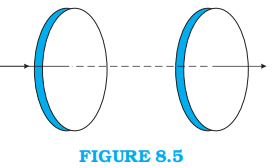
A parallel plate capacitor (Fig. 8.6) made of circular plates each of radius $(R = 6.0 \text{ cm})$ has a capacitance $(C = 100 \text{ pF})$. The capacitor is connected to a 230 V ac supply with a (angular) frequency of $(300 \text{ rad s}^{-1})$. (c) Determine the amplitude of $(B)$ at a point 3.0 cm from the axis between the plates.
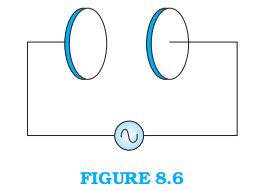
Figure 8.5 shows a capacitor made of two circular plates each of radius 12 cm, and separated by 5.0 cm. The capacitor is being charged by an external source (not shown in the figure). The charging current is constant and equal to 0.15A. (c) Is Kirchhoff’s first rule (junction rule) valid at each plate of the capacitor? Explain.
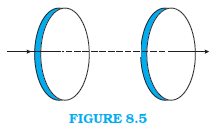
Figure 8.5 shows a capacitor made of two circular plates each of radius 12 cm, and separated by 5.0 cm. The capacitor is being charged by an external source (not shown in the figure). The charging current is constant and equal to 0.15A. (b) Obtain the displacement current across the plates.
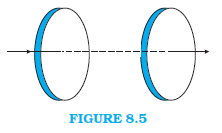
Figure 8.5 shows a capacitor made of two circular plates each of radius 12 cm, and separated by 5.0 cm. The capacitor is being charged by an external source (not shown in the figure). The charging current is constant and equal to 0.15A. (a) Calculate the capacitance and the rate of change of potential difference between the plates.
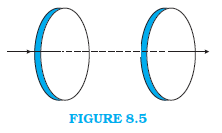
A parallel plate capacitor (Fig. 8.6) made of circular plates each of radius $R = 6.0$ cm has a capacitance $C = 100$ pF. The capacitor is connected to a $230$ V ac supply with a (angular) frequency of $300 \text{ rad s}^{-1}$. (c) Determine the amplitude of $B$ at a point 3.0 cm from the axis between the plates.
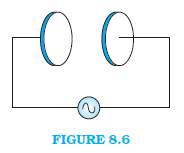
A parallel plate capacitor (Fig. 8.6) made of circular plates each of radius $(R = 6.0 \text{ cm})$ has a capacitance $(C = 100 \text{ pF})$. The capacitor is connected to a 230 V ac supply with a (angular) frequency of $(300 \text{ rad s}^{-1})$. (a) What is the rms value of the conduction current?
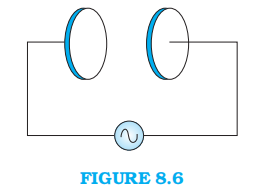
A parallel plate capacitor (Fig. 8.6) made of circular plates each of radius $R = 6.0$ cm has a capacitance $C = 100$ pF. The capacitor is connected to a $230$ V ac supply with a (angular) frequency of $300 \text{ rad s}^{-1}$. (b) Is the conduction current equal to the displacement current?
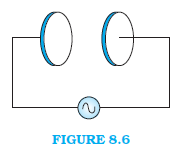
A parallel plate capacitor (Fig. 8.6) made of circular plates each of radius $(R = 6.0 \text{ cm})$ has a capacitance $(C = 100 \text{ pF})$. The capacitor is connected to a 230 V ac supply with a (angular) frequency of $(300 \text{ rad s}^{-1})$. (b) Is the conduction current equal to the displacement current?
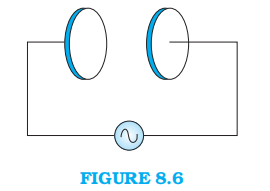
A parallel plate capacitor (Fig. 8.6) made of circular plates each of radius $R = 6.0$ cm has a capacitance $C = 100$ pF. The capacitor is connected to a $230$ V ac supply with a (angular) frequency of $300 \text{ rad s}^{-1}$. (a) What is the rms value of the conduction current?
Worksheet Answers
Solution:
To determine the amplitude of the electric field ($E_0$) from the given amplitude of the magnetic field ($B_0$) in a vacuum, we utilize the relationship derived from Maxwell's equations for electromagnetic waves propagating in free space.
[Per the electromagnetic wave theory, the magnitudes of the electric and magnetic fields are related by the ratio $c = \frac{E_0}{B_0}$].
Rearranging the relationship to isolate the electric field amplitude:
$E_0 = c \times B_0$
Substituting the known physical constants:
$E_0 = (3 \times 10^8 \text{ m/s}) \times (510 \times 10^{-9} \text{ T})$
Performing the multiplication step-by-step:
$E_0 = 3 \times 510 \times 10^{8-9}$
$E_0 = 1530 \times 10^{-1}$
$E_0 = 153 \text{ V/m}$
In an electromagnetic wave, the electric field vector $\vec{E}$, magnetic field vector $\vec{B}$, and the direction of propagation $\vec{k}$ are mutually perpendicular.
| Parameter | Value |
|---|---|
| Speed ($c$) | $3 \times 10^8 \text{ m/s}$ |
| Magnetic Amplitude ($B_0$) | $5.1 \times 10^{-7} \text{ T}$ |
| Electric Amplitude ($E_0$) | $153 \text{ V/m}$ |
Final Solution: The amplitude of the electric field part of the wave is $153 \text{ V/m}$.
Solution:
The problem concerns the fundamental relationship between the oscillation of a charged particle and the resultant emission of electromagnetic radiation. Given:
[Per Maxwell's Equations and the Theory of Electromagnetism, an accelerated or oscillating electric charge produces a time-varying electric field. This time-varying electric field induces a time-varying magnetic field (Ampere-Maxwell Law), which in turn regenerates the electric field (Faraday's Law).]
An oscillating charge acts as a source for electromagnetic waves. The frequency of the emitted electromagnetic wave ($f_{em}$) is fundamentally determined by the frequency at which the source charge oscillates ($f_{osc}$). This is an application of the principle of electromagnetic radiation generation from accelerated charges.
Mathematical identity: $f_{em} = f_{osc}$
The oscillating charge executes simple harmonic motion, producing a periodic variation in the localized electromagnetic field. Because the frequency of the field oscillation matches the frequency of the source driving the oscillation, no energy is shifted in the frequency domain during the emission process.
Since the problem specifies that the charge oscillates with a frequency of $10^9 \text{ Hz}$, the electromagnetic waves produced must propagate with the exact same frequency to maintain consistency with the source periodicity.
| Parameter | Value |
|---|---|
| Oscillation Frequency ($f_{osc}$) | $10^9 \text{ Hz}$ |
| EM Wave Frequency ($f_{em}$) | $10^9 \text{ Hz}$ |
Final Solution: The frequency of the electromagnetic waves produced is $10^9 \text{ Hz}$.
Solution:
To determine the capacitance and the rate of change of the potential difference, we identify the following physical parameters provided in the problem statement:
The capacitance of a parallel plate capacitor is given by the formula [Per the definition of parallel plate capacitance]:
$C = \frac{\epsilon_0 A}{d}$
First, calculate the area ($A$) of the circular plates:
$A = \pi r^2 = \pi (0.12)^2 \approx 3.14159 \times 0.0144 \approx 0.04524 \, \text{m}^2$
Now, substitute the values into the capacitance formula:
$C = \frac{(8.854 \times 10^{-12} \, \text{F/m}) \times (0.04524 \, \text{m}^2)}{0.05 \, \text{m}}$
$C \approx 8.01 \times 10^{-12} \, \text{F} = 8.01 \, \text{pF}$
The relation between charge ($q$), capacitance ($C$), and potential difference ($V$) is defined by the fundamental capacitor equation [Per Gauss's Law/Capacitance definition]:
$q = CV$
Differentiating both sides with respect to time ($t$):
$\frac{dq}{dt} = C \frac{dV}{dt}$
Since the charging current $I = \frac{dq}{dt}$, we rearrange to solve for $\frac{dV}{dt}$:
$\frac{dV}{dt} = \frac{I}{C}$
Substitute the known current and the calculated capacitance:
$\frac{dV}{dt} = \frac{0.15 \, \text{A}}{8.01 \times 10^{-12} \, \text{F}}$
$\frac{dV}{dt} \approx 1.87 \times 10^{10} \, \text{V/s}$
Final Solution: The capacitance is $8.01 \times 10^{-12} \, \text{F}$ (or $8.01 \, \text{pF}$) and the rate of change of potential difference between the plates is $1.87 \times 10^{10} \, \text{V/s}$.
Solution:
The following parameters are provided for the electromagnetic wave propagating in a vacuum:
To write the standard wave equation in the form $E = E_{0}\sin(kx - \omega t)$, we must determine the angular frequency ($\omega$) and the wave number ($k$).
Angular Frequency ($\omega$):
$\omega = 2\pi f = 2 \times \pi \times 50.0 \times 10^{6}\text{ rad/s}$
$\omega = 100\pi \times 10^{6} \approx 3.14 \times 10^{8}\text{ rad/s}$
Wave Number ($k$):
$k = \frac{\omega}{c} = \frac{3.14 \times 10^{8}}{3.00 \times 10^{8}} \approx 1.05\text{ rad/m}$
Per the relation between electric and magnetic field amplitudes in an electromagnetic wave [Maxwell’s Equations in vacuum]:
$B_{0} = \frac{E_{0}}{c}$
$B_{0} = \frac{120}{3.00 \times 10^{8}} = 40 \times 10^{-8}\text{ T} = 4.0 \times 10^{-7}\text{ T}$
Assuming the wave propagates in the $+x$ direction and the electric field oscillates along the $y$-axis, the magnetic field must oscillate along the $z$-axis [Per the Poynting Vector definition $\vec{S} = \frac{1}{\mu_{0}}(\vec{E} \times \vec{B})$].
Electric Field Expression ($E$):
$E_{y} = 120 \sin(1.05x - 3.14 \times 10^{8}t)\text{ V/m}$
Magnetic Field Expression ($B$):
$B_{z} = B_{0} \sin(kx - \omega t)$
$B_{z} = 4.0 \times 10^{-7} \sin(1.05x - 3.14 \times 10^{8}t)\text{ T}$
Final Solution: The expressions for the fields are $E = 120 \sin(1.05x - 3.14 \times 10^{8}t)\text{ V/m}$ and $B = 4.0 \times 10^{-7} \sin(1.05x - 3.14 \times 10^{8}t)\text{ T}$.
Solution:
The supply voltage is typically given as an RMS value. The amplitude $V_0$ is derived as follows:
$V_0 = V_{rms} \times \sqrt{2} = 230 \times 1.414 \approx 325.27 \text{ V}$ [Per standard AC circuit definitions]In a capacitor, the displacement current $I_d$ equals the conduction current in the connecting wires. The current amplitude $I_0$ is related to voltage amplitude by the capacitive reactance $X_C = \frac{1}{\omega C}$:
$I_0 = \frac{V_0}{X_C} = V_0 \omega C$ $I_0 = (325.27) \times (300) \times (10^{-10})$ $I_0 = 9.758 \times 10^{-6} \text{ A} \approx 9.76 \times 10^{-6} \text{ A}$According to the Maxwell-Ampere Law for a region between the plates of a circular capacitor, the magnetic field $B$ at a radial distance $r < R$ is given by:
$\oint B \cdot dl = \mu_0 I_d(r)$ $B(2\pi r) = \mu_0 \left( \frac{I_0 \pi r^2}{\pi R^2} \right)$ [Since current density is uniform, $I_d(r) = I_0 \frac{r^2}{R^2}$] $B = \frac{\mu_0 I_0 r}{2\pi R^2}$Using $\mu_0 = 4\pi \times 10^{-7} \text{ T m A}^{-1}$:
$B_0 = \frac{(4\pi \times 10^{-7}) \times (9.76 \times 10^{-6}) \times (3.0 \times 10^{-2})}{2\pi \times (6.0 \times 10^{-2})^2}$ $B_0 = \frac{2 \times 10^{-7} \times 9.76 \times 10^{-6} \times 3.0 \times 10^{-2}}{36 \times 10^{-4}}$ $B_0 = \frac{58.56 \times 10^{-15}}{36 \times 10^{-4}}$ $B_0 \approx 1.626 \times 10^{-11} \text{ T}$Final Solution: The amplitude of the magnetic field $B$ at $r = 3.0 \text{ cm}$ is approximately $1.63 \times 10^{-11} \text{ T}$.
Solution:
Kirchhoff’s First Rule (Junction Rule) is derived from the Principle of Conservation of Charge. It states that the algebraic sum of currents meeting at a junction must be zero ($\sum I = 0$). In a standard resistive circuit, charge carriers flow continuously through the junction. However, in the case of a capacitor plate, we must distinguish between conduction current ($I_c$) and displacement current ($I_d$).
Consider one plate of the capacitor as a junction point. The current $I = 0.15 \, \text{A}$ enters the plate via the connecting wire. This is a conduction current ($I_c$).
According to the Maxwell-Ampere law, the current flowing between the plates is the displacement current ($I_d$), defined as:
$I_d = \epsilon_0 \frac{d\Phi_E}{dt} = \frac{dq}{dt}$
[Per Maxwell's modification to Ampere's Law].
If we treat the plate as a junction point where the wire meets the plate, Kirchhoff’s Junction Rule states that the current entering the junction must equal the current leaving the junction.
Since the rate of accumulation of charge on the plate ($\frac{dq}{dt}$) is exactly equal to the conduction current $I_c$ supplied to it, the total current (the sum of conduction and displacement current) is conserved.
Kirchhoff's first rule is technically valid at each plate of the capacitor provided that the current is defined as the sum of conduction current and displacement current ($I_{total} = I_c + I_d$). If one considers only conduction current, the rule appears to be violated because current does not flow "through" the dielectric gap. However, by including displacement current, the continuity of charge is maintained at the junction [Per Maxwell-Ampere Law].
Final Solution: Kirchhoff’s first rule is valid at the plates of the capacitor if the displacement current is included in the junction equation. The total current at the junction is $I_c = I_d = 0.15 \, \text{A}$, satisfying the continuity of charge.
Solution:
The electromagnetic spectrum obeys the fundamental wave equation relating frequency ($\nu$), wavelength ($\lambda$), and the speed of light ($c$):
$c = \nu \lambda$
Where:
Rearranging for wavelength: $\lambda = \frac{c}{\nu}$ [By Algebraic Rearrangement]
The given band is from $7.5 \text{ MHz}$ to $12 \text{ MHz}$. We must convert these to standard SI units ($\text{Hz}$):
We calculate the corresponding wavelengths for both frequency extremes using $\lambda = \frac{c}{\nu}$.
For $\nu_1 = 7.5 \times 10^6 \text{ Hz}$:
$\lambda_1 = \frac{3 \times 10^8}{7.5 \times 10^6} = \frac{300}{7.5} \text{ m} = 40 \text{ m}$
For $\nu_2 = 12 \times 10^6 \text{ Hz}$:
$\lambda_2 = \frac{3 \times 10^8}{12 \times 10^6} = \frac{300}{12} \text{ m} = 25 \text{ m}$
Because the wavelength is inversely proportional to frequency, the lower frequency limit ($7.5 \text{ MHz}$) corresponds to the upper wavelength limit ($40 \text{ m}$), and the higher frequency limit ($12 \text{ MHz}$) corresponds to the lower wavelength limit ($25 \text{ m}$).
| Frequency Band | Wavelength Band |
|---|---|
| $7.5 \text{ MHz}$ | $40 \text{ m}$ |
| $12 \text{ MHz}$ | $25 \text{ m}$ |
Final Solution: The corresponding wavelength band is $25 \text{ m}$ to $40 \text{ m}$.
Solution:
All electromagnetic waves, regardless of their position in the electromagnetic spectrum (X-rays, visible light, or radio waves), propagate through a vacuum at a constant speed, denoted by $c$.
According to Maxwell’s equations [Per Maxwell's Theory of Electromagnetism], the speed of an electromagnetic wave in free space is defined by the relationship between the permeability ($\mu_0$) and permittivity ($\epsilon_0$) of free space:
$c = \frac{1}{\sqrt{\mu_0 \epsilon_0}}$
Substituting the standard values:
$\mu_0 = 4\pi \times 10^{-7} \, \text{T}\cdot\text{m/A}$
$\epsilon_0 = 8.854 \times 10^{-12} \, \text{C}^2/\text{N}\cdot\text{m}^2$
$c \approx 3.00 \times 10^8 \, \text{m/s}$
We are provided with three distinct wavelengths ($\lambda$):
While the frequency ($\nu$) varies according to the relation $\nu = \frac{c}{\lambda}$ and the energy of the photons ($E = h\nu$) differs significantly across these ranges, the speed of propagation in a vacuum remains an invariant fundamental physical quantity for all electromagnetic radiation.
Because electromagnetic waves are oscillating electric and magnetic fields traveling through space, their phase velocity in a vacuum is dictated solely by the properties of free space [Per Postulates of Special Relativity and Classical Electrodynamics]. Consequently, the speed is independent of the wavelength or frequency of the wave.
Final Solution: The physical quantity that is the same for all these waves is their speed in a vacuum ($c = 3.00 \times 10^8 \, \text{m/s}$).
Solution:
The problem concerns three distinct components of the electromagnetic spectrum: X-rays, visible red light, and radiowaves. To determine the invariant quantity, we must examine the fundamental nature of electromagnetic waves in a vacuum.
According to Maxwell’s equations and the wave nature of light, all electromagnetic waves—regardless of their wavelength ($\lambda$) or frequency ($\nu$)—propagate through a vacuum with the same fundamental speed [Per the theory of Electromagnetism].
The speed of an electromagnetic wave ($c$) is defined by the relationship between its wavelength ($\lambda$) and frequency ($\nu$):
$c = \nu \lambda$
Where:
| Wave Type | Wavelength ($\lambda$) | Speed in Vacuum ($c$) |
|---|---|---|
| X-rays | $10^{-10} \text{ m}$ | $3 \times 10^8 \text{ m/s}$ |
| Red Light | $6800 \text{ \AA} = 6.8 \times 10^{-7} \text{ m}$ | $3 \times 10^8 \text{ m/s}$ |
| Radiowaves | $500 \text{ m}$ | $3 \times 10^8 \text{ m/s}$ |
While the energy of the waves ($E = h\nu$) and their frequencies differ across the spectrum, the propagation velocity remains constant in a vacuum. This is a fundamental postulate of Special Relativity and classical electrodynamics, stating that $c$ is independent of the source's motion or the wave's frequency [Per Einstein’s Postulate of the Constancy of the Speed of Light].
Final Solution: The physical quantity that is the same for all these electromagnetic waves in a vacuum is their speed of propagation, which is $3 \times 10^8 \text{ m/s}$.
Solution:
To determine the displacement current across the plates of a parallel plate capacitor, we identify the following parameters provided by the problem statement:
The concept of displacement current ($I_d$) was introduced by James Clerk Maxwell to resolve the inconsistency in Ampere’s circuital law. According to the Maxwell-Ampere Law, the displacement current is defined as the current that arises due to the time-varying electric field between the capacitor plates [Per Maxwell’s modification of Ampere’s Law].
The displacement current is given by the relation:
$I_d = \epsilon_0 \frac{d\Phi_E}{dt}$
Where $\Phi_E$ is the electric flux through the surface between the plates.
In a charging capacitor, the conduction current ($I_c$) flowing through the external circuit must be equal to the displacement current ($I_d$) flowing between the plates to maintain the principle of continuity of charge [Based on the Law of Conservation of Charge and Maxwell’s Equation].
Mathematically, for a parallel plate capacitor:
$I_d = I_c$
Since the charging current $I_c$ is provided as a constant value of $0.15\text{ A}$, and the capacitor plates are charging such that the charge $q$ on the plates increases at a rate $dq/dt = I_c$, the displacement current must equal the charging current at every instant during the charging process.
Calculation:
$I_d = \frac{dq}{dt} = 0.15\text{ A}$
| Variable | Value |
|---|---|
| Conduction Current ($I_c$) | $0.15\text{ A}$ |
| Displacement Current ($I_d$) | $0.15\text{ A}$ |
Final Solution: The displacement current across the plates is 0.15 A.
Solution:
The energy density of an electromagnetic field in a vacuum is partitioned between the electric field ($E$) and the magnetic field ($B$). The instantaneous energy densities ($u_E$ and $u_B$) are defined as:
$u_E = \frac{1}{2} \epsilon_0 E^2$ [Definition of electric energy density]
$u_B = \frac{1}{2\mu_0} B^2$ [Definition of magnetic energy density]
For a sinusoidal wave, the electric field is represented as $E = E_0 \sin(kx - \omega t)$. The average value of $\sin^2(\theta)$ over one full cycle is $\frac{1}{2}$. Therefore, the average energy density for the electric field is:
$\langle u_E \rangle = \frac{1}{2} \epsilon_0 \langle E^2 \rangle = \frac{1}{2} \epsilon_0 \left( \frac{E_0^2}{2} \right) = \frac{1}{4} \epsilon_0 E_0^2$
Similarly, for the magnetic field where $B = B_0 \sin(kx - \omega t)$, the average energy density is:
$\langle u_B \rangle = \frac{1}{2\mu_0} \langle B^2 \rangle = \frac{1}{2\mu_0} \left( \frac{B_0^2}{2} \right) = \frac{1}{4\mu_0} B_0^2$
In a plane electromagnetic wave propagating in a vacuum, the amplitudes of the electric and magnetic fields are related by the speed of light $c$:
$E_0 = c B_0$ [Relation between field amplitudes]
Given $c = \frac{1}{\sqrt{\mu_0 \epsilon_0}}$, we can square both sides to get $c^2 = \frac{1}{\mu_0 \epsilon_0}$, which implies $\frac{1}{\epsilon_0} = \mu_0 c^2$.
We substitute $B_0 = \frac{E_0}{c}$ into the expression for $\langle u_B \rangle$:
$\langle u_B \rangle = \frac{1}{4\mu_0} \left( \frac{E_0}{c} \right)^2 = \frac{E_0^2}{4\mu_0 c^2}$
Since $c^2 = \frac{1}{\mu_0 \epsilon_0}$, we substitute $\mu_0 c^2 = \frac{1}{\epsilon_0}$ into the denominator:
$\langle u_B \rangle = \frac{E_0^2}{4(1/\epsilon_0)} = \frac{1}{4} \epsilon_0 E_0^2$
Comparing the result with Step 2:
$\langle u_E \rangle = \frac{1}{4} \epsilon_0 E_0^2$
$\langle u_B \rangle = \frac{1}{4} \epsilon_0 E_0^2$
Final Solution: Through the derivation using the relation $E_0 = c B_0$ and the speed of light constant $c = 1/\sqrt{\mu_0 \epsilon_0}$, it is shown that $\langle u_E \rangle = \langle u_B \rangle = \frac{1}{4} \epsilon_0 E_0^2$.
Solution:
The system is a parallel-plate capacitor with the following defined values:
The capacitance of a parallel-plate capacitor is defined by the geometry of the plates [Per the formula $C = \frac{\varepsilon_0 A}{d}$]. First, calculate the area ($A$) of the circular plates:
$A = \pi r^2 = \pi (0.12 \, \text{m})^2 \approx 0.04524 \, \text{m}^2$
Substitute $A$ into the capacitance formula:
$C = \frac{(8.854 \times 10^{-12} \, \text{F/m}) \times (0.04524 \, \text{m}^2)}{0.05 \, \text{m}}$
$C \approx 8.01 \times 10^{-12} \, \text{F} = 8.01 \, \text{pF}$
The relationship between charge ($Q$), capacitance ($C$), and potential difference ($V$) is given by $Q = CV$. Differentiating both sides with respect to time ($t$) yields the charging current [By the Definition of Current]:
$I = \frac{dQ}{dt} = C \frac{dV}{dt}$
Rearranging to solve for the rate of change of potential difference ($\frac{dV}{dt}$):
$\frac{dV}{dt} = \frac{I}{C}$
Substitute the known values:
$\frac{dV}{dt} = \frac{0.15 \, \text{A}}{8.01 \times 10^{-12} \, \text{F}}$
$\frac{dV}{dt} \approx 1.87 \times 10^{10} \, \text{V/s}$
| Parameter | Calculated Value |
|---|---|
| Capacitance ($C$) | $8.01 \, \text{pF}$ |
| $\frac{dV}{dt}$ | $1.87 \times 10^{10} \, \text{V/s}$ |
Final Solution: The capacitance of the capacitor is $8.01 \times 10^{-12} \, \text{F}$, and the rate of change of potential difference is $1.87 \times 10^{10} \, \text{V/s}$.
Solution:
Based on the problem statement, we have the following physical parameters:
The voltage provided is rms. We require the amplitude (peak value) for the magnetic field calculation. [Per AC circuit theory]:
$V_0 = V_{rms} \sqrt{2} = 230 \times 1.414 = 325.22 \text{ V}$
The peak conduction current $I_0$ in the circuit is given by [Ohm's Law for Capacitive Reactance $X_C = 1/(\omega C)$]:
$I_0 = \frac{V_0}{X_C} = V_0 \cdot \omega C$
$I_0 = 325.22 \times 300 \times 10^{-10} = 9.7566 \times 10^{-6} \text{ A} \approx 9.76 \times 10^{-6} \text{ A}$
For a point inside the capacitor ($r < R$), the magnetic field $B$ is determined by the displacement current $I_d$ enclosed by an Amperian loop of radius $r$. [Per Maxwell’s modification to Ampere’s Law]:
$\oint \vec{B} \cdot d\vec{l} = \mu_0 I_d(r)$
Since the current density is assumed uniform across the plates, the displacement current $I_d(r)$ enclosed by a circle of radius $r$ is a fraction of the total current $I_0$ flowing through the area $\pi R^2$:
$I_d(r) = I_0 \left( \frac{\pi r^2}{\pi R^2} \right) = I_0 \left( \frac{r}{R} \right)^2$
Substituting into the line integral ($B \cdot 2\pi r = \mu_0 I_d$):
$B(2\pi r) = \mu_0 I_0 \frac{r^2}{R^2} \implies B = \frac{\mu_0 I_0 r}{2\pi R^2}$
Substitute the known values into the derived expression:
$B = \frac{(4\pi \times 10^{-7}) \times (9.7566 \times 10^{-6}) \times (3.0 \times 10^{-2})}{2\pi \times (6.0 \times 10^{-2})^2}$
$B = \frac{2 \times 10^{-7} \times 9.7566 \times 10^{-6} \times 3.0 \times 10^{-2}}{36 \times 10^{-4}}$
$B = \frac{58.5396 \times 10^{-15}}{36 \times 10^{-4}} = 1.626 \times 10^{-11} \text{ T}$
Final Solution: The amplitude of the magnetic field $B$ at 3.0 cm from the axis is $1.63 \times 10^{-11} \text{ T}$.
Solution:
The energy density associated with an electromagnetic wave is divided between the electric field ($E$) and the magnetic field ($B$). The instantaneous energy density ($u$) is given by the sum of the electric energy density ($u_E$) and the magnetic energy density ($u_B$).
For the electric field component: $u_E = \frac{1}{2} \epsilon_0 E^2$ [Per Maxwell's equations and energy conservation in fields]
For the magnetic field component: $u_B = \frac{1}{2} \frac{B^2}{\mu_0}$ [Per Maxwell's equations and energy conservation in fields]
In a plane electromagnetic wave, $E$ and $B$ vary sinusoidally with time: $E = E_0 \sin(\omega t - kx)$ and $B = B_0 \sin(\omega t - kx)$.
The time-averaged value of $\sin^2(\theta)$ over one cycle is $\langle \sin^2(\theta) \rangle = \frac{1}{2}$. Thus, the average energy densities are:
$\langle u_E \rangle = \frac{1}{2} \epsilon_0 \langle E^2 \rangle = \frac{1}{2} \epsilon_0 \left( \frac{E_0^2}{2} \right) = \frac{1}{4} \epsilon_0 E_0^2$
$\langle u_B \rangle = \frac{1}{2 \mu_0} \langle B^2 \rangle = \frac{1}{2 \mu_0} \left( \frac{B_0^2}{2} \right) = \frac{1}{4 \mu_0} B_0^2$
From the properties of electromagnetic waves, the amplitude of the electric field and magnetic field are related by the speed of light ($c$):
$E_0 = c B_0$
Squaring both sides: $E_0^2 = c^2 B_0^2$
Furthermore, the speed of light in vacuum is defined as $c = \frac{1}{\sqrt{\mu_0 \epsilon_0}}$, which implies $c^2 = \frac{1}{\mu_0 \epsilon_0}$.
Substitute $B_0^2 = \frac{E_0^2}{c^2}$ into the expression for $\langle u_B \rangle$:
$\langle u_B \rangle = \frac{1}{4 \mu_0} \left( \frac{E_0^2}{c^2} \right)$
Substitute $c^2 = \frac{1}{\mu_0 \epsilon_0}$ into the equation:
$\langle u_B \rangle = \frac{1}{4 \mu_0} \left( \frac{E_0^2}{1/(\mu_0 \epsilon_0)} \right)$
$\langle u_B \rangle = \frac{1}{4 \mu_0} \cdot E_0^2 \cdot \mu_0 \epsilon_0$
$\langle u_B \rangle = \frac{1}{4} \epsilon_0 E_0^2$
Comparing this with $\langle u_E \rangle = \frac{1}{4} \epsilon_0 E_0^2$, we arrive at the conclusion:
$\langle u_E \rangle = \langle u_B \rangle$
Final Solution: The derivation demonstrates that $\langle u_E \rangle = \frac{1}{4} \epsilon_0 E_0^2$ and $\langle u_B \rangle = \frac{1}{4} \epsilon_0 E_0^2$, proving that the average energy density of the electric field is exactly equal to the average energy density of the magnetic field in a plane electromagnetic wave.
Solution:
In an AC circuit containing only a capacitor, the conduction current ($I_{\text{rms}}$) is determined by the capacitive reactance ($X_C$) and the applied rms voltage. Per Ohm’s Law for AC circuits [Reference: $I_{\text{rms}} = \frac{V_{\text{rms}}}{X_C}$].
The capacitive reactance is defined as the opposition offered by the capacitor to the flow of AC current. The formula is:
$X_C = \frac{1}{\omega C}$
Substituting the given values:
$X_C = \frac{1}{(300 \text{ rad s}^{-1}) \times (10^{-10} \text{ F})}$
$X_C = \frac{1}{3 \times 10^{-8}} \Omega = \frac{1}{3} \times 10^8 \Omega \approx 3.33 \times 10^7 \Omega$
Applying the relation derived in Step 1:
$I_{\text{rms}} = \frac{V_{\text{rms}}}{X_C} = V_{\text{rms}} \times \omega C$
$I_{\text{rms}} = 230 \text{ V} \times 300 \text{ rad s}^{-1} \times 10^{-10} \text{ F}$
$I_{\text{rms}} = 230 \times 3 \times 10^{-8} \text{ A}$
$I_{\text{rms}} = 690 \times 10^{-8} \text{ A}$
$I_{\text{rms}} = 6.9 \times 10^{-6} \text{ A}$
Final Solution: The rms value of the conduction current is $6.9 \times 10^{-6} \text{ A}$ or $6.9 \text{ \mu A}$.
Solution:
In a plane electromagnetic wave propagating through a vacuum, the magnitudes of the electric field vector $\vec{E}$ and the magnetic field vector $\vec{B}$ are linked by the speed of light. Per Maxwell's equations and the wave equation for electromagnetic fields, the relationship between their peak amplitudes is given by:
$c = \frac{E_0}{B_0}$
[Justification: Based on the fundamental derivation of EM wave propagation where $\vec{E} \times \vec{B}$ dictates the direction of the Poynting vector, and the ratio of magnitudes must equal the velocity of the wave.]
To solve for the amplitude of the magnetic field, we rearrange the formula:
$B_0 = \frac{E_0}{c}$
Substituting the provided values into the equation:
$B_0 = \frac{48 \text{ V m}^{-1}}{3.0 \times 10^8 \text{ m s}^{-1}}$
$B_0 = 16 \times 10^{-8} \text{ T}$
Converting to standard scientific notation:
$B_0 = 1.6 \times 10^{-7} \text{ T}$
| Parameter | Value | Unit |
|---|---|---|
| $E_0$ | $48$ | $\text{V m}^{-1}$ |
| $c$ | $3.0 \times 10^8$ | $\text{m s}^{-1}$ |
| $B_0$ | $1.6 \times 10^{-7}$ | $\text{Tesla (T)}$ |
Final Solution: The amplitude of the oscillating magnetic field is $1.6 \times 10^{-7} \text{ T}$.
Solution:
The displacement current ($I_d$) is defined by Maxwell’s modification to Ampere’s Law. In a parallel plate capacitor, the time-varying electric field between the plates creates a displacement current given by:
$I_d = \varepsilon_0 \frac{d\Phi_E}{dt}$
Where $\Phi_E$ is the electric flux. For a capacitor, this is equivalent to the rate of change of charge on the plates [Per Maxwell-Ampere Law]:
$I_d = \frac{dq}{dt}$
In any circuit involving a capacitor, the current flowing through the conducting wires (conduction current, $I_c$) must be equal to the displacement current ($I_d$) between the plates to satisfy the principle of continuity of current [Per Kirchhoff’s Junction Rule applied to a capacitor plate].
The conduction current $I_c$ is determined by the impedance of the capacitor ($X_C$):
$X_C = \frac{1}{\omega C} = \frac{1}{300 \times 10^{-10}} = \frac{10^{10}}{300} \approx 3.33 \times 10^7 \text{ }\Omega$
The RMS current ($I_{rms}$) is:
$I_c = \frac{V_{rms}}{X_C} = 230 \times (300 \times 10^{-10}) = 6.9 \times 10^{-6} \text{ A} = 6.9 \text{ }\mu\text{A}$
Since the electric field $E$ between the plates is $E = \frac{Q}{\varepsilon_0 A}$, and the flux $\Phi_E = E \cdot A = \frac{Q}{\varepsilon_0}$, the displacement current is:
$I_d = \varepsilon_0 \frac{d}{dt} \left( \frac{Q}{\varepsilon_0} \right) = \frac{dQ}{dt} = I_c$
| Current Type | Mechanism | Magnitude |
|---|---|---|
| Conduction ($I_c$) | Flow of electrons in wires | $6.9 \times 10^{-6} \text{ A}$ |
| Displacement ($I_d$) | Time-varying electric field flux | $6.9 \times 10^{-6} \text{ A}$ |
Final Solution: Yes, the conduction current is equal to the displacement current ($I_c = I_d = 6.9 \times 10^{-6} \text{ A}$), ensuring the continuity of the total current in the circuit.
Solution:
To determine if the conduction current ($I_c$) is equal to the displacement current ($I_d$), we must rely on the generalized form of Ampere’s Law, known as the Ampere-Maxwell law. According to Maxwell's modification, the total current in a circuit containing a capacitor is the sum of the conduction current and the displacement current.
The displacement current is defined as $I_d = \epsilon_0 \frac{d\Phi_E}{dt}$, where $\Phi_E$ is the electric flux through the capacitor. By the continuity equation for currents in a circuit with a capacitor, the current flowing through the conducting wires (conduction current) must equal the current flowing between the plates (displacement current) to maintain charge conservation [Per Kirchhoff's Current Law and the Continuity Equation $\nabla \cdot \mathbf{J} + \frac{\partial \rho}{\partial t} = 0$].
Given parameters:
The conduction current ($I_c$) flowing through the external circuit is given by the Ohm's law for AC circuits:
$I_c = \frac{V}{X_C} = V \cdot (\omega C)$
Substituting the values:
$I_c = 230 \times 300 \times 10^{-10} \text{ A}$
$I_c = 69000 \times 10^{-10} \text{ A} = 6.9 \times 10^{-6} \text{ A} = 6.9 \text{ } \mu\text{A}$
In a parallel plate capacitor circuit, the charge $q$ on the plates at any instant is $q = CV$. The conduction current is the rate of flow of charge into the plates:
$I_c = \frac{dq}{dt} = \frac{d}{dt}(CV) = C \frac{dV}{dt}$
The displacement current $I_d$ between the plates is defined as:
$I_d = \epsilon_0 \frac{d\Phi_E}{dt} = \epsilon_0 \frac{d}{dt} (E \cdot A) = \epsilon_0 \frac{d}{dt} \left( \frac{\sigma}{\epsilon_0} A \right) = \frac{d}{dt} (q) = \frac{dq}{dt}$
[Maxwell’s modification to Ampere’s Law: $I_d = I_c$ at every instant].
Since the conduction current $I_c$ represents the rate at which charge accumulates on the capacitor plates and the displacement current $I_d$ represents the rate of change of the electric field within the dielectric/vacuum between the plates, these two quantities must be identical to satisfy the principle of charge conservation in a closed loop.
Final Solution: Yes, the conduction current is equal to the displacement current. Both equal $6.9 \text{ } \mu\text{A}$.
Solution:
To determine the amplitude of the oscillating magnetic field in a plane electromagnetic wave, we identify the following parameters provided in the problem statement:
The relationship between the electric field amplitude ($E_0$) and the magnetic field amplitude ($B_0$) for a plane electromagnetic wave propagating in a vacuum is defined by the fundamental ratio:
$c = \frac{E_0}{B_0}$
[Per the properties of Maxwell's Equations and the definition of the speed of light in free space, $c = \frac{1}{\sqrt{\mu_0 \epsilon_0}}$]
To isolate the target variable $B_0$, we perform the following algebraic manipulation:
$B_0 = \frac{E_0}{c}$
Substitute the given values into the derived equation:
$B_0 = \frac{48 \text{ V m}^{-1}}{3.0 \times 10^8 \text{ m s}^{-1}}$
$B_0 = 16 \times 10^{-8} \text{ T}$
$B_0 = 1.6 \times 10^{-7} \text{ T}$
Final Solution: The amplitude of the oscillating magnetic field $B_0$ is $1.6 \times 10^{-7} \text{ T}$.
Solution:
In an AC circuit containing a capacitor, the conduction current $I$ is determined by the capacitive reactance $X_C$. The relationship between current, voltage, and reactance is governed by Ohm's Law for AC circuits [Per Ohm’s Law for AC circuits: $I_{rms} = \frac{V_{rms}}{Z}$].
Since the capacitor is an ideal component in this context, the impedance $Z$ is equal to the capacitive reactance $X_C$:
$X_C = \frac{1}{\omega C}$
Substituting the given values into the reactance formula:
$X_C = \frac{1}{(300 \text{ rad s}^{-1}) \times (10^{-10} \text{ F})}$
$X_C = \frac{1}{3 \times 10^{-8}} \Omega$
$X_C = \frac{10^8}{3} \Omega \approx 3.33 \times 10^7 \Omega$
Now, apply the expression for rms current [By the definition of capacitive circuit current]:
$I_{rms} = \frac{V_{rms}}{X_C}$
$I_{rms} = \frac{230}{\left( \frac{10^8}{3} \right)}$
$I_{rms} = \frac{230 \times 3}{10^8} \text{ A}$
$I_{rms} = \frac{690}{10^8} \text{ A} = 6.9 \times 10^{-6} \text{ A}$
To express the result in microamperes ($\mu\text{A}$):
$I_{rms} = 6.9 \times 10^{-6} \text{ A} = 6.9 \text{ } \mu\text{A}$
Final Solution: The rms value of the conduction current is $6.9 \times 10^{-6} \text{ A}$ or $6.9 \text{ } \mu\text{A}$.


