


Your Worksheet is Ready
CBSE - Class 12 Mathematics Probability Worksheet
Miscellaneous Exercise on Chapter 13
Suppose we have four boxes A,B,C and D containing coloured marbles as given below: 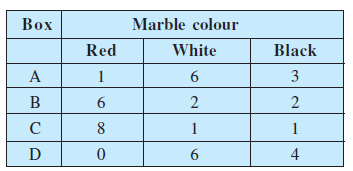
One of the boxes has been selected at random and a single marble is drawn from it. If the marble is red, what is the probability that it was drawn from box A?, box B?, box C?
Worksheet Answers
Solution:
Based on the problem statement, we define the following events:
The total probability of event $B$ failing is the sum of the probability that B fails while A fails, and the probability that B fails while A does not fail.
$P(B) = P(A \cap B) + P(B \cap A^c)$ [By the Law of Total Probability]
$P(B) = 0.15 + 0.15 = 0.30$
We are required to find $P(A \text{ fails} | B \text{ has failed})$, which is denoted as $P(A|B)$.
The formula for conditional probability is:
$P(A|B) = \frac{P(A \cap B)}{P(B)}$ [Per the Axiom of Conditional Probability]
Substitute the values derived in the previous steps:
$P(A|B) = \frac{0.15}{0.30}$
$P(A|B) = \frac{15}{30} = 0.5$
Final Solution: $P(A|B) = 0.5$
Solution:
Let $A$ be the event that subsystem $A$ fails, and $B$ be the event that subsystem $B$ fails. Based on the problem statement, we define the following probabilities:
The event "A fails alone" can be represented as the event that $A$ occurs, but $B$ does not occur. In set-theoretic notation, this is $P(A \cap B^c)$.
By the Law of Total Probability or the properties of set operations, the event $A$ can be expressed as the union of two mutually exclusive events:
$A = (A \cap B) \cup (A \cap B^c)$
Consequently, by the Addition Theorem of Probability for mutually exclusive events:
$P(A) = P(A \cap B) + P(A \cap B^c)$
We rearrange the equation to isolate the target probability $P(A \cap B^c)$:
$P(A \cap B^c) = P(A) - P(A \cap B)$
Substituting the known values into the equation:
$P(A \cap B^c) = 0.2 - 0.15$
$P(A \cap B^c) = 0.05$
The diagram illustrates the intersection $P(A \cap B) = 0.15$, the "A alone" region $P(A \cap B^c) = 0.05$, and the "B alone" region $P(B \cap A^c) = 0.15$.
Final Solution: $P(\text{A fails alone}) = 0.05$
Solution:
Let the gender of a child be represented by $B$ (Boy) or $G$ (Girl). For a family with two children, the sample space $S$ consists of all possible ordered pairs $(Child_1, Child_2)$:
$S = \{BB, BG, GB, GG\}$
Each outcome is considered equally likely, where $|S| = 4$. [Per the Classical Definition of Probability]
Let $E$ be the event that both children are females. Thus, $E = \{GG\}$.
Let $F$ be the event that the elder child is a female. The elder child corresponds to the first position in the ordered pair. Thus, $F = \{GG, GB\}$.
We are required to find the probability of event $E$ given that event $F$ has occurred, denoted as $P(E|F)$.
The formula for conditional probability is:
$P(E|F) = \frac{P(E \cap F)}{P(F)}$ [By the definition of Conditional Probability]
First, identify the intersection of events $E$ and $F$:
$E \cap F = \{GG\} \cap \{GG, GB\} = \{GG\}$
Calculate the individual probabilities based on the sample space size:
Substitute the values into the conditional probability formula:
$P(E|F) = \frac{1/4}{2/4} = \frac{1}{2}$
Final Solution: The probability that both children are females, given that the elder child is a female, is $\frac{1}{2}$.
Solution:
We are provided with the condition $P(B|A) = 1$, where $P(A) \neq 0$. The definition of conditional probability for any two events $A$ and $B$ in a sample space $S$ is given by:
$P(B|A) = \frac{P(A \cap B)}{P(A)}$ [Definition of Conditional Probability]
Substituting the given value $P(B|A) = 1$ into the definition:
$1 = \frac{P(A \cap B)}{P(A)}$
$P(A) = P(A \cap B)$ [Algebraic manipulation]
The identity $P(A \cap B) = P(A)$ implies that the probability of the intersection of $A$ and $B$ is equal to the probability of $A$ itself. In the context of set theory and probability measures:
Given $P(B|A) = 1$ and $P(A) \neq 0$, it follows that:
$P(A \cap B) = P(A)$
By set-theoretic axioms, this indicates that the event $A$ is a subset of event $B$ ($A \subset B$). Specifically, if the occurrence of $A$ guarantees the occurrence of $B$, $A$ must be entirely contained within the region defined by $B$.
Final Solution: A \subset B
Solution:
The given condition is $P(A|B) > P(A)$. Per the definition of conditional probability for any two events $A$ and $B$ where $P(B) > 0$, the probability of $A$ given $B$ is expressed as:
$P(A|B) = \frac{P(A \cap B)}{P(B)}$
[By the Multiplicative Rule of Probability]
Substituting the definition into the given inequality:
$\frac{P(A \cap B)}{P(B)} > P(A)$
Assuming $P(B) > 0$, we can multiply both sides by $P(B)$ without reversing the inequality:
$P(A \cap B) > P(A) \cdot P(B)$
To determine the relation between $P(B|A)$ and $P(B)$, we use the symmetry of the intersection formula, $P(A \cap B) = P(B \cap A)$. Applying the conditional probability definition for $B$ given $A$ (assuming $P(A) > 0$):
$P(B|A) = \frac{P(A \cap B)}{P(A)}$
From our inequality $P(A \cap B) > P(A) \cdot P(B)$, divide both sides by $P(A)$:
$\frac{P(A \cap B)}{P(A)} > \frac{P(A) \cdot P(B)}{P(A)}$
$P(B|A) > P(B)$
The condition $P(A|B) > P(A)$ implies that the occurrence of event $B$ increases the probability of the occurrence of event $A$. This is the definition of positive correlation between two events in probability theory. Mathematically, this is equivalent to $P(B|A) > P(B)$.
| Relationship | Logical Equivalent |
|---|---|
| $P(A|B) > P(A)$ | $P(B|A) > P(B)$ |
| Events are positively correlated | Occurrence of one increases the likelihood of the other |
Final Solution: The correct relation is $P(B|A) > P(B)$.
Solution:
Let the sample space $S$ represent all possible gender combinations for two children, where $B$ denotes a boy and $G$ denotes a girl. The birth order matters:
$S = \{BB, BG, GB, GG\}$The total number of outcomes is $n(S) = 4$.
Let $E$ be the event that both children are males, and $F$ be the event that at least one child is male.
Per the definition of events, the intersection of $E$ and $F$ is:
$E \cap F = \{BB\}$We are required to find $P(E|F)$, the probability that both children are males given that at least one is a male. [By the Definition of Conditional Probability]:
$P(E|F) = \frac{P(E \cap F)}{P(F)}$Calculating the individual probabilities:
Substituting the values into the formula:
$P(E|F) = \frac{1/4}{3/4}$ $P(E|F) = \frac{1}{4} \times \frac{4}{3} = \frac{1}{3}$Final Solution: The probability that both children are males, given that at least one is male, is $\frac{1}{3}$.
Solution:
The problem provides the following equation involving the probabilities of two events, $A$ and $B$, within a sample space $S$:
$P(A) + P(B) - P(A \cap B) = P(A)$
[Given: The probability of the union of two events is defined by the Addition Theorem of Probability: $P(A \cup B) = P(A) + P(B) - P(A \cap B)$].
By substituting the definition of the union of two events into the given equation, we derive the following logical equivalence:
$P(A \cup B) = P(A)$
[By the Axiom of Probability, for any two sets $A$ and $B$, $A \subseteq (A \cup B)$].
If $P(A \cup B) = P(A)$, this implies that the event $(A \cup B)$ is effectively equivalent to event $A$ in terms of probability measure. Since $A \subseteq (A \cup B)$ is always true, the condition $P(A \cup B) = P(A)$ implies that the set $B$ must be a subset of $A$.
Specifically:
[Per the Monotonicity Property of Probability: If $B \subseteq A$, then $P(B) \leq P(A)$ and $P(A \cap B) = P(B)$].
Revisiting the original equation: $P(A) + P(B) - P(A \cap B) = P(A)$.
Subtract $P(A)$ from both sides:
$P(B) - P(A \cap B) = 0$
$P(B) = P(A \cap B)$
This result is the necessary and sufficient condition for $B \subseteq A$. If the probability of the intersection of two events is equal to the probability of one of the events, that event must be contained within the other.
The given equation simplifies to $P(B) = P(A \cap B)$, which holds if and only if $B$ is a subset of $A$ ($B \subseteq A$).
Final Solution: B \subseteq A
Solution:
Let $M$ be the event that the selected person is male, and $W$ be the event that the selected person is female. Let $G$ be the event that the selected person has grey hair.
Given that there are equal numbers of males and females, the prior probabilities are:
The conditional probabilities of having grey hair given the gender are:
Per the Law of Total Probability, the probability that a randomly selected person has grey hair is given by:
$P(G) = P(M) \cdot P(G|M) + P(W) \cdot P(G|W)$
$P(G) = (0.5 \times 0.05) + (0.5 \times 0.0025)$
$P(G) = 0.025 + 0.00125$
$P(G) = 0.02625$
We aim to find the probability that the person is male given they have grey hair, denoted as $P(M|G)$. According to Bayes' Theorem:
$P(M|G) = \frac{P(M) \cdot P(G|M)}{P(G)}$
Substituting the calculated values:
$P(M|G) = \frac{0.5 \times 0.05}{0.02625}$
$P(M|G) = \frac{0.025}{0.02625}$
To simplify the fraction, multiply both the numerator and denominator by 100,000:
$P(M|G) = \frac{2500}{2625}$
Divide both terms by their greatest common divisor ($125$):
$P(M|G) = \frac{2500 \div 125}{2625 \div 125} = \frac{20}{21}$
Final Solution: The probability that the person with grey hair is male is $\frac{20}{21} \approx 0.9524$ or $95.24\%$.
Solution:
Let $E$ be the event that the patient suffers a heart attack. Let $A_1$ and $A_2$ be the events of choosing the meditation/yoga course and the drug prescription, respectively.
The initial probability of a heart attack is $0.40$.
We determine the reduced probability of a heart attack given the chosen course:
We are required to find $P(A_1|E)$, the probability that the patient followed meditation/yoga given they suffered a heart attack. [Per Bayes' Theorem: $P(A_i|E) = \frac{P(A_i)P(E|A_i)}{\sum P(A_j)P(E|A_j)}$]
Calculating the total probability $P(E)$:
$P(E) = P(A_1)P(E|A_1) + P(A_2)P(E|A_2)$ $P(E) = (0.5 \times 0.28) + (0.5 \times 0.30)$ $P(E) = 0.14 + 0.15 = 0.29$Final Solution: The probability that the patient followed a course of meditation and yoga is $\frac{14}{29} \approx 0.4827$.
Solution:
Let $E$ be the event that the marble drawn is red. Let $A, B, C,$ and $D$ be the events of selecting boxes A, B, C, and D, respectively. Since there are four boxes and one is selected at random:
$P(A) = P(B) = P(C) = P(D) = \frac{1}{4}$ [By the principle of equal likelihood]
Based on the provided distribution (A: 1 Red, 6 White; B: 2 Red, 2 White; C: 3 Red, 1 White; D: 4 Red, 0 White), we calculate the probability of drawing a red marble given a specific box selection:
Per the Law of Total Probability: $P(E) = P(A)P(E|A) + P(B)P(E|B) + P(C)P(E|C) + P(D)P(E|D)$
$P(E) = \left( \frac{1}{4} \times \frac{1}{7} \right) + \left( \frac{1}{4} \times \frac{1}{2} \right) + \left( \frac{1}{4} \times \frac{3}{4} \right) + \left( \frac{1}{4} \times 1 \right)$
$P(E) = \frac{1}{4} \left( \frac{1}{7} + \frac{1}{2} + \frac{3}{4} + 1 \right) = \frac{1}{4} \left( \frac{8 + 28 + 42 + 56}{56} \right) = \frac{1}{4} \left( \frac{134}{56} \right) = \frac{67}{112}$
To find the probability that the marble was drawn from a specific box given it is red, we use: $P(X|E) = \frac{P(X)P(E|X)}{P(E)}$ where $X \in \{A, B, C, D\}$.
| Box ($X$) | Calculation ($P(X)P(E|X) / P(E)$) | Result |
|---|---|---|
| A | $(\frac{1}{4} \times \frac{1}{7}) / \frac{67}{112} = \frac{1}{28} \times \frac{112}{67}$ | $\frac{4}{67}$ |
| B | $(\frac{1}{4} \times \frac{1}{2}) / \frac{67}{112} = \frac{1}{8} \times \frac{112}{67}$ | $\frac{14}{67}$ |
| C | $(\frac{1}{4} \times \frac{3}{4}) / \frac{67}{112} = \frac{3}{16} \times \frac{112}{67}$ | $\frac{21}{67}$ |
| D | $(\frac{1}{4} \times 1) / \frac{67}{112} = \frac{1}{4} \times \frac{112}{67}$ | $\frac{28}{67}$ |
Final Solution: The probabilities that the red marble was drawn from boxes A, B, C, and D are $\frac{4}{67}, \frac{14}{67}, \frac{21}{67},$ and $\frac{28}{67}$ respectively.
Solution:
The conditional probability of an event $B$ occurring given that event $A$ has already occurred is defined by the multiplication rule of probability:
$P(B|A) = \frac{P(A \cap B)}{P(A)}$
[Per the definition of conditional probability for any two events $A$ and $B$ where $P(A) \neq 0$]
The problem states that $A \cap B = \phi$, where $\phi$ denotes the empty set (or null event). In probability theory, the probability of an impossible or empty event is defined as:
$P(A \cap B) = P(\phi) = 0$
[By the Axiom of Probability, the measure of the empty set in the sample space $S$ is zero]
Substitute the value obtained in Step 2 into the formula established in Step 1:
$P(B|A) = \frac{0}{P(A)}$
Since the problem provides the constraint $P(A) \neq 0$, the expression is well-defined and evaluates as follows:
$P(B|A) = 0$
Final Solution: $P(B|A) = 0$
Solution:
Let the events be defined as follows:
Bag I contains 3 red balls and 4 black balls (Total = 7 balls).
Bag II contains 4 red balls and 5 black balls (Total = 9 balls).
Probabilities of transferring balls from Bag I:
If $E_1$ occurs, Bag II receives a red ball. The composition of Bag II becomes (4+1) red and 5 black (Total = 10 balls).
$P(A|E_1) = \frac{5}{10} = \frac{1}{2}$
If $E_2$ occurs, Bag II receives a black ball. The composition of Bag II becomes 4 red and (5+1) black (Total = 10 balls).
$P(A|E_2) = \frac{4}{10} = \frac{2}{5}$
We are required to find the probability that the transferred ball was black, given that the drawn ball is red, i.e., $P(E_2|A)$.
Per Bayes' Theorem [Theorems of Total Probability and Bayes' Rule]:
$P(E_2|A) = \frac{P(E_2) \cdot P(A|E_2)}{P(E_1) \cdot P(A|E_1) + P(E_2) \cdot P(A|E_2)}$
Substitute the established values into the formula:
$P(E_2|A) = \frac{\frac{4}{7} \cdot \frac{4}{10}}{\left(\frac{3}{7} \cdot \frac{5}{10}\right) + \left(\frac{4}{7} \cdot \frac{4}{10}\right)}$
$P(E_2|A) = \frac{\frac{16}{70}}{\frac{15}{70} + \frac{16}{70}}$
$P(E_2|A) = \frac{\frac{16}{70}}{\frac{31}{70}}$
$P(E_2|A) = \frac{16}{31}$
Final Solution: The probability that the transferred ball is black is $\frac{16}{31}$.
Solution:
A standard year consists of $365$ days, whereas a leap year consists of $366$ days [Per the Gregorian calendar definition].
We convert the total number of days into weeks:
$366 \text{ days} = 52 \text{ weeks} + 2 \text{ days}$
This implies that every leap year is guaranteed to have $52$ Tuesdays, as $52 \times 7 = 364$ days cover $52$ full cycles of the week.
The remaining $2$ days (the $365^{th}$ and $366^{th}$ days) can be any two consecutive days of the week. We denote the sample space $S$ as follows:
The total number of outcomes is $n(S) = 7$.
For the year to contain exactly $53$ Tuesdays, one of the two remaining days must be a Tuesday. Let $E$ be the event of selecting such a pair:
The number of favorable outcomes is $n(E) = 2$.
Using the Classical Definition of Probability [Probability $P(E) = \frac{n(E)}{n(S)}$]:
$P(E) = \frac{2}{7}$
Final Solution: The probability that a leap year contains 53 Tuesdays is $\frac{2}{7}$.
Solution:
The problem involves a fixed number of independent Bernoulli trials, where each trial (selecting a person) has two possible outcomes: right-handed (success) or not right-handed (failure). Since the probability of success is constant, we apply the Binomial Distribution formula:
$P(X = k) = \binom{n}{k} p^k q^{n-k}$
Where:
We are required to find the probability that at most 6 people are right-handed. This is expressed as:
$P(X \leq 6) = \sum_{k=0}^{6} \binom{10}{k} (0.9)^k (0.1)^{10-k}$
Due to the law of total probability, it is computationally more efficient to calculate the complement and subtract from 1:
$P(X \leq 6) = 1 - [P(X=7) + P(X=8) + P(X=9) + P(X=10)]$
We compute each term $P(X=k) = \binom{10}{k} (0.9)^k (0.1)^{10-k}$:
| $k$ | Calculation: $\binom{10}{k} (0.9)^k (0.1)^{10-k}$ | Value |
|---|---|---|
| $7$ | $\frac{10!}{7!3!} (0.9)^7 (0.1)^3 = 120 \times 0.4782969 \times 0.001$ | $0.0573956$ |
| $8$ | $\frac{10!}{8!2!} (0.9)^8 (0.1)^2 = 45 \times 0.4304672 \times 0.01$ | $0.1937102$ |
| $9$ | $\frac{10!}{9!1!} (0.9)^9 (0.1)^1 = 10 \times 0.3874205 \times 0.1$ | $0.3874205$ |
| $10$ | $\frac{10!}{10!0!} (0.9)^{10} (0.1)^0 = 1 \times 0.3486784 \times 1$ | $0.3486784$ |
Summing the probabilities for $k > 6$:
$\sum_{k=7}^{10} P(X=k) = 0.0573956 + 0.1937102 + 0.3874205 + 0.3486784 = 0.9872047$
Subtracting from total probability [Per the Complement Rule]:
$P(X \leq 6) = 1 - 0.9872047 = 0.0127953$
Final Solution: The probability that at most 6 people are right-handed is approximately 0.0128.
Solution:
A second-order determinant is represented as:
$D = \begin{vmatrix} a_{11} & a_{12} \\ a_{21} & a_{22} \end{vmatrix} = a_{11}a_{22} - a_{12}a_{21}$
Each entry $a_{ij}$ can take a value from the set $\{0, 1\}$. Since there are 4 positions and each position has 2 possible values, the total number of possible determinants is $2^4 = 16$. [Per the Fundamental Counting Principle].
We require the value of the determinant $D > 0$. Given the expression $D = a_{11}a_{22} - a_{12}a_{21}$, the condition $D > 0$ implies:
$a_{11}a_{22} - a_{12}a_{21} > 0 \implies a_{11}a_{22} > a_{12}a_{21}$
Since the entries are restricted to $\{0, 1\}$, the products $a_{11}a_{22}$ and $a_{12}a_{21}$ can only take values $0$ or $1$. For the inequality $a_{11}a_{22} > a_{12}a_{21}$ to hold, the only possibility is:
We analyze the two conditions independently:
Condition 1: $a_{11}a_{22} = 1$
This occurs only if $a_{11} = 1$ AND $a_{22} = 1$. There is $1$ way to satisfy this.
Condition 2: $a_{12}a_{21} = 0$
This occurs if $a_{12} = 0, a_{21} = 0$; OR $a_{12} = 0, a_{21} = 1$; OR $a_{12} = 1, a_{21} = 0$. There are $3$ ways to satisfy this.
By the Multiplication Rule for independent events, the total number of favorable outcomes is $1 \times 3 = 3$.
The probability $P(E)$ is defined as the ratio of favorable outcomes to the total number of elements in the sample space. [By the Classical Definition of Probability].
$P(D > 0) = \frac{\text{Favorable Outcomes}}{\text{Total Outcomes}} = \frac{3}{16}$
Final Solution: The probability that the value of the determinant is positive is $\frac{3}{16}$.
Solution:
The conditional probability of an event $B$, given that event $A$ has occurred, is defined as:
$P(B|A) = \frac{P(A \cap B)}{P(A)}$
[Per the definition of Conditional Probability provided in the axiomatic framework of probability theory, where $P(A) > 0$.]
The problem states that $A$ is a subset of $B$ ($A \subseteq B$). By the set-theoretic definition of a subset, if every element of set $A$ is also an element of set $B$, then the intersection of $A$ and $B$ is equal to set $A$ itself.
$A \cap B = A$
[By the property of set intersection: if $A \subseteq B$, then $A \cap B = A$.]
Applying the result from Step 2 to the probability of the intersection:
$P(A \cap B) = P(A)$
Substitute $P(A \cap B) = P(A)$ into the expression derived in Step 1:
$P(B|A) = \frac{P(A)}{P(A)}$
Since it is given that $P(A) \neq 0$, the ratio $\frac{P(A)}{P(A)}$ simplifies to unity:
$P(B|A) = 1$
The Venn diagram illustrates that all outcomes within region $A$ are strictly contained within region $B$. Consequently, if event $A$ is known to have occurred, it is certain that event $B$ has also occurred.
Final Solution: $P(B|A) = 1$


