


Your Worksheet is Ready
CBSE - Class 12 Mathematics Vector Algebra Worksheet
EXERCISE 10.1
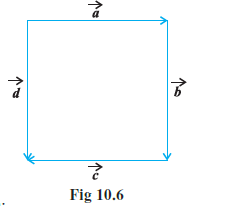
In Fig 10.6 (a square), identify the following vectors. (i) Coinitial
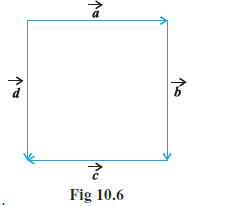
In Fig 10.6 (a square), identify the following vectors. (ii) Equal
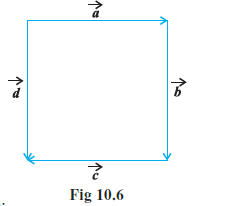
In Fig 10.6 (a square), identify the following vectors. (iii) Collinear but not equal
Worksheet Answers
Solution:
Two vectors $\vec{a}$ and $\vec{b}$ are defined as collinear (or parallel) if there exists a non-zero scalar $\lambda$ such that:
$$\vec{b} = \lambda \vec{a}$$
[Per the definition of collinearity in Vector Algebra, vectors are collinear if they are parallel to the same line, irrespective of their magnitudes or directions.]
Consider the magnitudes of the two vectors. If $\vec{b} = \lambda \vec{a}$, then by the property of vector magnitude:
$$|\vec{b}| = |\lambda \vec{a}| = |\lambda| |\vec{a}|$$
The condition for the two vectors to be equal in magnitude is $|\vec{b}| = |\vec{a}|$, which implies $|\lambda| = 1$. This only occurs if $\lambda = 1$ or $\lambda = -1$.
To determine if the statement "Two collinear vectors are always equal in magnitude" is true, we test for a counter-example where $\lambda \neq \pm 1$.
Calculations:
| Vector | Magnitude Formula | Result |
|---|---|---|
| $|\vec{a}|$ | $\sqrt{1^2 + 1^2 + 1^2}$ | $\sqrt{3}$ |
| $|\vec{b}|$ | $\sqrt{2^2 + 2^2 + 2^2}$ | $\sqrt{12} = 2\sqrt{3}$ |
Since $\sqrt{3} \neq 2\sqrt{3}$, the vectors are collinear but their magnitudes are not equal. [By the property of scalar multiplication of vectors].
The statement is False because collinear vectors are defined by parallelism (the existence of a scalar multiple), not by identity of magnitude. Only if the scalar multiple $\lambda$ is restricted to $\pm 1$ would the magnitudes be equal.
Final Solution: False
Solution:
To classify a physical quantity, we must distinguish between scalars and vectors based on their mathematical properties:
The quantity provided is $40\text{ watt}$.
Power is calculated as the scalar product of force $\vec{F}$ and velocity $\vec{v}$ ($P = \vec{F} \cdot \vec{v}$). Although force and velocity are vectors, the result of a dot product is always a scalar quantity [By the Properties of the Scalar Product]. Since $40\text{ watt}$ describes the rate of energy conversion without reference to a directional component, it satisfies the criteria for a scalar quantity.
Final Solution: The measure 40 watt is a scalar quantity.
Solution:
In classical mechanics, velocity is defined as the rate of change of displacement with respect to time. Mathematically, it is expressed as the derivative of the position vector $\vec{r}$ with respect to time $t$:
$$\vec{v} = \frac{d\vec{r}}{dt}$$
[Per the definitions of Kinematics in Vector Algebra]
To classify a physical quantity as either scalar or vector, we must evaluate its adherence to the following criteria:
Velocity possesses two fundamental attributes:
Since velocity explicitly requires direction to be fully defined—moving at $50 \, \text{km/h}$ is physically incomplete without specifying the cardinal direction (e.g., North) or vector orientation—it behaves as a directed line segment in $\mathbb{R}^3$ space.
| Attribute | Scalar (e.g., Speed) | Vector (e.g., Velocity) |
|---|---|---|
| Magnitude | Yes | Yes |
| Direction | No | Yes |
| Algebraic Law | Arithmetic Addition | Parallelogram/Triangle Law |
Final Solution: Velocity is a vector quantity because it possesses both magnitude (speed) and a defined direction in space.
Solution:
The given measure is $40^\circ$. This represents a magnitude of temperature or angular measurement depending on the physical context, but inherently, it signifies a scalar value.
To distinguish between scalar and vector quantities, we apply the following definitions:
The measurement $40^\circ$ is a pure magnitude. Whether it represents an angle between two lines or a temperature on a scale (such as Celsius), it lacks an associated directional component (a vector direction such as $\hat{i}, \hat{j}, \hat{k}$ or an orientation in 3D space) required to qualify as a vector [By the principles of Scalar Algebra].
| Measure | Category | Reasoning |
|---|---|---|
| $40^\circ$ | Scalar | Possesses magnitude only; lacks directional component. |
Final Solution: The measure $40^\circ$ is classified as a Scalar quantity.
Solution:
In vector algebra, two or more vectors are classified as coinitial if they originate from the same initial point [Definition: A set of vectors $\{ \vec{a}, \vec{b}, \vec{c}, ... \}$ are coinitial if there exists a point $P$ such that $P$ is the tail of all vectors in the set].
Given a square $ABCD$ with vertices mapped in a 2D Cartesian plane, we identify the vectors emanating from each vertex. Based on standard conventions for a square $ABCD$ labeled in counter-clockwise order:
By inspecting the vertices where two vectors share a common starting point:
| Vertex (Initial Point) | Coinitial Vectors |
|---|---|
| Vertex A | $\vec{AB}$ and $\vec{AD}$ |
| Vertex B | $\vec{BA}$ and $\vec{BC}$ |
| Vertex C | $\vec{CB}$ and $\vec{CD}$ |
| Vertex D | $\vec{DA}$ and $\vec{DC}$ |
Since the problem asks to identify the coinitial vectors in the square, we provide the sets emanating from the vertices. These pairs satisfy the requirement of sharing a common origin [Per the properties of vectors in a geometric polygon].
Final Solution: The pairs of coinitial vectors are $(\vec{AB}, \vec{AD})$, $(\vec{BA}, \vec{BC})$, $(\vec{CB}, \vec{CD})$, and $(\vec{DA}, \vec{DC})$.
Solution:
In classical mechanics, work done ($W$) is defined as the product of the magnitude of the force applied to an object and the magnitude of the displacement in the direction of that force. Mathematically, it is expressed as the scalar product (or dot product) of the force vector ($\vec{F}$) and the displacement vector ($\vec{d}$):
$W = \vec{F} \cdot \vec{d} = |\vec{F}| |\vec{d}| \cos(\theta)$
[Per the definition of the Dot Product in Vector Algebra: The dot product of two vectors always yields a scalar value, as $\cos(\theta)$ is a real number ranging from $-1$ to $1$.]
Since work done $W$ is defined by the dot product of two vectors, it lacks a direction. In vector calculus, quantities defined by the projection of one vector onto another, resulting in a magnitude only, are strictly classified as Scalars.
| Criterion | Result |
|---|---|
| Possesses Magnitude? | Yes |
| Possesses Direction? | No |
| Obeys Vector Addition? | N/A (Scalar Algebra applies) |
Final Solution: Work done is a scalar quantity.
Solution:
To classify the physical quantity distance, we must adhere to the definitions established in Euclidean geometry and classical mechanics:
Distance is defined as the total path length covered by an object moving between two points. By definition:
| Feature | Distance | Displacement |
|---|---|---|
| Definition | Total path length | Shortest change in position |
| Type | Scalar | Vector |
| Directionality | None | Required (Vector magnitude + direction) |
Since distance is a measure of total length traversed between two points without any inherent requirement for a directional vector component, it is mathematically classified as a scalar quantity.
Final Solution: Distance is a scalar quantity.
Solution:
To classify a measure as a scalar or a vector, we analyze two fundamental properties:
[Definition of Scalar: A physical quantity having magnitude but no specified direction.]
[Definition of Vector: A physical quantity having both magnitude and direction.]
The quantity provided is $10 \text{ kg}$, which represents mass.
| Attribute | Analysis |
|---|---|
| Magnitude | $10$ (A defined numerical value) |
| Unit | $\text{kg}$ (Kilogram, the SI unit of mass) |
| Direction | Mass is an intrinsic property of matter; it possesses no spatial orientation or directionality. [Per Fundamental Physical Definitions] |
Since the measure $10 \text{ kg}$ only provides information regarding the amount of matter (magnitude) and lacks a directional component, it satisfies the necessary and sufficient conditions for a scalar quantity.
Final Solution: The measure $10 \text{ kg}$ is classified as a scalar.
Solution:
To evaluate the statement "Two vectors having same magnitude are collinear," we must strictly define the geometric and algebraic properties of vectors in $\mathbb{R}^3$:
Consider two vectors in a 2D Cartesian plane:
Let $\vec{a} = 1\hat{i} + 0\hat{j}$
Let $\vec{b} = 0\hat{i} + 1\hat{j}$
Calculate the magnitude of $\vec{a}$:
$|\vec{a}| = \sqrt{1^2 + 0^2} = 1$ [By the Euclidean norm formula]
Calculate the magnitude of $\vec{b}$:
$|\vec{b}| = \sqrt{0^2 + 1^2} = 1$ [By the Euclidean norm formula]
Observation: $|\vec{a}| = |\vec{b}|$. The magnitudes are identical.
For $\vec{a}$ and $\vec{b}$ to be collinear, there must exist a scalar $k$ such that $\vec{a} = k\vec{b}$:
$1\hat{i} + 0\hat{j} = k(0\hat{i} + 1\hat{j})$
$1\hat{i} + 0\hat{j} = 0\hat{i} + k\hat{j}$
Equating components:
Since the component equality fails, no such scalar $k$ exists. Therefore, $\vec{a}$ and $\vec{b}$ are not collinear. [By the Principle of Vector Equivalence].
Since we have demonstrated a case where vectors possess equal magnitude but are not parallel (they are orthogonal in the provided example), the universal claim that equality of magnitude implies collinearity is false.
Final Solution: False. Two vectors having the same magnitude are not necessarily collinear. Collinearity requires the vectors to be scalar multiples of each other, which magnitude equality does not guarantee.
Solution:
To classify the given quantity, 2 meters north-west, we must decompose it into its constituent parts based on the fundamental definitions of scalar and vector quantities in classical physics and mathematics [Per Euclidean Geometry and Vector Analysis]:
We apply the standard academic definitions to distinguish between the two classifications:
| Classification | Definition | Requirement for Identification |
|---|---|---|
| Scalar | A physical quantity defined solely by its magnitude. | Only magnitude exists. |
| Vector | A physical quantity defined by both magnitude and a specific direction. | Magnitude + Direction must both exist. |
Since the given measure, $2$ meters north-west, possesses a definite magnitude ($2$ meters) and a clearly defined direction (north-west, which represents an angle of $135^\circ$ from the positive x-axis or standard coordinate North), it satisfies the criteria for a vector quantity [By the definition of a displacement vector].
Because the measure indicates a displacement rather than a mere distance, and because it specifies a vector orientation, it is categorically a vector. In the context of Vector Algebra, this is a representation of a displacement vector $\vec{d}$.
Final Solution: The measure "2 meters north-west" is a Vector.
Solution:
To analyze the statement, we must formally define the criteria for vector equality. Two vectors $\mathbf{a}$ and $\mathbf{b}$ are considered equal if and only if:
[Per the definition of Equality of Vectors in Vector Algebra].
Two vectors $\mathbf{a}$ and $\mathbf{b}$ are collinear if they are parallel to the same line, irrespective of their magnitudes and directions. Mathematically, $\mathbf{b} = k\mathbf{a}$ for some non-zero scalar $k$. [By the definition of Collinear Vectors].
If two vectors are collinear and have the same magnitude, there are two distinct possibilities for their direction:
Consider two vectors $\mathbf{a}$ and $\mathbf{b}$ such that $\mathbf{a} = \hat{i}$ and $\mathbf{b} = -\hat{i}$.
Because there exists a subset of collinear vectors with the same magnitude that possess opposite directions (making them unequal), the universal statement "Two collinear vectors having the same magnitude are equal" is logically invalid.
Final Solution: False
Solution:
The given value is $10^{-19}$ Coulomb. In physics and vector algebra, the unit "Coulomb" ($C$) is the SI derived unit of electric charge [Per the International System of Units (SI)].
Electric charge is an intrinsic property of matter. While charges are designated as "positive" or "negative," these signs denote the type of charge (polarity) rather than a direction in three-dimensional Cartesian space [Per the Principle of Conservation of Charge and Electromagnetism].
Since the measure $10^{-19}$ Coulomb represents a magnitude of charge without associated spatial orientation (i.e., it does not change based on the coordinate system chosen to observe it), it satisfies the mathematical definition of a scalar.
Final Solution: $10^{-19}$ coulomb is a scalar quantity.
Solution:
The given quantity is $20\text{ m/s}^2$. To classify this as a scalar or a vector, we must decompose the expression into its constituent components: magnitude and direction.
According to the principles of classical mechanics and vector algebra:
| Category | Definition |
|---|---|
| Scalar | A physical quantity that is completely described by its magnitude (a single real number) and unit. |
| Vector | A physical quantity that requires both magnitude and a specific direction to be fully defined. |
Acceleration is defined as the time rate of change of velocity. Since velocity ($\vec{v}$) is a vector quantity—possessing both magnitude (speed) and direction—its derivative with respect to time, acceleration ($\vec{a}$), inherits the property of direction [By the properties of vector differentiation].
Even though the specific numerical value $20$ represents the magnitude of the acceleration, the presence of the unit $\text{m/s}^2$ identifies the quantity as acceleration. Acceleration is a directed quantity; therefore, it is classified as a vector.
Since the physical quantity acceleration necessitates a direction to fully describe its state in space, it does not satisfy the requirement of being a scalar quantity.
Final Solution: The measure $20 \text{ m/s}^2$ represents acceleration, which is a Vector quantity.
Solution:
Consider a square $ABCD$ in a 2D plane. Based on the geometric properties of a square, the vectors representing the sides and diagonals are defined by their direction and magnitude. In a square $ABCD$, let the vertices be represented as vectors from the origin or as displacement vectors between vertices.
Two vectors $\vec{a}$ and $\vec{b}$ are defined as equal if and only if:
[Per the standard definition of vector equality in Euclidean space].
In square $ABCD$, the sides can be represented as follows:
| Vector Pair | Magnitude Equal? | Direction Same? | Equal? |
|---|---|---|---|
| $\vec{AB}, \vec{DC}$ | Yes ($a = a$) | Yes | Yes |
| $\vec{AD}, \vec{BC}$ | Yes ($a = a$) | Yes | Yes |
| $\vec{AB}, \vec{AD}$ | Yes | No (orthogonal) | No |
Based on the geometric properties of the square $ABCD$ provided in the coordinate plane:
1. The vector $\vec{AB}$ is equal to the vector $\vec{DC}$ as they are directed along the same axis (parallel) and have the same magnitude $a$.
2. The vector $\vec{AD}$ is equal to the vector $\vec{BC}$ as they are directed along the same axis (parallel) and have the same magnitude $a$.
Final Solution: The equal vectors in the square $ABCD$ are $\vec{AB} = \vec{DC}$ and $\vec{AD} = \vec{BC}$.
Solution:
To classify a physical quantity, we must evaluate it against two primary criteria:
Definitions per standard physical conventions:
The time period represents the duration taken for a phenomenon to complete one full cycle or the interval between two events.
When measuring time period ($T$):
Since the time period ($T \in \mathbb{R}^+$) is characterized solely by its magnitude and is independent of coordinate geometry directions ($\hat{i}, \hat{j}, \hat{k}$), it fulfills the criteria for a scalar quantity. [Based on the properties of scalar time in Newtonian physics].
Final Solution: Time period is a Scalar quantity.
Solution:
Two vectors $\vec{a}$ and $\vec{b}$ are defined as collinear if and only if they are parallel to the same line, irrespective of their magnitudes and directions. Mathematically, two non-zero vectors $\vec{a}$ and $\vec{b}$ are collinear if there exists a non-zero scalar $\lambda$ such that:
$\vec{b} = \lambda \vec{a}$
[Per the definition of parallel/collinear vectors in Euclidean Space]
We are given two vectors, $\vec{a}$ and $-\vec{a}$. We seek to determine if there exists a scalar $\lambda$ that satisfies the collinearity condition.
Let $\vec{b} = -\vec{a}$. We can rewrite this expression as:
$\vec{b} = (-1) \vec{a}$
Here, the scalar $\lambda = -1$. Since $\lambda \neq 0$, the condition for collinearity is satisfied.
Geometrically, the vector $-\vec{a}$ has the same magnitude as $\vec{a}$ but acts in the exact opposite direction. Because both vectors lie along the same line of support (the line passing through the origin and the terminal point of $\vec{a}$), they are inherently collinear.
Final Solution: True. $\vec{a}$ and $-\vec{a}$ are collinear because $-\vec{a} = (-1)\vec{a}$, satisfying the condition for collinearity.
Solution:
To identify vectors that are collinear but not equal in a square $ABCD$, we establish a Cartesian coordinate system. Let the vertices of the square be defined as $A(0, a)$, $B(a, a)$, $C(a, 0)$, and $D(0, 0)$, where $a > 0$ represents the side length of the square. [By definition of a square in a 2D plane].
We evaluate pairs of parallel sides of the square $ABCD$:
In the standard square configuration provided in Figure 10.6:
Final Solution: The vectors $\vec{AB}$ and $\vec{CD}$ are collinear because they are parallel to the same line, but they are not equal because they point in opposite directions ($\vec{AB} = -\vec{CD}$).
Solution:
To classify the physical quantity "force," we must apply the fundamental definitions established in classical mechanics and vector algebra:
Force is defined by Newton's Second Law of Motion as the product of mass ($m$) and acceleration ($\vec{a}$):
$\vec{F} = m \vec{a}$
In this expression:
Since the product of a scalar and a vector yields a vector, force must inherently possess a directional component. [By the property of vector scaling].
Because force requires a specific magnitude (Newton units) and a specific orientation to define its effect on a body, it satisfies the requirements of a vector.
Final Solution: Force is a vector quantity.
Solution:
To represent the displacement vector $\vec{d}$, we define the following parameters:
To ensure high precision, we convert the polar representation $(r, \theta)$ to Cartesian coordinates $(x, y)$.
The vector $\vec{d}$ is represented starting from the origin $(0,0)$ in the coordinate plane:
Final Solution: The displacement vector is represented as a directed line segment of length 4 units, originating at the coordinate intersection and oriented at an angle of 30° East of North, equivalent to a displacement of 40 km.


