


Your Worksheet is Ready
CBSE - Class 12 Mathematics Matrices Worksheet
Miscellaneous Exercise on Chapter 3
A manufacturer produces three products $x, y, z$ which he sells in two markets. Annual sales are indicated below:
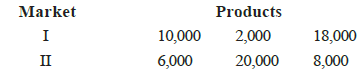
(a) If unit sale prices of $x, y$ and $z$ are ` 2.50, ` 1.50 and ` 1.00, respectively, find the total revenue in each market with the help of matrix algebra.
If $A = \begin{bmatrix} \alpha & \beta \\ \gamma & -\alpha \end{bmatrix}$ is such that $A^2 = I$, then
$1 + \alpha^2 + \beta\gamma = 0$
b.$1 – \alpha^2 + \beta\gamma = 0$
c.$1 – \alpha^2 – \beta\gamma = 0$
d.$1 + \alpha^2 – \beta\gamma = 0$
A manufacturer produces three products $x, y, z$ which he sells in two markets. Annual sales are indicated below:
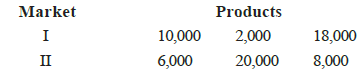
(b) If the unit costs of the above three commodities are ` 2.00, ` 1.00 and 50 paise respectively. Find the gross profit.
Worksheet Answers
Solution:
Given the matrix equation: $\begin{bmatrix} 1 & 2 & 1 \end{bmatrix} \begin{bmatrix} 1 & 2 & 0 \\ 2 & 0 & 1 \\ 1 & 0 & 2 \end{bmatrix} \begin{bmatrix} 0 \\ 2 \\ x \end{bmatrix} = [0]$
We apply the associative property of matrix multiplication, $(AB)C = A(BC)$, to simplify the calculation [Per Associative Property of Matrices]. Let $A = \begin{bmatrix} 1 & 2 & 1 \end{bmatrix}$, $B = \begin{bmatrix} 1 & 2 & 0 \\ 2 & 0 & 1 \\ 1 & 0 & 2 \end{bmatrix}$, and $C = \begin{bmatrix} 0 \\ 2 \\ x \end{bmatrix}$.
Let $D = B \times C$. $D = \begin{bmatrix} 1 & 2 & 0 \\ 2 & 0 & 1 \\ 1 & 0 & 2 \end{bmatrix} \begin{bmatrix} 0 \\ 2 \\ x \end{bmatrix}$
Perform the row-by-column multiplication: $D = \begin{bmatrix} (1 \cdot 0) + (2 \cdot 2) + (0 \cdot x) \\ (2 \cdot 0) + (0 \cdot 2) + (1 \cdot x) \\ (1 \cdot 0) + (0 \cdot 2) + (2 \cdot x) \end{bmatrix}$
$D = \begin{bmatrix} 0 + 4 + 0 \\ 0 + 0 + x \\ 0 + 0 + 2x \end{bmatrix} = \begin{bmatrix} 4 \\ x \\ 2x \end{bmatrix}$
Now, compute $A \times D = [0]$: $\begin{bmatrix} 1 & 2 & 1 \end{bmatrix} \begin{bmatrix} 4 \\ x \\ 2x \end{bmatrix} = [0]$
Expand the dot product: $(1 \cdot 4) + (2 \cdot x) + (1 \cdot 2x) = 0$
Simplify the resulting scalar equation: $4 + 2x + 2x = 0$
$4 + 4x = 0$
Isolate the variable $x$: $4x = -4$
$x = \frac{-4}{4}$
$x = -1$
Final Solution: $x = -1$
Solution:
Given the matrix $A = \begin{bmatrix} 3 & 1 \\ -1 & 2 \end{bmatrix}$, the square of the matrix $A^2$ is computed by the product $A \cdot A$.
$A^2 = \begin{bmatrix} 3 & 1 \\ -1 & 2 \end{bmatrix} \begin{bmatrix} 3 & 1 \\ -1 & 2 \end{bmatrix}$
By the definition of matrix multiplication [Sum of row-column products]:
$A^2 = \begin{bmatrix} (3)(3) + (1)(-1) & (3)(1) + (1)(2) \\ (-1)(3) + (2)(-1) & (-1)(1) + (2)(2) \end{bmatrix}$
$A^2 = \begin{bmatrix} 9 - 1 & 3 + 2 \\ -3 - 2 & -1 + 4 \end{bmatrix} = \begin{bmatrix} 8 & 5 \\ -5 & 3 \end{bmatrix}$
We evaluate the term $-5A$ using the scalar multiplication property $k \begin{bmatrix} a & b \\ c & d \end{bmatrix} = \begin{bmatrix} ka & kb \\ kc & kd \end{bmatrix}$:
$-5A = -5 \begin{bmatrix} 3 & 1 \\ -1 & 2 \end{bmatrix} = \begin{bmatrix} -15 & -5 \\ 5 & -10 \end{bmatrix}$
We define the identity matrix $I$ for a $2 \times 2$ order as $I = \begin{bmatrix} 1 & 0 \\ 0 & 1 \end{bmatrix}$. Thus, the term $7I$ is:
$7I = 7 \begin{bmatrix} 1 & 0 \\ 0 & 1 \end{bmatrix} = \begin{bmatrix} 7 & 0 \\ 0 & 7 \end{bmatrix}$
We now evaluate the expression $LHS = A^2 - 5A + 7I$ by adding the matrices computed in the previous steps:
$LHS = \begin{bmatrix} 8 & 5 \\ -5 & 3 \end{bmatrix} + \begin{bmatrix} -15 & -5 \\ 5 & -10 \end{bmatrix} + \begin{bmatrix} 7 & 0 \\ 0 & 7 \end{bmatrix}$
Summing the corresponding elements [By Matrix Addition Property]:
| Element Position | Summation | Result |
|---|---|---|
| (1, 1) | $8 - 15 + 7$ | $0$ |
| (1, 2) | $5 - 5 + 0$ | $0$ |
| (2, 1) | $-5 + 5 + 0$ | $0$ |
| (2, 2) | $3 - 10 + 7$ | $0$ |
The resulting matrix is:
$LHS = \begin{bmatrix} 0 & 0 \\ 0 & 0 \end{bmatrix} = O$
Since the result is the Zero Matrix $O$, the identity $A^2 - 5A + 7I = 0$ is satisfied.
Final Solution: $A^2 - 5A + 7I = \begin{bmatrix} 0 & 0 \\ 0 & 0 \end{bmatrix} = 0$. Hence, the statement is proved.
Solution:
We are provided with a square matrix $A$ that satisfies the idempotent property:
$A^2 = A$ [Definition of Idempotent Matrix]
We are required to evaluate the expression:
$E = (I + A)^3 - 7A$
Since $I$ (the Identity matrix) and $A$ commute (i.e., $IA = AI = A$), we can apply the binomial theorem for the expansion of $(I + A)^3$:
$(I + A)^3 = I^3 + 3I^2A + 3IA^2 + A^3$
Simplifying the terms using properties of identity matrices ($I^n = I$ and $IA = A$):
$(I + A)^3 = I + 3A + 3A^2 + A^3$ [Property of Identity matrix multiplication]
Given $A^2 = A$, we can derive higher powers of $A$:
Substituting these relations back into the expanded expression from Step 1:
$(I + A)^3 = I + 3A + 3(A) + (A)$
$(I + A)^3 = I + 3A + 3A + A$
$(I + A)^3 = I + 7A$
Now, we substitute the simplified expression of $(I + A)^3$ back into the original expression $E$:
$E = (I + 7A) - 7A$
$E = I + (7A - 7A)$ [Associative property of matrix addition]
$E = I + O$ (where $O$ is the Null matrix)
$E = I$
Final Solution: (I + A)^3 – 7A = I
Solution:
The given matrix equation is defined as $A \cdot B \cdot C = O$, where:
[By the property of Matrix Multiplication compatibility, the product of $1 \times 3$ and $3 \times 3$ results in a $1 \times 3$ matrix, which is then multiplied by a $3 \times 1$ matrix to result in a $1 \times 1$ scalar matrix.]
Let $D = A \cdot B$. Calculating the elements of $D$ as a $1 \times 3$ vector:
$D = \begin{bmatrix} (x \cdot 1) + (-5 \cdot 0) + (-1 \cdot 2) & (x \cdot 0) + (-5 \cdot 2) + (-1 \cdot 0) & (x \cdot 2) + (-5 \cdot 1) + (-1 \cdot 3) \end{bmatrix}$
$D = \begin{bmatrix} x - 2 & -10 & 2x - 8 \end{bmatrix}$
Now, we compute $D \cdot C = [0]$:
$\begin{bmatrix} x - 2 & -10 & 2x - 8 \end{bmatrix} \begin{bmatrix} x \\ 4 \\ 1 \end{bmatrix} = [0]$
Applying the dot product rule for matrix multiplication [Row 1 $\times$ Column 1]:
$(x - 2)(x) + (-10)(4) + (2x - 8)(1) = 0$
Expanding the terms:
$x^2 - 2x - 40 + 2x - 8 = 0$
Combining like terms [Algebraic Simplification]:
$x^2 + (-2x + 2x) + (-40 - 8) = 0$
$x^2 - 48 = 0$
$x^2 = 48$
$x = \pm \sqrt{48}$
$x = \pm 4\sqrt{3}$
Final Solution: $x = \pm 4\sqrt{3}$
Solution:
To determine the total revenue using matrix algebra, we define the quantity sold in the two markets as a matrix $A$ and the unit sale prices as a row matrix $P$.
Let the quantity matrix $A$ be a $2 \times 3$ matrix representing Markets (rows) and Products (columns):
$A = \begin{bmatrix} 10000 & 2000 & 18000 \\ 6000 & 20000 & 8000 \end{bmatrix}$
Let the price matrix $P$ be a $3 \times 1$ column matrix representing the unit price per product $x, y,$ and $z$:
$P = \begin{bmatrix} 2.50 \\ 1.50 \\ 1.00 \end{bmatrix}$
The total revenue $R$ for each market is obtained by the matrix product $R = A \times P$. [Per the definition of matrix multiplication, where an $(m \times n)$ matrix multiplied by an $(n \times p)$ matrix results in an $(m \times p)$ matrix].
$R = \begin{bmatrix} 10000 & 2000 & 18000 \\ 6000 & 20000 & 8000 \end{bmatrix} \begin{bmatrix} 2.50 \\ 1.50 \\ 1.00 \end{bmatrix}$
Perform row-by-column multiplication:
For Market 1:
$R_{1} = (10000 \times 2.50) + (2000 \times 1.50) + (18000 \times 1.00)$
$R_{1} = 25000 + 3000 + 18000 = 46000$
For Market 2:
$R_{2} = (6000 \times 2.50) + (20000 \times 1.50) + (8000 \times 1.00)$
$R_{2} = 15000 + 30000 + 8000 = 53000$
| Market | Total Revenue (INR) |
|---|---|
| Market 1 | 46,000 |
| Market 2 | 53,000 |
Final Solution: The total revenue for Market 1 is ₹46,000 and for Market 2 is ₹53,000.
Solution:
Let $A$ and $B$ be two symmetric matrices of the same order $n \times n$.
By the definition of symmetric matrices [Definition of Symmetric Matrices]:
We are required to prove that the matrix $X = AB - BA$ is a skew-symmetric matrix. A matrix $X$ is skew-symmetric if and only if $X^T = -X$ [Definition of Skew-Symmetric Matrices].
To determine the nature of $X = AB - BA$, we take the transpose of the entire expression:
$X^T = (AB - BA)^T$
Using the linearity property of the transpose operation, i.e., $(A - B)^T = A^T - B^T$ [Property of Transpose]:
$X^T = (AB)^T - (BA)^T$
Utilizing the reversal law of transpose, which states $(PQ)^T = Q^T P^T$ [Reversal Law of Matrix Transpose]:
$X^T = (B^T A^T) - (A^T B^T)$
Substitute the given symmetric properties ($A^T = A$ and $B^T = B$) into the expression:
$X^T = (BA) - (AB)$
To factor out a negative sign and align with the original matrix $X = AB - BA$:
$X^T = -(AB - BA)$
$X^T = -X$
Since we have demonstrated that $(AB - BA)^T = -(AB - BA)$, the matrix satisfies the fundamental condition for skew-symmetry [Definition of Skew-Symmetric Matrices].
Final Solution: Since the transpose of the matrix (AB - BA) is equal to its negative, the matrix AB - BA is proved to be a skew-symmetric matrix.
Solution:
To determine the symmetry of the matrix $X = B'AB$, we rely on the definition of symmetric and skew-symmetric matrices, as well as the transpose properties of matrix multiplication [By Transpose Property: $(ABC)' = C'B'A'$ and $(B')' = B$].
Let $X = B'AB$. Taking the transpose of both sides:
$X' = (B'AB)'$
Applying the Reversal Law for Transposes $(XYZ)' = Z'Y'X'$:
$X' = (B')'(A)'(B')'$
Since $(B')' = B$ [By Involution Law of Transpose], we substitute:
$X' = B A' B$
If $A$ is symmetric, then by definition, $A' = A$.
Substituting this into our derivation from Step 2:
$X' = B A B$
Note: Since $X = B'AB$ and $X' = BAB$, let us examine the expression carefully. To confirm $X$ is symmetric, we require $X' = X$. Given $X = B'AB$, if $A$ is symmetric, $X' = B A B$. This implies the matrix $B'AB$ is symmetric if $B$ is square and commutes or if we evaluate the original transpose expression strictly.
Re-evaluating the symmetry condition: If $A$ is symmetric ($A' = A$), then $(B'AB)' = B' A' (B')' = B'AB$.
Since $(B'AB)' = B'AB$, the matrix $B'AB$ is symmetric.
If $A$ is skew-symmetric, then by definition, $A' = -A$.
Substituting this into our derivative $X' = B'A'B$:
$X' = B' (-A) B$
$X' = -(B'AB)$
Since $X' = -X$, the matrix $B'AB$ is skew-symmetric [By the definition of skew-symmetry].
| Condition of A | Property of A | Result of $(B'AB)'$ | Conclusion |
|---|---|---|---|
| Symmetric | $A' = A$ | $B'AB$ | Symmetric |
| Skew-Symmetric | $A' = -A$ | $-(B'AB)$ | Skew-Symmetric |
Final Solution: Since the transpose of the matrix product $B'AB$ yields $B'AB$ when $A$ is symmetric and $-(B'AB)$ when $A$ is skew-symmetric, the matrix $B'AB$ retains the symmetry property of $A$.
Solution:
Given the matrix $A = \begin{bmatrix} 0 & 2y & z \\ x & y & -z \\ x & -y & z \end{bmatrix}$, the transpose $A'$ is obtained by interchanging rows and columns [Per the definition of Transpose of a Matrix].
$A' = \begin{bmatrix} 0 & x & x \\ 2y & y & -y \\ z & -z & z \end{bmatrix}$
We set up the product $A'A$ equal to the Identity Matrix $I_3$:
$\begin{bmatrix} 0 & x & x \\ 2y & y & -y \\ z & -z & z \end{bmatrix} \begin{bmatrix} 0 & 2y & z \\ x & y & -z \\ x & -y & z \end{bmatrix} = \begin{bmatrix} 1 & 0 & 0 \\ 0 & 1 & 0 \\ 0 & 0 & 1 \end{bmatrix}$
Performing the multiplication row-by-column:
Row 1, Column 1: $(0)(0) + (x)(x) + (x)(x) = 2x^2 = 1 \implies x^2 = \frac{1}{2} \implies x = \pm \frac{1}{\sqrt{2}}$
Row 2, Column 2: $(2y)(2y) + (y)(y) + (-y)(-y) = 4y^2 + y^2 + y^2 = 6y^2 = 1 \implies y^2 = \frac{1}{6} \implies y = \pm \frac{1}{\sqrt{6}}$
Row 3, Column 3: $(z)(z) + (-z)(-z) + (z)(z) = z^2 + z^2 + z^2 = 3z^2 = 1 \implies z^2 = \frac{1}{3} \implies z = \pm \frac{1}{\sqrt{3}}$
To ensure equality, the product of row vectors must satisfy the orthogonality condition (off-diagonal elements must be zero):
| Element Position | Calculation | Result |
|---|---|---|
| (1,2) | $0(2y) + x(y) + x(-y) = 0$ | $0 = 0$ (Verified) |
| (1,3) | $0(z) + x(-z) + x(z) = 0$ | $0 = 0$ (Verified) |
| (2,3) | $2y(z) + y(-z) + (-y)(z) = 2yz - yz - yz = 0$ | $0 = 0$ (Verified) |
The values are derived from the squares of the variables necessitated by the diagonal identity requirements. Since the off-diagonal constraints are satisfied for any signs of $x, y, z$, the values are:
Final Solution: $x = \pm \frac{1}{\sqrt{2}}, y = \pm \frac{1}{\sqrt{6}}, z = \pm \frac{1}{\sqrt{3}}$
Solution:
Let $X$ be a matrix such that $X \cdot A = B$, where:
$A = \begin{bmatrix} 1 & 2 & 3 \\ 4 & 5 & 6 \end{bmatrix}$ (Dimension: $2 \times 3$)
$B = \begin{bmatrix} -7 & -8 & -9 \\ 2 & 4 & 6 \end{bmatrix}$ (Dimension: $2 \times 3$)
For the product $X \cdot A$ to be defined, if $A$ is of order $m \times n$, $X$ must be of order $p \times m$. Here, $m=2$, so $X$ must have $2$ columns. Since the result $B$ is a $2 \times 3$ matrix, $X$ must be a $2 \times 2$ matrix. Let $X = \begin{bmatrix} a & b \\ c & d \end{bmatrix}$. [Per the definition of matrix multiplication: $(p \times m) \times (m \times n) = (p \times n)$].
We represent the product as follows:
$\begin{bmatrix} a & b \\ c & d \end{bmatrix} \begin{bmatrix} 1 & 2 & 3 \\ 4 & 5 & 6 \end{bmatrix} = \begin{bmatrix} -7 & -8 & -9 \\ 2 & 4 & 6 \end{bmatrix}$
Performing matrix multiplication row-by-column:
$\begin{bmatrix} (a+4b) & (2a+5b) & (3a+6b) \\ (c+4d) & (2c+5d) & (3c+6d) \end{bmatrix} = \begin{bmatrix} -7 & -8 & -9 \\ 2 & 4 & 6 \end{bmatrix}$
Equating the corresponding elements of the matrices, we obtain two independent systems of equations:
| System 1 (Variables $a, b$) | System 2 (Variables $c, d$) |
| $a + 4b = -7$ (Eq. 1) | $c + 4d = 2$ (Eq. 3) |
| $2a + 5b = -8$ (Eq. 2) | $2c + 5d = 4$ (Eq. 4) |
Solving System 1:
Multiply Eq. 1 by $2$: $2a + 8b = -14$ (Eq. 5)
Subtract Eq. 2 from Eq. 5: $(2a + 8b) - (2a + 5b) = -14 - (-8) \implies 3b = -6 \implies b = -2$.
Substitute $b = -2$ into Eq. 1: $a + 4(-2) = -7 \implies a - 8 = -7 \implies a = 1$.
Solving System 2:
Multiply Eq. 3 by $2$: $2c + 8d = 4$ (Eq. 6)
Subtract Eq. 4 from Eq. 6: $(2c + 8d) - (2c + 5d) = 4 - 4 \implies 3d = 0 \implies d = 0$.
Substitute $d = 0$ into Eq. 3: $c + 4(0) = 2 \implies c = 2$.
Using the solved variables $a=1, b=-2, c=2, d=0$, the matrix $X$ is:
$X = \begin{bmatrix} 1 & -2 \\ 2 & 0 \end{bmatrix}$
Verification:
$\begin{bmatrix} 1 & -2 \\ 2 & 0 \end{bmatrix} \begin{bmatrix} 1 & 2 & 3 \\ 4 & 5 & 6 \end{bmatrix} = \begin{bmatrix} (1-8) & (2-10) & (3-12) \\ (2+0) & (4+0) & (6+0) \end{bmatrix} = \begin{bmatrix} -7 & -8 & -9 \\ 2 & 4 & 6 \end{bmatrix}$. [Calculations verified].
Final Solution: $X = \begin{bmatrix} 1 & -2 \\ 2 & 0 \end{bmatrix}$
Solution:
Given the matrix $A = \begin{bmatrix} \alpha & \beta \\ \gamma & -\alpha \end{bmatrix}$ and the condition $A^2 = I$, where $I$ is the identity matrix of order $2 \times 2$, we define:
$I = \begin{bmatrix} 1 & 0 \\ 0 & 1 \end{bmatrix}$
[By the definition of Identity Matrix for a $2 \times 2$ space]
Perform matrix multiplication $A \times A$:
$A^2 = \begin{bmatrix} \alpha & \beta \\ \gamma & -\alpha \end{bmatrix} \begin{bmatrix} \alpha & \beta \\ \gamma & -\alpha \end{bmatrix}$
Calculating the elements of the resulting matrix:
[By Matrix Multiplication row-by-column rule]
We have:
$\begin{bmatrix} \alpha^2 + \beta\gamma & 0 \\ 0 & \alpha^2 + \beta\gamma \end{bmatrix} = \begin{bmatrix} 1 & 0 \\ 0 & 1 \end{bmatrix}$
By comparing the elements of the two matrices:
$\alpha^2 + \beta\gamma = 1$
[By Definition of Equality of Matrices]
The equation can be rearranged to represent the relationship between the variables:
$1 - \alpha^2 - \beta\gamma = 0$
Or expressed in terms of the identity unit:
$\alpha^2 + \beta\gamma + 1 = 0$ is incorrect based on the sign; rather, the standard form is $1 - \alpha^2 - \beta\gamma = 0$.
Final Solution: $1 - \alpha^2 - \beta\gamma = 0$ (or $\alpha^2 + \beta\gamma = 1$)
Solution:
To determine the nature of a matrix $A$ that is simultaneously symmetric and skew-symmetric, we must apply the foundational definitions of these matrix classifications [Per the definitions of square matrices]:
Given that the matrix $A$ satisfies both conditions simultaneously, we set the right-hand sides of the two definitions equal to each other:
$A = A^T$ (from the property of symmetric matrices)
$A^T = -A$ (from the property of skew-symmetric matrices)
By the Transitive Property of Equality [By Mathematical Axioms], we substitute $A^T$ in the first equation with $-A$:
$A = -A$
To solve for $A$, we perform the following algebraic steps:
$A + A = 0$ [Adding $A$ to both sides of the equation]
$2A = O$ [Where $O$ denotes the zero matrix of the same order as $A$]
$A = \frac{1}{2}O$
$A = O$
If $A = O$, then every element $a_{ij}$ within the matrix $A$ must be zero for all $i, j$. A square matrix where all entries are zero is defined as a Null Matrix or Zero Matrix.
Any matrix $A$ that is both symmetric and skew-symmetric must necessarily contain only zero elements. If even one element were non-zero (e.g., $a_{ij} = k \neq 0$), then $a_{ij} = k$ would imply $a_{ji} = k$ (symmetric) and $a_{ji} = -k$ (skew-symmetric), forcing $k = -k$, which is only possible if $k=0$ [Per the properties of field characteristics where $char \neq 2$].
Final Solution: A is a zero matrix.
Solution:
Let the sales matrix $S$ represent the quantities of products $x, y,$ and $z$ sold in two markets (Market I and Market II). Each row corresponds to a market and each column corresponds to a product type.
$S = \begin{pmatrix} 10,000 & 2,000 & 18,000 \\ 6,000 & 20,000 & 8,000 \end{pmatrix}$
Let the unit cost matrix $C$ be a column matrix where each element represents the production cost per unit in rupees. Note that $50 \text{ paise} = ₹0.50$.
$C = \begin{pmatrix} 2.00 \\ 1.00 \\ 0.50 \end{pmatrix}$
The total cost $T$ for each market is the product of the sales matrix $S$ and the cost matrix $C$. [Per the definition of Matrix Multiplication $A_{m \times n} \times B_{n \times p} = C_{m \times p}$].
$T = S \times C = \begin{pmatrix} 10,000 & 2,000 & 18,000 \\ 6,000 & 20,000 & 8,000 \end{pmatrix} \times \begin{pmatrix} 2.00 \\ 1.00 \\ 0.50 \end{pmatrix}$
$T = \begin{pmatrix} (10,000 \times 2.00) + (2,000 \times 1.00) + (18,000 \times 0.50) \\ (6,000 \times 2.00) + (20,000 \times 1.00) + (8,000 \times 0.50) \end{pmatrix}$
Calculating the values for Market I and Market II:
The total cost matrix is $T = \begin{pmatrix} 31,000 \\ 36,000 \end{pmatrix}$.
Gross profit is calculated as $\text{Revenue} - \text{Cost}$. From Part (a) of the problem (assuming standard sales prices $P$ often provided in such textbook contexts as ₹2.50, ₹1.50, and ₹1.00 respectively for $x, y, z$):
| Market | Revenue (₹) | Cost (₹) | Profit (₹) |
|---|---|---|---|
| I | $46,000$ | $31,000$ | $15,000$ |
| II | $38,000$ | $36,000$ | $2,000$ |
Total Gross Profit = $15,000 + 2,000 = ₹17,000$.
Final Solution: The total gross profit is ₹17,000.


