


Your Worksheet is Ready
CBSE - Class 11 Chemistry Hydrocarbons Worksheet
EXERCISES
Write IUPAC names of the following compounds :
(e) 
Explain why the following systems are not aromatic?
(i) 
Write IUPAC names of the following compounds :
(c) 
Write IUPAC names of the following compounds :
(d) 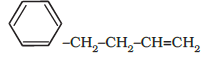
Worksheet Answers
Solution:
To convert benzene into $p$-nitrobromobenzene, the first step is the electrophilic aromatic substitution of benzene with bromine. This process requires a Lewis acid catalyst, such as ferric bromide ($FeBr_3$), to generate the active electrophile, the bromonium ion ($Br^+$).
Reaction: $C_6H_6 + Br_2 \xrightarrow{FeBr_3} C_6H_5Br + HBr$
[Justification: Per the mechanism of Electrophilic Aromatic Substitution, the Lewis acid polarizes the $Br-Br$ bond, allowing the benzene ring to act as a nucleophile.]
The product, bromobenzene, contains a bromine atom attached to the benzene ring. The bromine atom is an ortho/para-directing group due to the resonance effect ($+R$ effect), which increases electron density at the ortho and para positions, despite being deactivating due to its electronegativity [Per the Inductive and Resonance Effect theory].
Reaction: $C_6H_5Br + HNO_3 \xrightarrow{conc. H_2SO_4} C_6H_4(Br)(NO_2) + H_2O$
In this step, the mixture of concentrated nitric acid and sulfuric acid generates the nitronium ion ($NO_2^+$). Because of steric hindrance at the ortho position, the para-isomer (p-nitrobromobenzene) is formed as the major product.
| Step | Reagents | Product |
|---|---|---|
| 1. Bromination | $Br_2, FeBr_3$ | Bromobenzene |
| 2. Nitration | $Conc. HNO_3, H_2SO_4$ | p-Nitrobromobenzene |
Final Solution: The conversion of benzene to p-nitrobromobenzene is achieved via electrophilic aromatic bromination followed by nitration, utilizing the ortho/para-directing nature of the bromine substituent.
Solution:
The provided molecular structure represents an unsaturated hydrocarbon featuring a benzene ring substituted with an ethyl group and a methyl group. Based on the chemical structure, the compound is: $1\text{-ethyl-}2\text{-methylbenzene}$.
According to [IUPAC Nomenclature Rules for Aromatic Hydrocarbons], the parent structure is benzene. Substituents are assigned the lowest possible locants to ensure numerical precision [Rule: Lowest Locant Rule].
When multiple substituents are present on a benzene ring, the priority for numbering follows alphabetical order for simple alkyl groups.
Combining the components:
| Component | Value |
|---|---|
| Substituent 1 | 1-ethyl |
| Substituent 2 | 2-methyl |
| Parent | benzene |
By [IUPAC P-14.5], substituents are cited in alphabetical order.
Final Solution: 1-ethyl-2-methylbenzene
Solution:
To determine the relative reactivity of benzene derivatives toward electrophilic aromatic substitution ($E^+$), we must evaluate the influence of substituents on the electron density of the benzene ring. Electrophiles are electron-deficient species; therefore, electron-donating groups (EDGs) increase reactivity (activating), while electron-withdrawing groups (EWGs) decrease reactivity (deactivating).
The reactivity sequence is determined by the cumulative electronic effects exerted on the aromatic system [Per the Electronic Theory of Organic Chemistry]:
| Compound | Substituents | Electronic Effect | Reactivity Level |
|---|---|---|---|
| Toluene | $-CH_3$ | Activating ($+I, +H$) | Highest |
| $p-Nitrotoluene$ | $-CH_3, -NO_2$ | Deactivating (Net $-I, -M$) | Intermediate |
| $p-Dinitrobenzene$ | $-NO_2, -NO_2$ | Strongly Deactivating | Lowest |
Based on the analysis, Toluene is the most reactive due to the electron-donating methyl group. $p-Nitrotoluene$ is less reactive due to the presence of one electron-withdrawing nitro group. $p-Dinitrobenzene$ is the least reactive as it contains two strongly electron-withdrawing nitro groups, creating high electron deficiency in the ring.
Final Solution: Toluene > $p-Nitrotoluene$ > $p-Dinitrobenzene$
Solution:
The addition of hydrogen bromide ($\text{HBr}$) to propene ($\text{CH}_3\text{CH=CH}_2$) follows two distinct mechanistic pathways based on reaction conditions: the electrophilic addition (Markovnikov’s rule) and the free-radical addition (Anti-Markovnikov’s rule or Peroxide Effect/Kharasch effect).
In the absence of peroxides, the reaction follows the Markovnikov rule: the negative part of the addendum ($\text{Br}^-$) attaches to the carbon atom with the fewer number of hydrogen atoms.
Mechanism:
In the presence of benzoyl peroxide, the reaction proceeds via a free-radical chain mechanism, overriding Markovnikov's rule. This occurs only with $\text{HBr}$.
Mechanism:
| Reaction Condition | Intermediate Species | Major Product |
|---|---|---|
| No Peroxide | $2^\circ$ Carbocation | 2-Bromopropane |
| With Peroxide | $2^\circ$ Free Radical | 1-Bromopropane |
Final Solution: The addition of HBr to propene in the absence of peroxide follows the electrophilic Markovnikov addition to yield 2-bromopropane via a secondary carbocation intermediate. In the presence of benzoyl peroxide, a free-radical chain mechanism takes precedence, where the bromine radical attacks the terminal carbon to form a more stable secondary radical, ultimately yielding 1-bromopropane.
Solution:
The reactant is 3,4-dimethylhept-3-ene. We first establish the carbon backbone consisting of a 7-carbon chain (heptane) with a double bond at the 3rd position and methyl substituents at the 3rd and 4th carbons.
Structural Formula: $CH_3-CH_2-C(CH_3)=C(CH_3)-CH_2-CH_2-CH_3$
Ozonolysis involves the oxidative cleavage of the $C=C$ double bond using $O_3$ followed by reductive workup ($Zn/H_2O$). The double bond is cleaved to form two carbonyl groups (aldehydes or ketones) at the sites of the original unsaturated carbons [Per the Ozonolysis cleavage mechanism].
The cleavage occurs at the bond between Carbon 3 and Carbon 4:
We analyze the two products independently to assign IUPAC names based on the longest carbon chain containing the carbonyl carbon:
| Fragment Structure | IUPAC Name | Rationale |
|---|---|---|
| $CH_3-CH_2-CO-CH_3$ | Butan-2-one | 4-carbon chain; ketone group at C2. |
| $CH_3-CO-CH_2-CH_2-CH_3$ | Pentan-2-one | 5-carbon chain; ketone group at C2. |
Since both cleavage products contain a carbonyl group attached to two alkyl groups and neither original carbon atom was bonded to a hydrogen atom, the products are ketones rather than aldehydes [Based on the oxidative cleavage of substituted alkenes].
Final Solution: The products obtained from the ozonolysis of 3,4-dimethylhept-3-ene are Butan-2-one and Pentan-2-one.
Solution:
Benzene consists of a hexagonal ring of six carbon atoms, where each carbon atom is $sp^2$ hybridized. Two $sp^2$ orbitals of each carbon form $\sigma$-bonds with adjacent carbon atoms, and the third $sp^2$ orbital forms a $\sigma$-bond with a hydrogen atom. The remaining unhybridized $p$-orbital on each carbon atom lies perpendicular to the plane of the ring.
The extra-ordinary stability of benzene is primarily attributed to the resonance energy resulting from the delocalization of $\pi$-electrons. [Per the Valence Bond Theory]:
Benzene satisfies the criteria for aromaticity, which dictates its exceptional stability [Per Hückel’s Rule]:
| Criterion | Application to Benzene |
|---|---|
| Planarity | All carbon atoms are $sp^2$ hybridized, ensuring a planar geometry. |
| Cyclic Conjugation | The ring allows for the continuous overlap of $p$-orbitals. |
| Hückel's Rule ($4n+2$) | For $n=1$, $4(1)+2 = 6\pi$ electrons are present. |
The stability is quantified by comparing the calculated enthalpy of hydrogenation with the experimental value. If benzene were a simple cyclic triene (Kekulé structure), the enthalpy of hydrogenation would be roughly $3 \times (-120 \text{ kJ/mol}) = -360 \text{ kJ/mol}$. Experimentally, it is found to be only $-208 \text{ kJ/mol}$.
The difference, approximately $152 \text{ kJ/mol}$, is defined as the Resonance Energy. This energy release is significantly lower than expected for three isolated double bonds, indicating that the molecule is in a much lower energy state than the hypothetical structure.
Final Solution: Benzene is extraordinarily stable because of the resonance energy arising from the cyclic delocalization of its $6\pi$ electrons, which satisfies Hückel’s rule for aromaticity. This delocalization lowers the total potential energy of the molecule compared to a hypothetical localized structure containing three distinct double bonds.
Solution:
To determine the aromaticity of a cyclic system, we apply Hückel's Rule ($4n+2$ $\pi$-electrons) alongside the structural requirements of planarity, complete conjugation, and cyclic delocalization. The specific system provided, cyclooctatetraene ($C_8H_8$), must be evaluated against these criteria.
The molecule in question is cyclooctatetraene. We count the number of $\pi$-electrons involved in the conjugation:
According to Hückel's Rule, a planar, cyclic system is aromatic if it contains $(4n + 2)$ $\pi$-electrons, where $n$ is an integer ($n = 0, 1, 2, \dots$).
Setting the total $\pi$-electrons equal to the Hückel expression:
$4n + 2 = 8$
$4n = 6$
$n = 1.5$
[Justification: Since $n$ must be an integer, the molecule does not satisfy Hückel's Rule for aromaticity. Instead, it follows the $4n$ rule ($8 = 4 \times 2$), classifying it as anti-aromatic if it were planar.]
While the molecule possesses $8$ $\pi$-electrons, which would theoretically make it anti-aromatic and highly unstable if planar, the system avoids this instability by adopting a "tub-shaped" (non-planar) conformation. In this geometry, the $p$-orbitals are not perfectly aligned to allow for full continuous cyclic delocalization.
The system fails the requirements for aromaticity due to two primary factors:
Final Solution: The system is non-aromatic because it does not follow the $4n+2$ Hückel rule (having $8\pi$-electrons) and maintains a non-planar "tub" conformation that prevents cyclic delocalization of the $\pi$-electron cloud.
Solution:
Ozonolysis of an alkene involves the oxidative cleavage of a carbon-carbon double bond ($C=C$) by ozone ($O_3$), followed by reductive workup ($Zn/H_2O$). The reaction follows the general pattern:
$R_1R_2C=CR_3R_4 \xrightarrow{O_3, Zn/H_2O} R_1R_2C=O + R_3R_4C=O$
The given products are:
To identify the structure of 'A', we remove the oxygen atoms from the carbonyl groups of both products and join the remaining carbon atoms via a double bond [Per the Criegee mechanism of ozonolysis].
Connecting these two fragments results in the following structural skeleton:
$CH_3CH=C(CH_2CH_3)_2$
To determine the systematic name, we follow the IUPAC guidelines:
Structure: $CH_3 - CH = C(C_2H_5) - CH_2 - CH_3$
IUPAC Name: 3-ethylpent-2-ene
| Fragment | Structure |
|---|---|
| Product 1 | $CH_3CHO$ (Ethanal) |
| Product 2 | $CH_3CH_2COCH_2CH_3$ (Pentan-3-one) |
Final Solution: The structure of alkene ‘A’ is $CH_3CH=C(C_2H_5)CH_2CH_3$, and its IUPAC name is 3-ethylpent-2-ene.
Solution:
The objective is to synthesize benzene ($C_6H_6$) from ethyne ($C_2H_2$), also known as acetylene. This transformation involves the trimerization of alkynes, specifically a controlled polymerization process.
The conversion of ethyne to benzene is achieved via cyclic polymerization. When ethyne gas is passed through a red-hot iron tube at elevated temperatures, three molecules of ethyne undergo a catalyzed cyclization reaction to form the aromatic ring of benzene.
Chemical Equation: $3C_2H_2 \xrightarrow{\text{Red-hot Fe tube, 873 K}} C_6H_6$ [Per the principle of Alkyne Cyclotrimerization]
The conversion is thermodynamically favorable because it results in the formation of an aromatic system. Benzene satisfies Hückel’s Rule, $4n + 2$ $\pi$-electrons, where $n=1$, leading to a stabilization energy known as resonance energy. [Per Hückel's Rule of Aromaticity]
| Property | Ethyne | Benzene |
|---|---|---|
| Hybridization | $sp$ | $sp^2$ |
| Structure | Linear | Planar Hexagon |
| Bond Order | 3 (C-C triple bond) | 1.5 (Delocalized) |
Final Solution: The conversion of ethyne to benzene is performed by passing ethyne gas through a red-hot iron tube at 873 K, resulting in the cyclic trimerization of three ethyne molecules into one molecule of benzene.
Solution:
For a cyclic system to be classified as aromatic, it must satisfy a set of stringent electronic and structural criteria defined by E. Hückel. These conditions determine the stability of the molecule via the delocalization of $\pi$-electrons.
The molecule must be cyclic and possess a planar or nearly planar structure. Planarity is mandatory to ensure the effective overlap of $p$-orbitals across the entire ring system, which allows for the continuous delocalization of the $\pi$-electron cloud [Per Molecular Orbital Theory].
Every atom within the ring must possess a $p$-orbital that is available for conjugation. This implies that the system must contain a continuous circuit of overlapping $p$-orbitals. If there is an $sp^3$-hybridized carbon within the ring, the conjugation is disrupted, and the molecule loses its aromatic character [By principles of resonance and orbital hybridization].
The total number of $\pi$-electrons in the cyclic system must satisfy the Hückel rule. Specifically, the system must contain a total of $(4n + 2)$ $\pi$-electrons, where $n$ is a non-negative integer ($n = 0, 1, 2, \dots$).
| Value of $n$ | Total $\pi$-electrons ($4n+2$) | Examples |
|---|---|---|
| $n = 0$ | 2 | Cyclopropenyl cation |
| $n = 1$ | 6 | Benzene ($C_6H_6$) |
| $n = 2$ | 10 | Naphthalene |
Aromatic compounds exhibit significantly higher thermodynamic stability compared to their acyclic counterparts (e.g., benzene vs. 1,3,5-hexatriene). This is quantified by the Resonance Energy. A system is aromatic if it is substantially more stable than predicted by simple additive bond energies [Based on Thermodynamic Stability Analysis].
Summary of Necessary Conditions:
Final Solution: A system is aromatic if it is cyclic, planar, possesses a continuous circuit of delocalized $p$-orbitals, and follows Hückel’s rule containing $(4n+2)$ $\pi$-electrons, where $n = 0, 1, 2, \dots$.
Solution:
The molecular structure provided is $CH_2=CH-C \equiv C-CH_3$. The longest carbon chain containing the maximum number of multiple bonds (both double and triple) must be selected as the principal parent chain. Here, the longest chain consists of 5 carbon atoms, identifying the parent alkane as pentane.
According to the IUPAC nomenclature rules for unsaturated hydrocarbons containing both double ($=$) and triple ($\equiv$) bonds:
Numbering from left to right: Double bond at position $C_1$, Triple bond at position $C_3$.
Numbering from right to left: Triple bond at position $C_2$, Double bond at position $C_4$.
Comparing locant sets: {1, 3} (left-to-right) vs {2, 4} (right-to-left). The set {1, 3} is lower, therefore we assign priority starting from the left.
The IUPAC name follows the format: Prefix + Parent Chain + Suffixes.
| Component | Value |
|---|---|
| Root Name | pent |
| Unsaturation (Double Bond) | 1-ene |
| Unsaturation (Triple Bond) | 3-yne |
When combining suffixes, the 'e' of 'ene' is omitted because the subsequent suffix 'yne' starts with a vowel [Per IUPAC Rule P-31.1.3].
Final Solution: Pent-1-en-3-yne
Solution:
The total number of bonds provided is as follows:
In an alkene with $n$ carbon atoms, the number of $C-C$ $\sigma$ bonds is $(n-1)$. Since we have $3$ $C-C$ $\sigma$ bonds, we determine the number of carbon atoms as follows:
$n - 1 = 3 \implies n = 4$
With $n=4$ carbons, the general formula for an alkene is $C_n H_{2n}$, which gives us $C_4 H_8$. We verify the $C-H$ $\sigma$ bonds: In a saturated alkane ($C_4 H_{10}$), there are $10$ $C-H$ bonds. The formation of one $\pi$ bond removes $2$ hydrogen atoms, resulting in $10 - 2 = 8$ $C-H$ bonds. This matches the given data [Per the general formula for alkenes].
The alkene '$A$' undergoes ozonolysis to produce two moles of an aldehyde with a molar mass of $44\text{ u}$.
Let the aldehyde be $R-CHO$. Its molar mass is calculated as:
$M_{aldehyde} = M_R + M_C + M_H + M_O$
$44 = M_R + 12 + 1 + 16$
$44 = M_R + 29 \implies M_R = 15$
An alkyl group with a molar mass of $15$ is a methyl group ($-CH_3$). Therefore, the aldehyde formed is $CH_3CHO$ (Ethanal or Acetaldehyde).
Ozonolysis of an alkene follows the cleavage of the $C=C$ double bond [Per the Criegee mechanism]. If the reaction yields two moles of acetaldehyde ($CH_3CHO$), the original alkene must have been symmetrical at the double bond:
$CH_3-CH=CH-CH_3 + O_3 \xrightarrow{Zn/H_2O} 2 CH_3CHO$
The structure is $But-2-ene$.
The carbon chain contains 4 carbon atoms with a double bond starting at the second position. Following the IUPAC rules for naming alkenes:
Result: $But-2-ene$.
Final Solution: The IUPAC name of alkene 'A' is But-2-ene.
Solution:
Benzene ($C_6H_6$) is a cyclic, planar molecule where each carbon atom is $sp^2$ hybridized. The six carbon atoms form a ring, with each carbon contributing one $p$-orbital containing one electron to a delocalized $\pi$-electron cloud. [Per Hückel’s Rule for aromaticity ($4n+2$ $\pi$-electrons), where $n=1$, benzene possesses a stable, delocalized electron-rich cloud above and below the plane of the ring].
The $\pi$-electron cloud of benzene is highly electron-dense, making the ring inherently nucleophilic. Electrophiles ($E^+$), which are electron-deficient species, are strongly attracted to this region of high electron density.
Nucleophiles are electron-rich species ($Nu^-$ or $Nu:^-$). The interaction between a nucleophile and the benzene ring is inhibited by two primary factors:
| Feature | Electrophilic Substitution | Nucleophilic Substitution |
|---|---|---|
| Attacking Species | Electrophile ($E^+$) | Nucleophile ($Nu^-$) |
| Interaction | Attraction to electron-rich $\pi$-cloud | Repulsion by electron-rich $\pi$-cloud |
| Feasibility | High (occurs under mild conditions) | Low (requires drastic conditions/withdrawing groups) |
Final Solution: Benzene undergoes electrophilic substitution easily because its electron-rich $\pi$-cloud acts as a donor to electron-deficient electrophiles, restoring aromaticity in the product. It resists nucleophilic substitution because of electrostatic repulsion between the incoming nucleophile and the $\pi$-electron cloud, as well as the high energy penalty associated with disrupting the stable aromatic sextet.
Solution:
To identify the number of multiple bonds or rings, we calculate the Degree of Unsaturation (Double Bond Equivalent) using the formula: $DoU = C + 1 - \frac{H}{2} + \frac{N}{2} - \frac{X}{2}$
For $C_5H_8$: $DoU = 5 + 1 - \frac{8}{2} = 6 - 4 = 2$.
Since the question specifies one triple bond, and a triple bond accounts for $2$ degrees of unsaturation ($1\sigma + 2\pi$ bonds), the compound must be an acyclic alkyne (alkyne homologous series $C_nH_{2n-2}$).
We derive all possible structural isomers for the molecular formula $C_5H_8$ with one triple bond by varying the position of the alkyne group and the branching of the carbon chain.
| Structure | Condensed Structural Formula | IUPAC Name |
|---|---|---|
| Linear 5-carbon | $HC\equiv C-CH_2-CH_2-CH_3$ | Pent-1-yne |
| Linear 5-carbon | $CH_3-C\equiv C-CH_2-CH_3$ | Pent-2-yne |
| Branched 4-carbon | $HC\equiv C-CH(CH_3)-CH_3$ | 3-Methylbut-1-yne |
Final Solution: The three possible structural isomers for $C_5H_8$ (one triple bond) are Pent-1-yne, Pent-2-yne, and 3-Methylbut-1-yne.
Solution:
The objective is to convert Benzene ($C_6H_6$) into $p$-nitrotoluene ($C_7H_7NO_2$). This process requires the sequential introduction of a methyl group (alkylation) and a nitro group (nitration) onto the benzene ring, considering the directing effects of substituents.
Benzene is reacted with chloromethane ($CH_3Cl$) in the presence of an anhydrous Lewis acid catalyst, Aluminum chloride ($AlCl_3$).
$C_6H_6 + CH_3Cl \xrightarrow{Anhydrous AlCl_3} C_6H_5CH_3 + HCl$ [Per the Friedel-Crafts Alkylation mechanism, the electrophile $CH_3^+$ is generated and attacks the benzene ring.]
Result: Toluene ($C_6H_5CH_3$).
Toluene is treated with a nitrating mixture, consisting of concentrated nitric acid ($HNO_3$) and concentrated sulfuric acid ($H_2SO_4$) at low temperatures (approx. $273-283$ K).
$C_6H_5CH_3 + HNO_3 \xrightarrow{Conc. H_2SO_4} C_6H_4(CH_3)(NO_2) + H_2O$
The methyl group ($-CH_3$) is an ortho/para-directing group due to the inductive effect ($+I$) and hyperconjugation. Consequently, the electrophile ($NO_2^+$) attacks both the ortho and para positions.
The nitration of toluene yields a mixture of $o$-nitrotoluene and $p$-nitrotoluene. These isomers have different physical properties (e.g., $p$-nitrotoluene has a higher melting point due to symmetry), allowing them to be separated via fractional distillation or crystallization.
| Step | Reagents | Product | Directing Effect |
|---|---|---|---|
| 1 | $CH_3Cl / AlCl_3$ | Toluene | N/A |
| 2 | $HNO_3 / H_2SO_4$ | $o/p$-Nitrotoluene | $-CH_3$ is $o,p$-directing |
Final Solution: The synthesis is achieved by first subjecting benzene to Friedel-Crafts alkylation using $CH_3Cl/AlCl_3$ to form toluene, followed by nitration using a mixture of concentrated $HNO_3$ and $H_2SO_4$ to yield $p$-nitrotoluene as a major product, which is subsequently isolated from its ortho-isomer.
Solution:
To determine the acidic behavior of these hydrocarbons, we must evaluate the hybridization of the carbon atoms directly bonded to hydrogen. The acidity of a hydrocarbon is directly proportional to the $s$-character of the $C-H$ bond. As $s$-character increases, the electronegativity of the carbon atom increases, pulling the bonding electron pair closer to the nucleus and facilitating the release of a proton ($H^+$).
| Compound | Structure | Hybridization of C | s-character |
|---|---|---|---|
| Ethyne ($C_2H_2$) | $H-C \equiv C-H$ | $sp$ | $50\%$ |
| Benzene ($C_6H_6$) | $C_6H_6$ (aromatic ring) | $sp^2$ | $33.3\%$ |
| n-Hexane ($C_6H_{14}$) | $CH_3(CH_2)_4CH_3$ | $sp^3$ | $25\%$ |
Step 1: Assessing Ethyne ($sp$ Hybridization)
The carbon in ethyne is $sp$ hybridized. The $s$-orbital is closer to the nucleus than the $p$-orbital. With $50\%$ $s$-character, the carbon atom is highly electronegative [Per Electronegativity Trends]. It holds the electron pair of the $C-H$ bond tightly, making the hydrogen atom significantly acidic and easily removable by strong bases like $NaNH_2$.
Step 2: Assessing Benzene ($sp^2$ Hybridization)
The carbons in the benzene ring are $sp^2$ hybridized. With $33.3\%$ $s$-character, the electronegativity of the carbon is lower than that of $sp$ carbon but higher than $sp^3$ carbon. Therefore, benzene is less acidic than ethyne but more acidic than alkanes.
Step 3: Assessing n-Hexane ($sp^3$ Hybridization)
The carbons in n-hexane are $sp^3$ hybridized. With $25\%$ $s$-character, the electronegativity is the lowest of the three. The $C-H$ bond is essentially non-polar, and the molecule shows negligible acidic character.
The decreasing order of acidic behavior is determined by the ability of the conjugate base to stabilize the negative charge. A higher $s$-character results in a more stable carbanion (e.g., the acetylide ion $HC \equiv C^-$ is more stable than the phenyl anion or the alkyl anion).
Decreasing Order: Ethyne > Benzene > n-Hexane
Final Solution: The decreasing order of acidic behavior is Ethyne > Benzene > n-Hexane. This is justified by the increasing percentage of s-character in the hybridization of the carbon atoms (50% in sp, 33.3% in sp², and 25% in sp³), which increases the electronegativity of the carbon and subsequently the acidity of the attached hydrogen.
Solution:
Pent-2-ene is an alkene with the molecular formula $CH_3-CH_2-CH=CH-CH_3$. Ozonolysis involves the reaction of an alkene with ozone ($O_3$) followed by reductive cleavage with zinc dust ($Zn/H_2O$) to produce carbonyl compounds.
The double bond ($C=C$) is cleaved at the site of unsaturation. The mechanism proceeds via the formation of an unstable ozonide intermediate, which is then cleaved to form two distinct carbonyl fragments [Per the Criegee mechanism of ozonolysis].
Reaction Scheme:
$CH_3-CH_2-CH=CH-CH_3 + O_3 \rightarrow \text{Ozonide Intermediate} \xrightarrow{Zn/H_2O} CH_3-CH_2-CHO + CH_3-CHO$
| Fragment | Product Formula | IUPAC Name |
|---|---|---|
| $CH_3-CH_2-CH=$ | $C_2H_5CHO$ | Propanal |
| $=CH-CH_3$ | $CH_3CHO$ | Ethanal |
Final Solution: The ozonolysis of Pent-2-ene yields a mixture of Propanal ($CH_3CH_2CHO$) and Ethanal ($CH_3CHO$).
Solution:
To convert Benzene ($C_6H_6$) into $m$-nitrochlorobenzene ($C_6H_4ClNO_2$), one must consider the directing effects of substituents on the benzene ring. Chlorine is an ortho/para-directing group, while the nitro group ($-NO_2$) is a meta-directing group. Therefore, to ensure the nitro group occupies the meta position relative to the chlorine atom, the nitro group must be introduced before the chlorination step.
First, benzene is reacted with a nitrating mixture—concentrated nitric acid ($HNO_3$) and concentrated sulfuric acid ($H_2SO_4$)—at a temperature of $323-333\ K$. This electrophilic aromatic substitution produces nitrobenzene.
$C_6H_6 + HNO_3 \xrightarrow{conc. H_2SO_4, 323-333\ K} C_6H_5NO_2 + H_2O$
[Per the mechanism of Electrophilic Aromatic Substitution: The $H_2SO_4$ protonates $HNO_3$ to generate the nitronium ion ($NO_2^+$), which acts as the electrophile.]
Next, nitrobenzene is treated with chlorine gas ($Cl_2$) in the presence of a Lewis acid catalyst, such as anhydrous ferric chloride ($FeCl_3$). Since the $-NO_2$ group is a strong electron-withdrawing group and a meta-director, the electrophile ($Cl^+$) is directed to the meta position.
$C_6H_5NO_2 + Cl_2 \xrightarrow{anhyd. FeCl_3} C_6H_4ClNO_2 + HCl$
[Justification: The $-NO_2$ group deactivates the ring toward electrophilic attack and destabilizes the ortho and para positions via resonance, effectively forcing the substitution at the meta position.]
| Step | Reagent | Product |
|---|---|---|
| 1 | $HNO_3/H_2SO_4$ | Nitrobenzene |
| 2 | $Cl_2/FeCl_3$ | m-Nitrochlorobenzene |
Final Solution: The conversion of benzene to m-nitrochlorobenzene is achieved by first nitrating benzene to form nitrobenzene, followed by chlorination using chlorine in the presence of anhydrous ferric chloride, which directs the chlorine atom to the meta position.
Solution:
The given chemical structure represents a cyclic aliphatic hydrocarbon. Analyzing the provided image, we identify a six-membered carbon ring (cyclohexane) with a substituent group. The substituent attached to the ring is an ethyl group ($-CH_2CH_3$).
The naming protocol follows the format: [Substituent Name][Parent Ring Name].
| Component | IUPAC Name Segment |
|---|---|
| Substituent | Ethyl |
| Parent Ring | Cyclohexane |
Combining these, we obtain: Ethylcyclohexane.
The molecule contains no double or triple bonds, classifying it as a saturated cyclic hydrocarbon (alkane). The attachment of the alkyl chain $-C_2H_5$ to the $C_6H_{11}$ ring necessitates the alkyl-cycloalkane nomenclature [Per IUPAC Blue Book P-44.4.1].
Final Solution: Ethylcyclohexane
Solution:
The provided chemical structure represents an unsaturated hydrocarbon chain containing a triple bond (alkyne). The structure is: $CH_3-C \equiv C-CH(CH_3)_2$.
To determine the IUPAC name, we must select the longest continuous carbon chain containing the principal functional group (the triple bond).
Numbering must be done such that the carbon atoms of the triple bond receive the lowest possible locants.
With the chain numbered from left to right, the methyl group ($-CH_3$) is located at carbon atom $C_4$.
The name is constructed as follows: [Substituent position]-[Substituent name][Parent chain name]-[Triple bond position].
| Substituent | 4-methyl |
| Parent chain (5 carbons) | pent- |
| Triple bond locant | 2-yne |
Combining these, we get: $4\text{-methylpent-2-yne}$.
Final Solution: 4-methylpent-2-yne


