


Your Worksheet is Ready
CBSE - Class 11 Chemistry Organic Chemistry – Some Basic Principles and Techniques Worksheet
EXERCISES
For the following bond cleavages, use curved-arrows to show the electron flow and classify each as homolysis or heterolysis. Identify reactive intermediate produced as free radical, carbocation and carbanion.
(b) 
Give the IUPAC names of the following compounds : (a) 
The reaction: $CH_3CH_2I + KOH(aq) \rightarrow CH_3CH_2OH + KI$ is classified as :
electrophilic substitution
b.nucleophilic substitution
c.elimination
d.addition
For the following bond cleavages, use curved-arrows to show the electron flow and classify each as homolysis or heterolysis. Identify reactive intermediate produced as free radical, carbocation and carbanion.
(c) 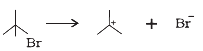
Identify the functional groups in the following compounds
(c) 
Identify the functional groups in the following compounds
(b) 
Worksheet Answers
Solution:
To determine the IUPAC name of the compound with the condensed formula $Cl_2CHCH_2OH$, we first expand the structure to identify the carbon backbone and the principal functional group:
The structure is: $Cl - \overset{\phantom{Cl}}{CH} (Cl) - CH_2 - OH$
According to the IUPAC priority rules, the principal functional group ($-OH$) must be assigned the lowest possible locant [Per IUPAC Blue Book P-14.4].
| Carbon Position | Attached Groups |
|---|---|
| C-1 | $-OH$ group |
| C-2 | Two $-Cl$ atoms |
Thus, the carbon attached to the hydroxyl group is designated as C-1. Consequently, the carbon attached to the two chlorine atoms is designated as C-2.
We assemble the components following the format: [Locants of substituents]-[Prefixes]-[Parent Alkane]-[Locant of functional group]-[Suffix].
Combining the elements: 2,2-dichloro + ethan + 1 + ol.
Result: 2,2-dichloroethanol
Final Solution: 2,2-dichloroethanol
Solution:
Distillation is a fundamental physical separation technique employed to purify liquids or to separate components of a liquid mixture based on differences in their boiling points. The process involves heating a liquid mixture until it vaporizes, followed by the immediate cooling and condensation of the vapors back into a liquid state in a separate vessel. [Per Dalton’s Law of Partial Pressures and Raoult’s Law, the composition of the vapor phase differs from that of the liquid phase if the components have distinct vapor pressures at a given temperature].
The separation relies on the fact that the liquid with the lower boiling point (more volatile) transitions into the vapor state at a lower temperature than the liquid with the higher boiling point. By carefully controlling the temperature, the volatile component is collected as a distillate, while the non-volatile impurities or the less volatile component remain in the original flask.
Consider a mixture of a liquid organic compound and a non-volatile impurity (e.g., Aniline mixed with salt/non-volatile contaminants).
| Condition | Application |
|---|---|
| Boiling Point Difference | $\Delta T > 20^\circ C - 30^\circ C$ is ideal. |
| Thermal Stability | Substances must not decompose at their boiling points. |
Final Solution: Distillation is a technique used to separate a volatile liquid from non-volatile impurities or to separate two or more liquids with significantly different boiling points by the process of differential vaporization and subsequent condensation.
Solution:
Phenol ($C_6H_5OH$) exhibits resonance due to the interaction between the lone pair of electrons on the oxygen atom of the hydroxyl ($-OH$) group and the $\pi$-electron system of the benzene ring. This phenomenon is governed by the +R (Resonance) effect, where the $-OH$ group acts as an electron-donating group. [Per the principles of Conjugated Systems and Delocalization].
The oxygen atom possesses two lone pairs. One lone pair participates in forming a $\pi$-bond with the adjacent carbon of the aromatic ring, triggering the migration of existing $\pi$-bonds across the ring structure. This creates a series of canonical structures (resonance contributors) where the ortho and para positions of the ring develop partial negative charge density.
| Structure | Electronic Feature | Stability Note |
|---|---|---|
| I | Neutral ground state; octets complete. | Most stable contributor. |
| II, III, IV | Charge separation; ortho/para negative charge. | Less stable due to electronegativity mismatch ($O^+$). |
| V | Canonical completion of the cyclic system. | Analogous to structure IV. |
Final Solution: The resonance structures for Phenol involve the delocalization of the oxygen lone pair into the ring, resulting in five contributing structures (I-V) where the ortho and para positions possess negative charge density and the $C-O$ bond acquires partial double-bond character.
Solution:
Steam distillation is a method employed for the isolation and purification of organic compounds that are immiscible with water and possess high molecular weights or high boiling points. The fundamental principle governing this process is the application of Dalton’s Law of Partial Pressures.
According to Dalton's Law, in a mixture of two immiscible liquids, the total vapor pressure exerted by the system is the sum of the individual vapor pressures of the pure components at that specific temperature:
$P_{total} = p_1 + p_2$
Where:
Boiling occurs when the total vapor pressure of the liquid system becomes equal to the external atmospheric pressure ($P_{atm}$):
$P_{total} = P_{atm}$
[Per the definition of boiling point]
For an organic liquid that is immiscible with water, the condition for boiling is achieved when:
$p_1 + p_2 = P_{atm}$
Since both the water and the organic liquid contribute to the total pressure, the vapor pressure of the organic liquid ($p_2$) alone does not need to reach $P_{atm}$ for vaporization to occur. Instead, it only needs to reach $P_{atm} - p_1$.
Because $p_1 > 0$ at any temperature where water exists as a liquid, it follows that:
$p_2 < P_{atm}$
Consequently, the temperature at which $p_2 = (P_{atm} - p_1)$ is necessarily lower than the temperature at which $p_2 = P_{atm}$ (which is the normal boiling point of the organic substance).
| Parameter | Condition in Isolation | Condition in Steam Distillation |
|---|---|---|
| Vapor Pressure required to boil | $p_{org} = P_{atm}$ | $p_{org} + p_{water} = P_{atm}$ |
| Temperature of boiling | $T_{normal}$ | $T_{distillation} < T_{normal}$ |
Final Solution: In steam distillation, the organic liquid vaporizes at a temperature below its boiling point because the total pressure of the system (sum of the partial pressures of water and the organic liquid) reaches the atmospheric pressure at a lower temperature than the individual vapor pressure of the organic liquid would alone.
Solution:
Isopropyl alcohol, systematically named propan-2-ol, consists of a three-carbon chain where the hydroxyl functional group ($-OH$) is attached to the central carbon atom. [Per IUPAC nomenclature for alkanols].
Structure: $CH_3-CH(OH)-CH_3$
The parent chain is butane (4 carbons). The aldehyde group ($-CHO$) defines carbon 1. Methyl substituents are located at positions 2 and 3. [Per IUPAC priority rules for carbonyl compounds].
Structure: $CH_3-CH(CH_3)-CH(CH_3)-CHO$
Heptan-4-one implies a seven-carbon saturated chain with a ketone functional group ($C=O$) positioned at the fourth carbon atom. [Per the suffix -one for ketones].
Structure: $CH_3-CH_2-CH_2-C(=O)-CH_2-CH_2-CH_3$
Final Solution: The bond line structures have been rendered sequentially based on IUPAC nomenclature requirements for identifying the parent carbon chain and functional group placement.
Solution:
In the chemical process provided, we are examining the cleavage of a $C-Br$ bond where the bonding electrons are transferred to the more electronegative atom (Bromine). The reaction is represented as follows:
$CH_3-CH_2-Br \longrightarrow CH_3-CH_2^+ + :Br^-$
To represent the electron flow using curved-arrow notation, a full-headed arrow ($\rightarrow$) is drawn from the center of the covalent bond toward the atom receiving the electron pair. This indicates the heterolytic movement of a shared electron pair.
| Attribute | Description |
|---|---|
| Cleavage Type | Heterolysis |
| Electron Displacement | Unequal (both electrons to $Br$) |
| Intermediate Formed | Ethyl Carbocation ($CH_3CH_2^+$) |
Final Solution: The bond cleavage is a heterolysis resulting in the formation of an ethyl carbocation ($CH_3CH_2^+$) and a bromide anion ($Br^-$).
Solution:
The total millimoles of $H_2SO_4$ added is calculated by: $n = M \times V(\text{in mL})$.
$\text{Total mmol of } H_2SO_4 = 0.5 \times 50 = 25\text{ mmol}$ [Definition of Molarity].
The reaction between $H_2SO_4$ and $NaOH$ is: $H_2SO_4 + 2NaOH \rightarrow Na_2SO_4 + 2H_2O$.
Millimoles of $NaOH$ used = $M \times V = 0.5 \times 60 = 30\text{ mmol}$.
Per the stoichiometry of the reaction, 2 moles of $NaOH$ neutralize 1 mole of $H_2SO_4$.
$\text{Residual mmol of } H_2SO_4 = \frac{\text{mmol of } NaOH}{2} = \frac{30}{2} = 15\text{ mmol}$.
The amount of acid consumed by the ammonia ($NH_3$) evolved from the sample is the difference between total acid and residual acid:
$\text{mmol of } H_2SO_4 \text{ reacted with } NH_3 = 25 - 15 = 10\text{ mmol}$.
The neutralization reaction is: $2NH_3 + H_2SO_4 \rightarrow (NH_4)_2SO_4$.
Since 1 mole of $H_2SO_4$ reacts with 2 moles of $NH_3$, the moles of $NH_3$ (and thus nitrogen atoms) are:
$\text{mmol of } NH_3 = 2 \times (\text{mmol of } H_2SO_4 \text{ reacted}) = 2 \times 10 = 20\text{ mmol}$.
Mass of Nitrogen = $\text{moles} \times \text{atomic mass} = 20 \times 10^{-3} \text{ mol} \times 14\text{ g/mol} = 0.28\text{ g}$.
$\text{Percentage of Nitrogen} = \frac{\text{Mass of Nitrogen}}{\text{Mass of Organic Compound}} \times 100$
$\text{Percentage} = \frac{0.28}{0.50} \times 100 = 56\%$
Final Solution: The percentage composition of nitrogen in the compound is 56%.
Solution:
The given compound is $H-CH=CH_2$, which is ethene ($C_2H_4$). This compound belongs to the alkene homologous series, characterized by the general molecular formula $C_nH_{2n}$ and the presence of a carbon-carbon double bond ($C=C$). Each successive member of the series differs by a $CH_2$ unit.
To identify the first five members, we start with $n=2$ (as the double bond requires a minimum of two carbon atoms) and increment the carbon chain length.
| Member | Molecular Formula | IUPAC Name | Condensed Structural Formula |
|---|---|---|---|
| 1 | $C_2H_4$ | Ethene | $CH_2=CH_2$ |
| 2 | $C_3H_6$ | Propene | $CH_3-CH=CH_2$ |
| 3 | $C_4H_8$ | But-1-ene | $CH_3-CH_2-CH=CH_2$ |
| 4 | $C_5H_{10}$ | Pent-1-ene | $CH_3-CH_2-CH_2-CH=CH_2$ |
| 5 | $C_6H_{12}$ | Hex-1-ene | $CH_3-CH_2-CH_2-CH_2-CH=CH_2$ |
The following diagram illustrates the structural geometry of the first two members, demonstrating the $sp^2$ hybridization at the double-bonded carbons [Per VSEPR Theory].
Final Solution: The first five members of the series are Ethene ($CH_2=CH_2$), Propene ($CH_3CH=CH_2$), But-1-ene ($CH_3CH_2CH=CH_2$), Pent-1-ene ($CH_3(CH_2)_2CH=CH_2$), and Hex-1-ene ($CH_3(CH_2)_3CH=CH_2$).
Solution:
Paper chromatography is a specific application of partition chromatography. The fundamental principle governing this technique is the differential distribution (partitioning) of components of a mixture between two immiscible phases: a stationary phase and a mobile phase [Per the Nernst Distribution Law].
The mixture to be separated is applied as a spot near the bottom of the cellulose paper. When the solvent (mobile phase) rises through the paper by capillary action, the individual components of the mixture partition themselves between the water held in the paper (stationary phase) and the moving solvent (mobile phase) [Based on the principle of differential solubility].
The extent to which each component moves is constant for a given set of experimental conditions. This is quantified by the Retardation Factor ($R_f$), defined by the ratio of the distance traveled by the substance to the distance traveled by the solvent front [Per IUPAC chromatographic conventions].
The mathematical expression is:
$R_f = \frac{\text{Distance travelled by the substance from the baseline}}{\text{Distance travelled by the solvent front from the baseline}}$
| Feature | Description |
|---|---|
| Phase Interaction | Components with higher solubility in the mobile phase travel faster; those with higher affinity for the stationary water phase travel slower. |
| Separation Basis | Differential rates of migration based on partitioning coefficients ($K_d$). |
Final Solution: Paper chromatography relies on the partition of mixture components between a stationary aqueous phase held in cellulose fibers and a mobile organic solvent phase, causing separation based on varying solubilities and resulting in characteristic $R_f$ values for each component.
Solution:
The provided image displays a branched alkane. To determine the IUPAC name, we must first identify the longest continuous carbon chain (the parent chain) and the substituents attached to it.
The structure is as follows: A central carbon bonded to three methyl groups ($CH_3$) and one carbon atom that is part of a longer chain. Let us expand the condensed structure:
$CH_3 - CH_2 - CH(CH_3) - CH_2 - CH_3$
Analyzing the backbone:
To assign the lowest possible locants to substituents [Per IUPAC Rule of Lowest Locants], we number the chain from the end that gives the substituent the lowest number:
| Position | 1 | 2 | 3 | 4 | 5 |
|---|---|---|---|---|---|
| Carbon | $CH_3$ | $CH_2$ | $CH$ | $CH_2$ | $CH_3$ |
By numbering from left to right, the methyl group is located at position 3.
Following the standard nomenclature format: [Substituent Locant]-[Substituent Name][Parent Alkane Name] [Per IUPAC Blue Book P-14.4]:
Final Solution: 3-methylpentane
Solution:
The given reaction involves the transformation of an alkyl halide (iodoethane) into an alcohol (ethanol) in the presence of an aqueous potassium hydroxide solution.
In this transformation, the hydroxide ion ($OH^-$), acting as a nucleophile provided by the aqueous $KOH$, attacks the electrophilic carbon atom bonded to the iodine atom. The iodide ion ($I^-$), being a superior leaving group, is displaced from the carbon chain. [Per the Nucleophilic Substitution mechanism].
The reaction is categorized as follows:
| Feature | Observation |
|---|---|
| Substrate Type | Primary Alkyl Halide |
| Reagent Function | Nucleophile ($OH^-$) |
| Reaction Type | Nucleophilic Substitution ($S_N2$) |
Final Solution: The reaction is classified as a Nucleophilic Substitution reaction (specifically, an $S_N2$ substitution or alkaline hydrolysis).
Solution:
The given reaction is: $CH_3COOH + \mathbf{HO^-} \rightarrow CH_3COO^- + H_2O$
In this chemical transformation, the species $\mathbf{HO^-}$ (hydroxide ion) is interacting with the carboxylic acid ($CH_3COOH$). Specifically, the oxygen atom in the hydroxide ion possesses a formal negative charge and three lone pairs of electrons, rendering it electron-rich [Per the Lewis Definition of Bases].
To classify $\mathbf{HO^-}$, we evaluate its role in the electronic interaction:
The hydroxide ion ($\mathbf{HO^-}$) acts as a base/nucleophile. It attacks the proton ($H^+$) attached to the oxygen atom of the acetic acid molecule. By donating its lone pair of electrons to the hydrogen atom, it forms a covalent bond, resulting in the formation of a water molecule ($H_2O$).
| Species | Electronic Characteristic | Functional Classification |
|---|---|---|
| $HO^-$ | Electron-rich (Lone pairs + Negative Charge) | Nucleophile |
Since the hydroxide ion provides an electron pair to form the $O-H$ bond in $H_2O$, it satisfies the criteria for a nucleophile according to the IUPAC definition of nucleophilic species.
Final Solution: The reagent $\mathbf{HO^-}$ acts as a nucleophile because it possesses a lone pair of electrons and a negative charge, which it donates to the electrophilic hydrogen center of the acetic acid molecule.
Solution:
To determine the correct IUPAC name, we must first construct the carbon skeletons based on the provided names: 2,4,7-trimethyloctane and 2,5,7-trimethyloctane. Both represent an octane parent chain ($C_8$ backbone).
According to the IUPAC nomenclature rules for alkanes, when multiple substituents are present, the chain must be numbered such that the set of locants is the lowest possible [Per IUPAC Blue Book Rule P-14.4].
| Candidate Name | Set of Locants | Sum of Locants |
|---|---|---|
| 2,4,7-Trimethyloctane | $\{2, 4, 7\}$ | $2 + 4 + 7 = 13$ |
| 2,5,7-Trimethyloctane | $\{2, 5, 7\}$ | $2 + 5 + 7 = 14$ |
The "Lowest Locant Rule" dictates that we compare the locant sets term-by-term starting from the first point of difference:
Since $4 < 5$, the set $\{2, 4, 7\}$ is the lower set of locants. Therefore, the numbering that results in 2,4,7-trimethyloctane is preferred over 2,5,7-trimethyloctane.
By selecting the 2,4,7-trimethyl configuration, we adhere to the IUPAC requirement of assigning the lowest possible numbers to substituents to ensure systematic, unambiguous identification of the organic structure.
Final Solution: The correct IUPAC name is 2,4,7-Trimethyloctane.
Solution:
The given chemical equation is:
$(CH_3)_2C = CH_2 + HCl \rightarrow (CH_3)_2ClC - CH_3$
In this transformation, we observe two distinct chemical phenomena:
The reaction involves the breaking of the $\pi$-bond of the alkene and the addition of the $H^+$ and $Cl^-$ species across the double bond. This is a characteristic Electrophilic Addition Reaction [Per the mechanism of electrophilic addition to alkenes].
The process follows these sub-stages:
According to Markovnikov's Rule, in the addition of a protic acid to an asymmetric alkene, the acid hydrogen ($H$) becomes attached to the carbon with fewer alkyl substituents (or the carbon with more hydrogens), and the halide group ($Cl$) attaches to the carbon with more alkyl substituents [Per Markovnikov’s Regioselectivity Principle].
| Reactant Feature | Transformation | Result |
|---|---|---|
| Unsaturated ($C=C$) | $\pi$-bond cleavage | Saturated ($C-C$) |
| Electrophile addition | $H^+$ adds first | Stable tertiary carbocation |
Final Solution: The reaction is classified as an Electrophilic Addition Reaction.
Solution:
The given structure represents an ethyl group bonded to a bromine atom ($CH_3-CH_2-Br$). The bond cleavage occurs at the $C-Br$ covalent bond. Bromine is more electronegative ($\chi \approx 2.96$) than carbon ($\chi \approx 2.55$), which polarizes the bond, placing partial negative charge on bromine and partial positive charge on carbon [Per Electronegativity Difference Principles].
To show the heterolytic cleavage of the $C-Br$ bond, a double-headed curved arrow is drawn starting from the center of the shared bond pointing towards the more electronegative bromine atom. This indicates the migration of the entire electron pair (2 electrons) to the bromine atom.
| Feature | Description |
|---|---|
| Cleavage Type | Heterolysis |
| Electron Movement | Both electrons shift to Bromine ($Br^-$) |
| Intermediate | Ethyl Carbocation ($CH_3CH_2^+$) |
Final Solution: The bond cleavage is classified as heterolysis. The reactive intermediate produced is a carbocation ($CH_3CH_2^+$).
Solution:
Based on the chemical structure provided in the image, we analyze the substituents attached to the benzene ring. The structure consists of a benzene ring substituted with two specific groups at the ortho ($1,2$) position.
| Functional Group | Chemical Formula/Representation | Classification |
|---|---|---|
| Aldehyde Group | $-CHO$ | Carbonyl-containing group where the carbon is bonded to a hydrogen and an oxygen via a double bond. |
| Hydroxyl Group | $-OH$ | An oxygen atom bonded to a hydrogen atom, characteristic of alcohols or phenols. |
The compound depicted is 2-hydroxybenzaldehyde, commonly known as Salicylaldehyde. We identify the groups as follows:
Final Solution: The functional groups present in the compound are the Aldehyde group ($-CHO$) and the Hydroxyl group ($-OH$).
Solution:
The provided structure represents an organic molecule containing a central benzene ring attached to a substituent group. Analyzing the functional groups present requires identifying the specific atoms and their bonding patterns:
Based on the structural components identified, we classify the functional groups as follows:
| Functional Group | Symbolic Representation | IUPAC Designation |
|---|---|---|
| Carboxylic Acid | $-COOH$ | -oic acid |
| Phenol (Hydroxyl) | $-OH$ | hydroxy- |
| Amine | $-NH_2$ | amino- |
The molecule demonstrates the coexistence of multiple functional groups on a single aromatic nucleus.
Final Solution: The compound contains a Carboxylic Acid group ($-COOH$), a Phenolic Hydroxyl group ($-OH$), and an Amino group ($-NH_2$).
Solution:
The chemical reaction provided is:
$CH_3CH_2Br + HS^- \rightarrow CH_3CH_2SH + Br^-$
Here, the substrate is bromoethane ($CH_3CH_2Br$) and the attacking species is the hydrosulfide ion ($HS^-$), which acts as a nucleophile. The bromide ion ($Br^-$) acts as the leaving group.
To classify this reaction, we observe the fundamental transformation occurring at the electrophilic carbon center ($C_1$ of the ethyl group). The nucleophile ($HS^-$) possesses a lone pair of electrons and is electron-rich. It attacks the carbon atom bonded to the electronegative bromine atom, resulting in the displacement of the bromide ion. [Per the definition of Nucleophilic Substitution reactions].
The reaction follows the general form:
$Nu^- + R-LG \rightarrow R-Nu + LG^-$
where $Nu = HS^-$, $R = CH_3CH_2-$, and $LG = Br^-$. This mechanism is classically defined as a Nucleophilic Substitution reaction.
The reaction involves the replacement of a bromine atom by a hydrosulfide group. Since the incoming group is a nucleophile and the departing group is a stable anion, the reaction is categorized under Nucleophilic Substitution ($S_N$ type). Specifically, as bromoethane is a primary alkyl halide, this reaction typically follows an $S_N2$ mechanism where the attack and departure occur in a concerted step [By IUPAC nomenclature standards and reaction kinetics theory].
Final Solution: The reaction is a Nucleophilic Substitution reaction.
Solution:
To determine the correct IUPAC name, we must first construct the carbon chain for both names provided. Both names imply a pentane backbone (a chain of 5 carbon atoms).
Compound A: 2-Chloro-4-methylpentane
Compound B: 4-Chloro-2-methylpentane
According to the IUPAC nomenclature rules for aliphatic hydrocarbons [Per IUPAC Rule P-14.4], when numbering the parent chain, the set of locants must be the lowest possible at the first point of difference.
| Naming Convention | Locant Set (Cl, Methyl) |
|---|---|
| 2-Chloro-4-methylpentane | {2, 4} |
| 4-Chloro-2-methylpentane | {2, 4} |
When two different numbering sequences yield the same set of locants, the priority is given to the substituent that appears first in alphabetical order [Per IUPAC Rule P-14.5].
Final Solution: The correct IUPAC name is 2-Chloro-4-methylpentane, as it assigns the lower locant to the substituent that appears first alphabetically (Chloro < Methyl).
Solution:
Inductive Effect ($I$-Effect): The permanent displacement of shared electron pairs along a chain of carbon atoms due to the difference in electronegativity of substituent atoms or groups. It operates through $\sigma$-bonds and decreases rapidly with distance from the source [Per the principle of polarization in sigma-bonds].
Electromeric Effect ($E$-Effect): A temporary effect involving the complete transfer of a shared pair of $\pi$-electrons to one of the atoms joined by a multiple bond at the requirement of an attacking reagent. It is represented by a curved arrow showing electron flow [Per the mechanism of nucleophilic/electrophilic addition].
The given acidity order is: $CH_3CH_2COOH > (CH_3)_2CHCOOH > (CH_3)_3C.COOH$.
To determine the acidity of carboxylic acids ($R-COOH$), we examine the stability of the conjugate base, the carboxylate ion ($R-COO^-$). An electron-donating group (EDG) destabilizes the carboxylate ion by increasing the negative charge density on the carboxylate group, thereby decreasing the acidity of the parent acid.
| Acid | Alkyl Group | Inductive Effect |
|---|---|---|
| $CH_3CH_2COOH$ | Ethyl ($-C_2H_5$) | Weakest $+I$ effect |
| $(CH_3)_2CHCOOH$ | Isopropyl ($-CH(CH_3)_2$) | Moderate $+I$ effect |
| $(CH_3)_3C.COOH$ | tert-Butyl ($-C(CH_3)_3$) | Strongest $+I$ effect |
Step-by-step logic:
Final Solution: The inductive effect ($+I$ effect) explains this order. As the number of electron-donating alkyl groups increases, the electron density on the carboxylate group increases, destabilizing the conjugate base and thus decreasing the acidity of the carboxylic acid.


