


Your Worksheet is Ready
CBSE - Class 11 Chemistry Classification of Elements and Periodicity in Properties Worksheet
EXERCISES
The first ((\Delta_{i}H_{1})) and the second ((\Delta_{i}H_{2})) ionization enthalpies (in (kJ mol^{-1})) and the ((\Delta_{eg}H)) electron gain enthalpy (in (kJ mol^{-1})) of a few elements are given below:
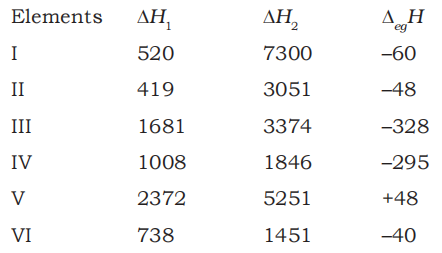
(b) the most reactive metal.
Worksheet Answers
Solution:
Isoelectronic species are defined as atoms, molecules, or ions that possess the same total number of electrons. Despite having different nuclear charges (different atomic numbers), these species exhibit identical electronic configurations in terms of the total count of their extranuclear electrons [Per the Principles of Atomic Structure].
To identify an isoelectronic species for $Mg^{2+}$, we must first determine the total number of electrons in the target ion.
We require a species (atom or ion) that also contains exactly $10$ electrons. We examine elements with atomic numbers near $10$.
Candidate: Neon ($Ne$)
Candidate: Fluoride ion ($F^-$)
Candidate: Sodium ion ($Na^+$)
| Species | Atomic Number ($Z$) | Charge | Total Electrons |
|---|---|---|---|
| $Mg^{2+}$ | $12$ | $+2$ | $10$ |
| $Na^+$ | $11$ | $+1$ | $10$ |
| $Ne$ | $10$ | $0$ | $10$ |
| $F^-$ | $9$ | $-1$ | $10$ |
Final Solution: A species isoelectronic with $Mg^{2+}$ is the Sodium ion ($Na^+$), the Fluoride ion ($F^-$), or the Neon atom ($Ne$), as all possess a total of $10$ electrons.
Solution:
The radius of an atom is defined as the distance from the center of the nucleus to the outermost shell containing electrons. When an atom loses an electron to become a positively charged ion (cation), the structural configuration of the atom undergoes a significant transition governed by the principles of electrostatic attraction and electron shielding [Per the Bohr-Sommerfeld model and principles of quantum mechanics].
When an electron is removed, the remaining electrons experience a higher effective nuclear charge ($Z_{eff}$). This occurs because the total number of protons ($Z$) remains constant while the number of electrons decreases. Consequently, the remaining electrons are pulled more strongly toward the nucleus by the electrostatic force of attraction, defined by Coulomb’s Law:
$F = k \cdot \frac{q_1 \cdot q_2}{r^2}$
Where $q_1$ is the nuclear charge and $q_2$ is the charge of the electron shell. As the ratio of protons to electrons increases, $Z_{eff}$ increases, resulting in a stronger contraction of the electron cloud.
The removal of an electron reduces the overall magnitude of electron-electron repulsion within the valence shell and between the valence shell and inner shells. With decreased inter-electronic repulsion, the orbital contraction is further facilitated, drawing the electron density closer to the nucleus [Based on Slater’s Rules for shielding constants].
| Factor | Effect on Radius |
|---|---|
| Effective Nuclear Charge ($Z_{eff}$) | Increases (decreased screening) |
| Inter-electronic Repulsion | Decreases |
| Resulting Radius ($r_2 < r_1$) | Contraction (Smaller size) |
Final Solution: The radius of an atom decreases when it loses an electron because the reduction in the number of electrons leads to a higher effective nuclear charge ($Z_{eff}$) acting on the remaining electrons, combined with decreased inter-electronic repulsion, which results in the contraction of the electron cloud toward the nucleus.
Solution:
The ionization enthalpy ($IE$) is defined as the minimum amount of energy required to remove the most loosely bound electron from an isolated gaseous atom in its ground state. Mathematically, for a hydrogen atom, this corresponds to the energy required to transition an electron from the ground state ($n=1$) to an infinite distance from the nucleus ($n=\infty$), where the potential energy of the electron is defined as zero.
The energy change ($\Delta E$) is expressed as:
$\Delta E = E_{\infty} - E_{ground}$
[Per the Bohr model of the hydrogen atom, where $E_{\infty} = 0$ J]
Given the energy of an electron in the ground state of a single hydrogen atom ($E_1$):
$E_1 = -2.18 \times 10^{-18} \, J$
The energy required to ionize one hydrogen atom is:
$\Delta E = 0 - (-2.18 \times 10^{-18} \, J) = +2.18 \times 10^{-18} \, J$
[Justification: By the Principle of Conservation of Energy, the energy absorbed must equal the difference between the final and initial states.]
To calculate the ionization enthalpy in terms of $J \, mol^{-1}$, we must multiply the energy per atom by the Avogadro constant ($N_A$), which represents the number of atoms in one mole ($6.022 \times 10^{23} \, mol^{-1}$).
$IE = \Delta E \times N_A$
$IE = (2.18 \times 10^{-18} \, J \cdot atom^{-1}) \times (6.022 \times 10^{23} \, atom \cdot mol^{-1})$
Executing the multiplication of the coefficients and the exponents:
$IE = 13.12796 \times 10^5 \, J \, mol^{-1}$
Normalizing to scientific notation:
$IE = 1.312796 \times 10^6 \, J \, mol^{-1}$
Final Solution: The ionization enthalpy of atomic hydrogen is $1.31 \times 10^6 \, J \, mol^{-1}$.
Solution:
The element with atomic number $Z = 71$ is Lutetium ($Lu$). [Per the Periodic Table of Elements, Lutetium is the final element in the Lanthanide series].
The ground state electronic configuration of Lutetium ($Lu$) is $[Xe] 4f^{14} 5d^1 6s^2$. [By the Aufbau Principle, the filling of the $4f$ subshell is complete at Ytterbium ($Z=70$), and the third electron enters the $5d$ orbital for Lutetium].
Given the configuration, Lutetium predominantly exhibits a stable oxidation state of $+3$ ($Lu^{3+}$) by losing the three electrons in the $5d^1 6s^2$ orbitals to achieve a noble gas configuration consistent with the $[Xe]$ core.
Fluorine ($F$) is a Group 17 (Halogen) element with an atomic number of $9$. Its electronic configuration is $1s^2 2s^2 2p^5$.
Fluorine requires one electron to achieve the stable octet configuration of Neon ($1s^2 2s^2 2p^6$). Consequently, Fluorine typically forms the fluoride ion, $F^-$, exhibiting a valency of $1$.
To form a stable binary compound, the total positive charge must neutralize the total negative charge to maintain electrical neutrality [Per the Law of Constant Proportions].
| Element | Valency/Charge |
|---|---|
| Lutetium ($Lu$) | $+3$ |
| Fluorine ($F$) | $-1$ |
Using the criss-cross method: The magnitude of the valency of $Lu$ ($3$) becomes the subscript for $F$, and the magnitude of the valency of $F$ ($1$) becomes the subscript for $Lu$.
Formula = $Lu_1 F_3$
Final Solution: The formula of the stable binary compound formed by Lutetium and Fluorine is $LuF_3$ (Lutetium(III) fluoride).
Solution:
The radius of an atom when it loses an electron undergoes a process known as the formation of a cation. The change in the atomic radius is governed by the interplay between nuclear charge ($Z$) and the total number of electrons ($e^-$), which dictates the effective nuclear charge experienced by the valence shell.
In a neutral atom, the nuclear charge $Z$ (the number of protons) is exactly balanced by the number of electrons. The atomic radius is defined as the distance from the center of the nucleus to the outermost shell containing electrons [Per the definition of covalent or metallic radius].
When an atom loses one or more electrons to form a positive ion ($M \rightarrow M^+ + e^-$), two primary factors facilitate a reduction in size:
| Feature | Neutral Atom | Cation |
|---|---|---|
| Proton-Electron Ratio | Equal | Protons > Electrons |
| Electrostatic Force | Baseline | Increased |
| Atomic Radius | $r$ | $r^+ < r$ |
Furthermore, in many cases, the loss of electrons may result in the complete removal of the outermost shell (principal quantum number $n$ decreases), leading to a drastic contraction in the ionic radius compared to the atomic radius [Per the shell model of the atom].
Final Solution: The radius of an atom decreases upon the loss of an electron because the increase in effective nuclear charge pulls the remaining electrons closer to the nucleus, and the reduction in inter-electronic repulsion allows for a more compact electron cloud. Consequently, the ionic radius of a cation is always smaller than the atomic radius of its parent atom.
Solution:
Non-metallic character is defined as the tendency of an element to gain electrons to form anions or to share electrons to form covalent bonds. This property is directly proportional to electronegativity and electron gain enthalpy, and inversely proportional to atomic radius [Per Periodic Trends of Elements].
In the periodic table:
We are analyzing Boron ($B$), Carbon ($C$), Nitrogen ($N$), Fluorine ($F$), and Silicon ($Si$).
| Element | Group | Period | Electronic Configuration |
|---|---|---|---|
| $B$ | 13 | 2 | $[He] 2s^2 2p^1$ |
| $C$ | 14 | 2 | $[He] 2s^2 2p^2$ |
| $N$ | 15 | 2 | $[He] 2s^2 2p^3$ |
| $F$ | 17 | 2 | $[He] 2s^2 2p^5$ |
| $Si$ | 14 | 3 | $[Ne] 3s^2 3p^2$ |
Step A: Compare elements in Period 2 ($B, C, N, F$)
Following the periodic trend across a period, electronegativity increases from left to right. Therefore, the order of non-metallic character for Period 2 elements is $B < C < N < F$.
Step B: Compare Carbon ($C$) and Silicon ($Si$)
Both $C$ and $Si$ belong to Group 14. Silicon is below Carbon. Per the group trend, non-metallic character decreases down a group due to the increase in atomic size and shielding effect. Thus, $Si < C$.
Step C: Integration
Since $Si < C$ and $B < C < N < F$, we integrate these observations. We know that Silicon is a metalloid and less non-metallic than Carbon. Boron is also a metalloid. Comparing $Si$ and $B$, Silicon is more metallic than Boron [due to larger size]. Combining these: $Si < B < C < N < F$.
By evaluating the electronegativity values ($F: 4.0, N: 3.0, C: 2.5, B: 2.0, Si: 1.8$), the quantitative trend confirms the qualitative periodic arrangement [Pauling Scale reference].
Final Solution: The correct order of non-metallic character is $Si < B < C < N < F$.
Solution:
Isoelectronic species are defined as atoms, molecules, or ions that possess the same total number of electrons. Despite having identical electron counts, these species exhibit different chemical properties due to variations in nuclear charge ($Z$), which affects the attraction exerted by the nucleus on the electron cloud [Per Atomic Theory and periodic trends].
The target species is the noble gas Argon ($Ar$).
Atomic number of $Ar$ ($Z$) = $18$.
Since $Ar$ is a neutral atom, the number of electrons is equal to the atomic number: $18$ electrons.
To find species isoelectronic with $Ar$, we must identify ions that result in a total of $18$ electrons. We use the formula for ion electron count: $e^- = Z - \text{charge}$.
All identified species share the same electronic configuration: $1s^2 2s^2 2p^6 3s^2 3p^6$.
| Species | Atomic Number ($Z$) | Charge | Total Electrons |
|---|---|---|---|
| $Ar$ | 18 | 0 | 18 |
| $Cl^-$ | 17 | -1 | 18 |
| $K^+$ | 19 | +1 | 18 |
| $S^{2-}$ | 16 | -2 | 18 |
| $Ca^{2+}$ | 20 | +2 | 18 |
Final Solution: Examples of species isoelectronic with $Ar$ ($18$ electrons) include $Cl^-$, $K^+$, $S^{2-}$, and $Ca^{2+}$.
Solution:
The modern periodic table is constructed on the principle of the Aufbau process, which governs the filling of atomic orbitals based on increasing energy levels. In this structural arrangement, the horizontal rows are defined as periods, while the vertical columns are defined as groups. [Per the Bohr-Bury scheme and the Pauli Exclusion Principle].
The position of an element in the periodic table is determined by its electronic configuration. Specifically, the period number corresponds to the principal quantum number ($n$) of the valence shell (outermost shell) being filled for that specific element.
| Period Number | Principal Quantum Number ($n$) | Valence Shell |
|---|---|---|
| 1 | $n=1$ | K-shell |
| 2 | $n=2$ | L-shell |
| 3 | $n=3$ | M-shell |
The period number in the modern periodic table indicates the value of the principal quantum number ($n$) for the valence shell of the elements in that period.
Final Solution: The period indicates the value of the principal quantum number ($n$) of the outermost or valence shell of the atom.
Solution:
Given the general outer electronic configuration for the element as $(n-1)d^{2}ns^{2}$ and the specified value of $n=4$, we perform the substitution:
To identify the element, we determine the full electronic configuration by filling the preceding inner orbitals ($1s^{2} 2s^{2} 2p^{6} 3s^{2} 3p^{6}$): $1s^{2} 2s^{2} 2p^{6} 3s^{2} 3p^{6} 4s^{2} 3d^{2}$ Summing the electrons: $2 + 2 + 6 + 2 + 6 + 2 + 2 = 22$. The element with atomic number $Z = 22$ is Titanium (Ti).
We classify the element based on its orbital occupancy:
| Attribute | Value |
|---|---|
| Configuration | $3d^{2}4s^{2}$ |
| Element Name | Titanium (Ti) |
| Period | 4 |
| Group | 4 |
| Block | $d$-block |
Final Solution: The element is Titanium (Ti), situated in Period 4, Group 4 of the periodic table.
Solution:
Dmitri Mendeleev formulated his periodic classification based on the atomic mass of the elements. His central thesis, known as the Mendeleev’s Periodic Law, states: "The properties of the elements are a periodic function of their atomic masses."
Mendeleev arranged elements in increasing order of their atomic masses, observing that elements with similar physical and chemical properties recur at regular intervals [Per Mendeleev's Periodic Law].
Mendeleev did not strictly adhere to the increasing order of atomic masses in all instances. He demonstrated significant scientific flexibility to ensure that elements with similar properties were grouped in the same family (Group). When a strict adherence to the atomic mass sequence conflicted with the chemical properties of an element, he prioritized the chemical properties.
The following instances exemplify his departure from the strict atomic mass sequence:
| Criterion | Mendeleev's Strategy |
|---|---|
| Primary Basis | Increasing Atomic Mass |
| Decision Driver | Chemical & Physical Properties (Valency, Hydride/Oxide formation) |
| Strictness | Flexible; chemical consistency prioritized over numerical sequence |
Final Solution: Mendeleev used atomic mass as the primary property for classification; however, he did not stick to it strictly. Whenever the atomic mass order conflicted with the requirement that elements with similar properties be placed in the same group, he prioritized the chemical and physical properties (valency and reactivity) over the strict numerical sequence of atomic mass.
Solution:
The chemical reactivity of a metal is directly proportional to its ability to lose valence electrons, a process quantified by the first ionization enthalpy ($\Delta_{i}H_{1}$). A lower $\Delta_{i}H_{1}$ indicates that the valence electron is less tightly bound to the nucleus and can be removed with less energy input [Per Periodic Trends in Metallic Character].
We evaluate the provided elements based on their $\Delta_{i}H_{1}$ values (in $\text{kJ mol}^{-1}$):
| Element | $\Delta_{i}H_{1}$ | $\Delta_{i}H_{2}$ | $\Delta_{eg}H$ |
|---|---|---|---|
| I | 520 | 7300 | -60 |
| II | 419 | 3051 | -48 |
| III | 1681 | 3374 | -328 |
| IV | 1008 | 1846 | -295 |
| V | 2372 | 5251 | +48 |
| VI | 738 | 1451 | -40 |
By comparing the values, Element II possesses the lowest first ionization enthalpy ($\Delta_{i}H_{1} = 419 \text{ kJ mol}^{-1}$). A lower value signifies the highest ease of ionization, which is the defining characteristic of a highly reactive metal [By Definition of Chemical Reactivity in Group 1 Metals].
Final Solution: Element II is the most reactive metal because it requires the least amount of energy to lose its valence electron, as evidenced by its lowest first ionization enthalpy of $419 \text{ kJ mol}^{-1}$.
Solution:
The first ionization enthalpy ($\Delta_iH$) is defined as the minimum amount of energy required to remove the most loosely bound electron from an isolated gaseous atom in its ground state. The process is represented by the equation:
$X(g) \rightarrow X^+(g) + e^-$
Isotopes are atoms of the same element that possess an identical number of protons ($Z$) and electrons ($e^-$), but a differing number of neutrons ($N$). Consequently, they possess identical electronic configurations, which is the primary determinant of chemical behavior and energy levels [Per the Pauli Exclusion Principle and Aufbau Principle].
The energy required to remove an electron depends on the effective nuclear charge ($Z_{eff}$) and the distance of the electron from the nucleus ($r$):
| Parameter | Isotope A ($^a_Z X$) | Isotope B ($^b_Z X$) |
|---|---|---|
| Protons ($Z$) | Identical | Identical |
| Electrons | Identical | Identical |
| Electronic Configuration | Identical | Identical |
| Ionization Enthalpy | Same | Same |
While isotopes differ in mass due to the number of neutrons, neutrons do not participate in electronic interactions or contribute to the electrostatic screening of the valence electrons. Although there exists a negligible "nuclear mass effect" (related to the slight difference in nuclear motion), it is orders of magnitude smaller than the electronic transition energies involved in ionization. Therefore, in the context of standard chemical periodicity, the first ionization enthalpies are considered identical [Per the Born-Oppenheimer approximation, which separates electronic and nuclear motion].
Final Solution: The first ionization enthalpies for two isotopes of the same element are expected to be the same because they possess identical electronic configurations and effective nuclear charges.
Solution:
A stable binary halide of the formula $MX_2$ implies that the metal $M$ typically exhibits an oxidation state of $+2$. For an element to form a stable $MX_2$ compound, the energy required to remove two electrons (the sum of the first and second ionization enthalpies, $\Delta_i H_1 + \Delta_i H_2$) must be low enough to be compensated by the lattice energy of the resulting ionic crystal or the bond dissociation energy in a covalent network [Per Born-Haber Cycle principles].
We analyze the sum of the first two ionization enthalpies ($\Sigma\Delta_i H = \Delta_i H_1 + \Delta_i H_2$) for the provided elements to identify which are most likely to form divalent cations ($M^{2+}$):
| Element | $\Delta_i H_1$ | $\Delta_i H_2$ | $\Sigma\Delta_i H$ (kJ $mol^{-1}$) |
|---|---|---|---|
| I | 520 | 7300 | 7820 |
| II | 419 | 3051 | 3470 |
| III | 1681 | 3374 | 5055 |
| IV | 1008 | 1846 | 2854 |
| V | 2372 | 5251 | 7623 |
| VI | 738 | 1451 | 2189 |
The ionization energy profile of Element VI ($738$ kJ $mol^{-1}$ for $\Delta_i H_1$ and $1451$ kJ $mol^{-1}$ for $\Delta_i H_2$) matches the expected trend for a metal located in Group 2 of the Periodic Table. By the Law of Conservation of Energy and Lattice Energy stability, the formation of $M^{2+}$ is exothermic or energetically favorable for such metals when forming halides [Per Born-Haber Cycle].
Final Solution: Element VI is the metal which can form a stable binary halide of the formula $MX_2$.
Solution:
To determine the incorrect statement, we must evaluate the fundamental principles governing the Modern Periodic Law and the electronic configuration of elements.
The Modern Periodic Law states: "The physical and chemical properties of the elements are periodic functions of their atomic numbers." [Per Moseley's Law].
| Statement Feature | Scientific Basis | Status |
|---|---|---|
| p-block elements include metals, metalloids, and non-metals. | The p-block consists of groups 13-18. It hosts a diverse range of elements including metals (e.g., $Al$), metalloids (e.g., $Si$), and non-metals (e.g., $O$, $N$). | Correct |
| d-block elements are known as transition elements. | Elements with partially filled $d$-orbitals ($n-1$) in their ground state or any common oxidation state are defined as transition elements. | Correct |
| f-block elements are known as inner-transition elements. | These elements involve the filling of $4f$ and $5f$ orbitals. They are placed separately at the bottom to maintain the structural integrity of the main table. | Correct |
| The first period contains 8 elements. | The first shell ($n=1$) contains only one orbital, the $1s$ orbital. Its maximum capacity is $2$ electrons ($1s^2$), thus hosting only Hydrogen and Helium. | Incorrect |
The period number corresponds to the principal quantum number ($n$) of the valence shell. For the first period:
Final Solution: The incorrect statement is "The first period contains 8 elements," as the first period consists of only 2 elements ($H$ and $He$) corresponding to the filling of the $1s$ orbital.
Solution:
To locate the element with atomic number $Z = 114$ in the periodic table, we must determine its electronic configuration by filling orbitals in increasing order of energy, as dictated by the Aufbau Principle [Per the $(n+l)$ rule].
The sequence of orbital filling is: $1s, 2s, 2p, 3s, 3p, 4s, 3d, 4p, 5s, 4d, 5p, 6s, 4f, 5d, 6p, 7s, 5f, 6d, 7p$.
Distributing $114$ electrons:
$1s^2, 2s^2, 2p^6, 3s^2, 3p^6, 4s^2, 3d^{10}, 4p^6, 5s^2, 4d^{10}, 5p^6, 6s^2, 4f^{14}, 5d^{10}, 6p^6, 7s^2, 5f^{14}, 6d^{10}, 7p^2$
Summing the electrons: $2+2+6+2+6+2+10+6+2+10+6+2+14+10+6+2+14+10+2 = 114$.
| Parameter | Determination |
|---|---|
| Valence Shell | $7s^2, 7p^2$ |
| Period | $7$ |
| Group | $14$ |
| Block | $p$-block |
Final Solution: The element with atomic number $Z = 114$ is located in Period 7 and Group 14 of the periodic table (also known as Flerovium, Fl).
Solution:
The discovery and naming of transuranium elements (elements with atomic numbers $Z > 92$) were primarily conducted by research groups at the Lawrence Berkeley National Laboratory (LBNL). The group led by Glenn T. Seaborg was instrumental in the synthesis of several transuranic elements, specifically those in the actinide series and the initial transactinide series.
Seaborg's group at the University of California, Berkeley, was responsible for the synthesis of the following elements:
In the context of the IUPAC nomenclature and historical periodic table questions, Seaborgium (element 106) is the element explicitly named after Glenn T. Seaborg. However, if the question refers to the element synthesized by his group that historically completed the actinide series, it is Lawrencium ($Z = 103$), or the element Seaborgium ($Z = 106$), which carries the namesake of the group leader.
The naming of elements following the transuranium synthesis often reflects the geographical location (e.g., Berkelium, Californium) or the scientists involved. Per the IUPAC recommendations regarding the naming of elements:
| Element Name | Atomic Number | Discovery Group |
|---|---|---|
| Seaborgium | 106 | Seaborg's Group / LBNL |
Final Solution: The element specifically named for the leader of the group is Seaborgium ($Z = 106$), though the group was responsible for the synthesis of elements 95 through 102, and 106.
Solution:
To determine the relative ionization enthalpies ($\Delta_{i}H$) of Nitrogen ($N$) and Oxygen ($O$), we must first analyze their ground-state electronic configurations in the second period of the periodic table.
[Per the Aufbau Principle and Hund’s Rule of Maximum Multiplicity]
The stability of an atom is significantly influenced by the occupancy of its valence subshells. Specifically, half-filled and fully-filled orbitals possess extra stability due to symmetry and exchange energy.
The $2p$ subshell consists of three degenerate orbitals ($p_{x}, p_{y}, p_{z}$).
Ionization enthalpy is the energy required to remove the most loosely bound electron from an isolated gaseous atom. The process can be represented as:
$N(g) \rightarrow N^{+}(g) + e^{-}$; $\Delta_{i}H = 1402 \text{ kJ/mol}$
$O(g) \rightarrow O^{+}(g) + e^{-}$; $\Delta_{i}H = 1314 \text{ kJ/mol}$
Although Oxygen has a higher effective nuclear charge ($Z_{eff}$) than Nitrogen—which would normally pull electrons closer and increase $\Delta_{i}H$—the stability factor dominates here.
Regarding Fluorine ($F$), it possesses a $2p^{5}$ configuration. Despite the inter-electronic repulsions, the significantly higher $Z_{eff}$ of Fluorine compared to Nitrogen creates a stronger electrostatic attraction between the nucleus and the valence electrons, which overrides the stability factor of Nitrogen. Therefore, the $\Delta_{i}H$ of $N$ is lower than $F$ due to the atomic size and $Z_{eff}$ increase, but Oxygen is lower than Nitrogen due to the destabilization caused by electron-electron repulsion in the $2p^{4}$ orbital.
Final Solution: Oxygen exhibits a lower ionization enthalpy than Nitrogen because Nitrogen's half-filled $2p^{3}$ subshell configuration provides extra electronic stability, whereas the removal of an electron from Oxygen's $2p^{4}$ configuration reduces the inter-electronic repulsions existing in the doubly occupied $p$-orbital.
Solution:
Non-metallic character is defined by the tendency of an element to accept electrons to form anions. This ability is directly proportional to the element's electronegativity and inversely proportional to its atomic radius. Across a period (from left to right), the effective nuclear charge ($Z_{eff}$) increases, and atomic size decreases, leading to an increase in non-metallic character. Down a group, atomic size increases due to the addition of new shells, which decreases the effective nuclear charge felt by valence electrons, thus decreasing non-metallic character [Per Periodic Trends in Electronegativity].
We map the given elements within the periodic framework:
| Element | Atomic Number ($Z$) | Period | Group |
|---|---|---|---|
| Boron ($B$) | 5 | 2 | 13 |
| Carbon ($C$) | 6 | 2 | 14 |
| Nitrogen ($N$) | 7 | 2 | 15 |
| Fluorine ($F$) | 9 | 2 | 17 |
| Silicon ($Si$) | 14 | 3 | 14 |
1. Intra-period Comparison (Period 2): $B, C, N,$ and $F$ all belong to Period 2. Following the periodic law, non-metallic character increases as we move from left to right (Group 13 to 17). Thus, the order for these elements is $B < C < N < F$.
2. Inter-group/Period Comparison ($Si$ vs $C$): $Si$ is located in the same group as $C$ (Group 14) but resides in Period 3. Because non-metallic character decreases down a group due to increased shielding and atomic radius, $Si$ is significantly less non-metallic than $C$.
3. Synthesis: Since $Si$ is less non-metallic than $C$, it must also be less non-metallic than $B$, as $B$ is positioned to the left of $C$ in Period 2 but is a metalloid, whereas $Si$ is a metalloid with even lower electronegativity relative to the small, compact atoms of Period 2. The combined relative non-metallic order is $Si < B < C < N < F$.
By assessing the electronegativity values ($F \approx 4.0, N \approx 3.04, C \approx 2.55, B \approx 2.04, Si \approx 1.90$ on the Pauling scale), we confirm the logical progression [Per Pauling Scale Data].
Final Solution: The correct order of non-metallic character is $Si < B < C < N < F$.
Solution:
Dmitri Mendeleev formulated his periodic table based on the atomic mass (or atomic weight) of the elements as the fundamental property. He proposed the Periodic Law, which states that the physical and chemical properties of the elements are a periodic function of their atomic masses [Based on the historical Periodic Law of 1869].
Mendeleev did not strictly adhere to the rule of increasing atomic mass. He demonstrated significant scientific intuition by prioritizing the chemical properties (valency, oxide/hydride formation) over the strict sequential order of atomic masses in several instances. Notable deviations include:
| Primary Criterion | Adherence Status | Reasoning for Deviation |
|---|---|---|
| Atomic Mass | Partial | Prioritization of chemical similarity (Group behavior) over strict mass order. |
Final Solution: Mendeleev used atomic mass as the primary criterion for classifying elements. He did not strictly adhere to this principle, as he purposefully inverted the order of certain elements—such as Tellurium ($127.6$) and Iodine ($126.9$)—whenever the chemical properties necessitated a deviation from the sequential arrangement based on atomic mass.
Solution:
The oxidizing property of an element is defined by its ability to gain electrons, which is synonymous with its electron affinity and electronegativity. In the periodic table, oxidizing power generally increases across a period (from left to right) due to increasing effective nuclear charge ($Z_{eff}$) and decreases down a group due to increased shielding and atomic radius [Per Periodic Trends in Chemistry].
The oxidizing power follows the order of electronegativity values: $F > O > Cl > N$.
| Element | Electronegativity (Pauling) | Oxidizing Strength |
|---|---|---|
| F | 4.0 | Highest |
| O | 3.5 | High |
| Cl | 3.0 | Moderate |
| N | 3.0 | Lower |
Note: While Cl and N have similar electronegativities, Cl acts as a better oxidizing agent in aqueous solutions due to its ability to attain a stable octet more effectively under standard conditions compared to the chemically inert characteristics often observed with $N_2$.
Based on the periodic trends [Per Periodic Law], the oxidizing power relies on the ease of gaining electrons. Fluorine, being the most electronegative element, leads the sequence. Oxygen follows, and while Chlorine is highly reactive, its position beneath Fluorine in the halogen group designates it as less powerful than F and O. Nitrogen, having the lowest electronegativity among these, concludes the sequence.
Final Solution: The correct order of oxidizing property is $F > O > Cl > N$.


